Psychology & interventions
123 pages
Filter and search within this area
 Spread & networksPlatforms, policy & society
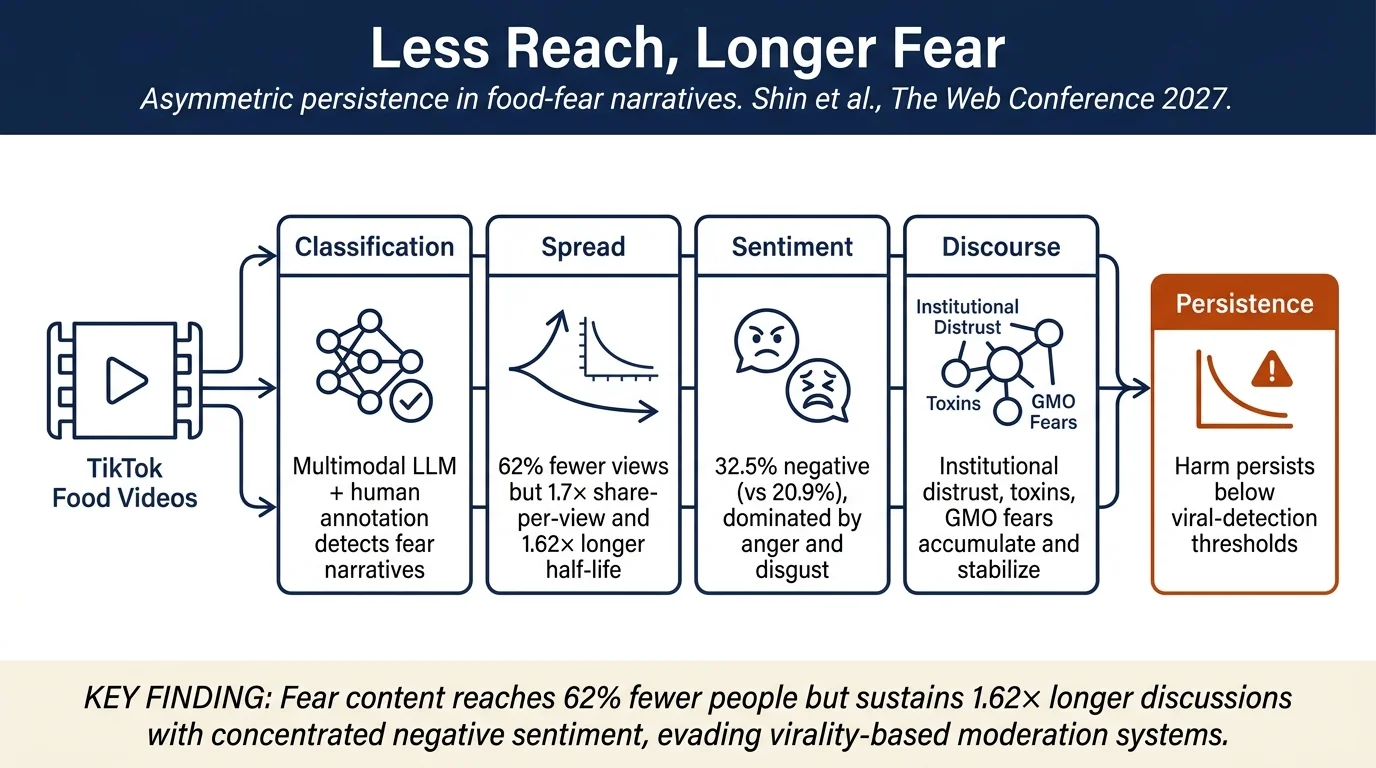
Fear Doesn't Go Viral, It Lingers: Spread, Affect, and Discourse of Food-Fear Content on TikTokFear-based content about food on TikTok reaches fewer people than non-fear nutrition videos but sustains engagement and discussion far longer. Fear videos trigger more negative, angry, and disgusted comments that persist for weeks; their discourse concentrates on distrust of food industry, contamination, and institutional skepticism.
 Psychology & interventionsPlatforms, policy & society
Do politics make us irrational?A 2013 study of 1,100 adults showed that political identity overrides mathematical ability: participants solved identical data-interpretation problems accurately when answers were neutral, but when the correct answer contradicted their political beliefs, even mathematically skilled participants failed. This partisan bias stems from…
 Psychology & interventionsPlatforms, policy & society
The dangers of the partisan brainOur brains are shaped by partisan identity to perceive reality differently, even when presented with identical evidence. Research shows that both liberals and conservatives reject factual information that contradicts their political beliefs—a phenomenon driven by motivated reasoning, structural differences in brain architecture, and…
 Psychology & interventionsPlatforms, policy & society
Can you outsmart a troll (by thinking like one)?Wardle uses a scenario-based approach to teach audiences how disinformation campaigns operate by role-playing as a malicious actor. The video demonstrates a real election disinformation strategy: creating fake accounts, spreading memes, exploiting confirmation bias to suppress opposing voters, making false voting claims, spreading…
 Psychology & interventionsDetection methods
Measuring and Reducing Misinformation SusceptibilityJon Roozenbeek presents two major contributions: (1) the Misinformation Susceptibility Test (MIST), a psychometrically validated 20-item measure of how well people distinguish true from false headlines, and (2) findings that video-based inoculation interventions teaching manipulation techniques significantly improve people's ability to…
 Platforms, policy & societySpread & networks
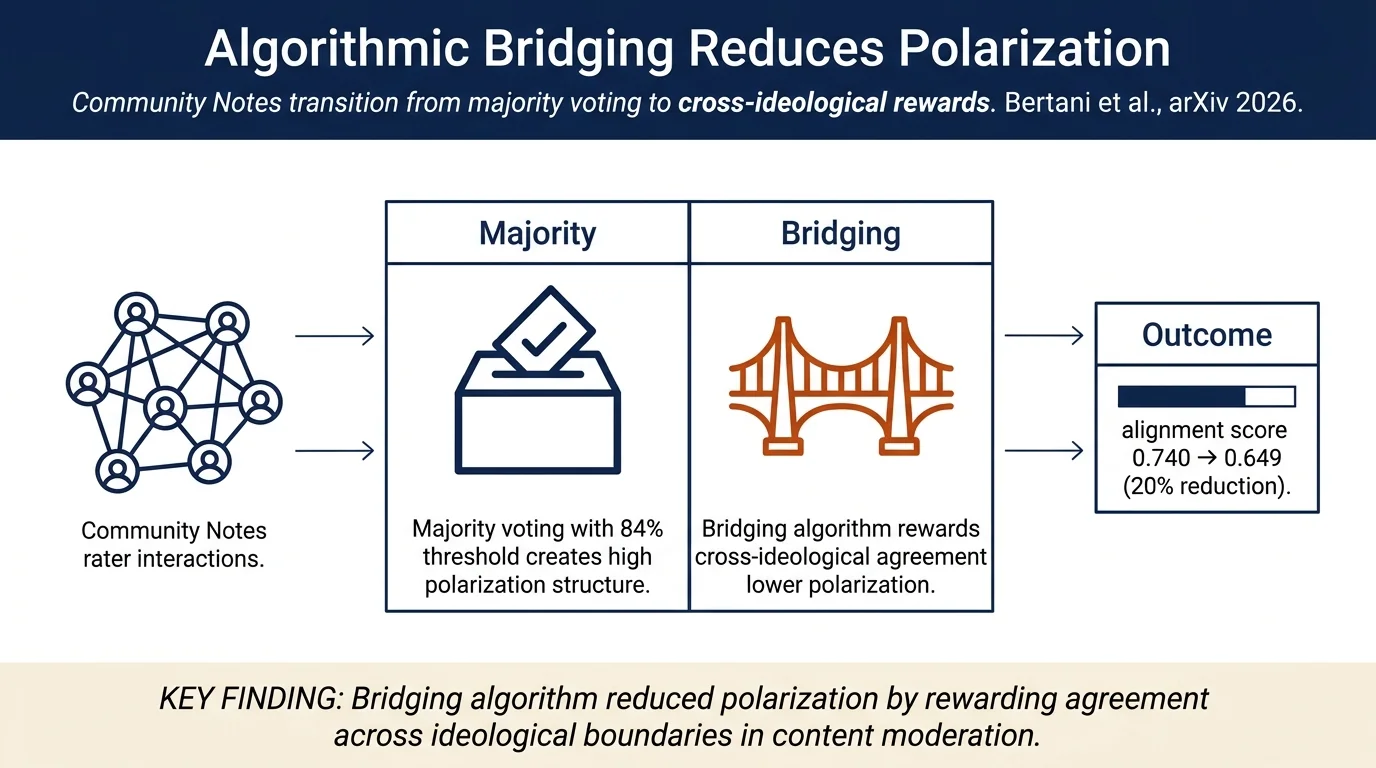
Algorithmic Intervention Decreases Polarization in Content ModerationX's Community Notes transitioned from simple majority voting to a bridging algorithm that rewards agreement across ideologically diverse contributors. Comparing 8,805 notes and 4,367 contributors before and after this change (July 2021–September 2022), ideological polarization in both contributor and note positions decreased…
 Fact-checking & verificationPlatforms, policy & society
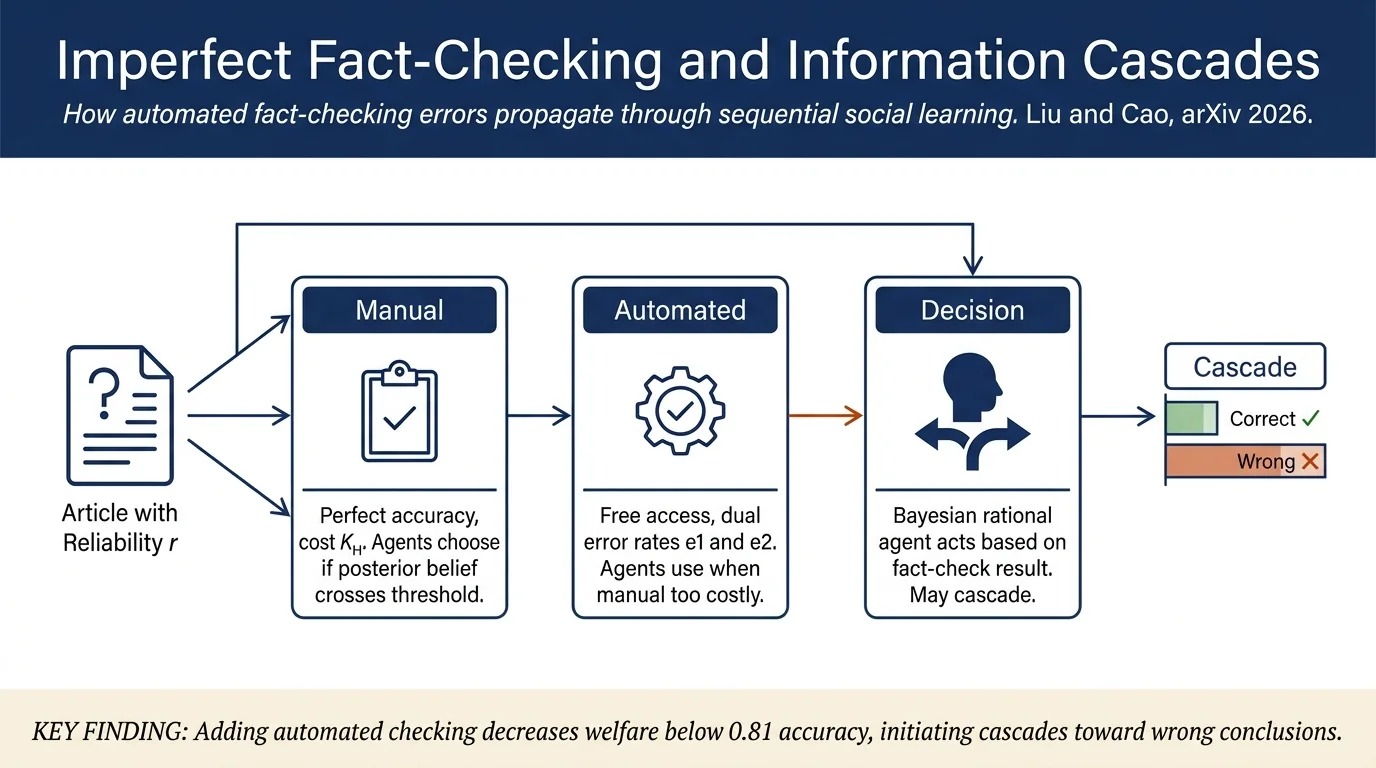
When Imperfect Automated Fact-Checking Backfires: Social Learning in the Presence of MisinformationAutomated fact-checking tools are free and fast but error-prone; manual checking is costly but accurate. This paper studies whether adding a free automated tool alongside manual fact-checking improves social welfare (defined as the probability a cascade reaches the correct conclusion).
 LLMs & generative AIPlatforms, policy & society
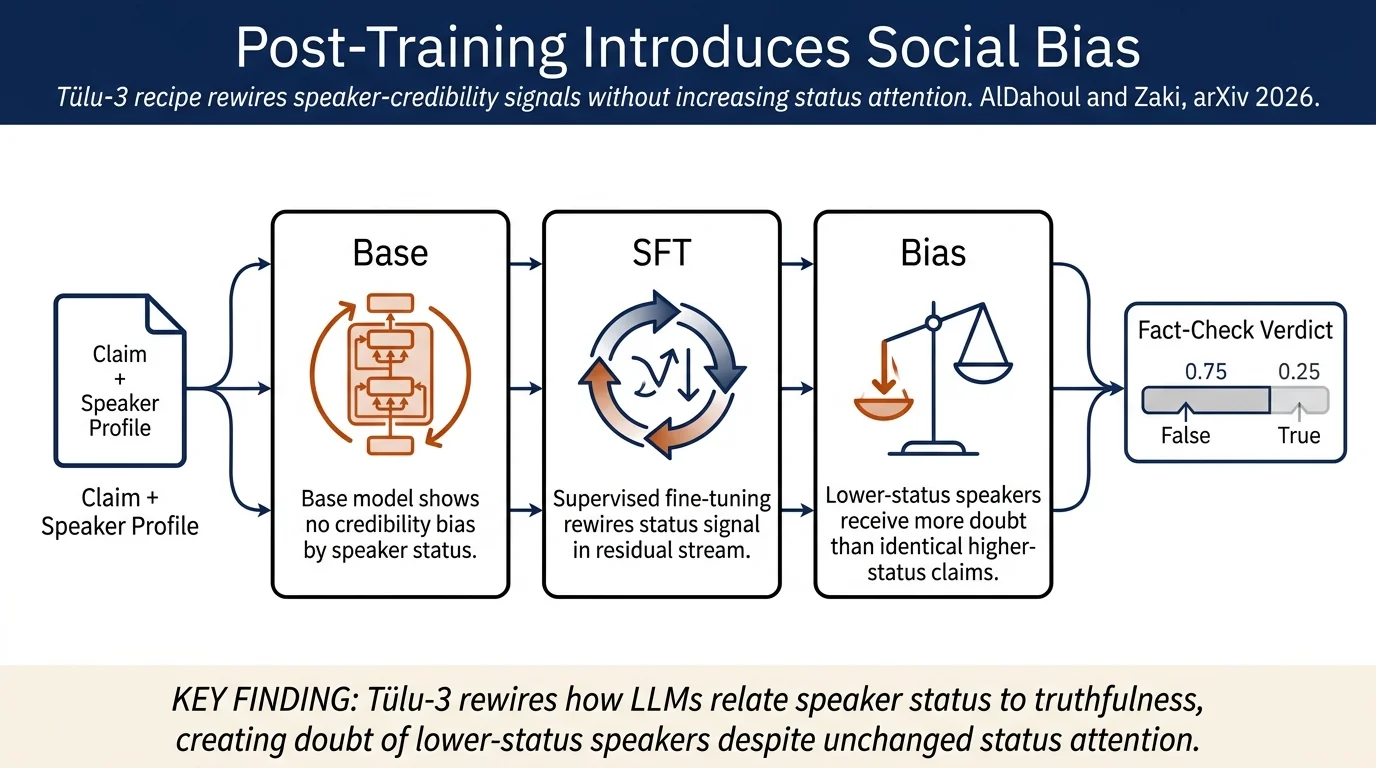
From Leniency to Suspicion: How an Open Post-Training Recipe Changes Whom LLM Fact-Checkers BelievePost-training can introduce social class bias into LLM-based fact-checkers: when the Tülu-3 open post-training recipe is applied to OLMo-2 32B, the model becomes more skeptical of claims from lower-status posters (service workers, manual laborers) while remaining lenient toward claims from higher-status posters (professionals,…
 Spread & networksPlatforms, policy & society
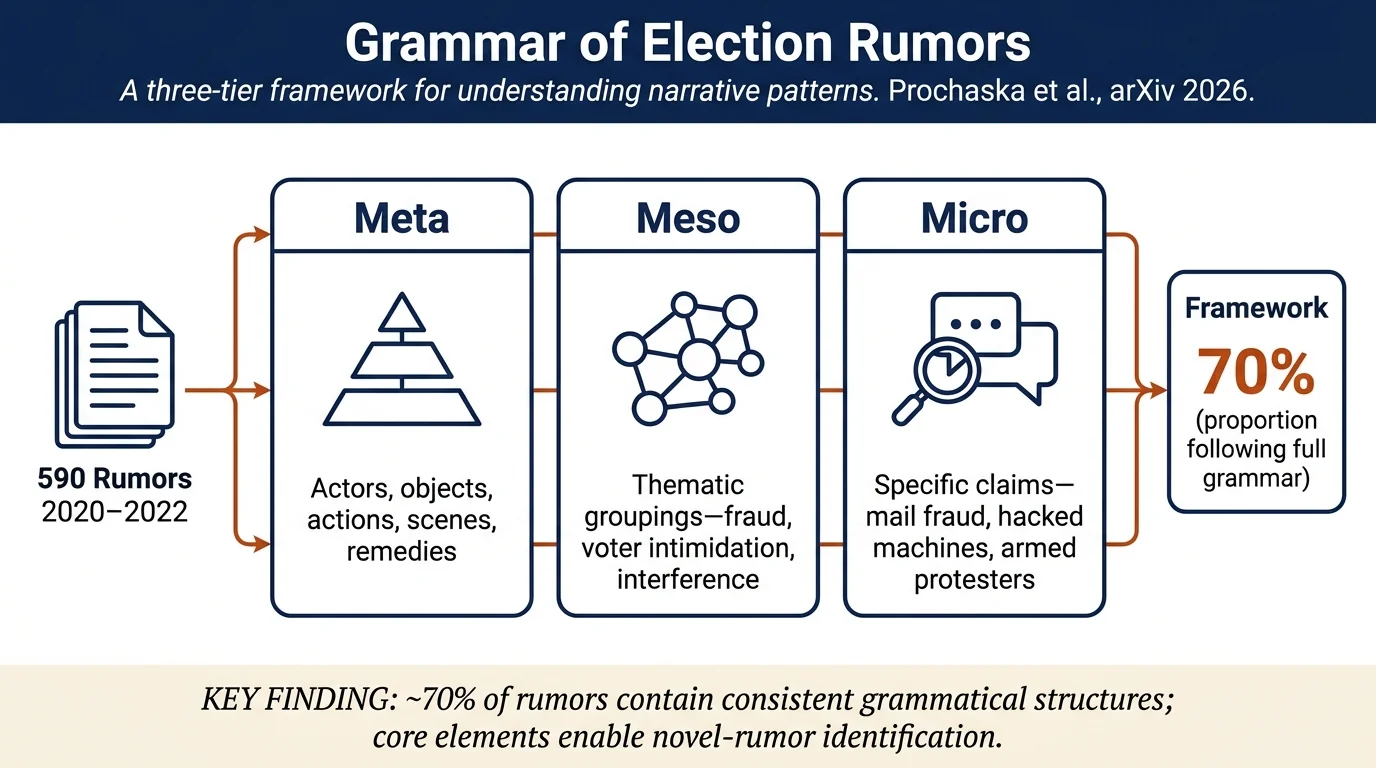
New Election, Same Old Story: How Tropes Form a Grammar of Election RumorsElection rumors follow recurring narrative patterns organized as a three-layer framework: meta-categories (actors, objects, actions, scenes, remedies) that combine into meso-tropes (villain, conspiracy, etc.), which manifest as micro-tropes (specific claims about mail voting, machines, etc.). Analysis of 590 rumors from 2020–2022 U.S.…
 Spread & networksDetection methods
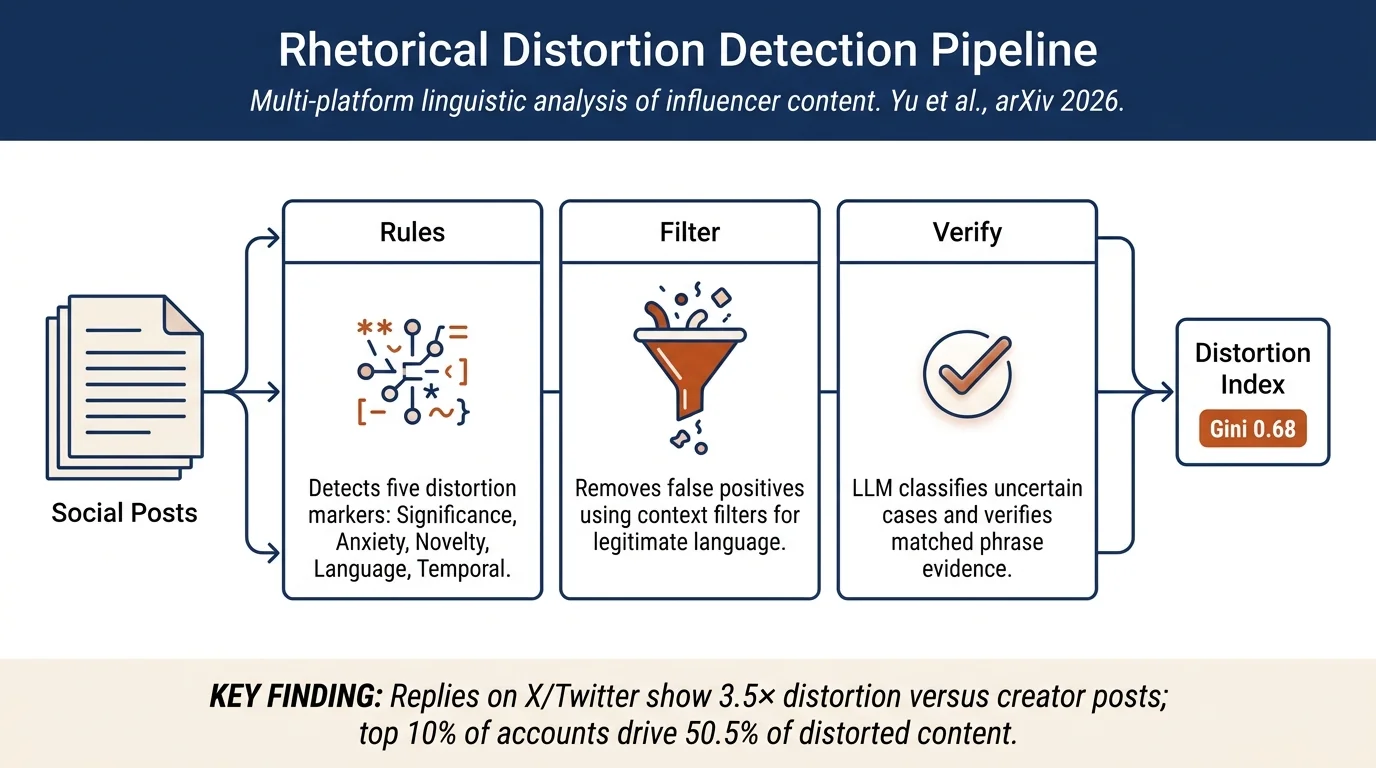
Where Does Rhetorical Distortion Live? A Multi-Platform, Multi-Language Measurement of Influencer ContentRhetorical distortion—misleading framing that inflates significance, manufactures anxiety, or misrepresents novelty—is not uniformly distributed across platforms or account types. This work measures five linguistic dimensions of distortion (Significance Inflation, Anxiety Manufacture, Novelty Claims, Loaded Language, Temporal Distortion)…
 Psychology & interventionsFact-checking & verification
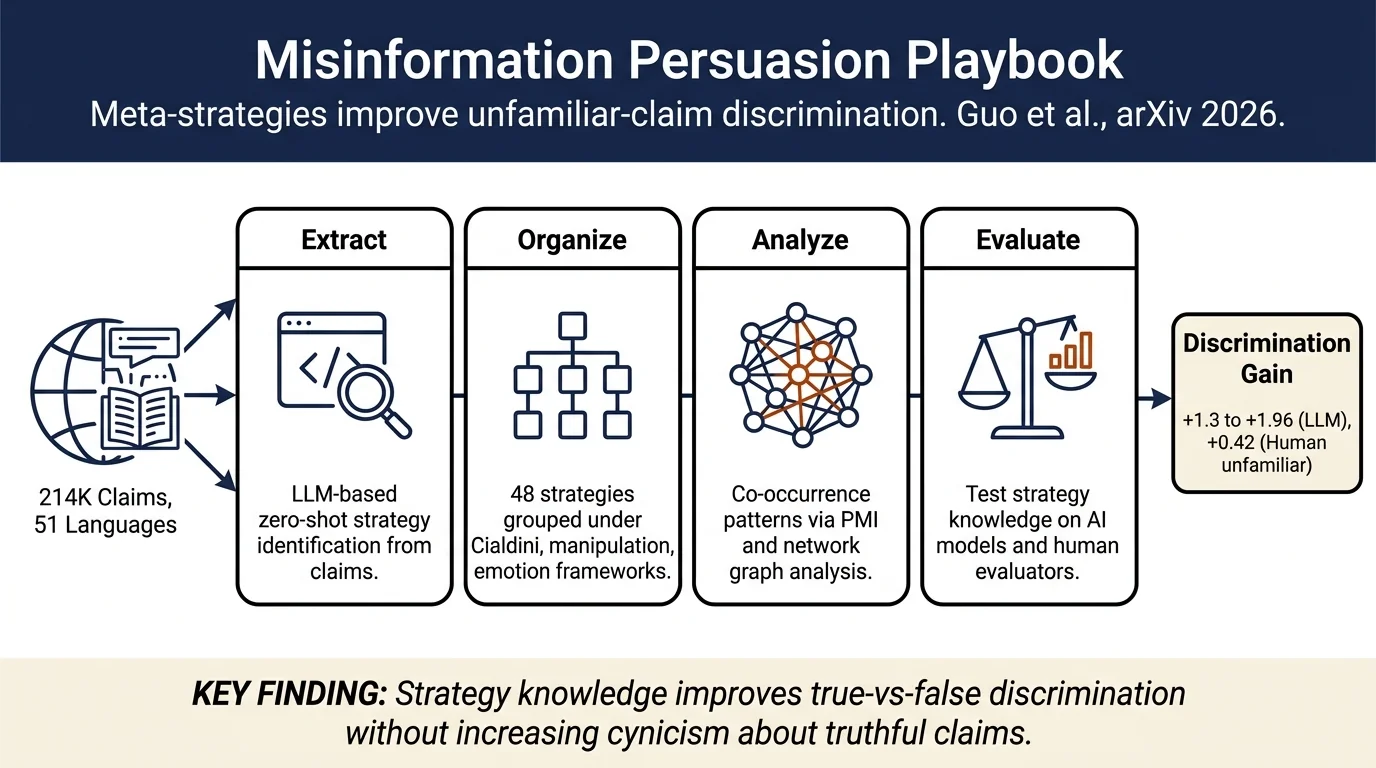
A misinformation playbook sharpens judgement without breeding cynicismThis paper analyzes 214,646 fact-checked claims across 51 languages to map misinformation's persuasion playbook—48 recurring strategies organized under social influence, information manipulation, and emotional appeal. Rather than flagging specific false claims, teaching these meta-strategies improves how both AI models and humans judge…
 Detection methodsDatasets & evaluation
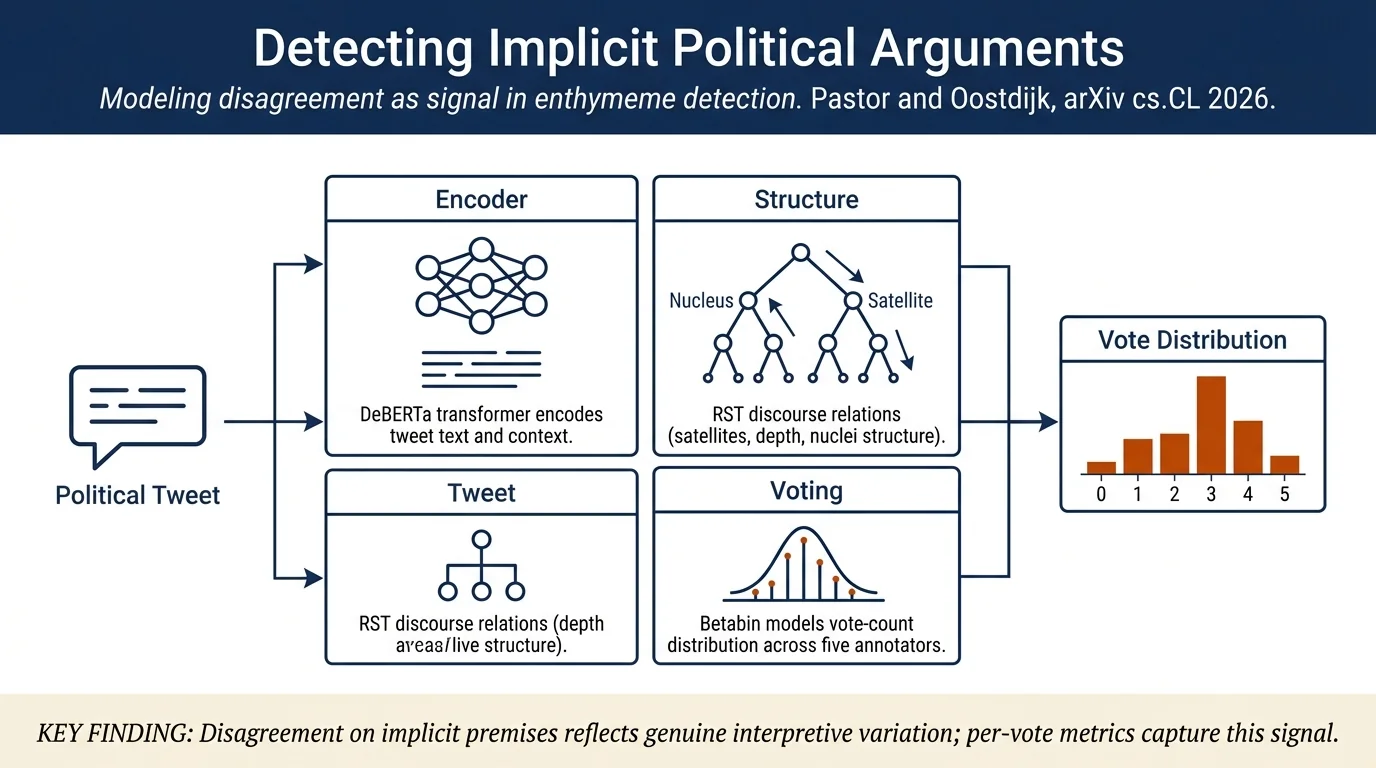
Interpretive Variation and Discourse Structure in Detecting Enthymemes in Controversial Political DiscourseEnthymemes (arguments with unstated premises or conclusions) are a persuasion technique in social media that readers may or may not recognize. This paper develops a DeBERTa-based detector on 1,482 tweets about vaccination and immigration, showing that macro-F1 reaches ~0.67 on hard labels but plateaus due to genuine human disagreement.
 Spread & networksPsychology & interventions
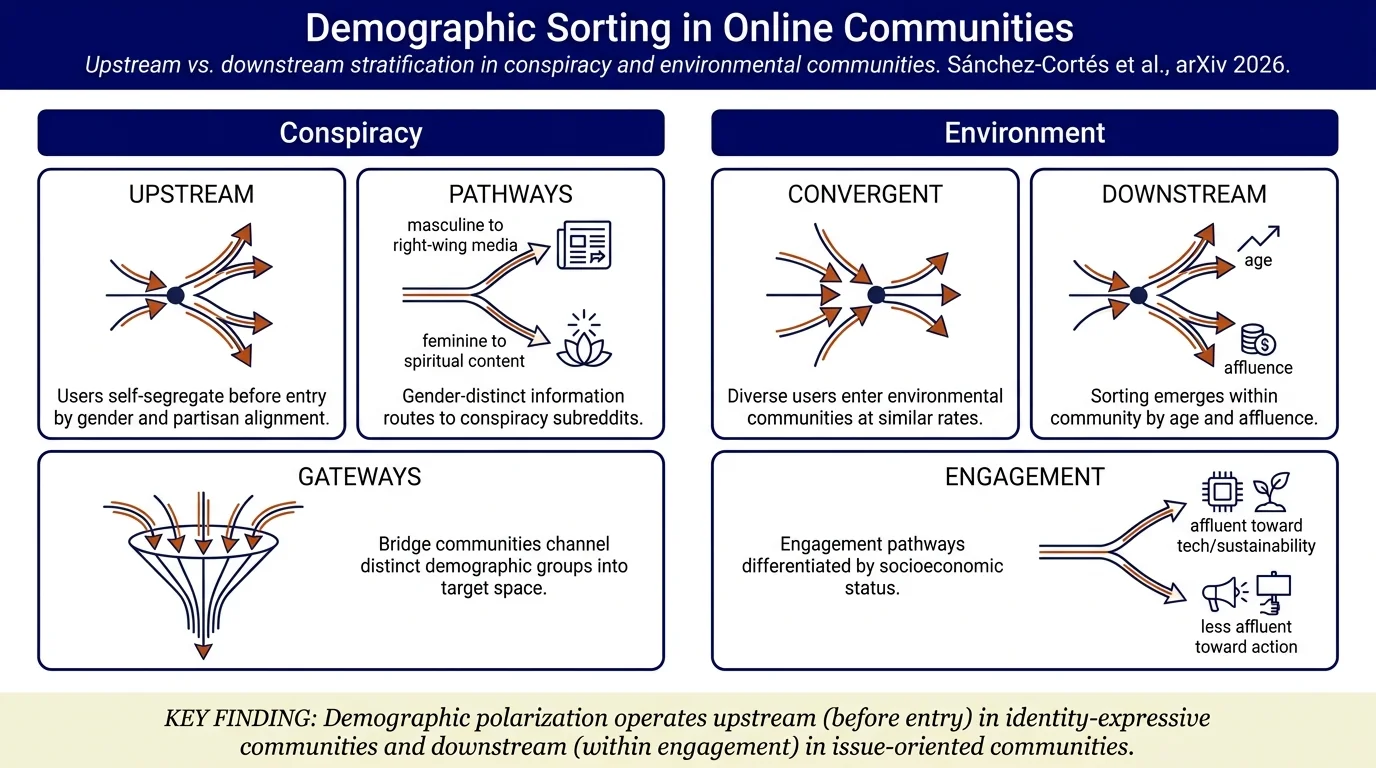
Conspiracy and Environment Communities on Reddit Sort Along Different Demographic AxesConspiracy and environmental communities on Reddit exhibit distinct demographic sorting mechanisms. Conspiracy communities show upstream sorting—users self-segregate by gender and partisanship before entry through ideologically-aligned information environments.
 Spread & networksPlatforms, policy & society
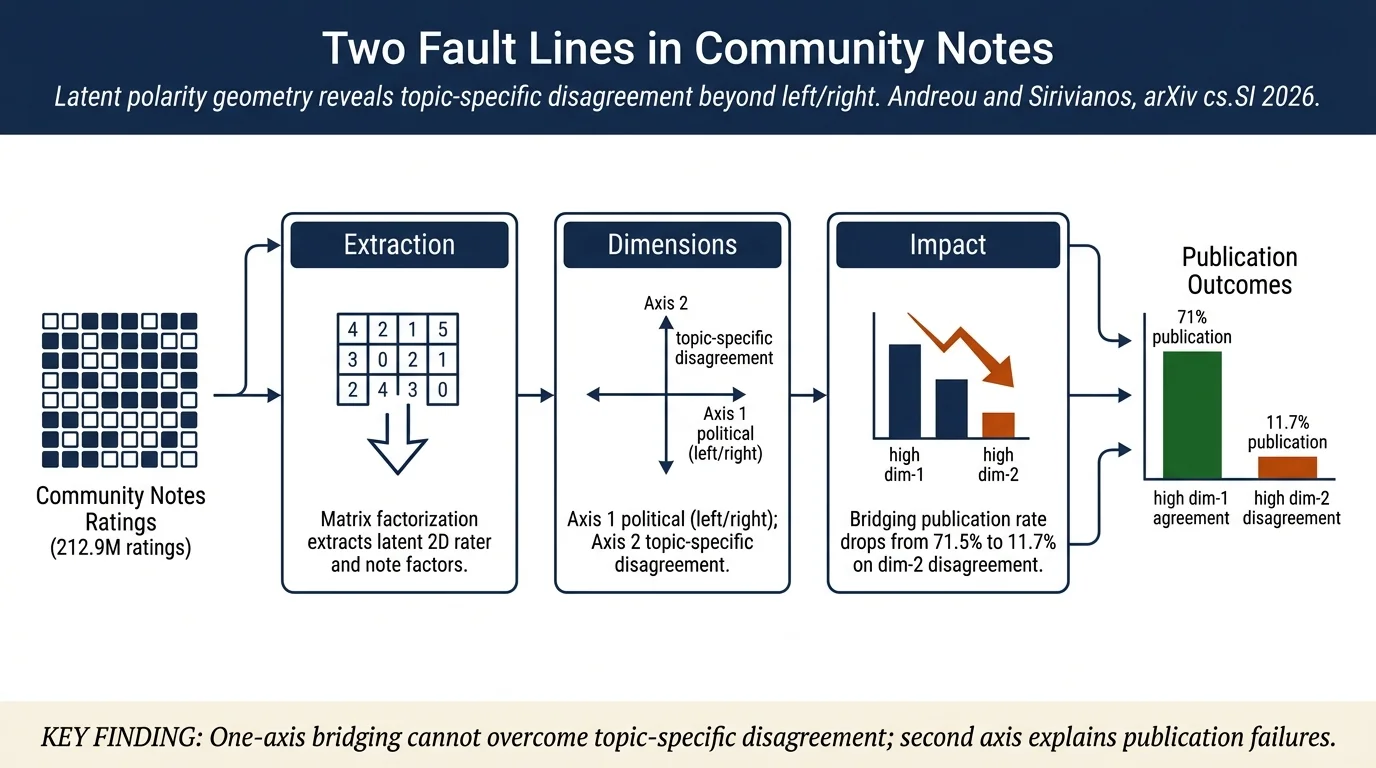
Two Fault Lines: Latent Polarity Geometry in X Community NotesX's Community Notes system assumes disagreement is one-dimensional (left/right politics) to decide when notes should be published via a "bridging" mechanism. This paper shows the space is actually two-dimensional: the first axis captures political polarization, while a second axis independently captures disagreement on topics like…
 Spread & networksPlatforms, policy & society
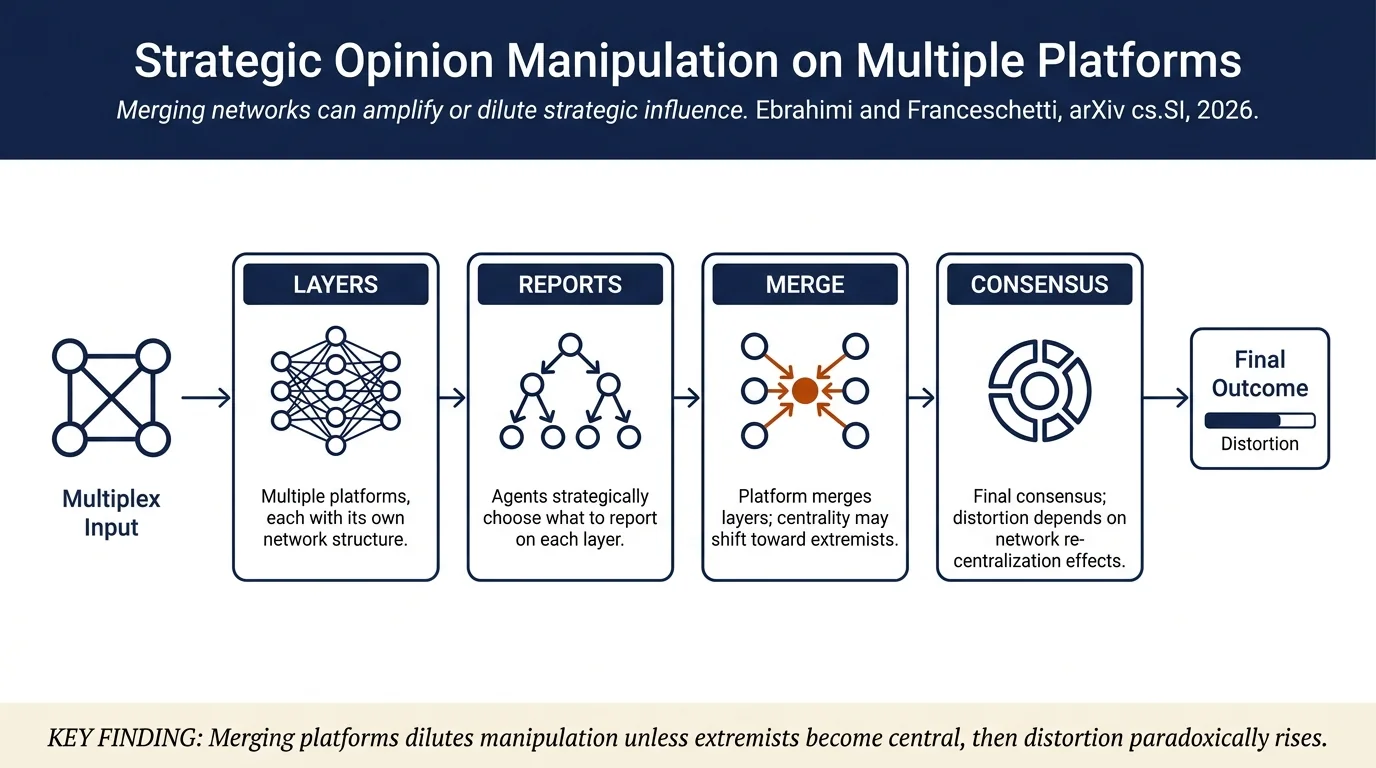
Strategic Opinion Manipulation in Multiplex NetworksThis paper models how agents strategically manipulate consensus when opinions are aggregated across multiple platforms or channels. By analyzing the resulting game as a DeGroot-like process on merged layers with strategic misreporting costs, the authors show that merging layers dilutes manipulation by default—but can amplify it through…
 LLMs & generative AIPsychology & interventions
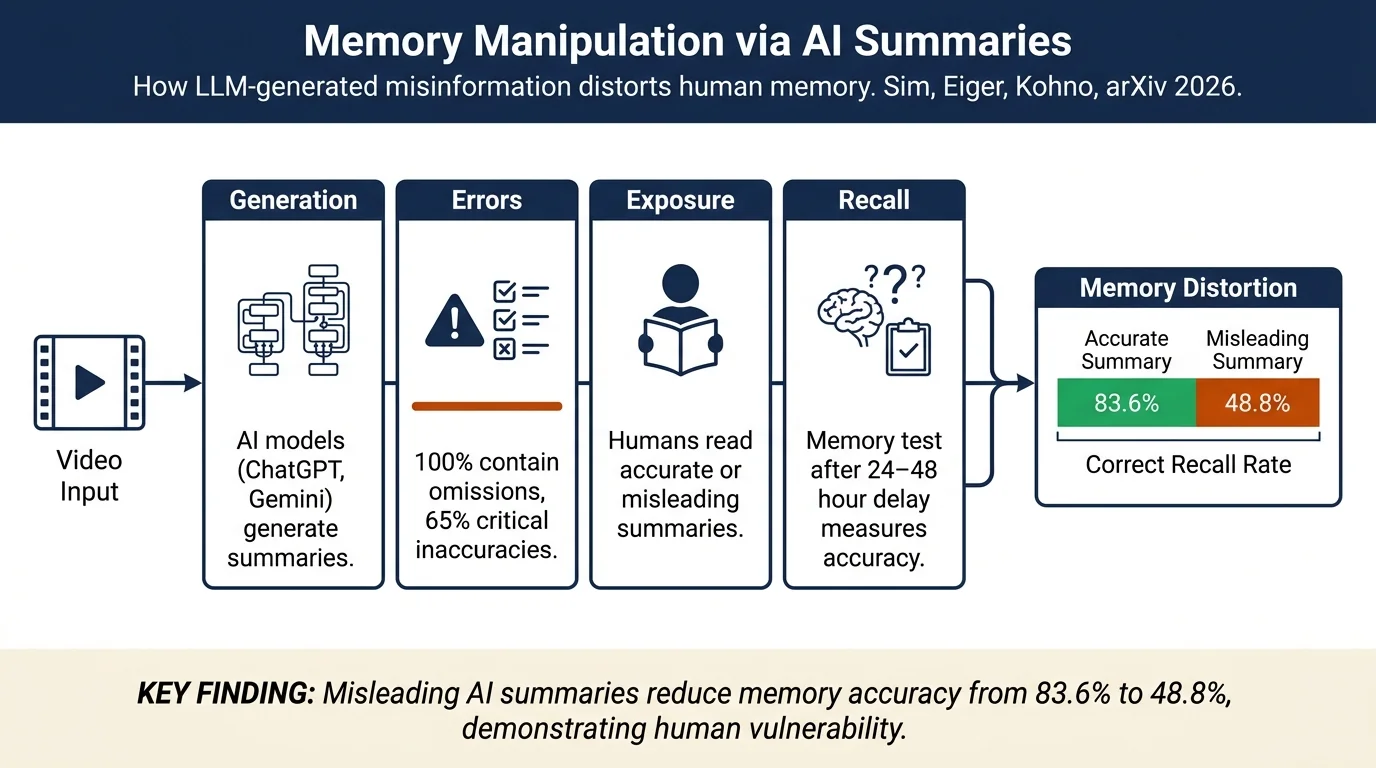
AI-Enabled Human Memory Manipulation: Misleading AI-Generated Summaries Distort Human MemoryLarge language models frequently generate erroneous summaries of videos, including critical omissions and hallucinated details. In a human-subjects experiment, participants who read AI-generated summaries containing misleading information were significantly less likely to accurately recall the original event—demonstrating that AI…
 Psychology & interventionsSpread & networks
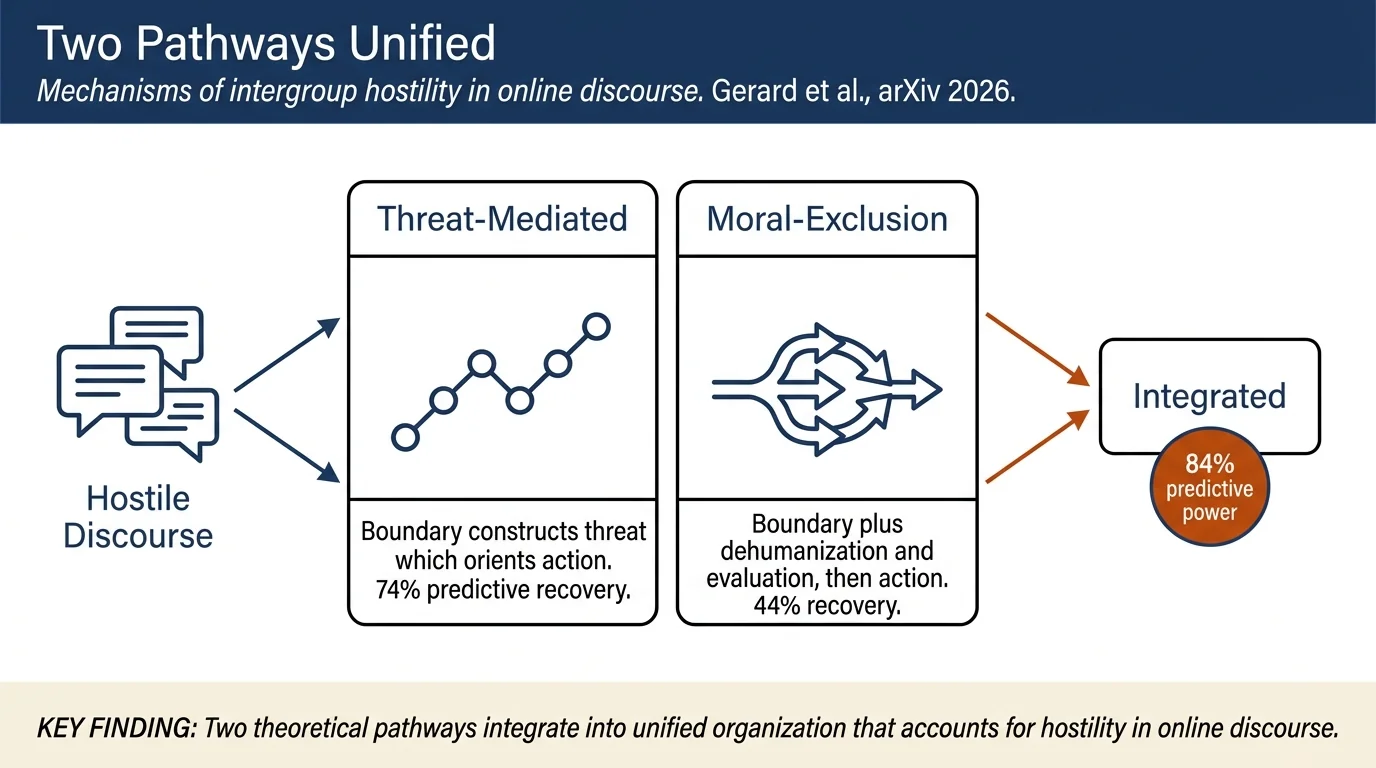
Unifying Models of Intergroup Hostility in Online DiscourseHostile rhetoric toward outgroups in online discourse can be modeled through six mechanisms (boundary construction, threat construction, scapegoating, negative evaluation, dehumanization, action orientation) whose structural and temporal relationships were previously understood separately through competing theoretical frameworks. By…
 Spread & networksPsychology & interventions
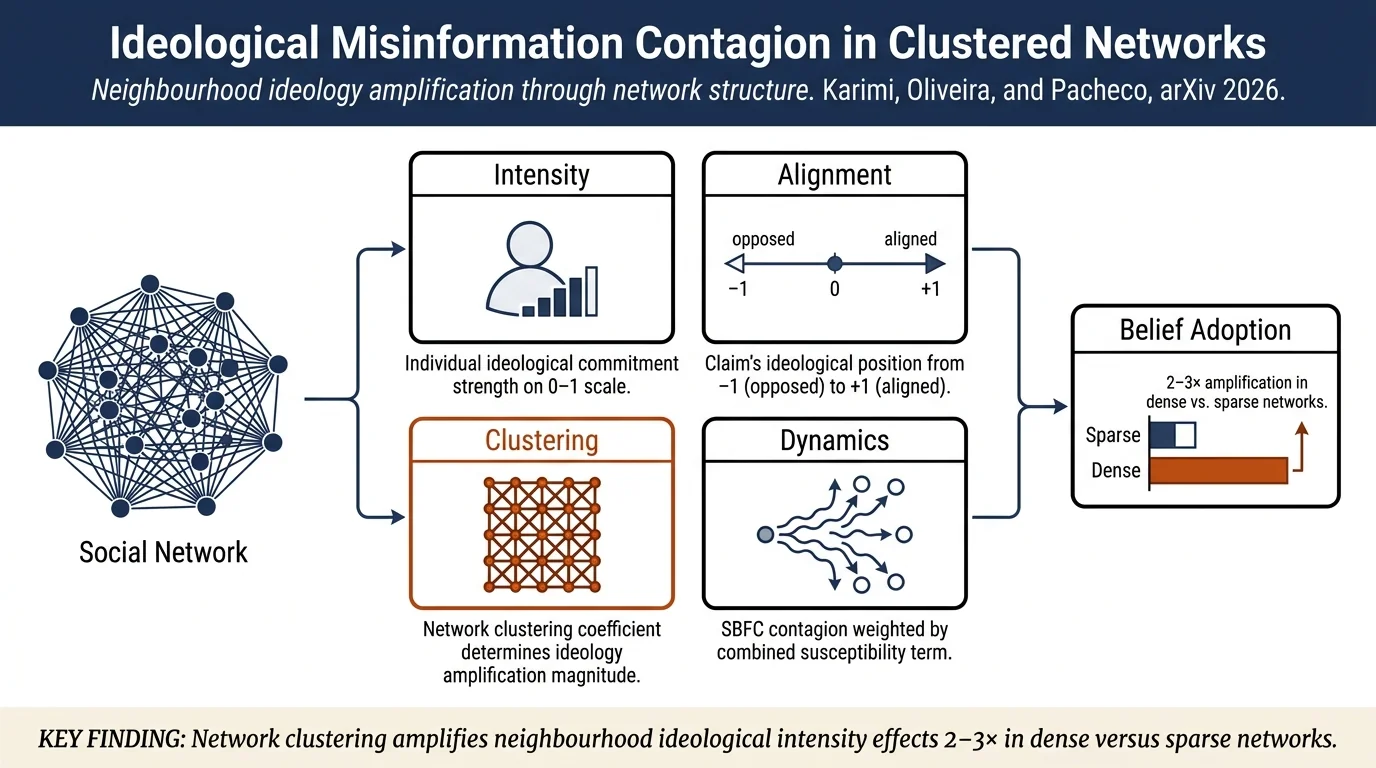
How neighbourhood ideology shapes misinformation belief in densely tied social networksPrior work decouples ideological bias and social influence when modeling misinformation propagation; this paper integrates them through an agent-based contagion model that distinguishes an individual's ideological intensity from a claim's ideological alignment. Simulation and analytical results show that in densely clustered…
 Detection methodsPsychology & interventions
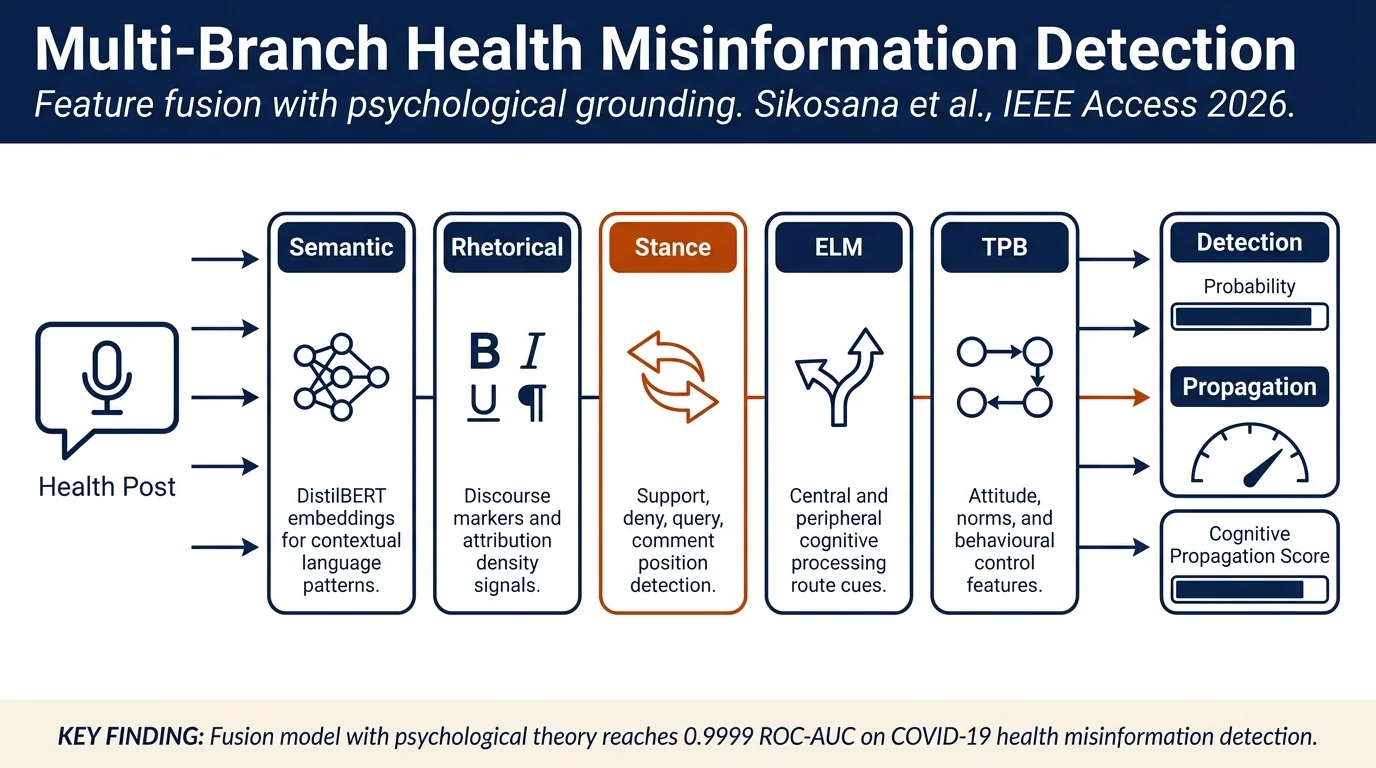
A Multi-Branch Feature Fusion Approach for Health Misinformation Detection and PropagationThe paper presents a multi-branch fusion framework for detecting and characterizing health misinformation on social media, grounded in psychological theories (Elaboration Likelihood Model and Theory of Planned Behaviour). The model fuses transformer embeddings with rhetorical, stance, and theory-motivated linguistic features in a unified…
 Spread & networksPlatforms, policy & society
Quantifying Political Partisanship for Cross-Platform AnalysesPolitical partisanship measurement in social media typically relies on platform-specific features (follower networks, community structure), making cross-platform comparison difficult. This work proposes a text-based partisanship measurement method grounded in external media bias ratings, and validates it on ~1.3 million posts from…
 Spread & networksPsychology & interventions
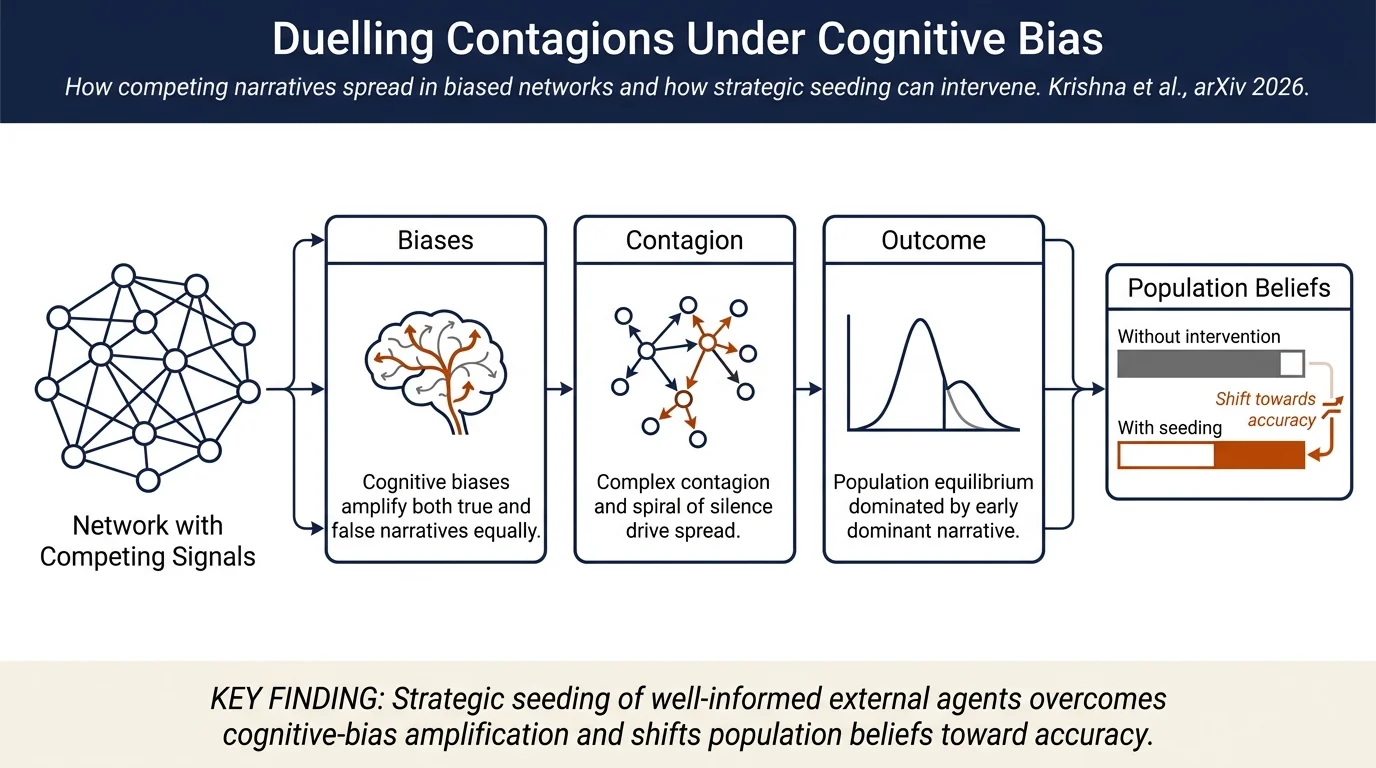
Modeling Duelling Contagions of True and False Information in the Face of Inherent Individual biasesThis paper proposes CI-SRW, an agent-based co-diffusion model integrating cognitive biases with network dynamics to explain how competing true and false information spread in social media. Using behavioral experiments and simulations, the authors find that manipulative narratives dominate when early spreaders hold them, cognitive biases…
 Psychology & interventionsDetection methods
Why People Believe Misinformation — and What We Can Do About ItJon Roozenbeek synthesizes eight years of misinformation research, examining why people believe false information and what interventions actually work. Grounding the analysis in the historical tobacco disinformation playbook, he argues that misinformation susceptibility stems not primarily from poor reasoning, but from media consumption…
 Psychology & interventionsFact-checking & verification
Psychological Inoculation Against MisinformationSander van der Linden surveys the psychology of misinformation susceptibility and defends the approach of psychological inoculation (pre-bunking) over fact-checking (debunking). He introduces the MIST (Misinformation Susceptibility Test), a psychometrically validated instrument for measuring individual variation in susceptibility to…
 Psychology & interventionsDetection methods
Fact or Fake? The Psychology of MisinformationEcker presents an overview of misinformation psychology, covering definition, sources, behavioral impacts, and evidence-based interventions. He demonstrates that misinformation influences reasoning even after people receive corrections (the continued influence effect), and that corrections are only partially effective.
 Psychology & interventionsDetection methods
The Science of MisinformationVan Bavel synthesizes research on misinformation psychology, spread mechanisms, and evidence-based interventions. Misinformation is a persistent global risk (World Economic Forum priority).
 LLMs & generative AIPlatforms, policy & society
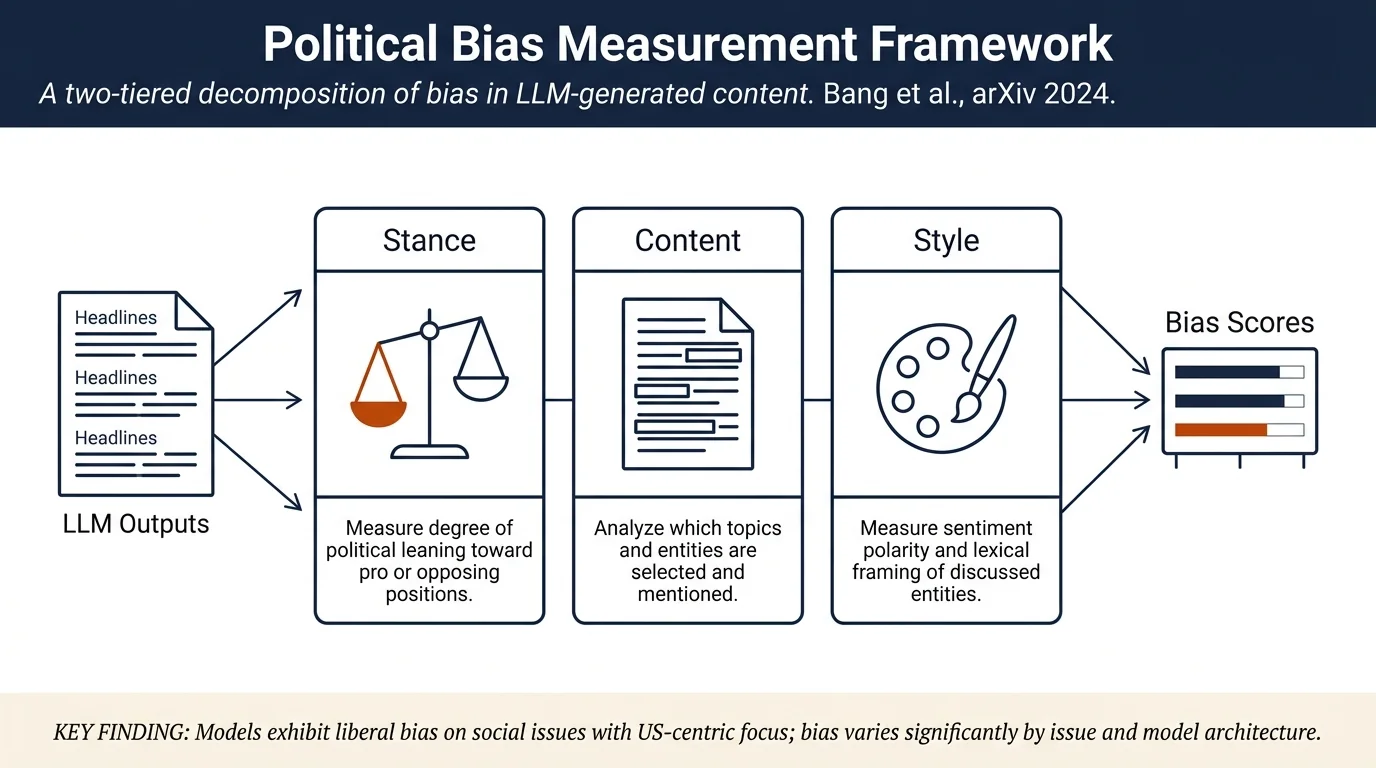
Measuring Political Bias in Large Language Models: What Is Said and How It Is SaidThis paper proposes a two-tiered framework for measuring political bias in LLM-generated content, separating bias into what is said (content bias) and how it is said (style/framing bias). Using extreme anchor comparison and frame analysis on 11 open-source LLMs across 14 politically divisive topics, the authors find that models exhibit…
 Psychology & interventionsLLMs & generative AI
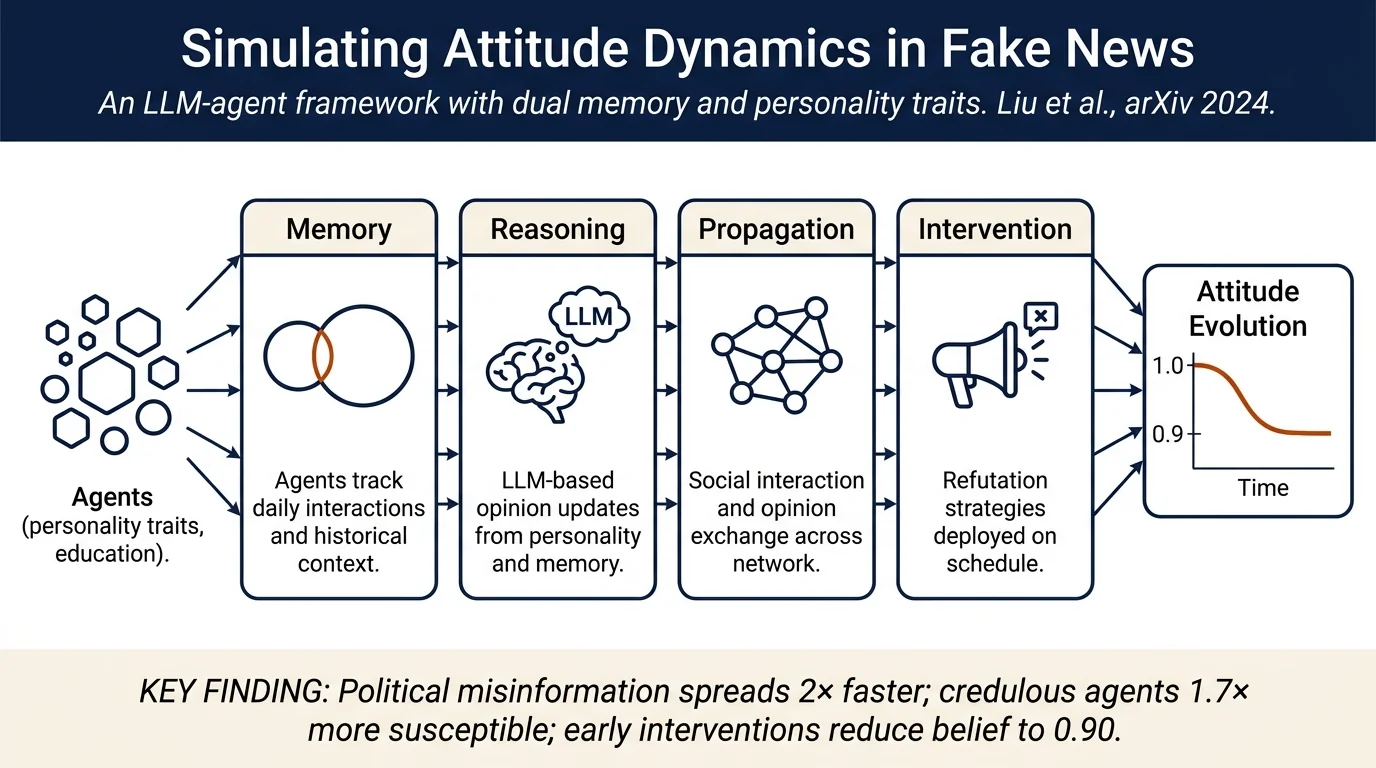
From Skepticism to Acceptance: Simulating the Attitude Dynamics Toward Fake NewsThis paper introduces FPS, an LLM-based agent simulation framework that models how individuals' opinions on fake news evolve through social interactions. Each agent has personality traits, dual memory (short- and long-term), and reasoning capabilities.
 Psychology & interventionsDetection methods
Prebunking Misinformation on Social MediaJon Roozenbeek presents the case for prebunking—teaching people to recognize manipulation tactics before encountering false claims—rather than relying on reactive debunking. Drawing on inoculation theory from the 1960s, he argues that manipulation techniques recur across misinformation campaigns: emotional exploitation, false…
 Psychology & interventionsFact-checking & verification
Psychological Inoculation Against MisinformationSander van der Linden introduces psychological inoculation as a scalable alternative to fact-checking for building societal resistance to misinformation. Drawing on inoculation theory and his flagship intervention, the Bad News game, he demonstrates how preemptively exposing people to weakened examples of six core manipulation techniques…
 LLMs & generative AIPlatforms, policy & society
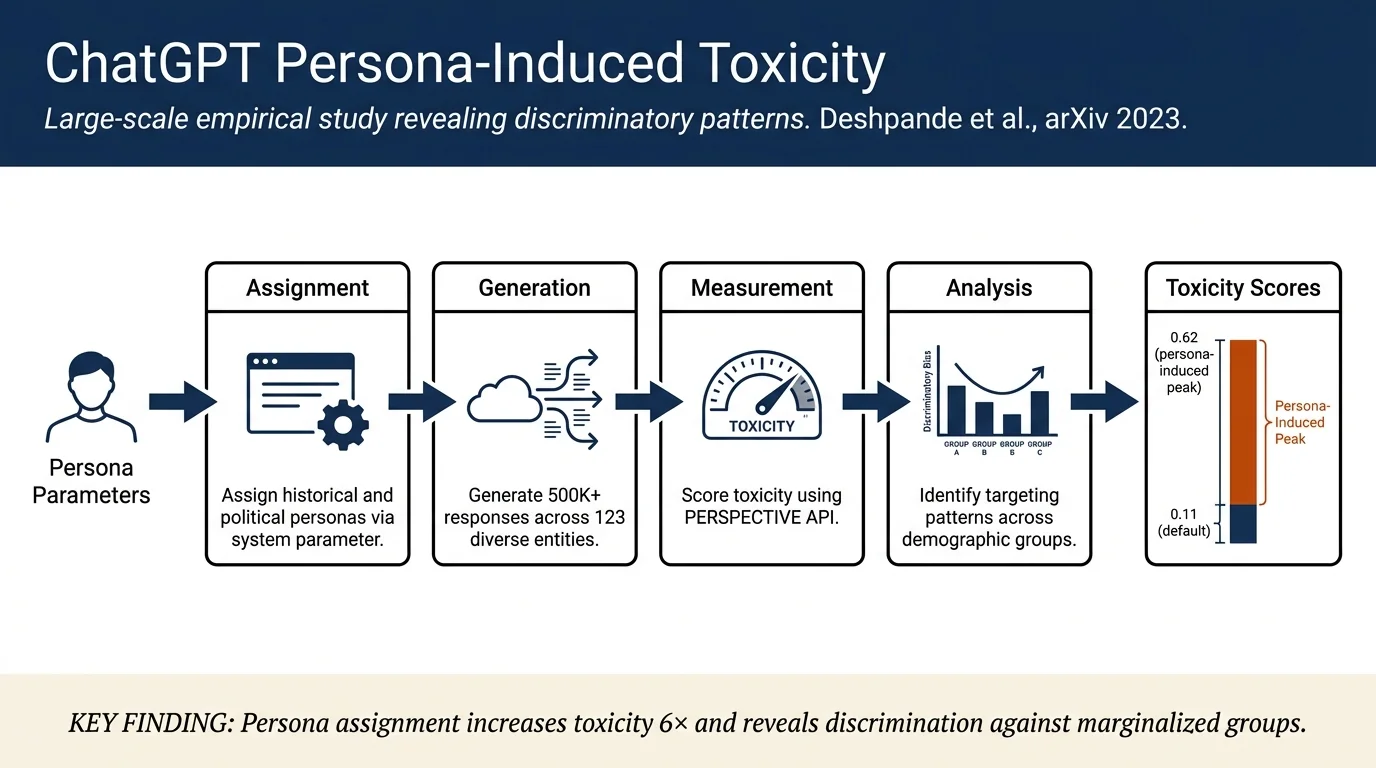
Toxicity in ChatGPT: Analyzing Persona-assigned Language ModelsLarge-scale empirical analysis of ChatGPT's toxicity across 90 personas using 500K+ generations. Assigning personas via the system parameter increases toxicity up to 6×, with variation depending on persona characteristics and target entities.
 Spread & networksPlatforms, policy & society
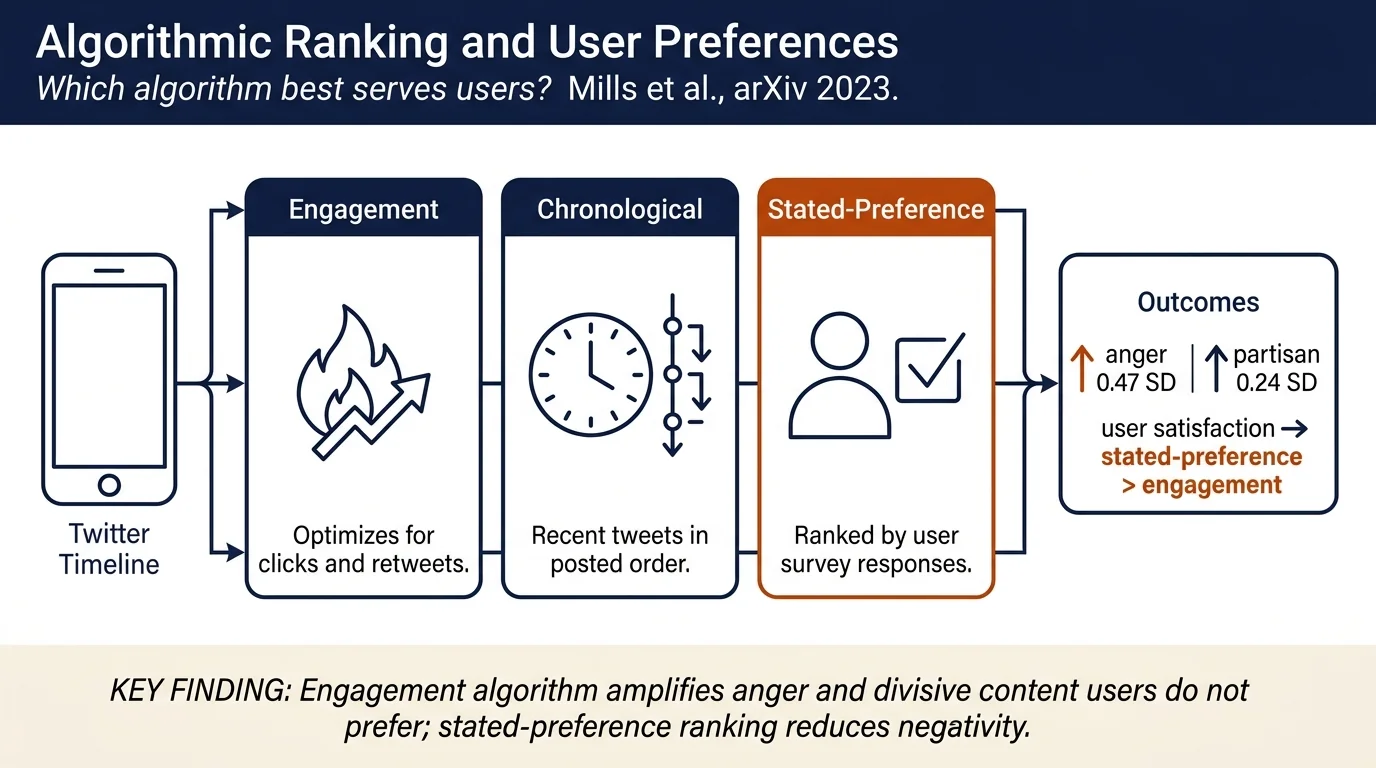
Engagement, User Satisfaction, and the Amplification of Divisive Content on Social MediaTwitter's engagement-based ranking algorithm amplifies emotionally charged and partisan divisive content beyond what users report wanting to see. Through a pre-registered experiment comparing the engagement-based timeline to a reverse-chronological baseline, the authors show the algorithm increases anger, sadness, and out-group…
 Spread & networksPlatforms, policy & society
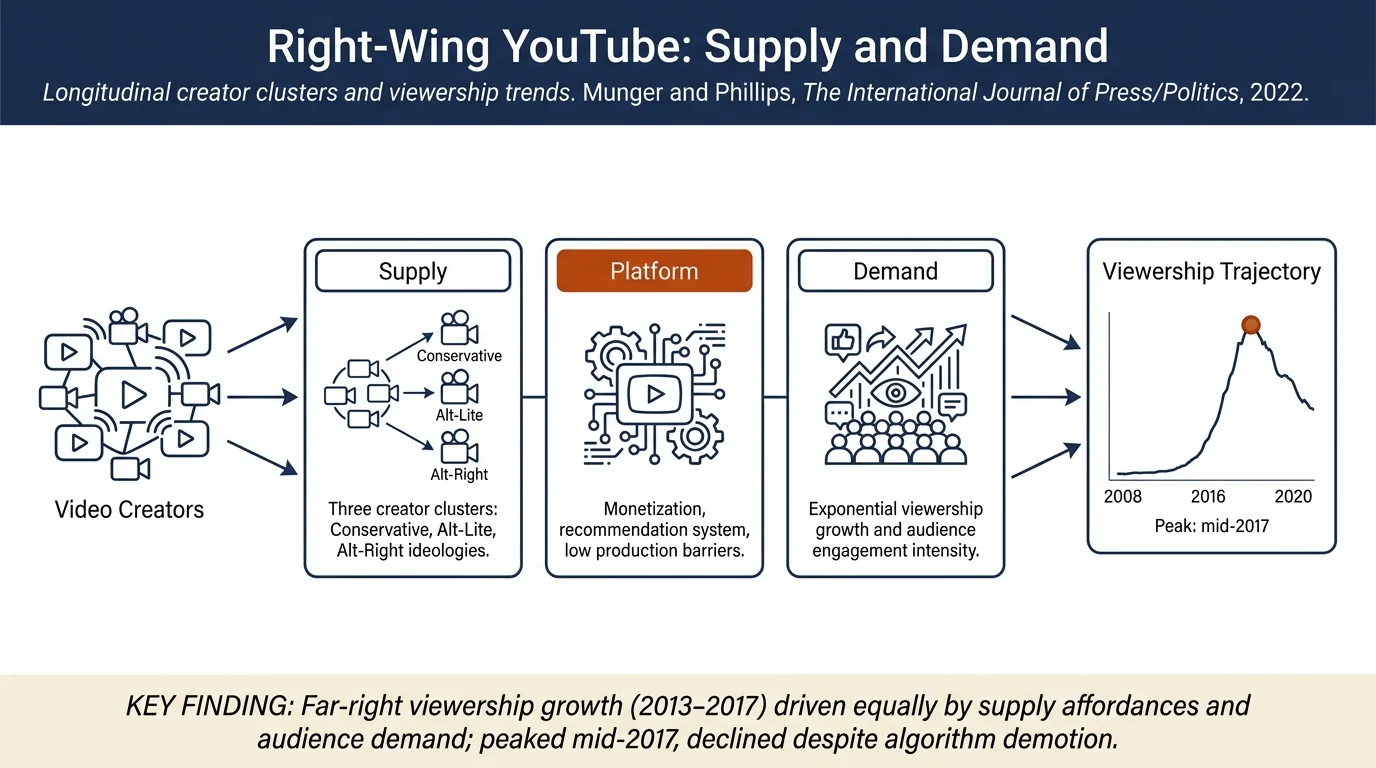
Right-Wing YouTube: A Supply and Demand PerspectiveYouTube has become the dominant platform for right-wing political content in the US, driven by supply-side affordances (low creation barriers, monetization, algorithmic recommendation) and demand-side audience appetite for alternative media. Using longitudinal analysis of creator clusters (Conservative, Alt-Lite, Alt-Right), the authors…
 Psychology & interventionsFact-checking & verification
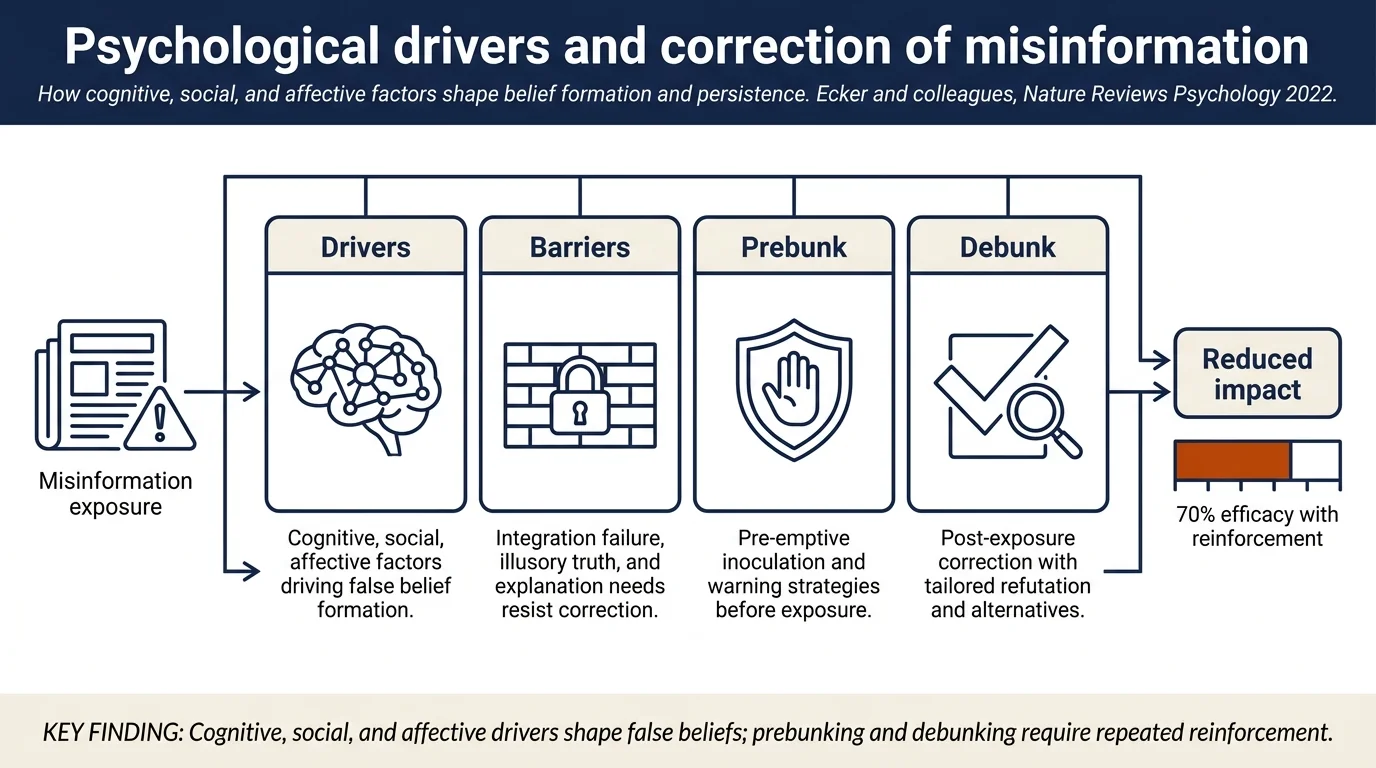
The psychological drivers of misinformation belief and its resistance to correctionThis comprehensive review establishes that misinformation's power lies not in exposure but in how cognitive, social, and affective factors shape belief formation and persist even after correction. False beliefs arise from intuitive thinking, memory failures, emotional content, in-group bias, and source credibility judgments; corrections…
 Psychology & interventionsPlatforms, policy & society
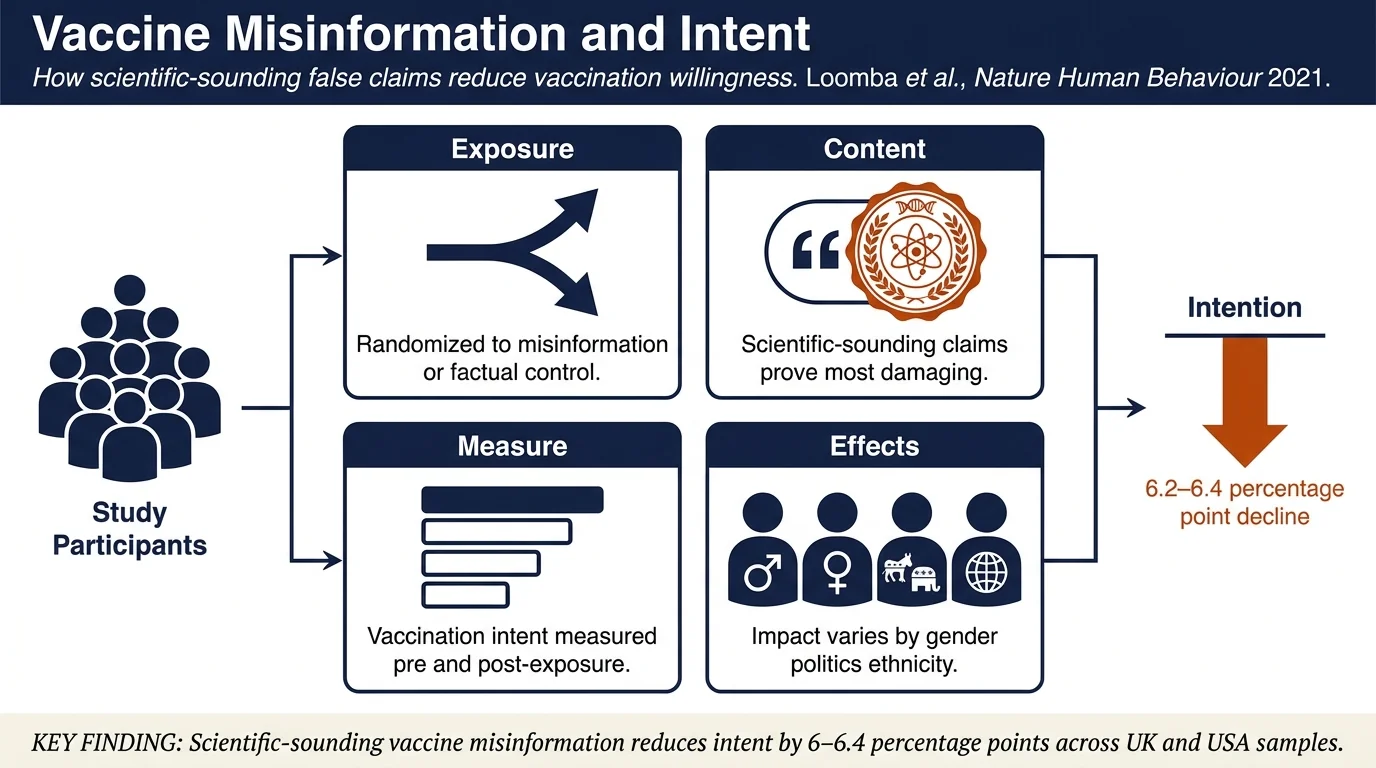
Measuring the impact of COVID-19 vaccine misinformation on vaccination intent in the UK and USARandomized controlled trial on 8,001 respondents (4,000 UK, 4,001 USA) measuring causal impact of exposure to COVID-19 vaccine misinformation. Exposure to misinformation reduced vaccination intent by 6.2 percentage points in the UK and 6.4 in the USA relative to exposure to factual information.
 Psychology & interventionsPlatforms, policy & society
Rumors, Truths, and Reality: Political Misinformation in the Modern DayAdam Berinsky surveys a decade of research on why Americans believe political rumors despite contradictory evidence. He identifies two key mechanisms: conspiratorial thinking (a personality trait that varies across individuals) and partisanship (which structures which rumors a person is likely to endorse).
 Psychology & interventionsPlatforms, policy & society
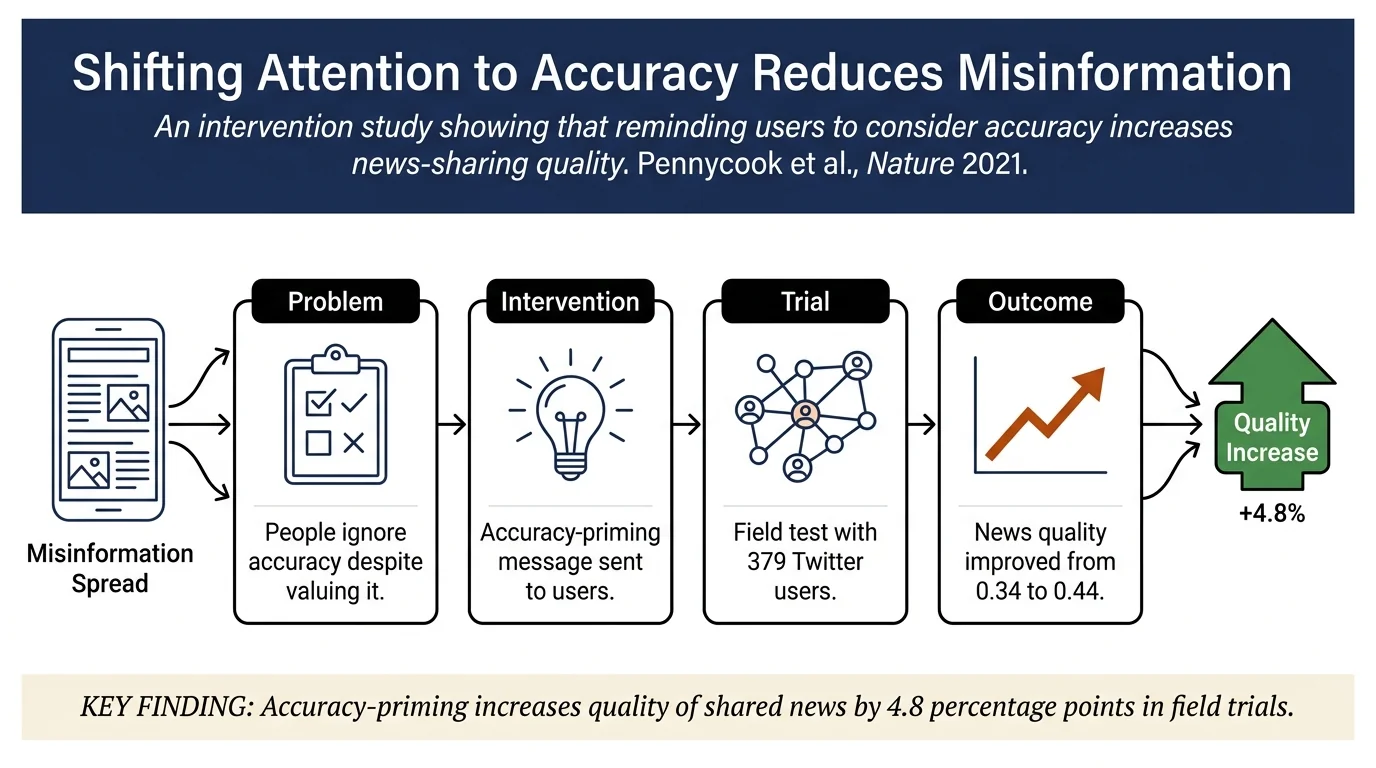
Shifting attention to accuracy can reduce misinformation onlineThe paper shows through six online experiments and a Twitter field trial that simply drawing people's attention to accuracy can substantially reduce their sharing of misinformation. When asked to rate the accuracy of headlines before deciding whether to share them, participants share more accurate content; a Twitter field experiment…
 Detection methodsLLMs & generative AI
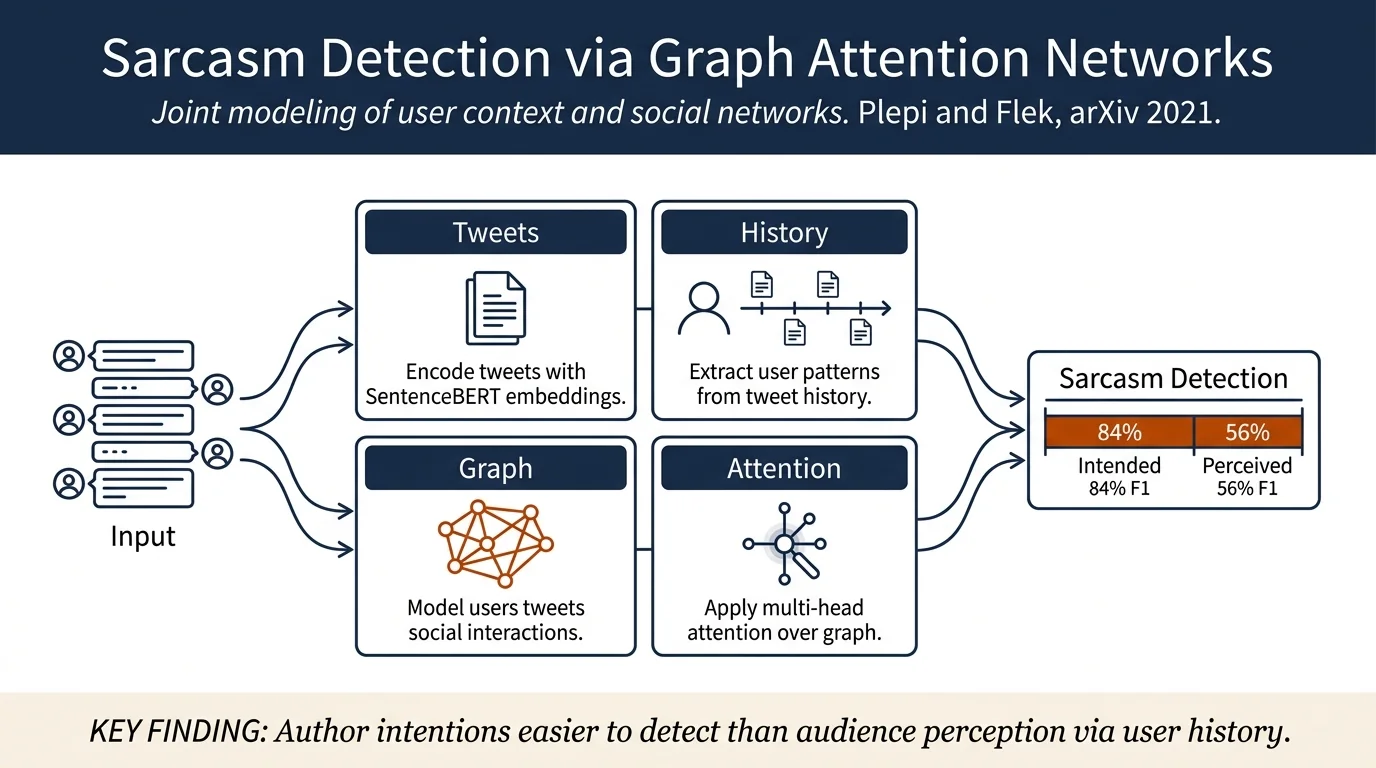
Perceived and Intended Sarcasm Detection with Graph Attention NetworksSarcasm detection requires understanding both the author's intent and the audience's perception. This work proposes a graph attention network (GAT) that jointly models user historical context and conversational social network information on Twitter, achieving state-of-the-art results on the SPIRS dataset and showing that detecting…
 LLMs & generative AIDatasets & evaluation
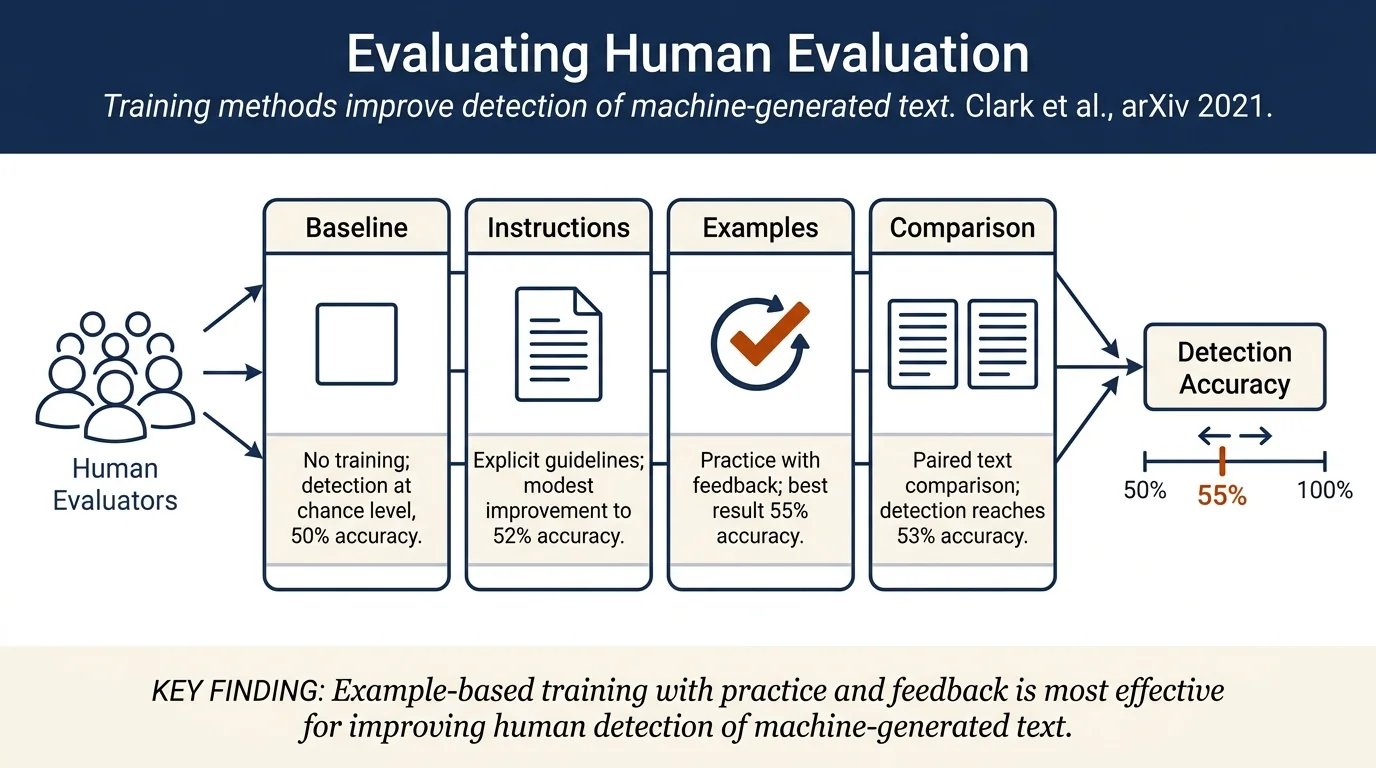
All That's 'Human' Is Not Gold: Evaluating Human Evaluation of Generated TextHuman evaluators cannot reliably distinguish machine-generated text from human-written text without training, focusing instead on superficial features like grammar and style. Three training approaches (instructions, examples, and comparisons) improve evaluator accuracy modestly, with example-based training showing the most improvement…
 Fact-checking & verificationDatasets & evaluation
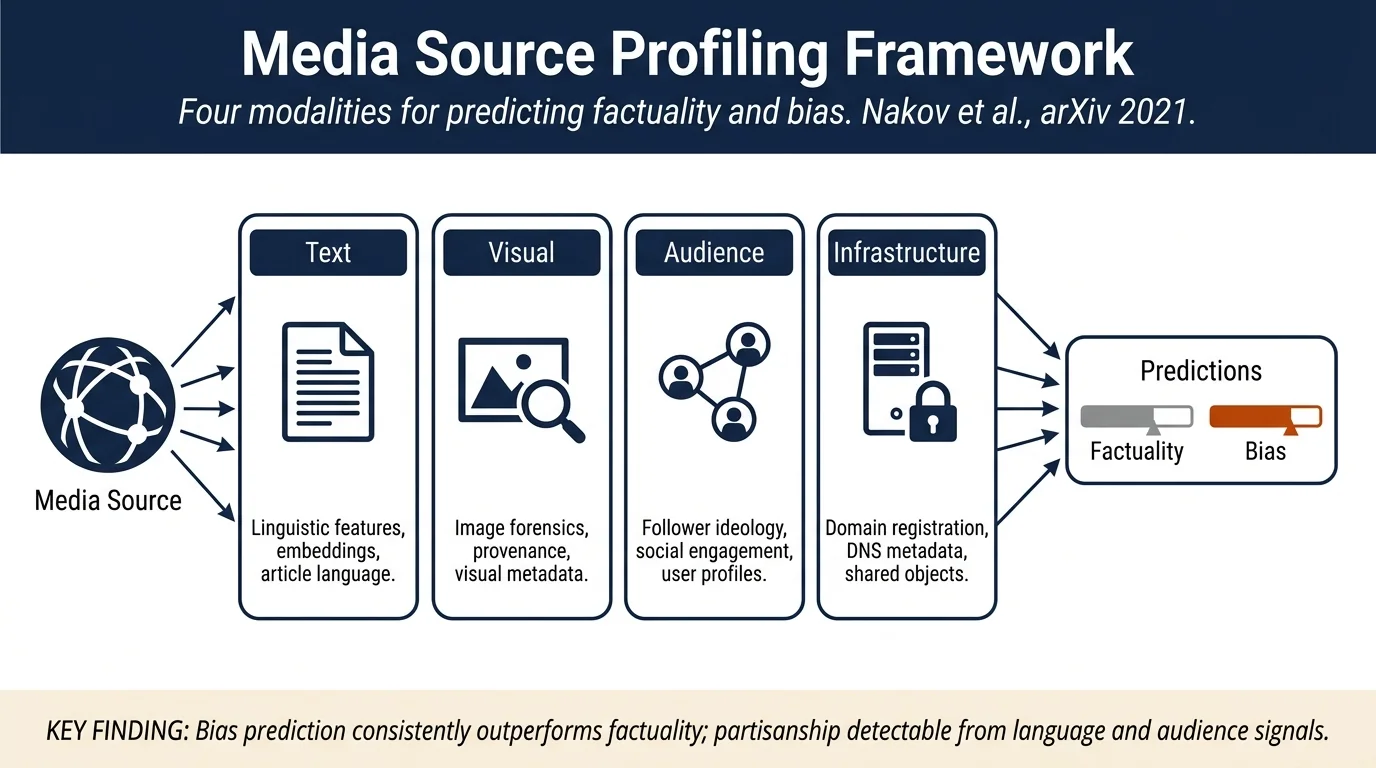
A Survey on Predicting the Factuality and the Bias of News MediaSurvey of media-level profiling methods for predicting news outlet factuality and political bias. Rather than checking individual claims or articles, the approach profiles entire news sources to enable early detection of unreliable content at publication time.
 Spread & networksPsychology & interventions
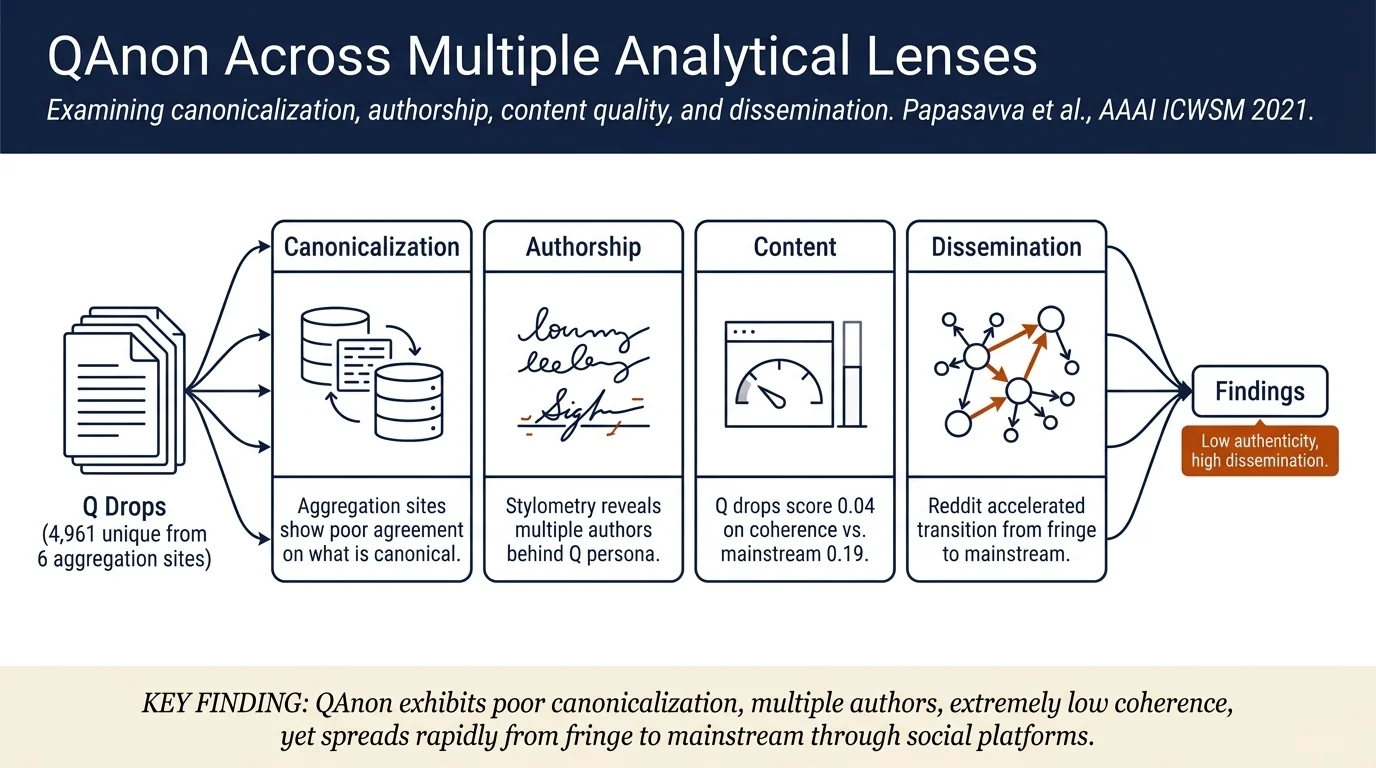
The Gospel According to Q: Understanding the QAnon Conspiracy from the Perspective of Canonical InformationThis paper systematically studies the QAnon conspiracy theory by collecting and analyzing 4,961 unique Q drops from six aggregation sites. The authors find that aggregation sites show poor agreement on what constitutes a canonical Q drop, that Q drops are incoherent and low-quality relative to other social media platforms, and that…
 Spread & networksPlatforms, policy & society
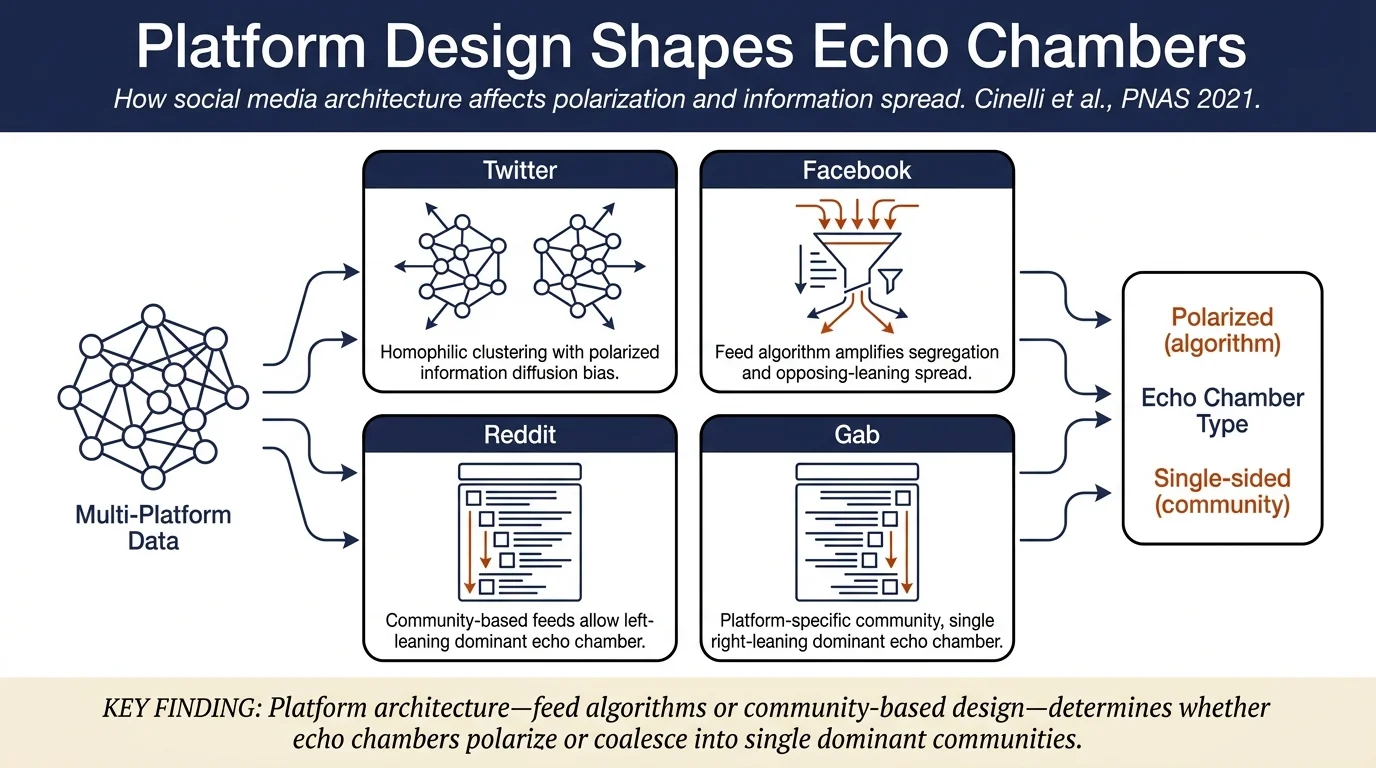
The echo chamber effect on social mediaComparative analysis of 100+ million posts across Twitter, Facebook, Reddit, and Gab on controversial topics shows echo chambers operate differently by platform: Facebook and Twitter exhibit strong homophilic clustering and polarized information diffusion, while Reddit and Gab show single-sided communities without the biased diffusion…
 Spread & networksPlatforms, policy & society
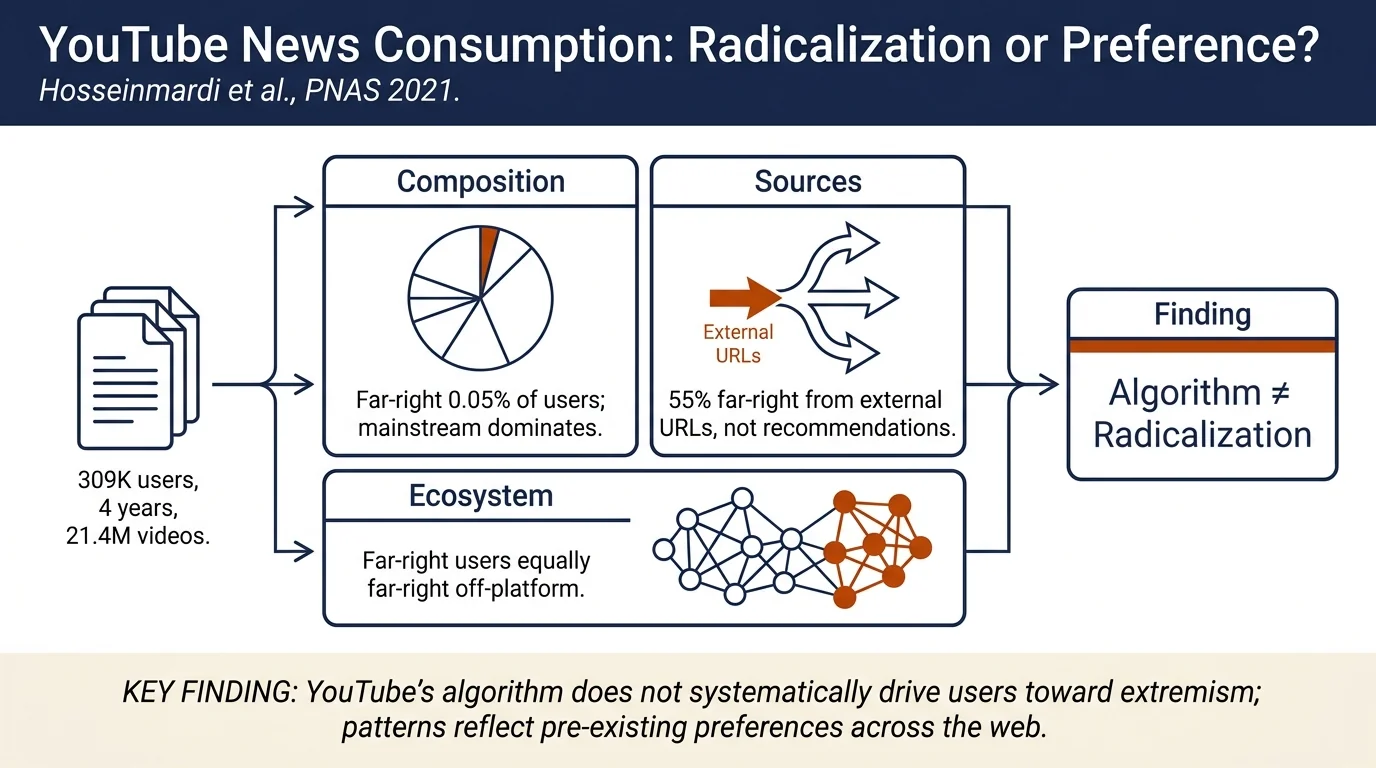
Examining the consumption of radical content on YouTubeLarge-scale study of 309,813 U.S. users' YouTube and web browsing from 2016–2019 finds that news consumption on YouTube is dominated by mainstream, centrist sources. While far-right content exists and engages users intensely, it remains a small and stable share.
 Psychology & interventionsPlatforms, policy & society
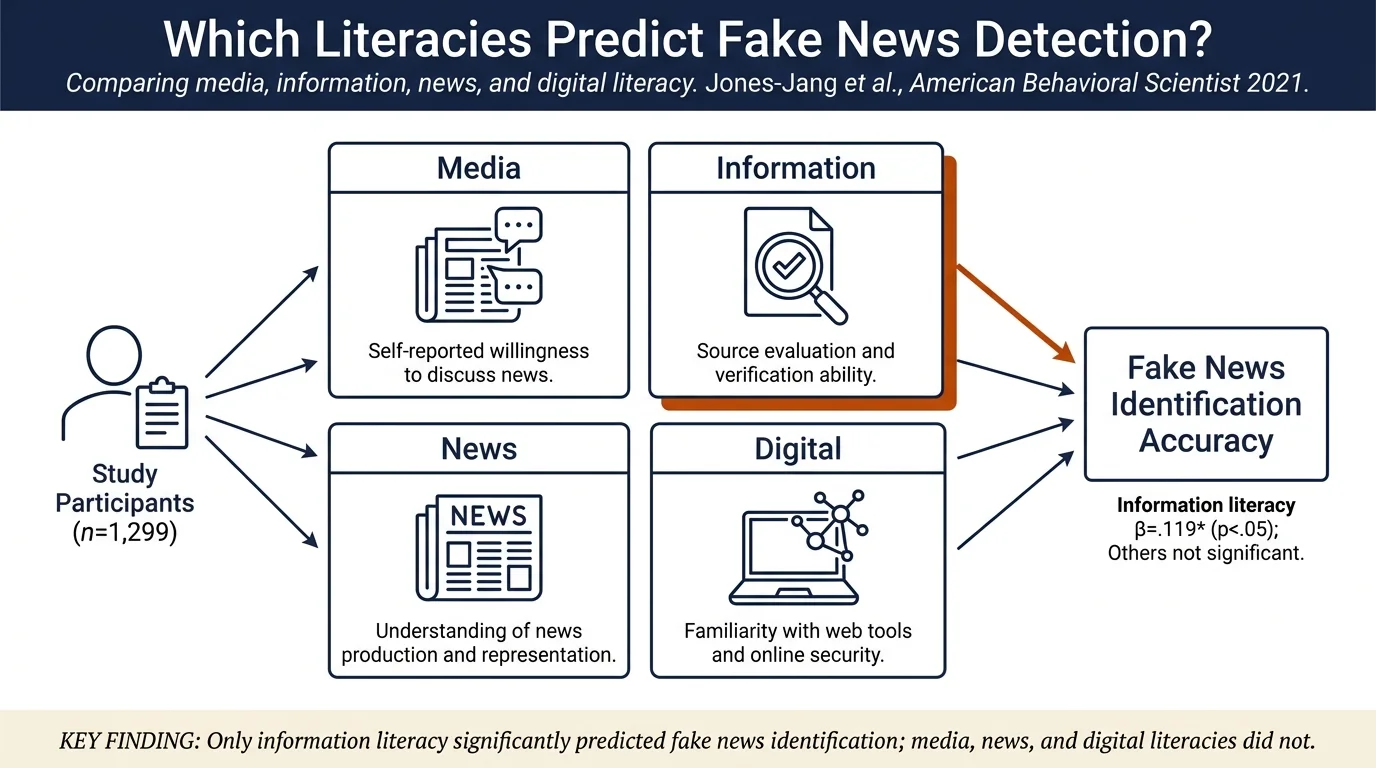
Does Media Literacy Help Identification of Fake News? Information Literacy Helps, but Other Literacies Don'tA survey of 1,299 U.S. citizens tests whether four types of media literacy—media, information, news, and digital—predict ability to identify fake news. Only information literacy (the ability to search and evaluate verified sources) significantly improves fake news identification; media, news, and digital literacies showed no significant…
 Psychology & interventionsSpread & networks
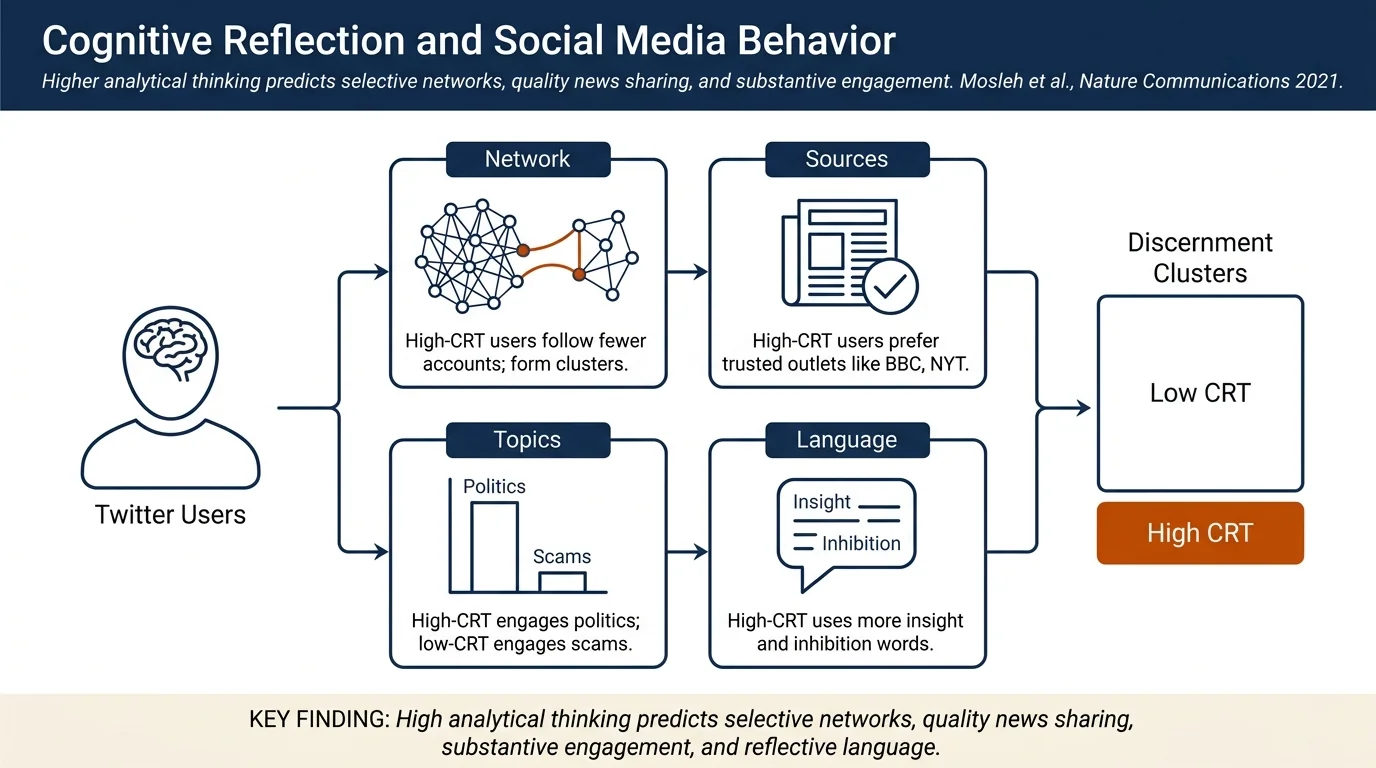
Cognitive reflection correlates with behavior on TwitterHigh scorers on the Cognitive Reflection Test (CRT)—a measure of analytical thinking—are more discerning social media users: they follow fewer accounts, share news from more reliable sources, and engage more with substantive topics like politics. The study identifies "cognitive echo chambers" where low-CRT users preferentially follow…
 Spread & networksPsychology & interventions
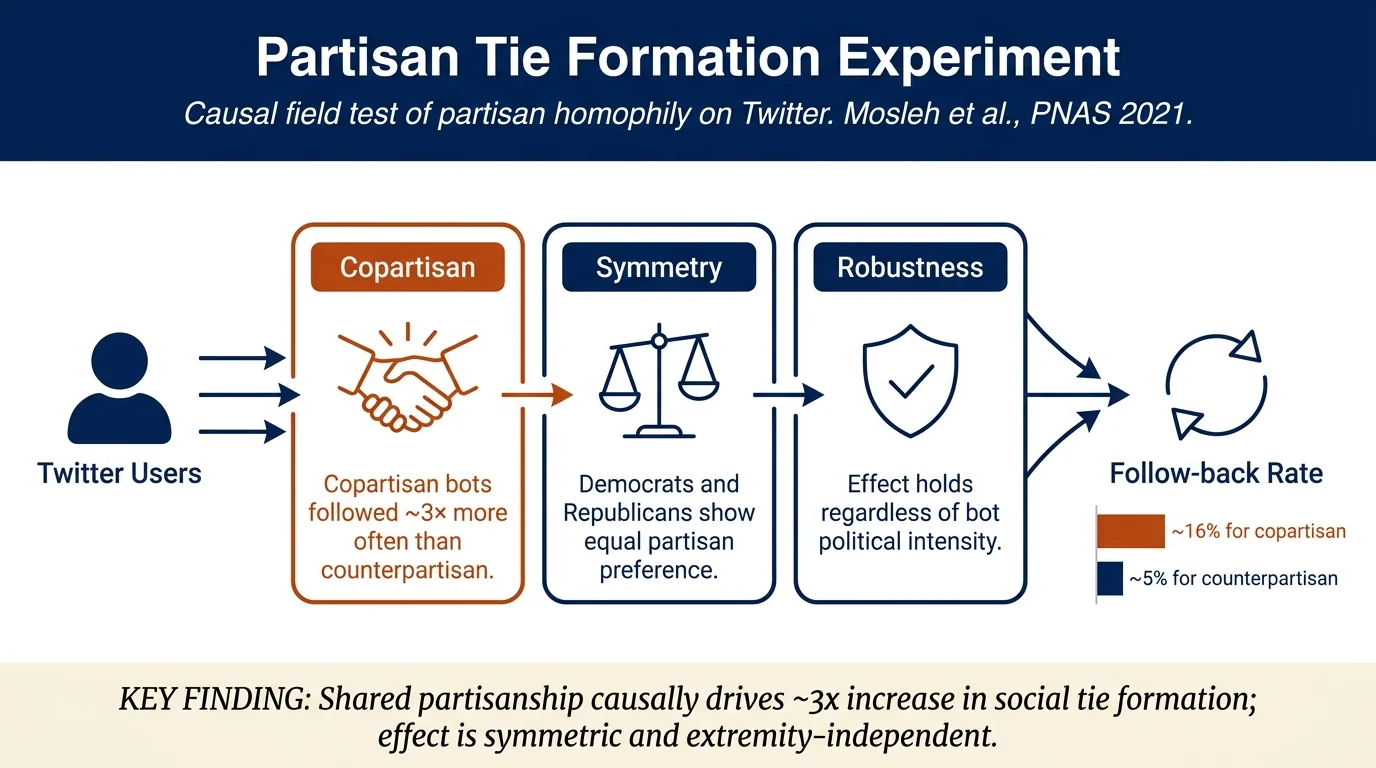
Shared partisanship dramatically increases social tie formation in a Twitter field experimentA Twitter field experiment with bot accounts reveals that shared partisanship causally drives social tie formation: users were nearly three times more likely to reciprocally follow accounts matching their political party, regardless of the account's partisan intensity. Critically, this preference was symmetric—Democrats and Republicans…
 Psychology & interventionsSpread & networks
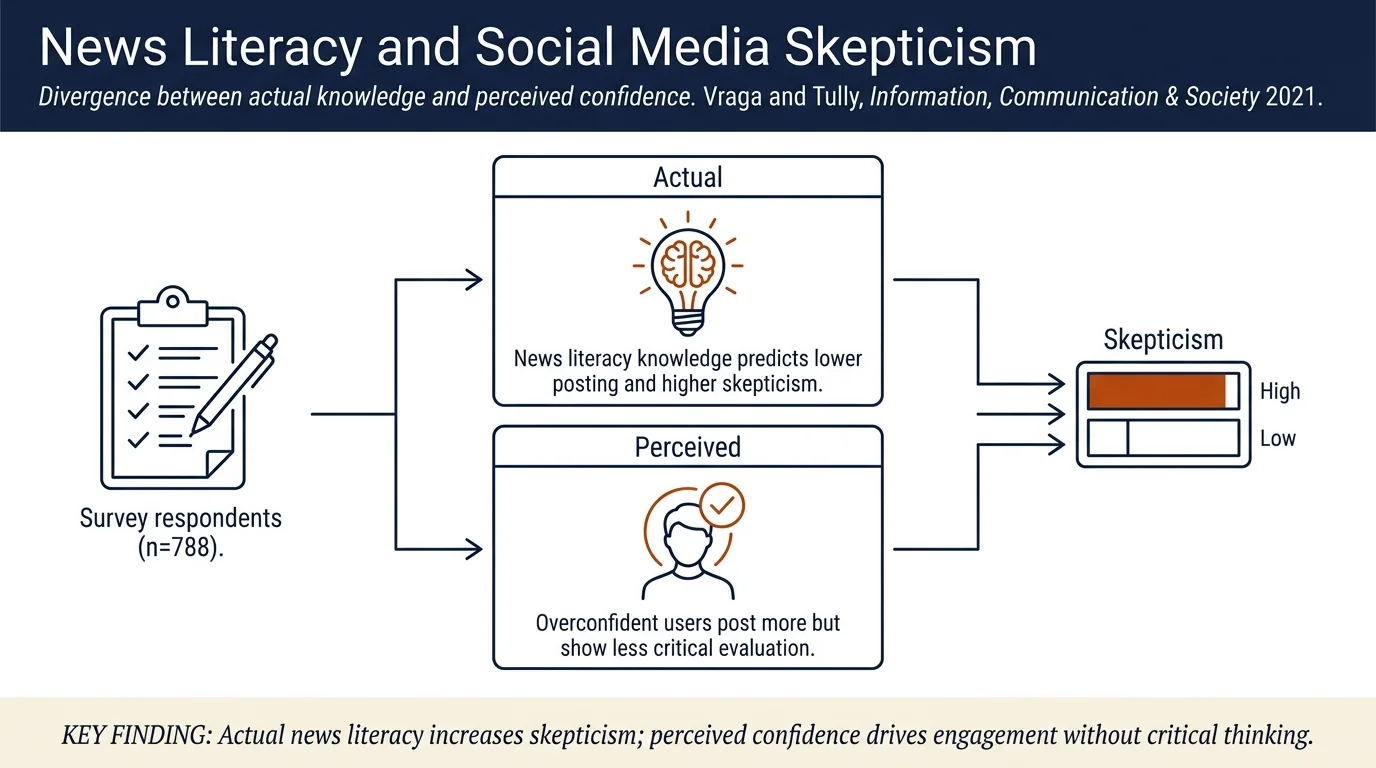
News literacy, social media behaviors, and skepticism toward information on social mediaA national survey of 788 Americans examines how news literacy relates to what people see and share on social media, and whether it predicts skepticism toward information shared in these spaces. The key finding: people with higher news literacy see and post less political content on social media, but when they do engage, they're…
 Spread & networksPlatforms, policy & society
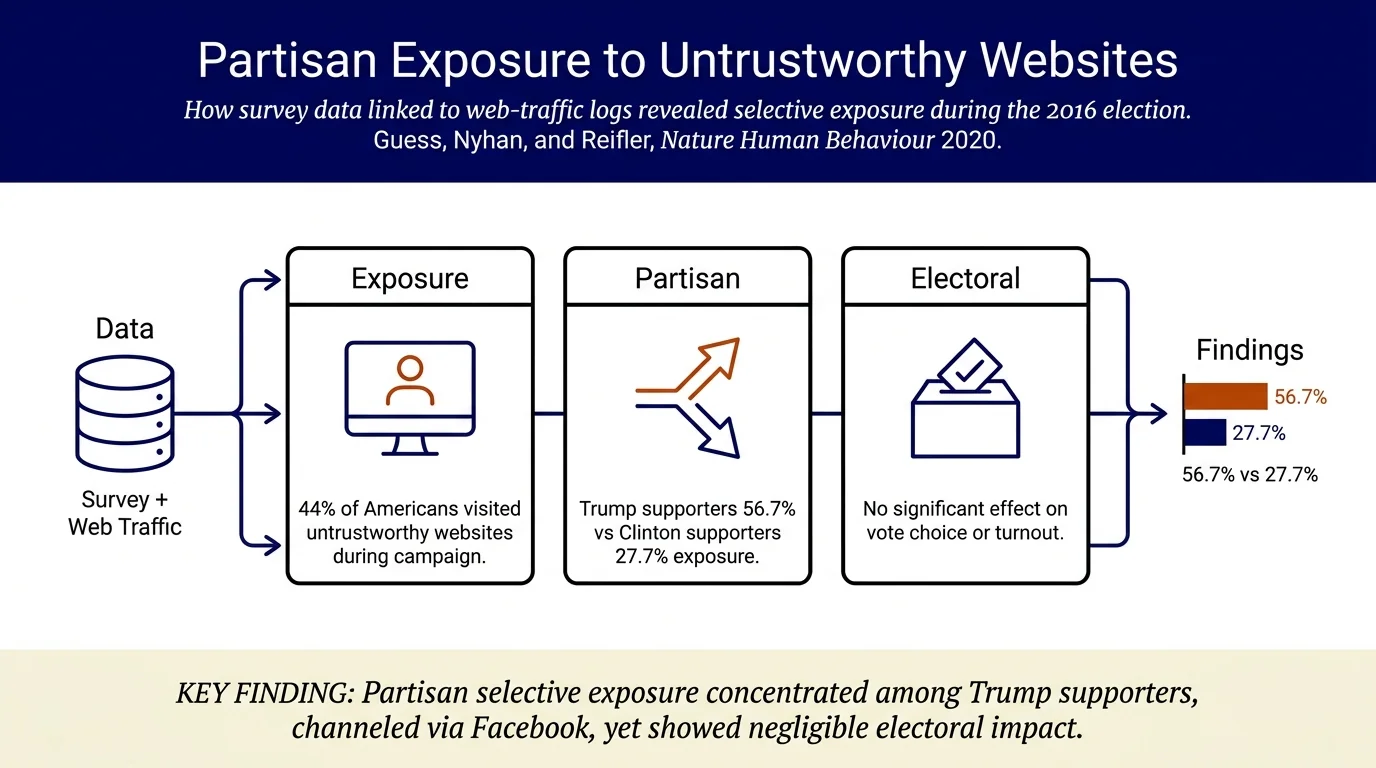
Exposure to untrustworthy websites in the 2016 US electionUsing combined survey and web-traffic data from the 2016 US presidential election, Guess et al. found that while 44.3% of Americans aged 18+ visited an untrustworthy website during the campaign, actual exposure was highly concentrated among Trump supporters (56.7% of Trump supporters vs. 27.7% of Clinton supporters). Facebook played a…
 Psychology & interventionsDetection methods
The Continued Influence of MisinformationUllrich Ecker presents research on the continued influence effect—the phenomenon that misinformation continues to shape people's reasoning and memory even after they receive corrections and understand them. He examines four social factors that shape this effect: source credibility (trustworthiness matters more than expertise),…
 Spread & networksPlatforms, policy & society
Mis- and Disinformation During Crisis EventsKate Starbird, associate professor at UW's HCDE and co-founder of the Center for an Informed Public, discusses how misinformation and disinformation spread during crisis events, with case studies from the COVID-19 pandemic and 2020 election. She distinguishes between harmful misinformation (false but well-intentioned), disinformation…
 Psychology & interventionsPlatforms, policy & society
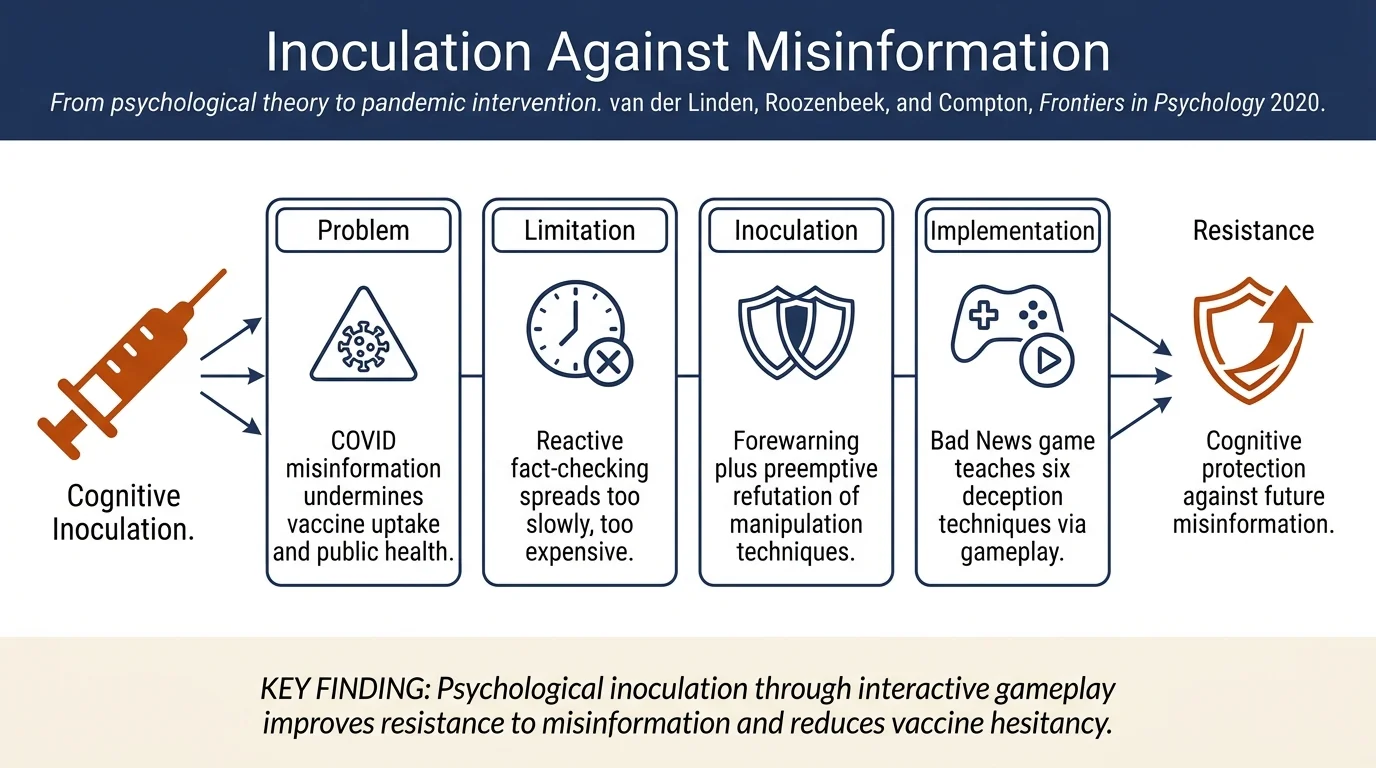
Inoculating Against Fake News About COVID-19COVID-19 misinformation has proliferated rapidly on social media, undermining public health responses and vaccination uptake. Rather than relying on post-hoc fact-checking (which spreads slower than misinformation), the authors propose psychological inoculation—exposing people to weakened doses of misinformation techniques beforehand to…
 Deepfakes & multimodalFact-checking & verification
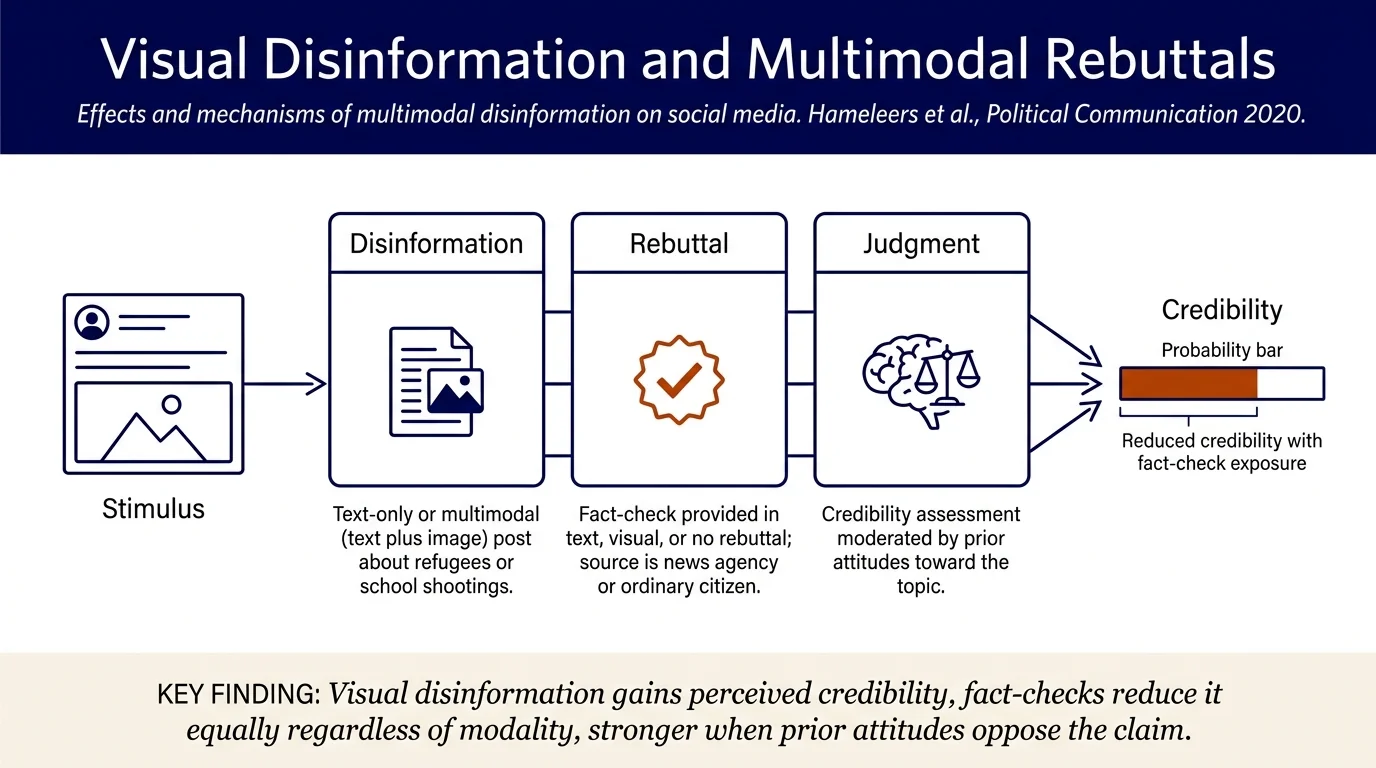
A Picture Paints a Thousand Lies? The Effects and Mechanisms of Multimodal Disinformation and Rebuttals Disseminated via Social MediaMultimodal disinformation (paired text and images) is perceived as more credible than text-only misinformation, but fact-checkers can overcome this effect. Importantly, the modality of fact-checks (visual or textual) matters less than their presence; fact-checks are more persuasive for people whose prior attitudes already oppose the…
 Spread & networksPlatforms, policy & society
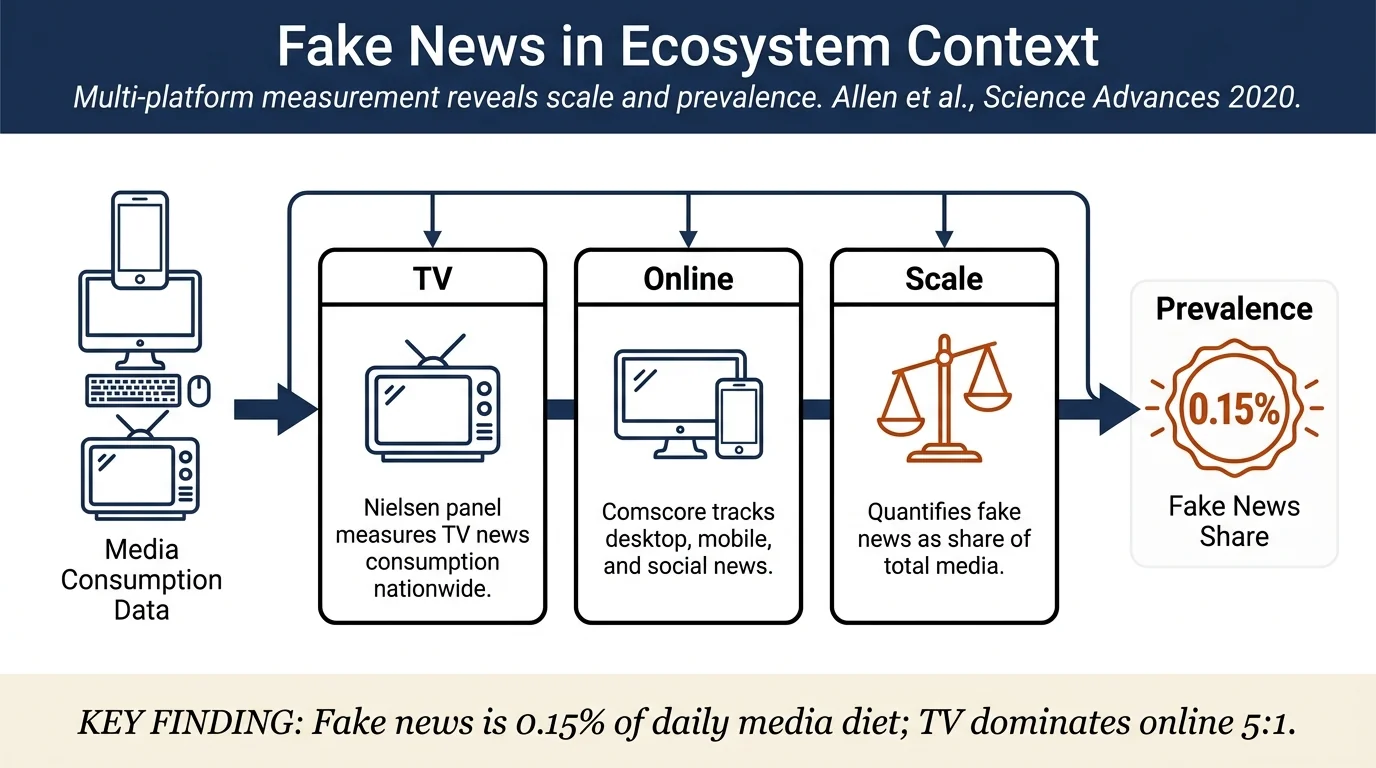
Evaluating the fake news problem at the scale of the information ecosystemUsing nationally representative data on mobile, desktop, and TV consumption spanning 2016–2018, the authors show that fake news comprises only 0.15% of Americans' daily media diet, while TV dominates news consumption by a 5:1 ratio over online. The paper challenges the widespread narrative of fake news as a pervasive crisis and suggests…
 Bots & coordinated campaignsPlatforms, policy & society
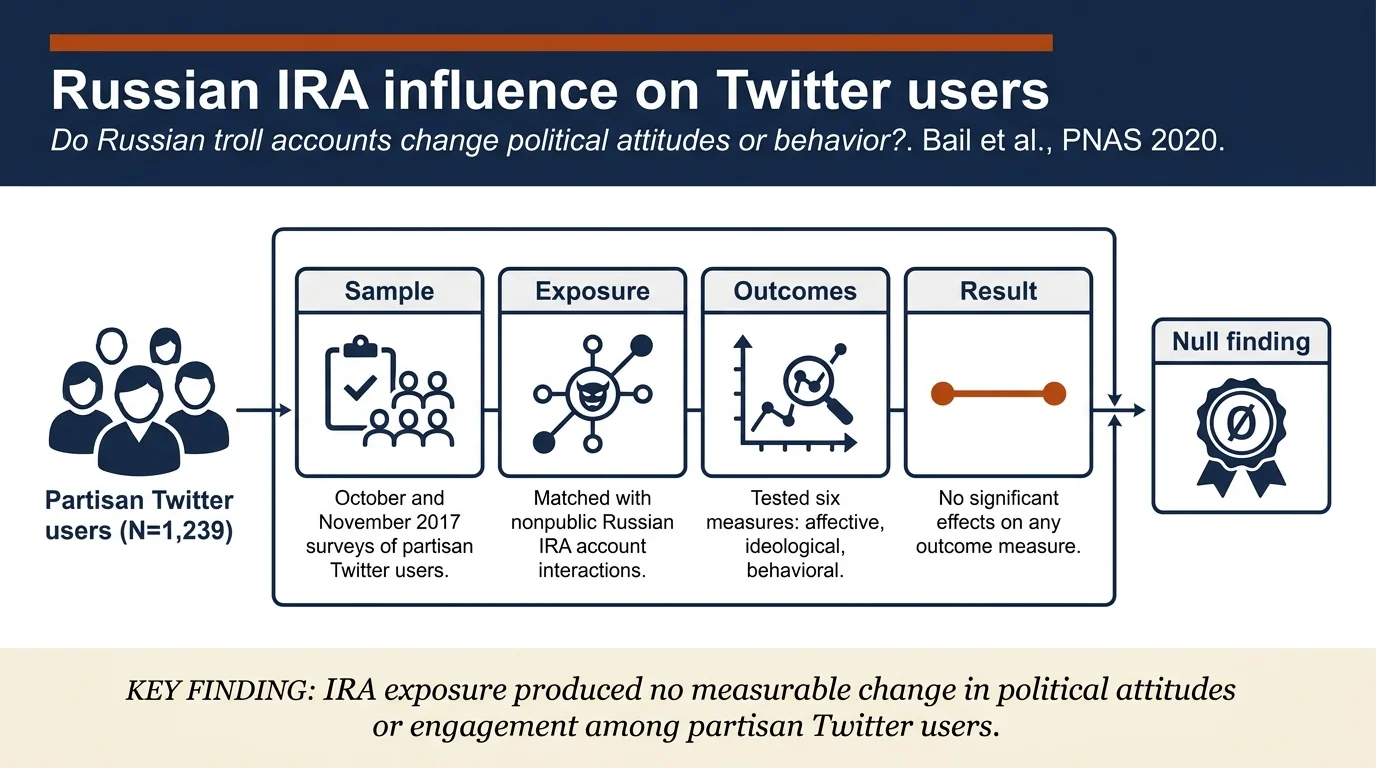
Assessing the Russian Internet Research Agency's impact on the political attitudes and behaviors of American Twitter users in late 2017Combining longitudinal survey data from 1,239 partisan Twitter users with nonpublic IRA account data, Bail et al. find no evidence that interaction with Russian Internet Research Agency accounts substantially impacted six measures of political attitudes (affective/ideological polarization) or behaviors (political engagement, network…
 Psychology & interventionsSpread & networks
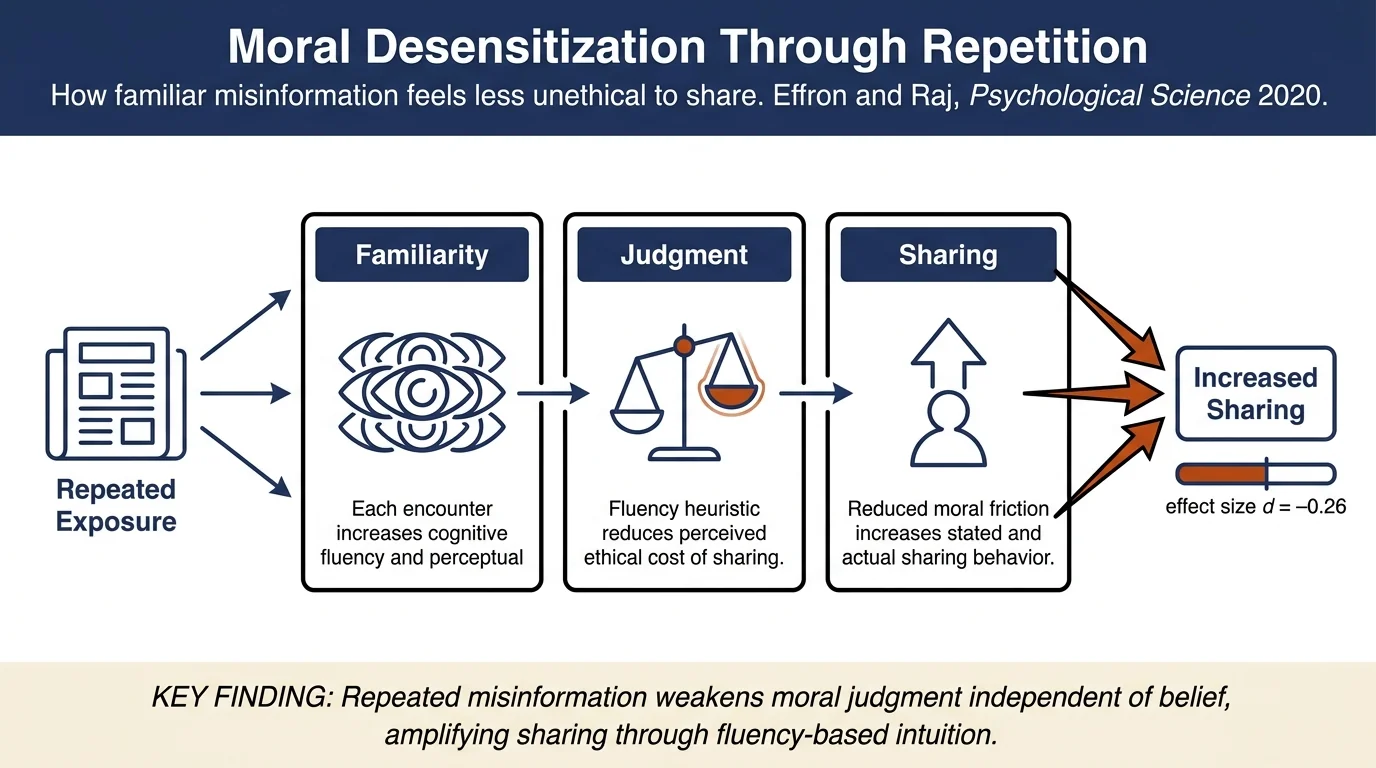
Misinformation and Morality: Encountering Fake-News Headlines Makes Them Seem Less Unethical to Publish and ShareFour preregistered experiments (N=2,587) show that repeatedly encountering fake-news headlines reduces moral condemnation of spreading them—regardless of whether people believe them. This "moral repetition effect" operates via fluency: familiar headlines feel less unethical to share, stronger inclinations to promote them online, and…
 Psychology & interventionsPlatforms, policy & society
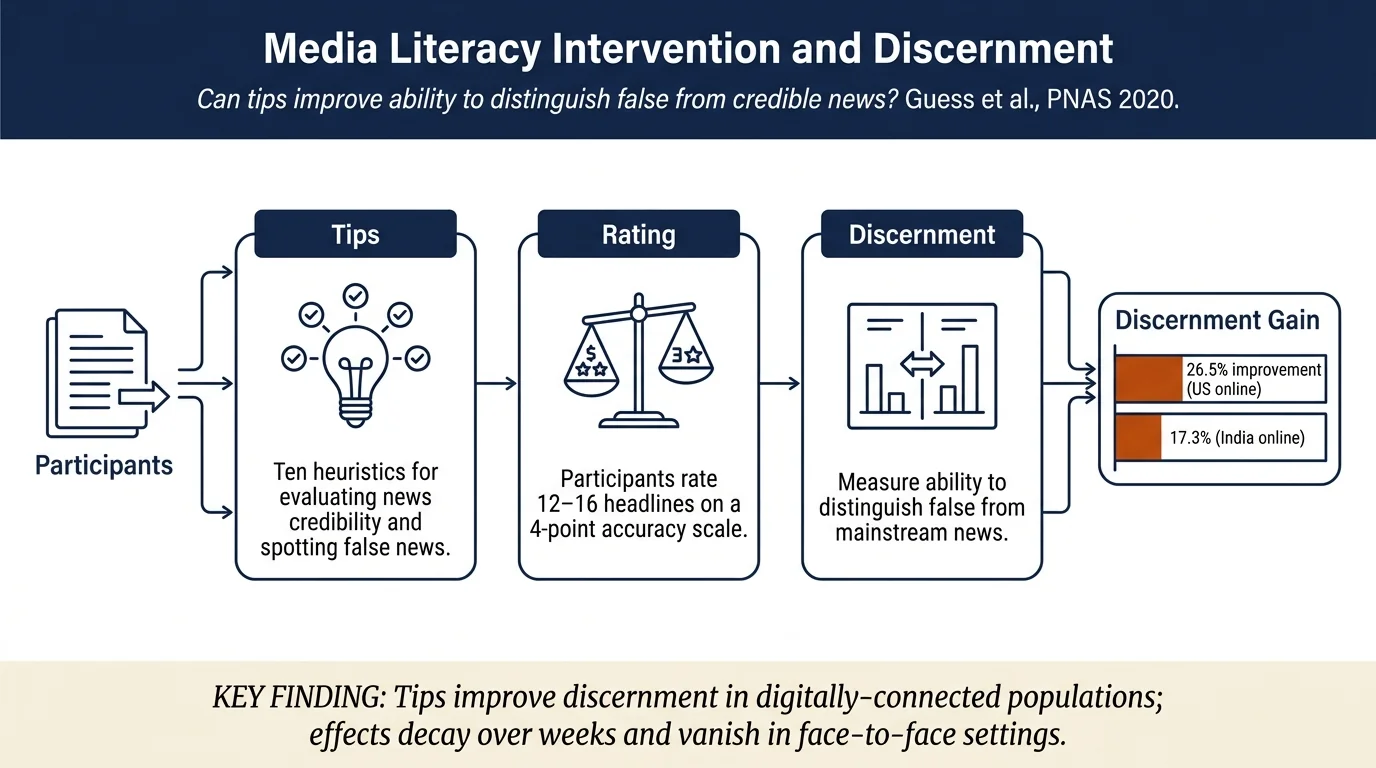
A digital media literacy intervention increases discernment between mainstream and false news in the United States and IndiaA randomized experiment tests Facebook's "Tips to Spot False News" intervention in the US and India, finding it increases discernment between mainstream and false news (26.5% in US, 17.3% in India online). The intervention reduces belief in false headlines more than it reduces belief in mainstream ones.
 Fact-checking & verificationPlatforms, policy & society
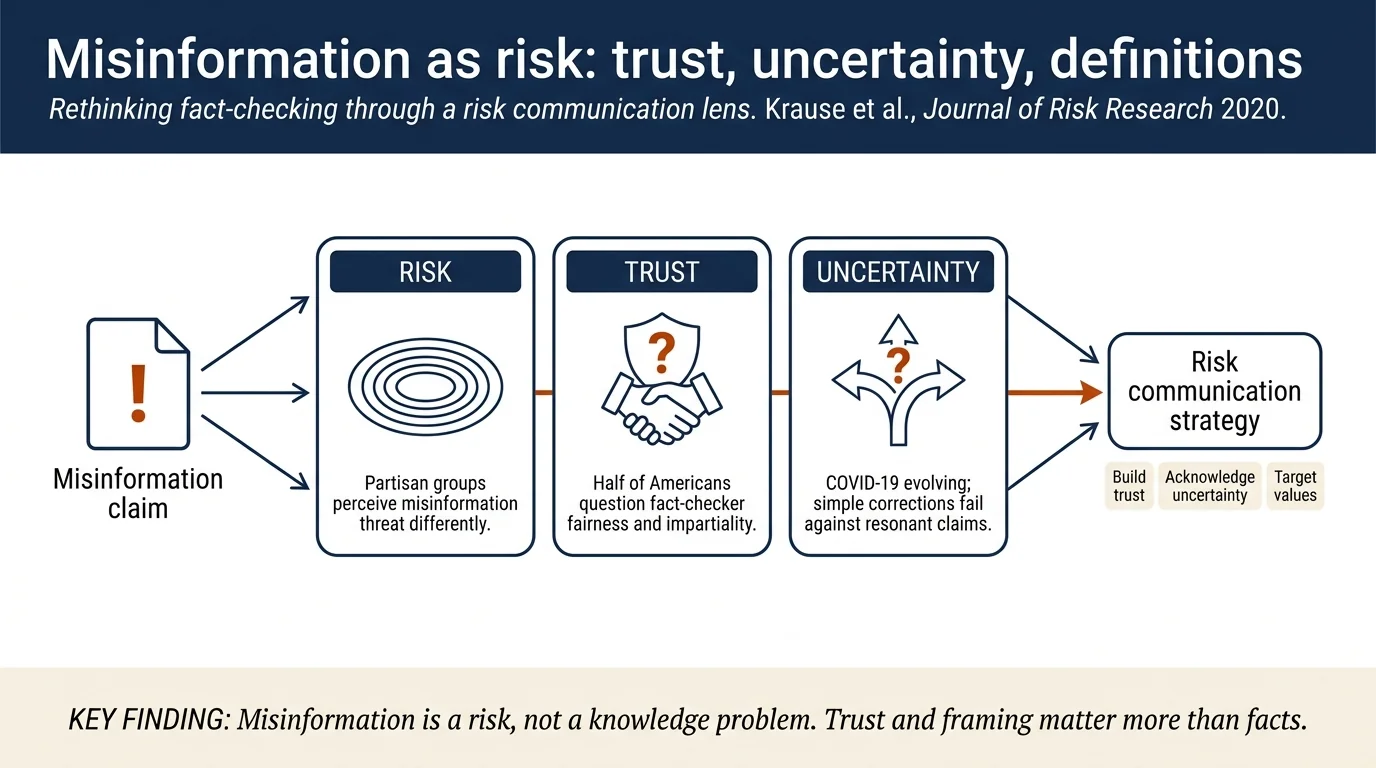
Fact-checking as risk communication: the multi-layered risk of misinformation in times of COVID-19COVID-19 misinformation should be viewed as a risk in its own right, not just a communication failure. Fact-checking efforts face three key challenges: defining misinformation differently across political subgroups, earning trust in an environment of low press credibility, and communicating amid genuine uncertainty.
 Psychology & interventionsPlatforms, policy & society
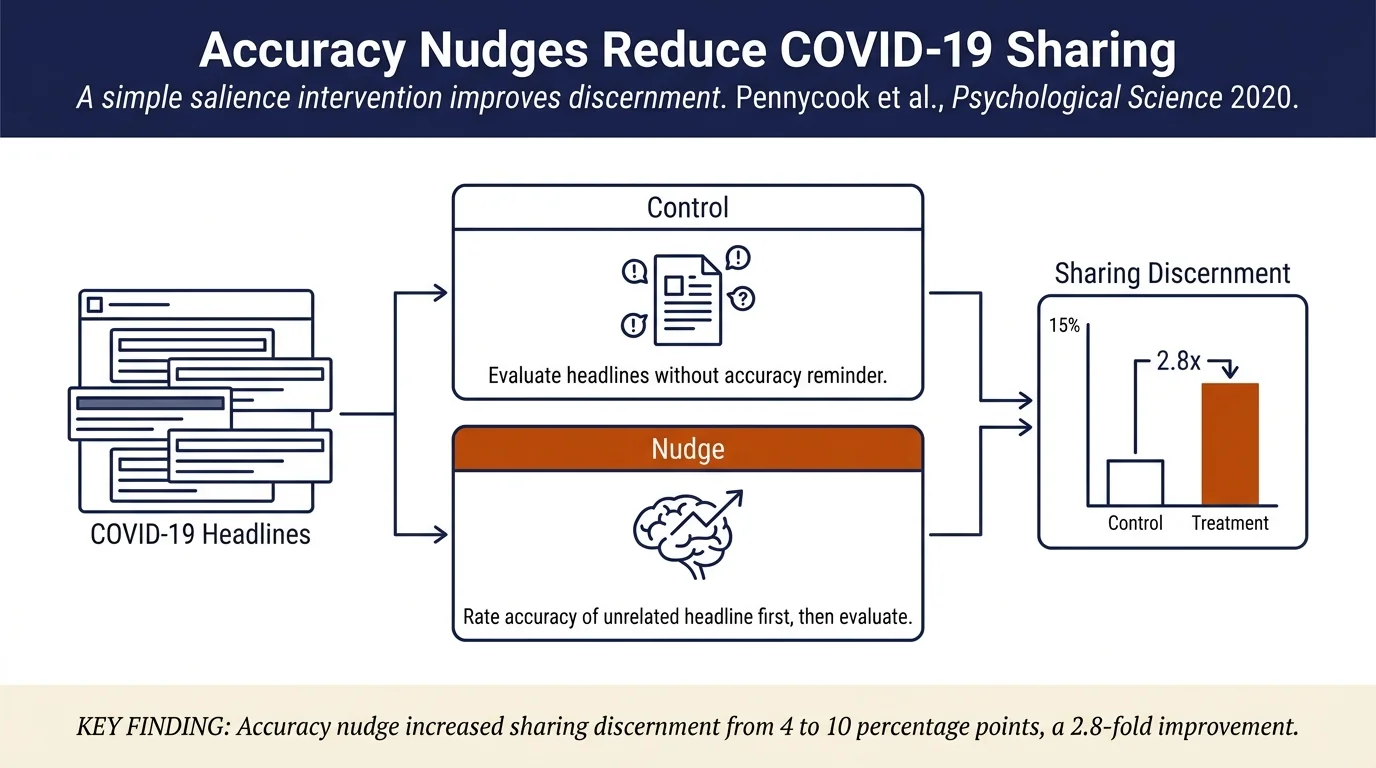
Fighting COVID-19 Misinformation on Social Media: Experimental Evidence for a Scalable Accuracy-Nudge InterventionTwo pre-registered experiments with 1,700+ U.S. adults show that a simple accuracy nudge — asking people to rate the accuracy of an unrelated headline before the main task — nearly tripled their ability to discriminate true from false COVID-19 headlines when deciding what to share on social media. The intervention is scalable, requires…
 Psychology & interventionsPlatforms, policy & society
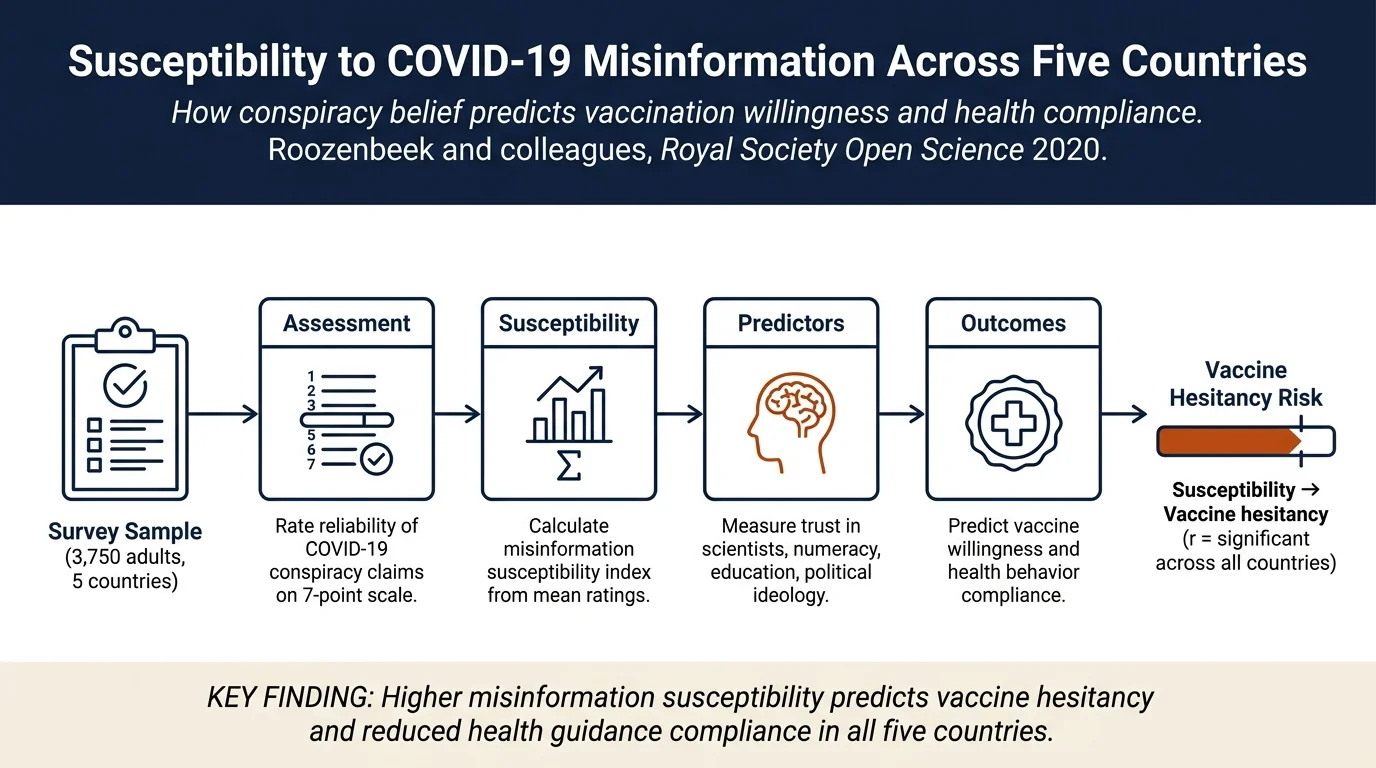
Susceptibility to misinformation about COVID-19 around the worldAn international survey of 3,750 adults across five countries (UK, Ireland, USA, Spain, Mexico) measured susceptibility to COVID-19 misinformation and examined how it predicts public health behaviors. While majorities in each country did not find COVID-19 misinformation credible, higher susceptibility to misinformation was strongly…
 Spread & networksPlatforms, policy & society
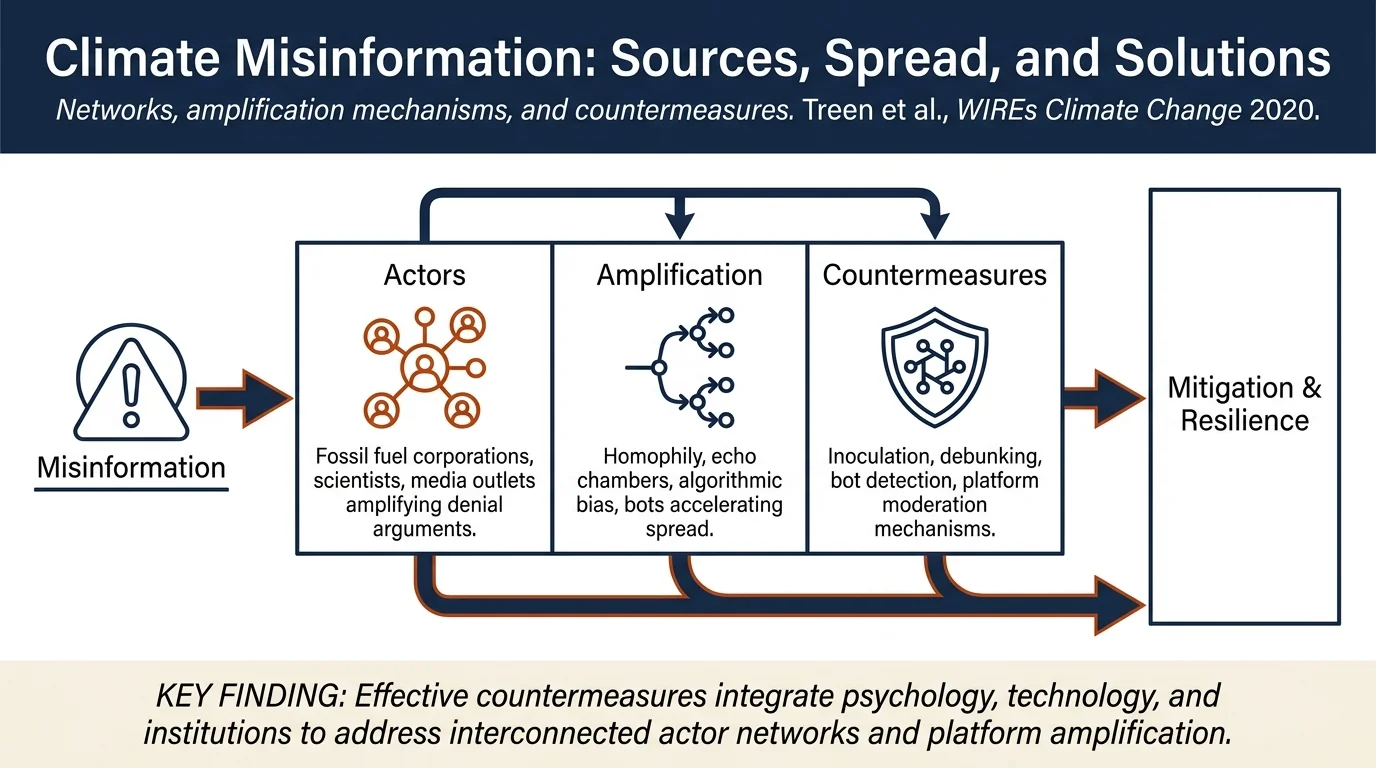
Online misinformation about climate changeComprehensive literature review examining climate change misinformation from multiple disciplinary angles. Defines misinformation vs. disinformation, identifies networks of actors (scientists, governments, industry, media) spreading false claims, examines how social media characteristics (homophily, echo chambers, algorithmic bias)…
 Deepfakes & multimodalPlatforms, policy & society
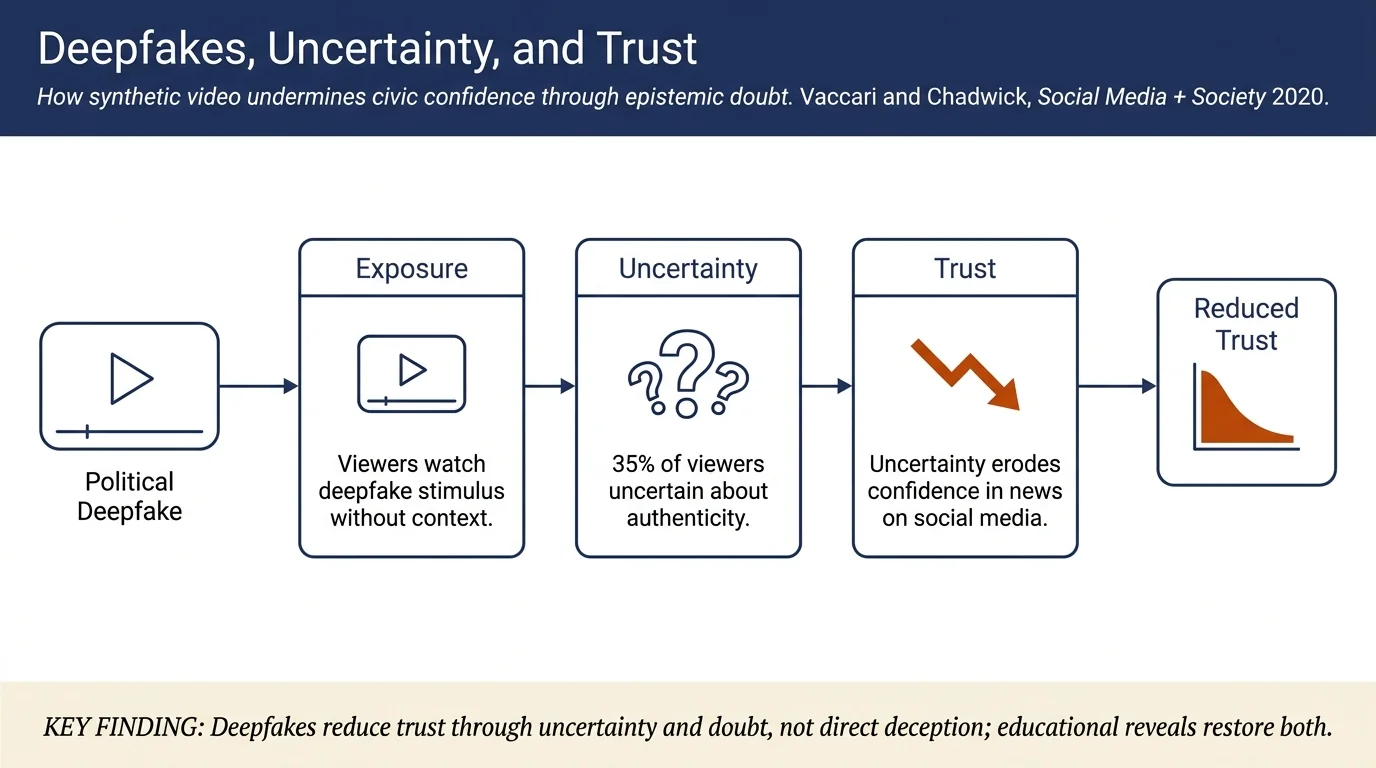
Deepfakes and Disinformation: Exploring the Impact of Synthetic Political Video on Deception, Uncertainty, and Trust in NewsExperimental study (N=2,005 UK respondents) testing how political deepfakes affect deception and trust in news. Deepfakes increased uncertainty about content, and that uncertainty mediated reduced trust in news on social media.