New Election, Same Old Story: How Tropes Form a Grammar of Election Rumors
Authors: Stephen Prochaska, Mert Can Bayar, Ashlyn B. Aske, Joseph Schafer, Kate Starbird
Venue: arXiv cs.SI, 2026 — arXiv:2610.37804
TL;DR
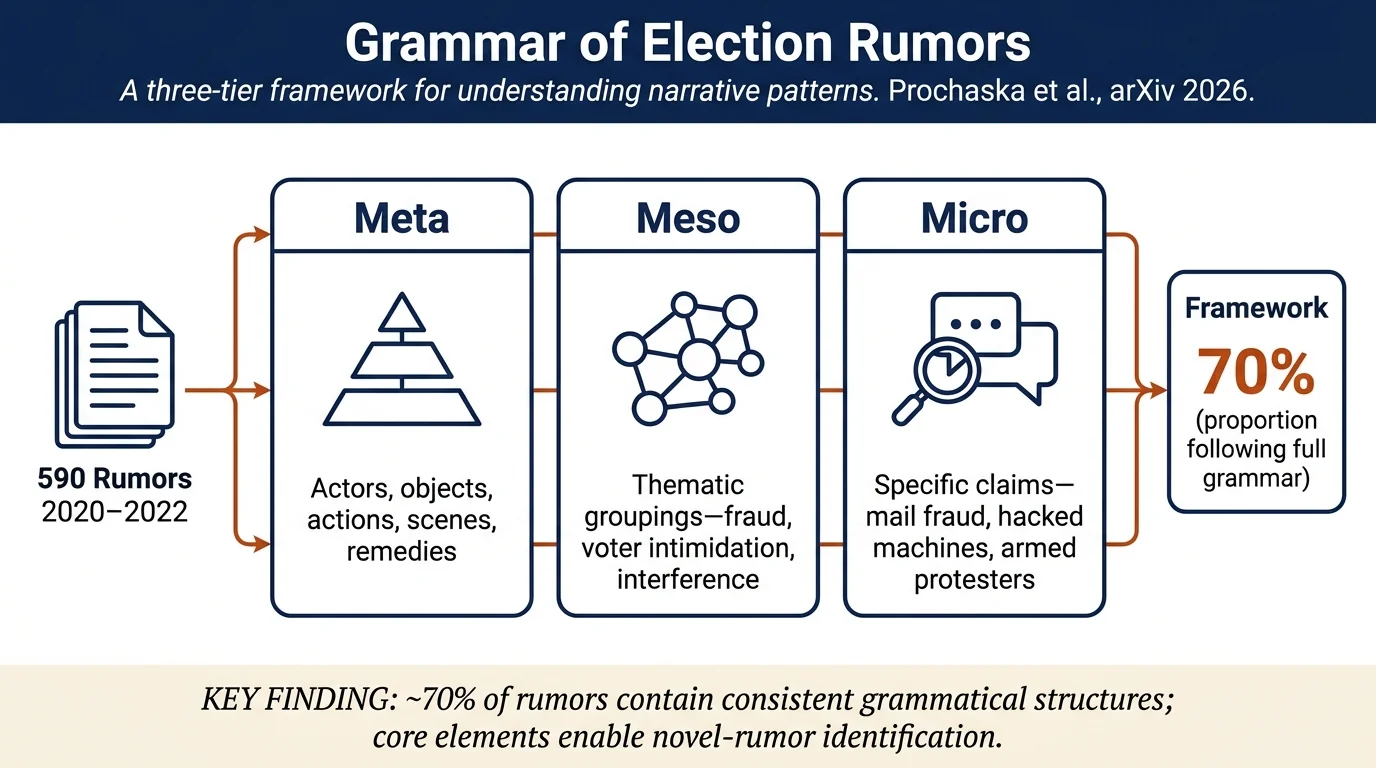
Election rumors follow recurring narrative patterns organized as a three-layer framework: meta-categories (actors, objects, actions, scenes, remedies) that combine into meso-tropes (villain, conspiracy, etc.), which manifest as micro-tropes (specific claims about mail voting, machines, etc.). Analysis of 590 rumors from 2020–2022 U.S. elections shows ~70% follow this grammar, enabling researchers to identify familiar narrative structures in novel rumors and anticipate how emerging claims will develop.
Contributions
- A three-tier narrative framework (meta, meso, micro tropes) for systematically analyzing election rumors
- Coded dataset of 590 election rumors from 2020 and 2022 presidential cycles with full trope annotations
- Empirical validation that election rumors follow consistent grammatical rules: 70% of rumors contain all core elements (actor, object, action, scene/setting) or a specific set of optional elements
- Network analysis showing how micro-tropes co-occur to form sub-narratives: a central cluster of actor/object/action tropes surrounds fraudulent-vote narratives; peripheral clusters address mail-voting, machine manipulation, and foreign interference
Method
The team used a mixed-methods approach combining qualitative analysis and computational tools. First, they extracted 590 election rumors from Twitter corpora covering the 2020 presidential election and 2022 midterms. An iterative, inductive coding process identified recurring patterns in actors, objects, and actions. ChatGPT 4.1 mini generated summaries of rumors (up to 1,000 tweets per rumor) to handle scale; researchers then coded each summary against the developed framework. Three coders met weekly to resolve disagreements, reaching consensus on ~92% of the dataset (568 final rumors after removing ambiguous cases). The resulting framework organizes tropes into:
- Meta-categories (highest level): Actors (e.g., villains, heroes, victims), Actor-Action (alleged acts), Objects (e.g., ballots, voting machines), Object-Action (e.g., hacked machines), Scene & Setting (timing and location), Suggested Remedies
- Meso-tropes (thematic grouping): e.g., "voter intimidation," "foreign interference," "poll worker negligence"
- Micro-tropes (granular instances): e.g., "armed protesters at polls," "Russians manipulating voting machines," "mail-in ballots dumped"
The team analyzed frequencies and co-occurrence patterns using Jaccard similarity and Louvain clustering to identify which tropes tend to appear together.
Results
Across 568 rumors, the actors meta-category appeared in 96.5% of rumors; object-action and actor-action each in ~63%. Most rumors (90%) contained "proper grammar"—at least actor, object, and action—while 30% included optional elements like scene/setting or remedies. Network analysis revealed distinct clusters: a central purple cluster organizing around fraud narratives (actors, objects, actions co-occurring), red clusters around media/tech villainy and ballot disputes, light-green clusters around voting machines and foreign interference, and orange clusters around voter intimidation. Micro-tropes co-occurred predictably: "hacked voting machines" and "corrupt machines" clustered together; "mail-in ballot fraud" and "ballot harvesting" appeared as sub-narratives. The grammar remained stable across 2020 and 2022, suggesting similar foundational narrative patterns structure election rumors across cycles.
Connections
- Related to Rumor detection on social media via shared focus on structure and patterns enabling identification of novel rumors
- Methodologically builds on Narrative Analysis and propaganda/computational propaganda frameworks
- Shares coding methodology with FakeNewsNet studies that annotated news properties at scale
- Informs Content moderation and threat assessment by characterizing recurring narrative templates
- Complements work on Election Integrity by documenting how rumors exploit administrative vulnerabilities
Notes
The paper's key strength is its systematic, replicable framework for understanding rumor grammar. Unlike prior work that treats rumors as isolated claims, this framework surfaces the underlying narrative vocabulary that recurs across cases. The three-layer hierarchy (meta → meso → micro) is conceptually clean and empirically validated, and the network visualization effectively shows how micro-tropes cluster into sub-narratives.
Limitations: (1) The framework is grounded in English-language Twitter data from U.S. elections, so transfer to other languages, platforms, or electoral contexts is unclear; (2) LLM-generated summaries introduced potential noise and bias—the authors acknowledge that visual information and sarcasm were often lost in text summaries, and coders occasionally over-emphasized elements the LLM flagged; (3) The two-cycle window (2020, 2022) is relatively short for identifying truly new tropes; broader longitudinal data would strengthen claims about stability. (4) The co-occurrence network visualization, while compelling, relies on Louvain clustering, which is sensitive to parameter choices and produces "fuzzy boundaries" between clusters.
The framework has immediate utility for election officials, communicators, and researchers: officials can use it to anticipate emerging narratives and tailor rebuttals; researchers can use it to structure rumor detection and classification; communicators can design counter-narratives that directly address the familiar building blocks rumors use. The paper also suggests promising directions: extending the framework to other rumors (COVID-19, climate, etc.), applying it to visual rumors (deepfakes), and using it to develop predictive models of rumor virality based on which tropes and combinations appear novel vs. familiar.