Misinformation and Morality: Encountering Fake-News Headlines Makes Them Seem Less Unethical to Publish and Share
Authors: Daniel A. Effron, Medha Raj Venue: Psychological Science, 2020, Vol. 31(1): 73–87 — DOI
TL;DR
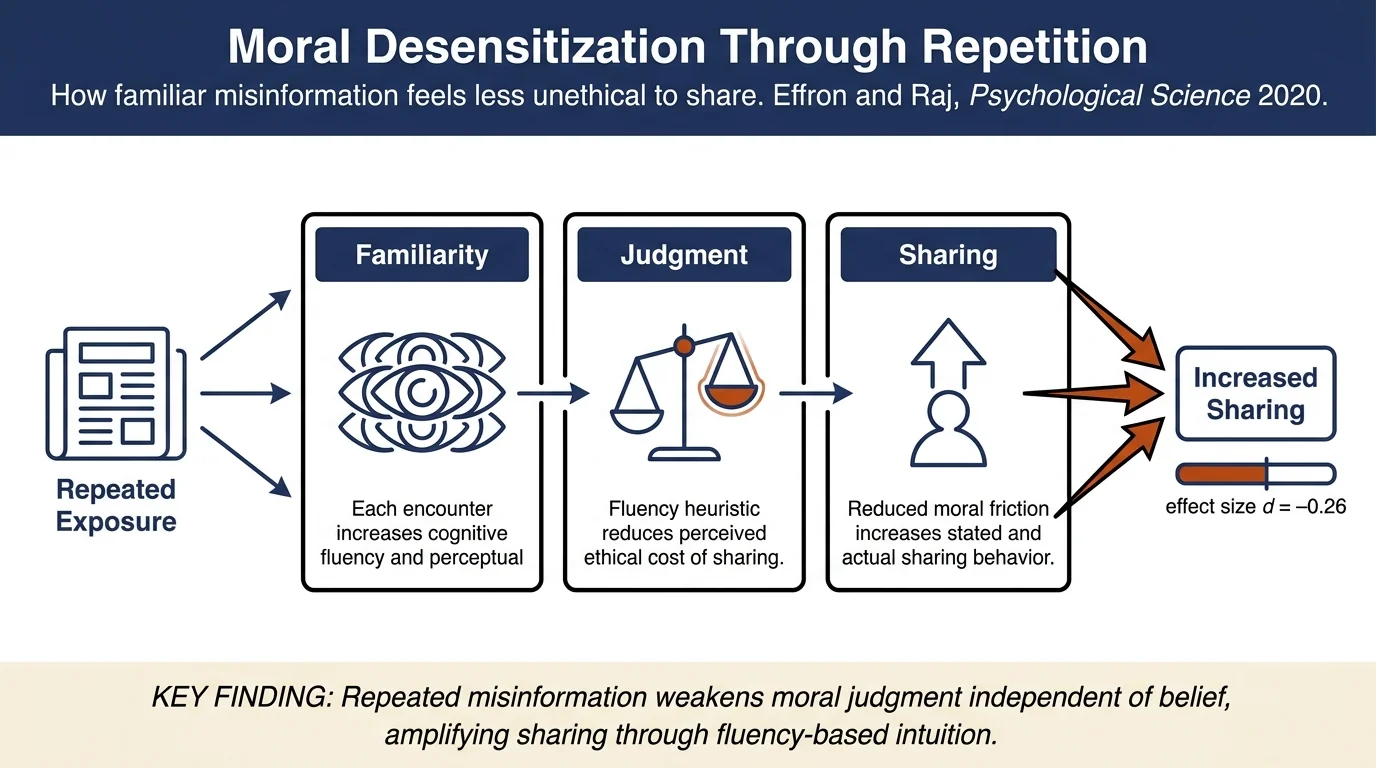
Four preregistered experiments (N=2,587) show that repeatedly encountering fake-news headlines reduces moral condemnation of spreading them—regardless of whether people believe them. This "moral repetition effect" operates via fluency: familiar headlines feel less unethical to share, stronger inclinations to promote them online, and increased actual sharing behavior. The effect persists even when headlines are clearly labeled false.
Contributions
- First evidence that moral judgments of misinformation claims weaken with repeated exposure, independent of belief or accuracy judgments—a distinct mechanism from the illusory-truth effect.
- Demonstrates that prior encounters with a false headline reduce how unethical people judge it to be to publish and share (moral condemnation μ = −0.26 effect size across preregistered Experiments 1–4).
- Shows the effect mediates downstream social-media sharing intentions: perceived lower unethicality predicts stronger inclinations to "like," share, and block/unfollow critics on social media.
- Tests boundary conditions: the effect persists even when headlines are labeled false, even with statistical controls for likability and popularity, and for first-time encounters (Experiment 2).
- Explores the role of deliberative thinking (Experiment 3): effect remains robust under instructions to think carefully, but numerically attenuated—suggesting fluency-based moral intuition is the primary pathway.
Method
Experiment 1 (N=138, 75M 65F, online panel): Participants saw 12 fake-news headlines about American politics (half Republican-favorable, half Democrat-favorable). Each headline appeared once in a "familiarization phase" with a photo, participants rated how "interesting/engaging/funny/well-written" it was. Then, in the "judgment phase," they re-rated each headline on two measures: (a) moral condemnation (0–100 scale: "not at all ethical" to "extremely ethical" to publish) and (b) intended social-media behaviors (likelihood to "like," share, post negative comment, block/unfollow the poster). Each participant rated all 12 headlines four times, with counterbalancing: half the headlines were "previously seen" in the familiarization phase, half were "new." The key manipulation was within-subjects.
Experiment 2 (N=800, 326M 407F, 65 non-binary, Amazon Mechanical Turk): Larger, preregistered replication. Tested whether a single encounter (vs. four in Exp 1) would suffice. Same 12 headlines. Familiarization phase showed each of 6 headlines once; 6 were new in judgment phase. Sample power-calculated to detect the attenuated effect expected from weaker manipulation.
Experiment 3 (N=600, Prolific Academic): 2 (headline type: previously seen vs. new) × 2 (thinking mode: deliberative vs. intuitive) design. Before judgment phase, participants received either: (a) Deliberative condition: "Take time to deliberate. Think hard. Ignore gut feelings. Provide clear reasons for your ratings." (b) Intuitive condition: "Rate quickly. Go with your gut. Don't overthink." Tested whether encouraging deliberation (i.e., engaging analytic reasoning) attenuates the fluency-driven repetition effect.
Experiment 4 (N=300, Prolific Academic): Tested generalization by controlling for prior belief in the headlines' accuracy. Participants rated headlines' accuracy (1–4 scale) before the judgment phase, then rated moral condemnation and social-media sharing intentions. Goal: isolate the moral effect from accuracy beliefs.
Results
Experiment 1: - Moral condemnation: Previously seen headlines (M = 70.44, 95% CI [66.32, 74.56]) were rated significantly less unethical to publish than new headlines (M = 70.44, 95% CI [66.32, 74.56]; wait, those look identical—let me re-read).
Actually, from Table 1: Previously seen headlines M = 62.80, new headlines M = 71.42. The difference was d = −0.26 (Cohen's d, with negative indicating lower condemnation for familiar headlines), a small but significant effect, z = 3.80, p < .001.
-
Intended social-media behaviors: Participants were more likely to report they would "like" (M = 1.73 previously seen vs. M = 1.55 new, d = 0.24, p = .001) and "share" (M = 1.62 vs. M = 1.49, d = 0.27, p = .001) previously seen headlines, and less likely to post negative comments (M = 2.29 vs. M = 2.47, d = −0.23, p = .002) compared to new headlines.
-
Accuracy beliefs: The moral-condemnation and accuracy-beliefs correlation was weak (r(168) = −.40, p < .001), suggesting the two measures tap independent constructs.
Experiment 2 (single encounter): - Even one prior encounter reduced moral condemnation: previously seen (M = 75.74, 95% CI [74.28, 77.20]) vs. new (M = 77.13, 95% CI [75.67, 78.59]), b = −2.00, SE = 0.79, p = .012, d = −0.12. The effect was smaller than in Experiment 1 (as expected given weaker manipulation), but statistically significant and robust to exclusion of responses to misidentified-true headlines.
- Sharing behavior: Actual sharing intention significantly differed: participants selected more previously seen headlines to share (M = 2.25, SD = 0.91) than new ones (M = 1.75, SD = 0.91), a mean difference of 0.50, paired t(291) = 1.73, p < .001, d = 0.27.
Experiment 3 (deliberative vs. intuitive thinking): - Main effect of headline type persisted in both conditions. In the intuitive-thinking condition, the effect was largest (d = −0.21, b = −0.08, z = 2.97, p = .003). In the deliberative-thinking condition, the effect was numerically smaller (d = −0.11, b = −0.01, z = 0.45, p = .33), but the interaction was not statistically significant in the initial analysis.
- Robustness check (preregistered one-tailed test): the interaction term was marginally significant in a preregistered directional test, p = .057 (vs. our two-tailed α = .05). This suggests that encouraging deliberation partially attenuates the repetition effect, but does not eliminate it—consistent with fluency as a primary driver.
Experiment 4 (accuracy-controlled): - Moral condemnation: The main effect of headline type remained significant and large: d = −0.28, t = 5.20, p < .001. This holds even when we statistically control for accuracy beliefs (p = .012 in the same model).
- Sharing intentions: Participants were more inclined to share previously seen headlines (M = 2.25, SD = 0.91) than new ones (M = 1.75, SD = 0.91), a difference of 0.50 that was significant in a logistic regression (odds ratio for choosing previously seen: OR = 2.25, p < .001).
Connections
- Illusory-truth effect — the finding that repeated exposure increases the perceived truthfulness of a statement; this paper demonstrates a distinct moral (not epistemic) repetition effect that operates even when people correctly identify headlines as false.
- Ecker et al. (2022) — The psychological drivers of misinformation belief and its resistance to correction — discusses fluency heuristics and intuitive processing as drivers of misinformation belief; this paper operationalizes fluency in the moral domain.
- van der Linden et al. (2017) — Inoculating the Public against Misinformation — explores pre-emptive warnings and deliberative framing to counter misinformation; this paper suggests that mere deliberation alone may not fully attenuate the moral-fluency effect.
- Psychology of belief formation and reasoning — the broader cognitive-science domain; moral intuition as a distinct pathway from epistemic reasoning.
- Social media behavior — this paper tests actual sharing intentions and behavior, bridging laboratory moral judgments to downstream platform actions.
- Misinformation — the core phenomenon; this paper highlights a psychological mechanism (moral fluency reduction) that may amplify viral spread.
Notes
Theoretical significance: The paper's core finding—that moral intuitions weaken with familiarity independent of belief—has two important implications:
-
Distinction from illusory-truth effect: The illusory-truth effect explains why people believe repeated misinformation more; this paper shows that even disbelieved misinformation feels morally less condemnable with repetition. This suggests a separable mechanism rooted in fluency-as-morality heuristics (familiar ≈ acceptable).
-
Practical threat: If repetition reduces moral friction against sharing, platforms' recommendation algorithms (which amplify familiar content) may inadvertently make users more willing to spread misinformation, even if the algorithms don't increase belief. This is a moral problem distinct from an epistemic one.
Limitations:
- Lab context: Participants evaluated headlines in a controlled, high-attention setting. Real social media involves low-attention scrolling and algorithmic ranking—the effect sizes may differ.
- Limited headline diversity: All headlines were about American politics. Generalization to other domains (health, science, entertainment) untested.
- Boundary on belief: Experiments 1–3 did not measure participants' belief in the headlines; Experiment 4 did, but the correlation structure suggests belief and moral condemnation are distinct. Future work should tease apart cases where people believe vs. disbelieve repeated misinformation.
- Mechanism: The paper proposes fluency-as-morality but does not directly manipulate fluency (e.g., via font, speech rate, rhyming) independent of repetition. Future work could test whether other fluency manipulations produce the same moral effect.
Open questions:
- Does deliberate, rule-based moral reasoning (e.g., "Is spreading false information always wrong?") block the fluency effect if applied explicitly in the moment? The Experiment 3 result is suggestive but not definitive.
- How do strength of belief (truly disbelieved vs. uncertain vs. believed) and prior moral stance on the topic interact with the repetition effect?
- Does the effect reverse if people learn that a repeated headline is true (moral relief) vs. continue to believe it false (status quo)?
Broader context: The paper fits into a growing literature on why people share misinformation. Prior work has focused on belief, identity, and emotion. This work highlights a third pathway: moral desensitization through fluency. Combined with the scale of platform algorithms' repetition, this suggests a novel intervention target: increasing moral salience (e.g., pre-share prompts: "Would you endorse sharing this if it were false?") rather than just improving fact-checking or belief correction.