How neighbourhood ideology shapes misinformation belief in densely tied social networks
Authors: Soroush Karimi, Marcos Oliveira, Diogo Pacheco Venue: arXiv cs.SI, 2026 — arXiv:2609.10277
TL;DR
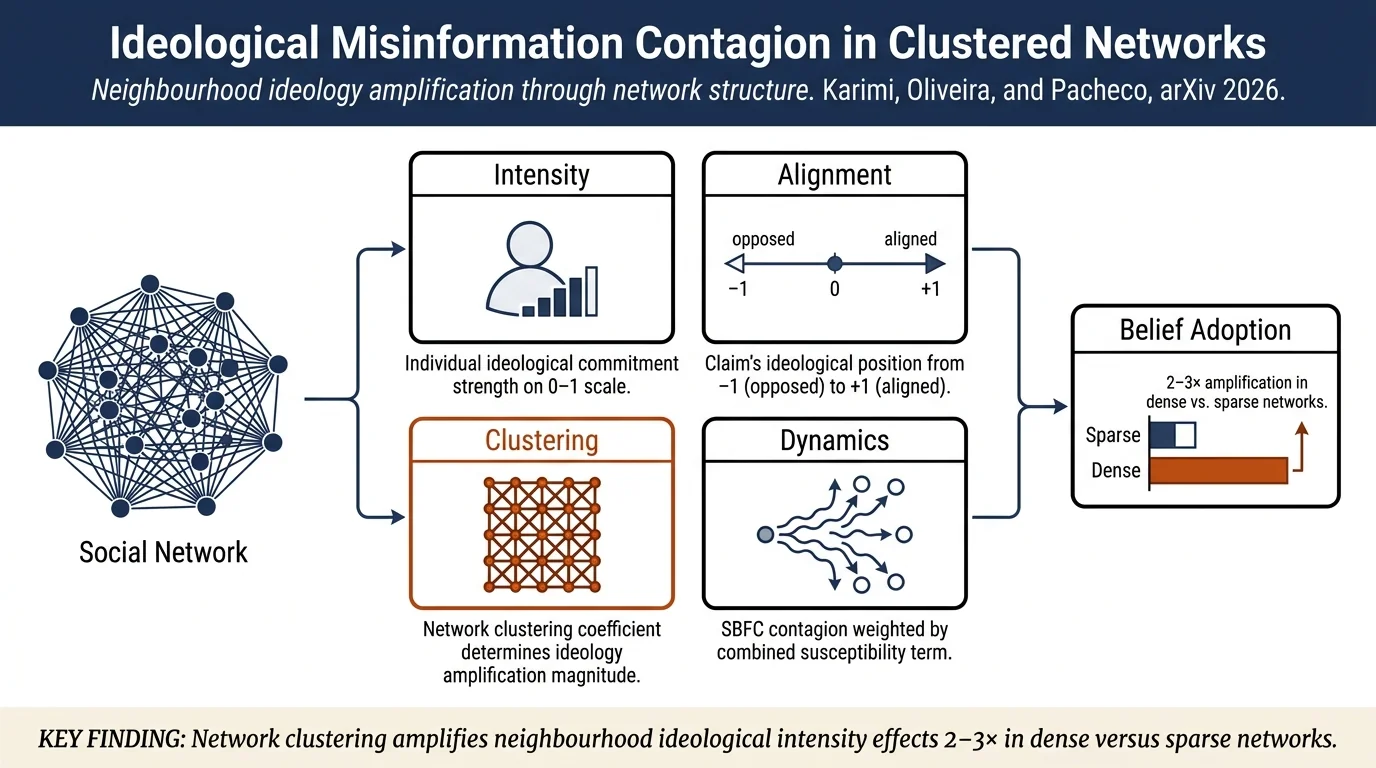
Prior work decouples ideological bias and social influence when modeling misinformation propagation; this paper integrates them through an agent-based contagion model that distinguishes an individual's ideological intensity from a claim's ideological alignment. Simulation and analytical results show that in densely clustered networks—like Facebook—neighbourhood ideology can amplify belief adoption beyond individual predisposition alone, and that small populations of extremists can significantly increase misinformation adoption among moderates in such networks.
Contributions
- Ideological Misinformation Contagion Model: Extends susceptible-believer-fact-checker (SBFC) dynamics with two parameters: ideological intensity \(I_i \in [0,1]\) for each agent and ideological alignment factor \(A_{\text{factor}} \in [-1, 1]\) for the claim, capturing how individuals respond differently to the same claim based on ideological alignment.
- Network structure effects: Demonstrates that social influence from neighbours' ideological intensity is most pronounced in highly clustered networks (e.g., Facebook clustering coefficient 0.606) compared to sparse networks (e.g., Erdős-Rényi 0.011).
- Dual-mechanism belief formation: Shows that network clustering endogenously amplifies the influence of neighbourhood ideology without explicit encoding in transition probabilities—amplification emerges from network topology alone.
- Placement strategies: Evaluates three topological strategies for distributing extremists (random, degree-based, localized clustering), showing localized clustering in dense networks achieves highest propagation.
Method
The model uses a static, undirected network \(G = (V, E)\) where each agent occupies one of three states: susceptible (S), believer (B), or fact-checker (F). For each agent \(i\):
- Ideological intensity \(I_i \in [0,1]\) quantifies commitment strength (baseline vulnerability parameter).
- Claim alignment \(A_{\text{factor}} \in [-1,1]\) indicates ideological position: \(-1\) = opposed, \(0\) = neutral, \(+1\) = aligned.
- Combined susceptibility \(L_i = \frac{\alpha + A_{\text{factor}} \cdot I_i}{2}\) blends baseline vulnerability \(\alpha\) with alignment-intensity interaction.
Transition probabilities: $\(f_i(t) = \beta \frac{n_i^B(t)(1 + L_i)}{n_i^B(t)(1 + L_i) + n_i^F(t)(1 - L_i)}\)$
where \(n_i^B, n_i^F\) count believer and fact-checker neighbours. Agents initialize as 98% susceptible, 1% believer, 1% fact-checker; simulation runs 500 time steps with spreading rate \(\beta = 0.5\), verification probability \(p_{\text{verify}} = 0.01\), and forget probability \(p_{\text{forget}} = 0.1\).
Network topologies tested: Erdős-Rényi (sparse), Watts-Strogatz (moderate clustering), Barabási-Albert (power-law degree), and real Facebook sample (\(N=4039\), clustering 0.606). Extremist placement: random (uniform), degree-based (hubs first), and breadth-first search (local clusters).
Results
-
Ideological alignment drives belief: When \(A_{\text{factor}} = 0\) (neutral claim), ideological intensity has no effect; when \(A_{\text{factor}} > 0\) (aligned), belief increases with intensity; when \(A_{\text{factor}} < 0\) (opposed), belief decreases with intensity.
-
Network clustering amplifies neighbourhood effect: In Facebook-like networks (high clustering), standardized regression coefficients for neighbours' ideological intensity are 2–3× larger than in sparse networks, despite neighbours' intensity not being explicitly encoded in transition rules.
-
Moderate gullibility sensitivity: At low gullibility (\(\alpha = 0.05\)), few moderate agents become believers without high ideological intensity; at higher gullibility, many become believers at low intensity, reflecting baseline vulnerability.
-
Extremist placement matters: Localized clustering (BFS placement) concentrates extremists, amplifying their influence on neighbours most dramatically in dense networks; random or degree-based placement has weaker effect.
-
Analytical steady-state solution: Markov-chain treatment yields closed-form steady-state fraction of believers: $\(P(B) = \begin{cases} \frac{\beta [2Lp_{\text{forget}} - (1-L)p_{\text{verify}}]}{2L(\beta + p_{\text{forget}})(p_{\text{forget}} + p_{\text{verify}})} & \text{if } \beta[2Lp_{\text{forget}} - (1-L)p_{\text{verify}}] > 0 \\ 0 & \text{otherwise} \end{cases}\)$ Numerical and analytical solutions align closely.
Connections
- Stein, Keuschnigg & van de Rijt (2023, Scientific Reports) — earlier work showing ideological segregation increases misinformation in both experiments and simulation; this paper extends the mechanism to capture claim-level alignment.
- Sikder et al. (2020, Scientific Reports) — foundational agent-based model of bias and polarization in networks; this work adds explicit ideological intensity as an individual parameter.
- Brooks & Porter (2020, Physical Review Research) — models how media accounts with fixed ideologies shape spread of online content; here we generalize to individual agents and claims with varying alignment.
- Rodriguez, Bollen & Ahn (2016, PLoS ONE) — examines multi-topic belief dynamics with cognitive coherence and social conformity; this paper specializes to single-topic misinformation with two-dimensional ideological structure.
- Motivated reasoning — psychological foundation for why ideological alignment increases belief; this paper operationalizes it in a contagion model.
- Homophily — structural principle underlying network clustering; the paper's key finding is that clustering amplifies ideological homophily effects on belief.
Notes
Strengths: - Clean analytical parameterization: separating individual ideological intensity from claim alignment is conceptually sound and allows the same individual to respond differently to different claims. - Rare formal analytical solution (Markov steady-state) alongside simulation, enabling validation and generalisation. - Systematic comparison across four network topologies and three extremist placement strategies, grounding results in structural variation. - Empirical Facebook network validation alongside synthetic models.
Limitations and open questions: - Single-dimensional ideology: the model treats ideology as a scalar \(I \in [0,1]\) and alignment as \(A_{\text{factor}} \in [-1,1]\). Realistic ideology is multi-dimensional (left-right, authoritarian-libertarian, etc.); extension to vector ideologies and dot-product alignment is mentioned but not explored. - No temporal network change: network structure is static; dynamic friendship formation and ideological drift are not modeled. - Fixed claim and parameter values: simulations use fixed \(\beta, p_{\text{verify}}, p_{\text{forget}}, \alpha\) across runs; sensitivity analysis across parameter space would strengthen robustness claims. - No empirical claim-level data: conclusions rest on synthetic claims with assigned \(A_{\text{factor}}\) values; validation on real claims with measured ideological position and adoption data would strengthen claims. - Coarse state space: S, B, F are discrete; soft beliefs (partial acceptance, skepticism) are not captured.
Significance: The paper makes a clear methodological point—that network structure alone can amplify the influence of neighbours' ideological intensity without explicit encoding—which is relevant to understanding why social media platforms with high clustering may be uniquely vulnerable to ideologically driven misinformation. The steady-state analytical treatment is technically sound and generalizable.