Two Fault Lines: Latent Polarity Geometry in X Community Notes
Authors: Andreas Andreou, Michael Sirivianos
Affiliation: Cyprus University of Technology, Limassol, Cyprus
Venue: arXiv cs.SI, 2026 — arXiv:2609.21496
TL;DR
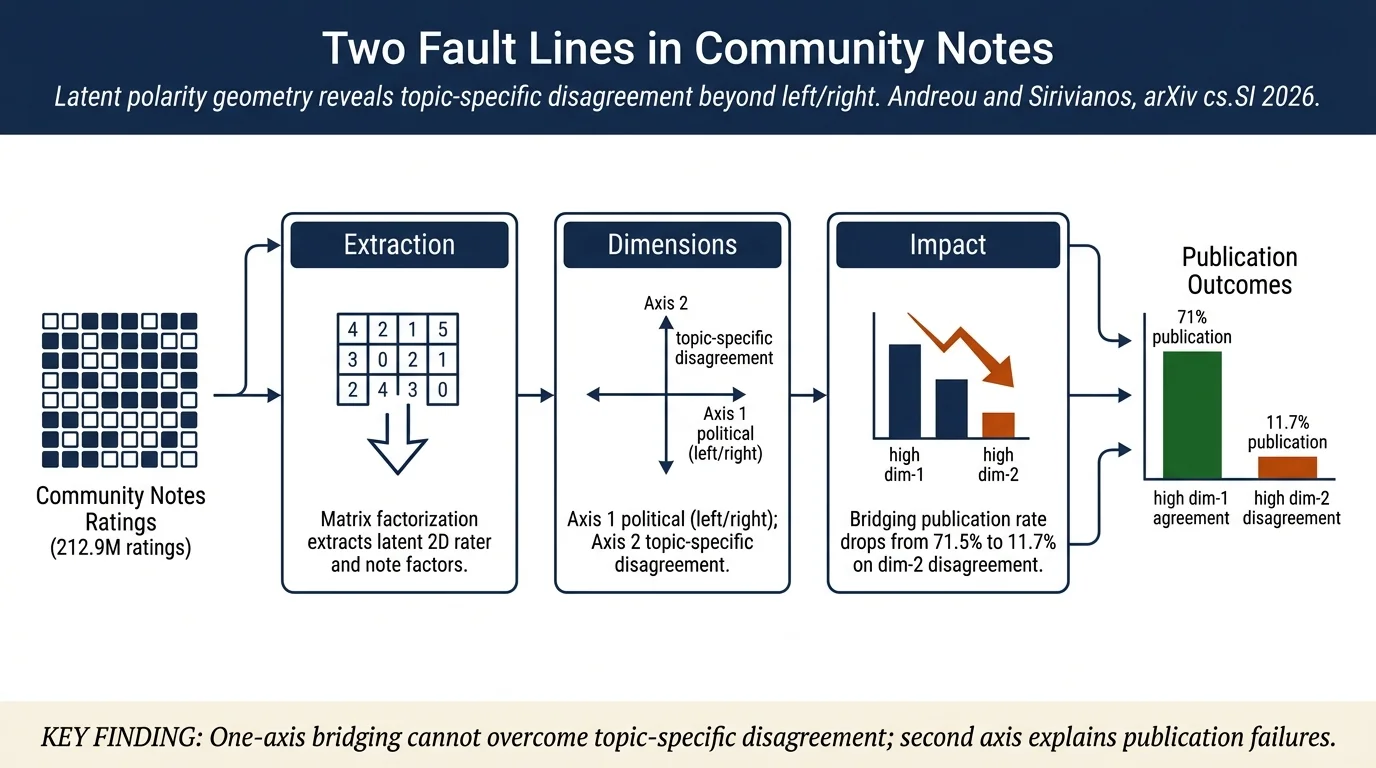
X's Community Notes system assumes disagreement is one-dimensional (left/right politics) to decide when notes should be published via a "bridging" mechanism. This paper shows the space is actually two-dimensional: the first axis captures political polarization, while a second axis independently captures disagreement on topics like COVID/vaccines, Ukraine/Russia, and institutional trust. This hidden second dimension explains publication failures that the one-axis model cannot account for.
Contributions
- First full-scale reconstruction of the Community Notes polarity geometry. Analysis of 212.9M ratings and 2.33M notes from X's public data release (June 2026), extending the prior one-dimensional latent-factor model to two dimensions via matrix factorization.
- Empirical evidence that disagreement is multidimensional. A second latent axis improves held-out prediction (RMSE gain ≈0.05 relative), and both axes are interpretable: dim 1 is left/right politics, dim 2 is a topic-specific disagreement axis independent of partisan position.
- Concrete measurement of mechanism failures. The paper shows that the platform's bridging rule (which assumes agreement-across-one-axis) cannot overcome disagreement on dim 2, leading to publication failures: notes with high second-axis disagreement fall from 71.5% to 11.7% publication rate.
- Full-data measurement of author bias, rater concentration, and language-equity gaps. Authors write notes aligned with their own position on both axes; heavily polarized raters dominate dim 1; Greek-script notes accumulate fewer ratings and have lower publication rates than global averages, indicating language-based inequity.
Method
The authors extend X's official bridging-based matrix factorization model (Wojcik et al. 2022) from one to two dimensions:
where \(\mathbf{f}_u, \mathbf{f}_n \in \mathbb{R}^2\) are 2D factor matrices for raters and notes. The model is fit via L2-regularized SGD on 212.9M ratings (held-out 982 train/validation split). Identifiability is ensured by SVD rotation of the factors to align with the principal-variance direction (the dim-1 political axis, recovered via external measures like ideology transfer across topics and cross-reference against Left/Right political scales from prior work).
Key methodological choices: - Held-out validation on 300 epochs with early stopping; regularization matched X's open-source hyperparameters. - Bimodality test: Sarlé's bimodality coefficient on dim-1 and dim-2 samples separately. A high BC (>0.555) indicates two-sample peakiness; dim 1 is bimodal (BC=0.597 among 50+ raters), dim 2 less so. - Topic assignment: Keyword matching on note summaries against 10 predefined topic categories (Elections, COVID/vaccines, Ukraine/Russia, etc.). Unmatched notes labeled "Other." - Author-note correlation: Pearson's r between rater's dim-1 position and note's dim-1 position (r=0.355 on dim 1, r=0.358 on dim 2), showing authors write aligned with their own positions on both axes. - Language detection: Unicode membership and script-based heuristics (Greek, Chinese/CJK, Latin, etc.). Greek-script detection covers Greek and Cypriot content.
Results
RQ1: Is disagreement multidimensional?
Yes. A second latent axis improves held-out RMSE from 0.2899 (rank-1 model) to 0.2892 (rank-2), a gain of 0.0185 (0.05 relative improvement). The gain is statistically significant but modest—the second axis explains only a quarter of dim-1's variance. This is evidence of a weak second dimension rather than an artifact; the dim-2 null model (random shuffling) yields no improvement.
RQ2: What does dim 2 represent?
Topic-specific disagreement independent of politics. Dim 2 separates notes and raters by topic rather than ideology: COVID/vaccines occupy one extreme (mean f₂ = 0.438), Ukraine/Russia another (f₂ = 0.307 but shifted diagonally at 43°), while Elections, Guns, and Climate sit near the origin (f₂ ≈ 0.08–0.13). Cross-topic transfer learning shows that rater factors learned on one topic predict poorly on another, confirming that dim 2 is topic-bound rather than a second ideological axis.
RQ3: How does dim 2 affect publication outcomes?
Heavily. Publication rate falls monotonically as second-axis disagreement increases: notes with |f₂| ≤ 0.1 publish at 71.5%, those with |f₂| > 0.4 publish at 11.7%. The official bridging mechanism (which expects agreement along one axis) cannot suppress dim-2 disagreement; a note published by bridging has no more protection on dim 2 than an unpublished note.
RQ4: How do authors and raters distribute?
Concentrated and aligned. The Gini coefficient for rater participation is 0.718 (top 1% contribute 23.1% of ratings). Authors write notes aligned with their own position on both axes (author-note correlation r=0.355 on dim 1, r=0.358 on dim 2). Roughly 9.4% of heavily polarized raters (|f₁| > 0.3 in the extreme quintile) drive much of the dim-1 signal, while lighter-participation raters contribute more evenly to dim 2.
RQ5: Language equity and bridgeability.
Greek-script notes (n=1,921) accumulate fewer ratings (median 19 vs 37 globally) and have lower raw publication rate (7.76% vs 10.85% global). When standardized to the same per-note rating distribution, Greek publication rate improves to 11.68%, still 2–3 points below the global rate—a language-based equity gap. Small-language communities (Portuguese, Turkish, Hindi) show similar patterns. Bridgeability varies sharply by topic: fraud-related notes (Scams/crypto) bridge easily (bridgeability ≈0.98) because both left and right agree fraud is wrong; COVID/vaccines and Immigration bridge poorly (≈0.20–0.40) due to true dim-2 disagreement, not bridging-mechanism failure.
Connections
- Related to Wojcik et al. 2022 (Birdwatch/Community Notes bridging model) via direct extension of the one-dimensional bridging model.
- Cited earlier work on Political polarization and ideological echo chambers and Social media polarization and echo chambers showing that political polarization is multidimensional.
- Complements prior work on participation inequality and platform moderating capacity in crowdsourced fact-checking.
- Methodologically aligned with multidimensional latent-factor estimation in political science.
Notes
Strengths: - Full-data empirical study on X's largest public release (212.9M ratings) — unprecedented scale. - Clear interpretation: dim 2 is not noise but real, topic-specific disagreement; the gap between one-axis predictions and two-axis improves held-out error robustly. - Concrete design implications: a one-axis bridging rule cannot succeed on topics where dim-2 disagreement is genuine. Proposed solutions include recruiting raters across dim 2, or relaxing the rule to allow cross-dim-2 disagreement.
Limitations: - Dimensionality is still speculative for dim 3+; the paper tests rank-3 and finds minimal gain. - Topic assignment relies on keyword matching (English-centric); "Other" category absorbs ~10.3% of notes, which may hide real topic signal. - The dim-2 interpretation (topic-specific vs. a second ideological axis) is inferred from topic structure and transfer learning, not from direct rater ideology measures outside Community Notes. External validation against Left/Right scales from prior work supports the inference, but direct measurement would be stronger. - Language coverage is limited by X's data release (most content is English); the Greek-script finding suggests bias is real but may not generalize to all underrepresented languages. - Temporal coverage is a single snapshot (June 2026); the evolution of dim 2 over time is not studied.
Open questions: - Can the system be redesigned to bridge across dim 2 without collapsing into consensus filtering? Recent proposals (Coval et al. 2026, Ovadya & Thorburn 2023) suggest alternative mechanisms. - What drives topic-specific disagreement (e.g., do COVID notes have dim-2 disagreement because they attract more activist raters, or is the topic itself divisive)? Causal analysis would help.