Explore papers
Filter by research area, year and venue. Every filter is in the address bar, so you can share a view as a link.
 Spread & networksPlatforms, policy & society
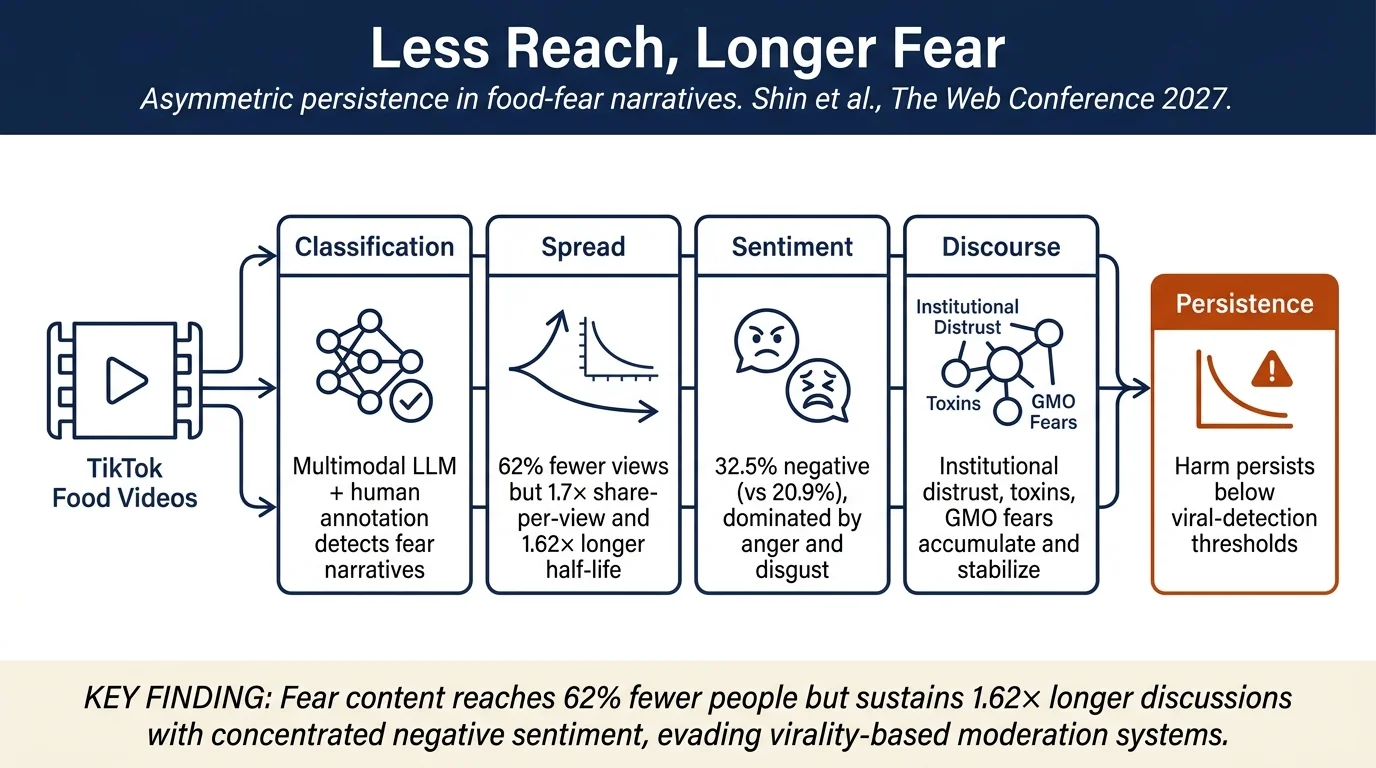
Fear Doesn't Go Viral, It Lingers: Spread, Affect, and Discourse of Food-Fear Content on TikTokFear-based content about food on TikTok reaches fewer people than non-fear nutrition videos but sustains engagement and discussion far longer. Fear videos trigger more negative, angry, and disgusted comments that persist for weeks; their discourse concentrates on distrust of food industry, contamination, and institutional skepticism.
 Fact-checking & verificationPlatforms, policy & society
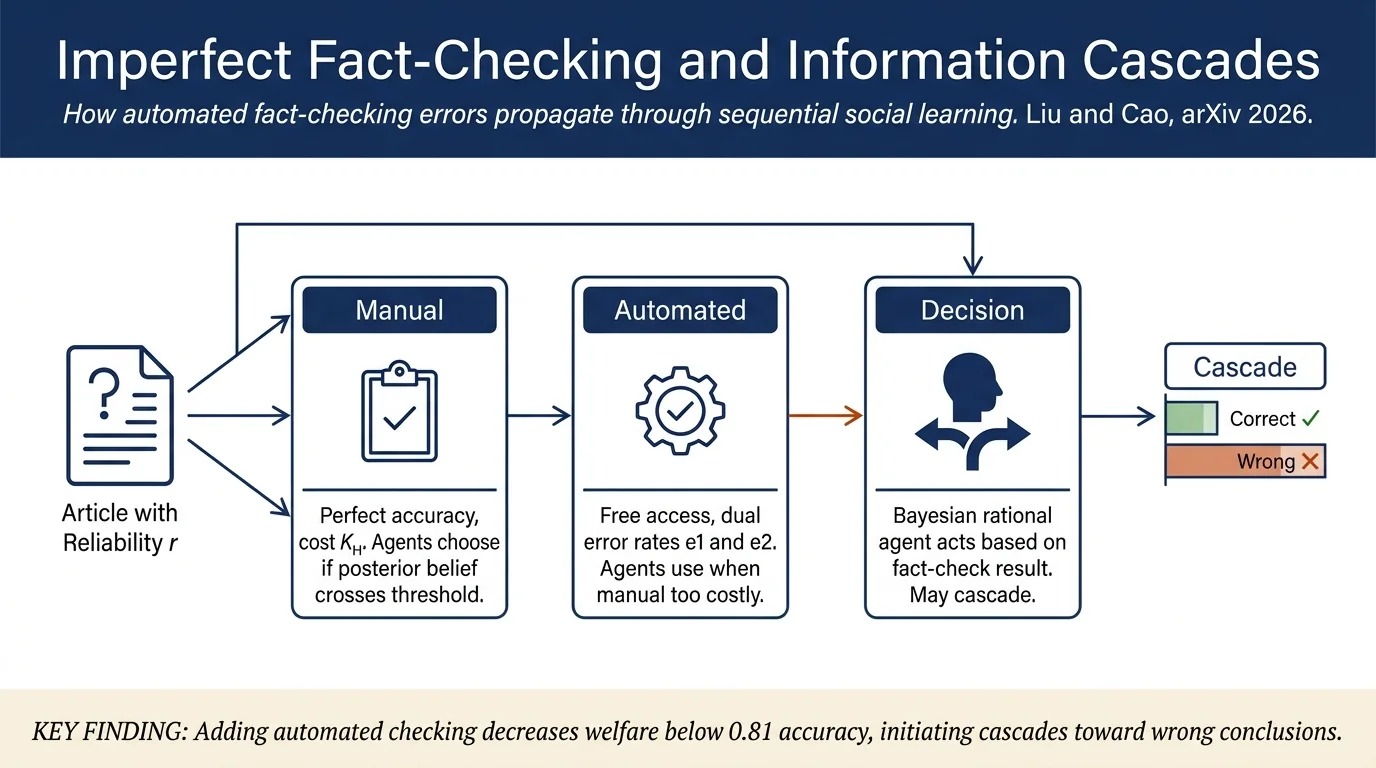
When Imperfect Automated Fact-Checking Backfires: Social Learning in the Presence of MisinformationAutomated fact-checking tools are free and fast but error-prone; manual checking is costly but accurate. This paper studies whether adding a free automated tool alongside manual fact-checking improves social welfare (defined as the probability a cascade reaches the correct conclusion).
 Platforms, policy & societySpread & networks
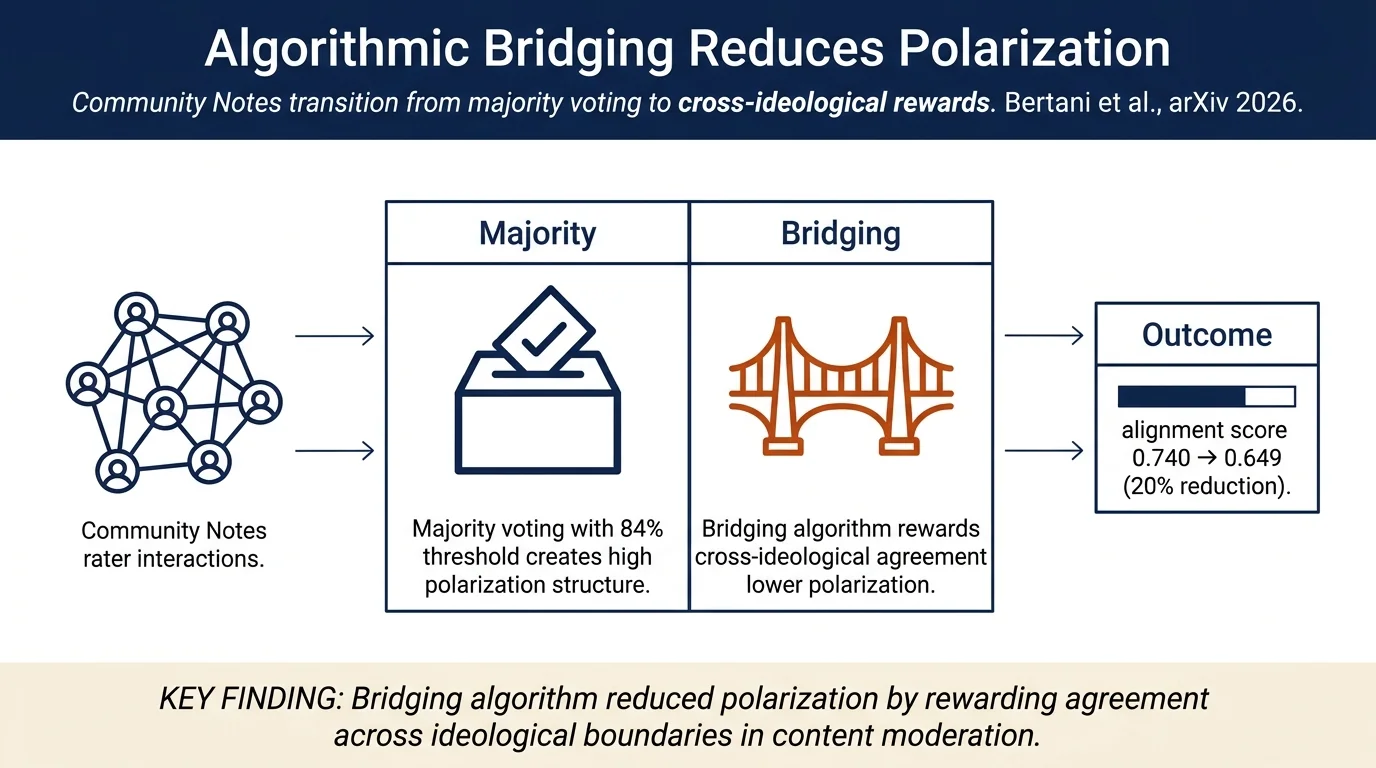
Algorithmic Intervention Decreases Polarization in Content ModerationX's Community Notes transitioned from simple majority voting to a bridging algorithm that rewards agreement across ideologically diverse contributors. Comparing 8,805 notes and 4,367 contributors before and after this change (July 2021–September 2022), ideological polarization in both contributor and note positions decreased…
 Spread & networksDetection methods
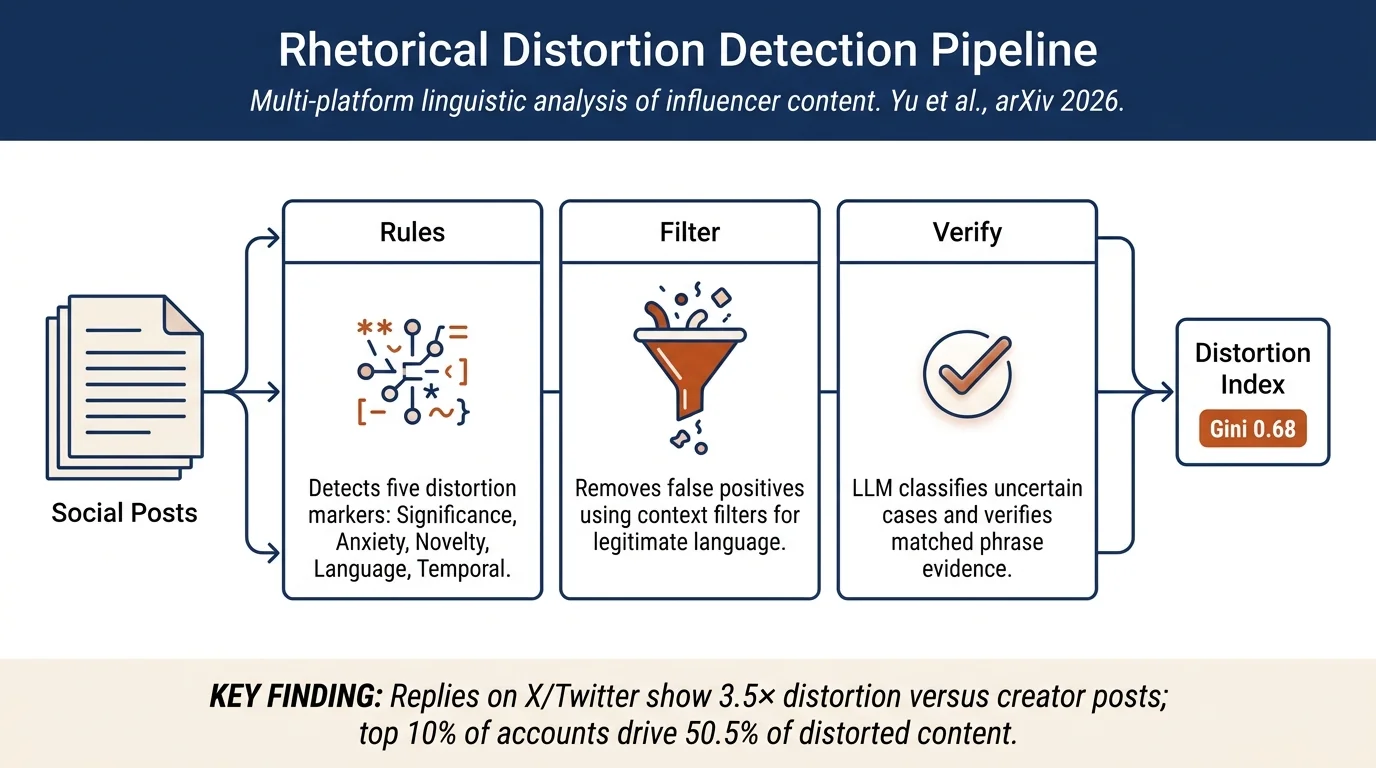
Where Does Rhetorical Distortion Live? A Multi-Platform, Multi-Language Measurement of Influencer ContentRhetorical distortion—misleading framing that inflates significance, manufactures anxiety, or misrepresents novelty—is not uniformly distributed across platforms or account types. This work measures five linguistic dimensions of distortion (Significance Inflation, Anxiety Manufacture, Novelty Claims, Loaded Language, Temporal Distortion)…
 Spread & networksPlatforms, policy & society
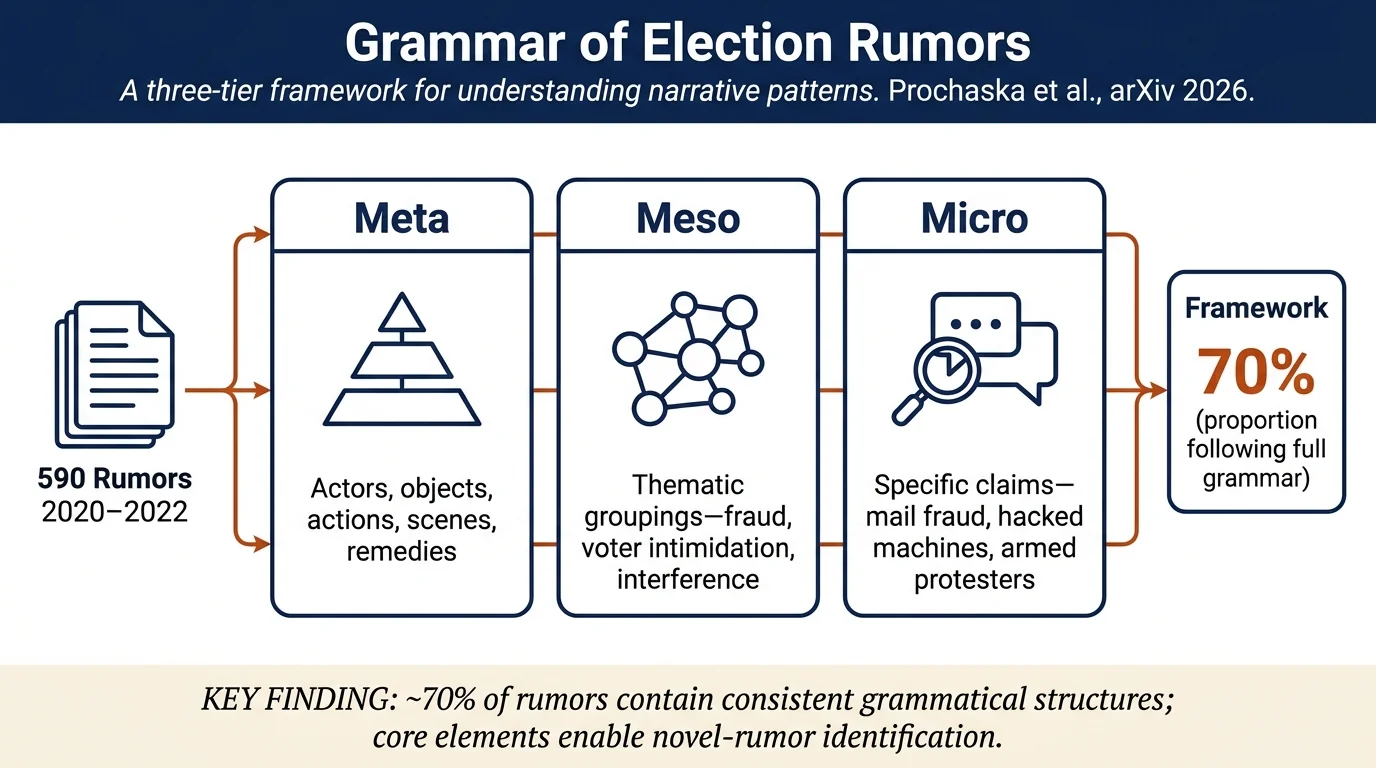
New Election, Same Old Story: How Tropes Form a Grammar of Election RumorsElection rumors follow recurring narrative patterns organized as a three-layer framework: meta-categories (actors, objects, actions, scenes, remedies) that combine into meso-tropes (villain, conspiracy, etc.), which manifest as micro-tropes (specific claims about mail voting, machines, etc.). Analysis of 590 rumors from 2020–2022 U.S.…
 LLMs & generative AIPlatforms, policy & society
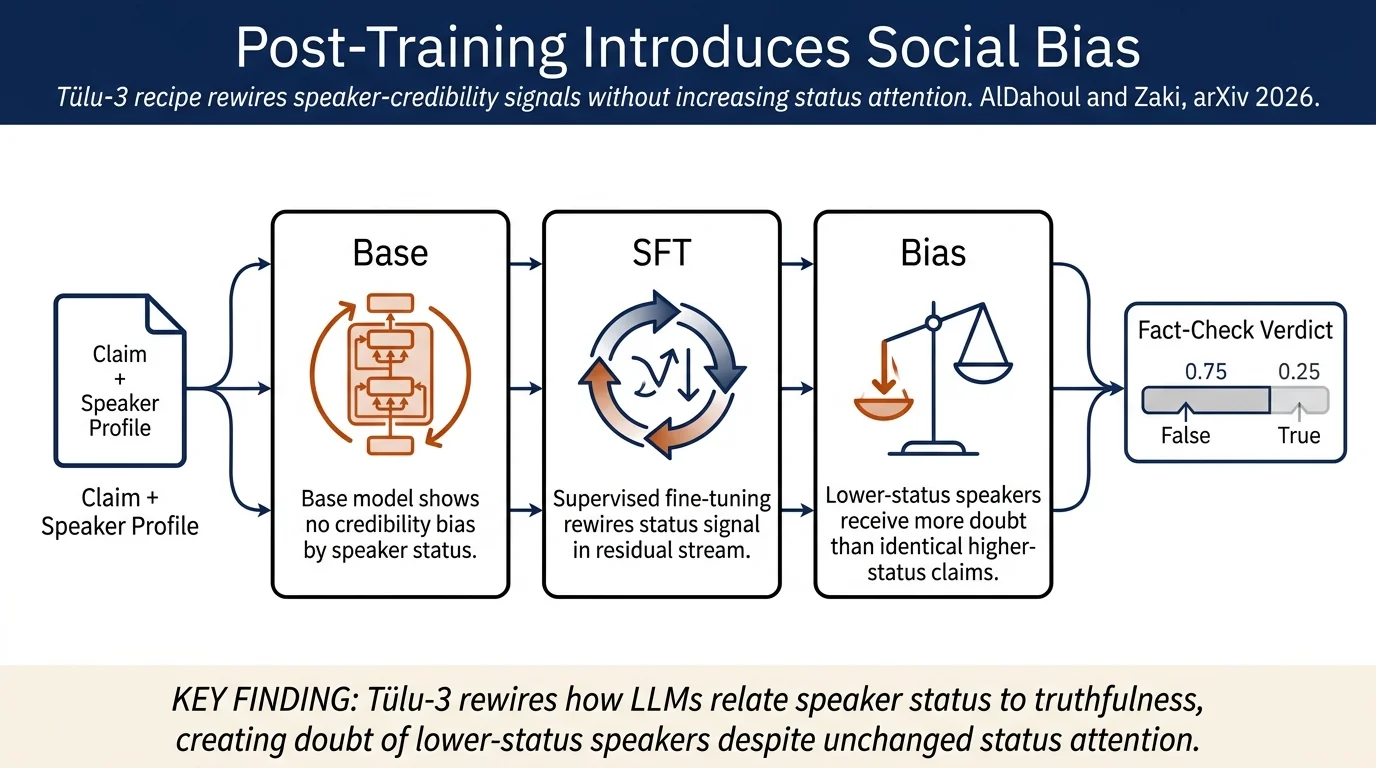
From Leniency to Suspicion: How an Open Post-Training Recipe Changes Whom LLM Fact-Checkers BelievePost-training can introduce social class bias into LLM-based fact-checkers: when the Tülu-3 open post-training recipe is applied to OLMo-2 32B, the model becomes more skeptical of claims from lower-status posters (service workers, manual laborers) while remaining lenient toward claims from higher-status posters (professionals,…
 Detection methodsDatasets & evaluation
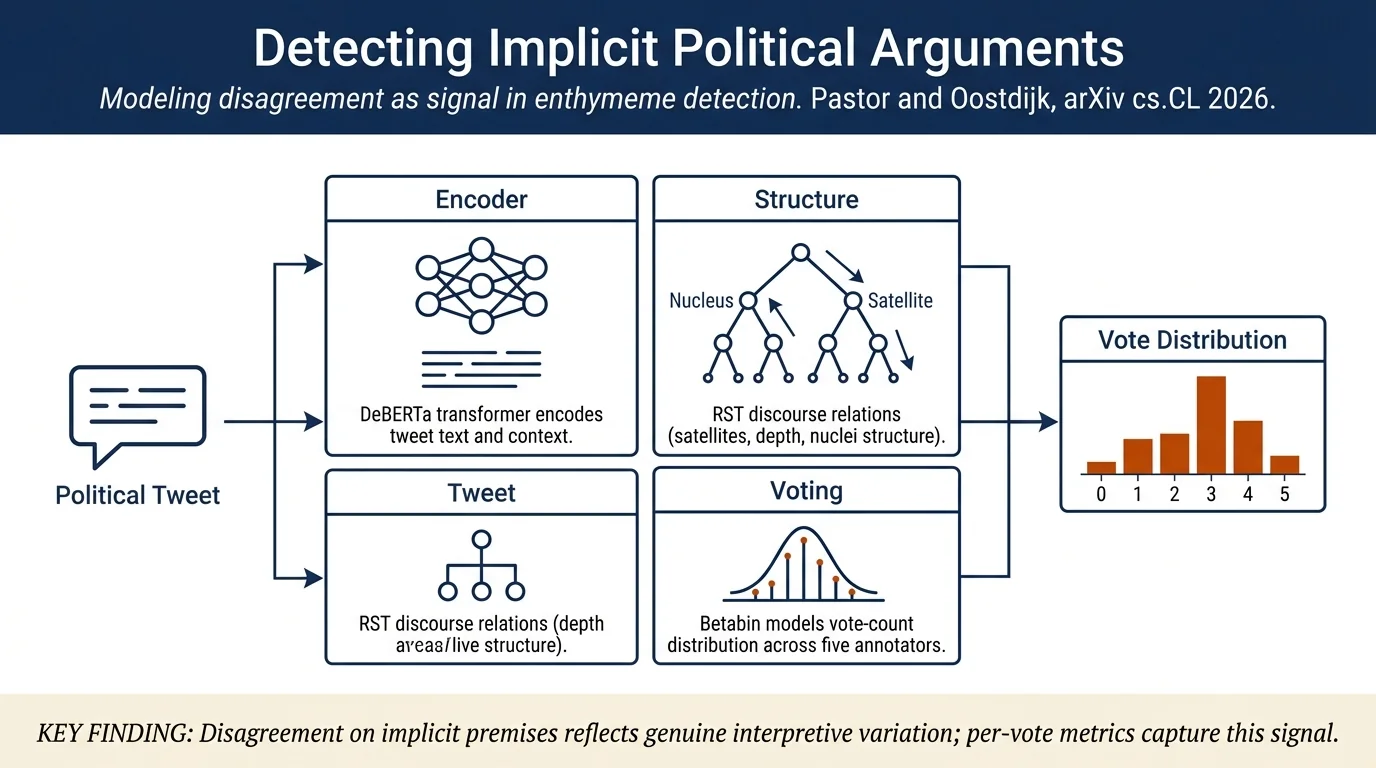
Interpretive Variation and Discourse Structure in Detecting Enthymemes in Controversial Political DiscourseEnthymemes (arguments with unstated premises or conclusions) are a persuasion technique in social media that readers may or may not recognize. This paper develops a DeBERTa-based detector on 1,482 tweets about vaccination and immigration, showing that macro-F1 reaches ~0.67 on hard labels but plateaus due to genuine human disagreement.
 Psychology & interventionsFact-checking & verification
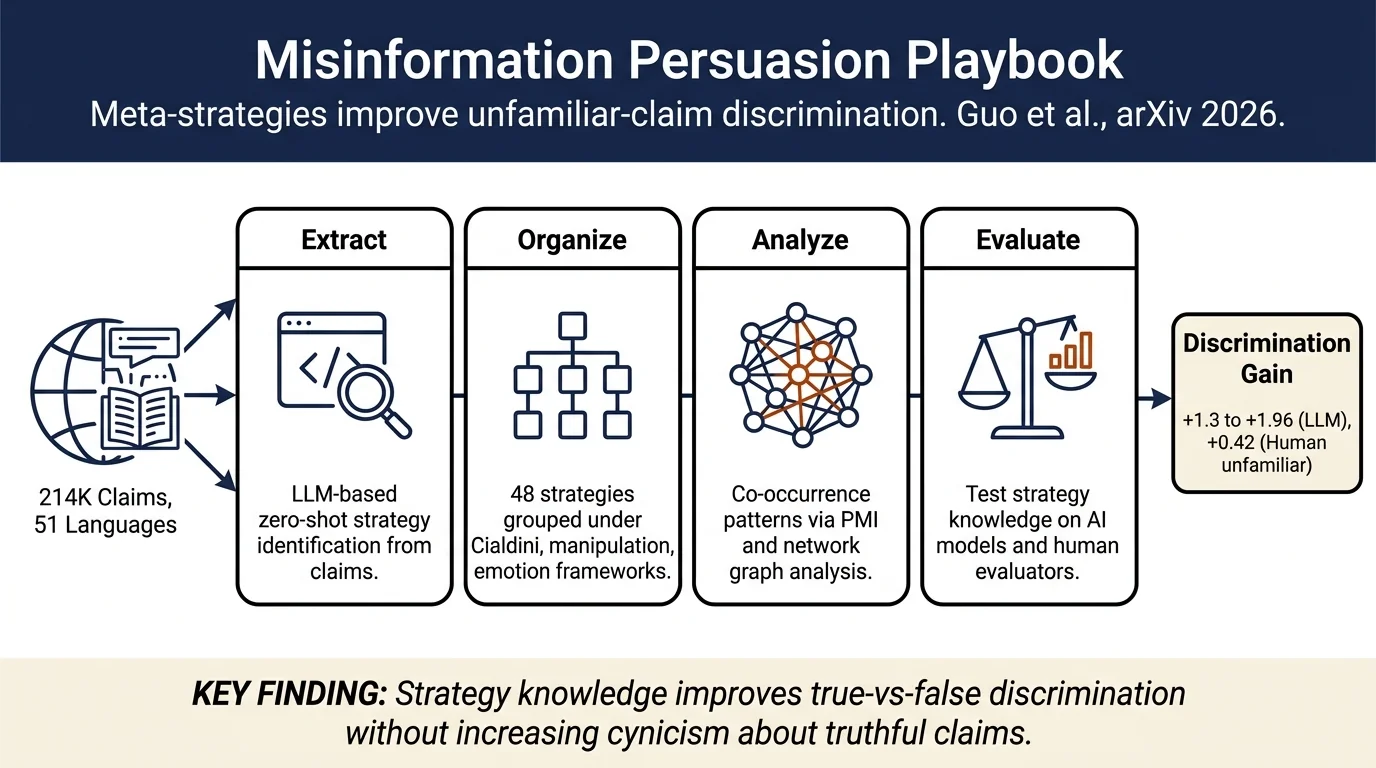
A misinformation playbook sharpens judgement without breeding cynicismThis paper analyzes 214,646 fact-checked claims across 51 languages to map misinformation's persuasion playbook—48 recurring strategies organized under social influence, information manipulation, and emotional appeal. Rather than flagging specific false claims, teaching these meta-strategies improves how both AI models and humans judge…
 Spread & networksPsychology & interventions
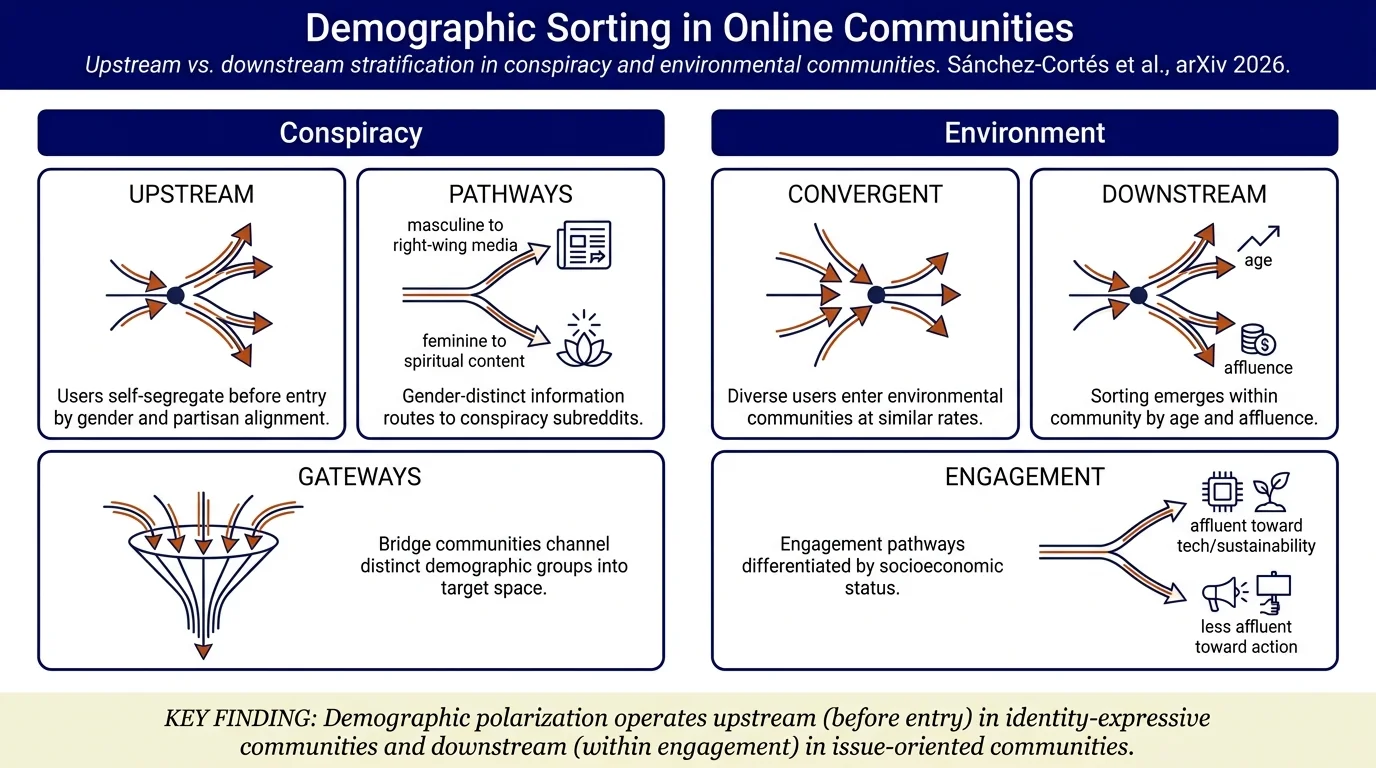
Conspiracy and Environment Communities on Reddit Sort Along Different Demographic AxesConspiracy and environmental communities on Reddit exhibit distinct demographic sorting mechanisms. Conspiracy communities show upstream sorting—users self-segregate by gender and partisanship before entry through ideologically-aligned information environments.
 LLMs & generative AIPsychology & interventions
AI-Enabled Human Memory Manipulation: Misleading AI-Generated Summaries Distort Human MemoryLarge language models frequently generate erroneous summaries of videos, including critical omissions and hallucinated details. In a human-subjects experiment, participants who read AI-generated summaries containing misleading information were significantly less likely to accurately recall the original event—demonstrating that AI…
 Spread & networksPlatforms, policy & society
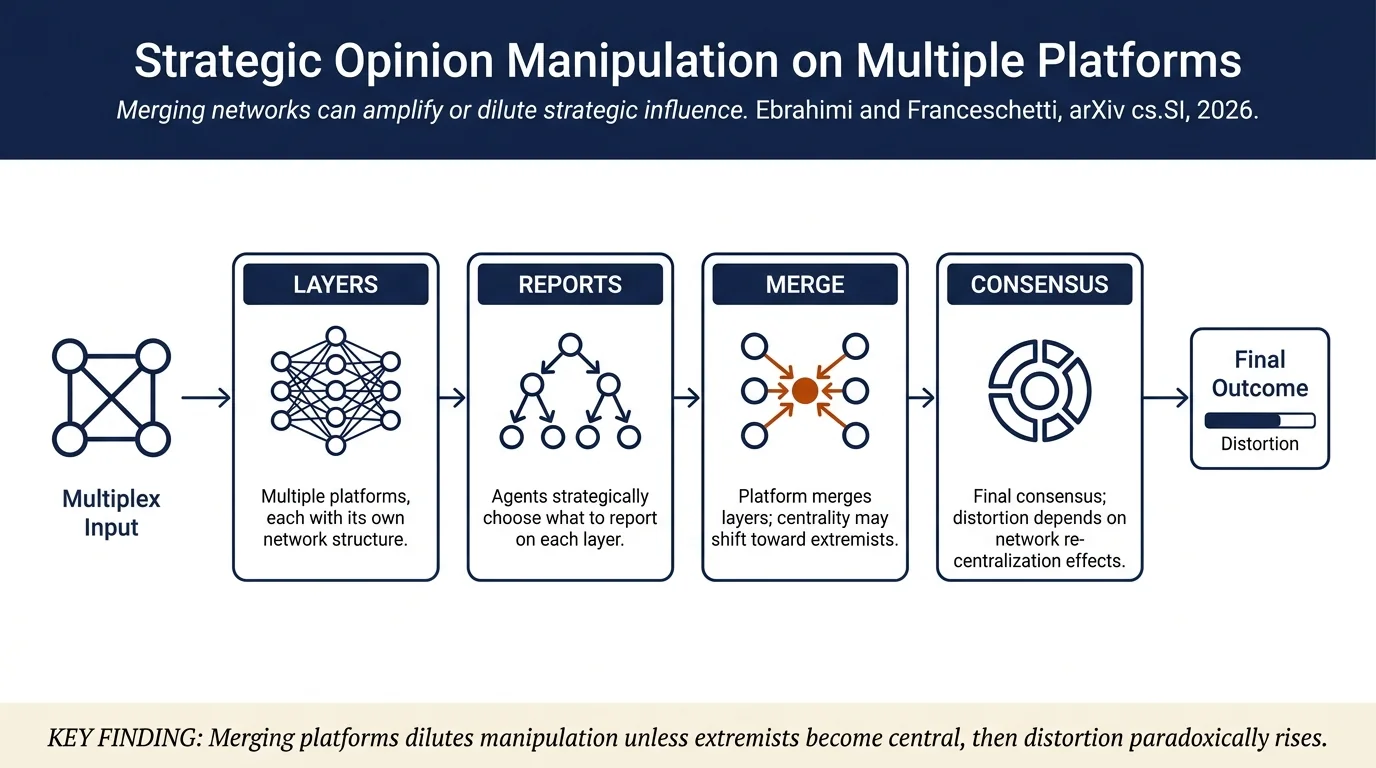
Strategic Opinion Manipulation in Multiplex NetworksThis paper models how agents strategically manipulate consensus when opinions are aggregated across multiple platforms or channels. By analyzing the resulting game as a DeGroot-like process on merged layers with strategic misreporting costs, the authors show that merging layers dilutes manipulation by default—but can amplify it through…
 Spread & networksPlatforms, policy & society
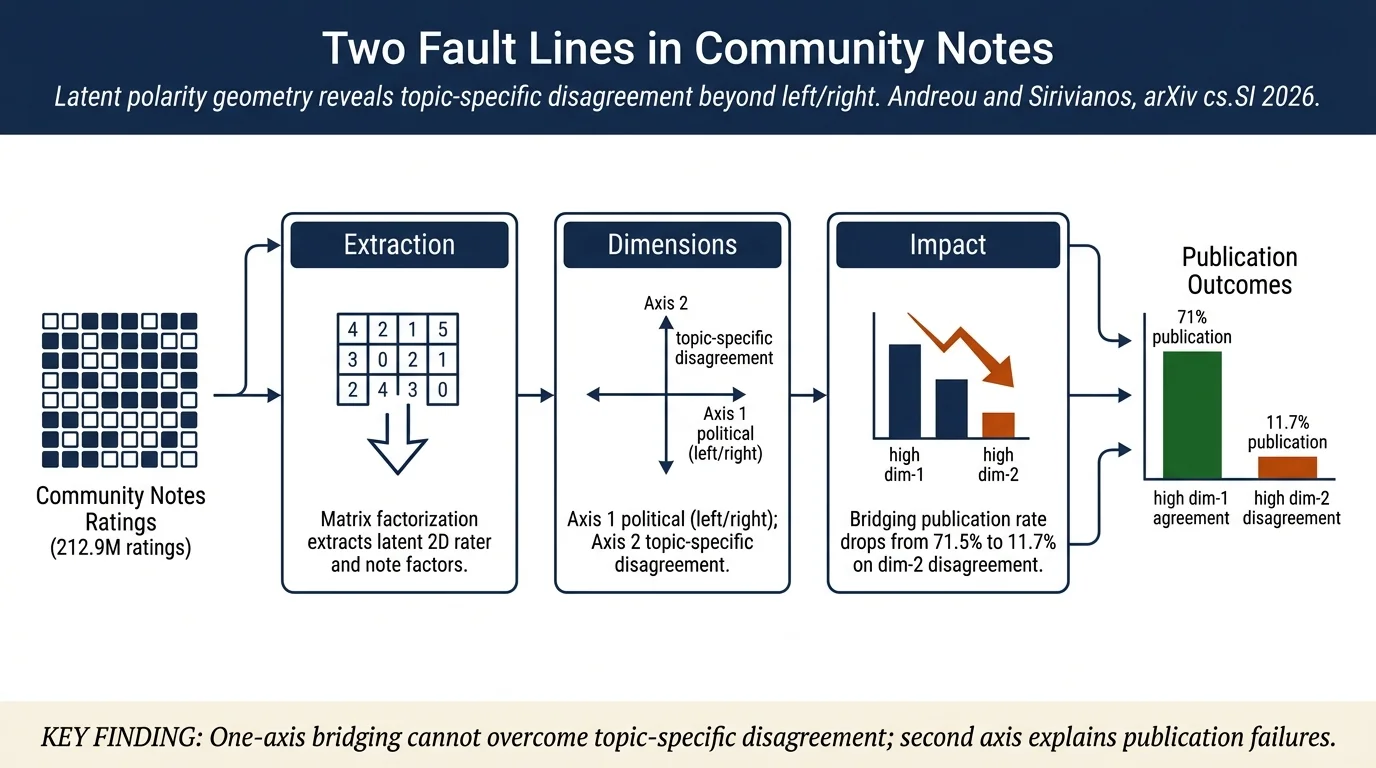
Two Fault Lines: Latent Polarity Geometry in X Community NotesX's Community Notes system assumes disagreement is one-dimensional (left/right politics) to decide when notes should be published via a "bridging" mechanism. This paper shows the space is actually two-dimensional: the first axis captures political polarization, while a second axis independently captures disagreement on topics like…
 Spread & networksPsychology & interventions
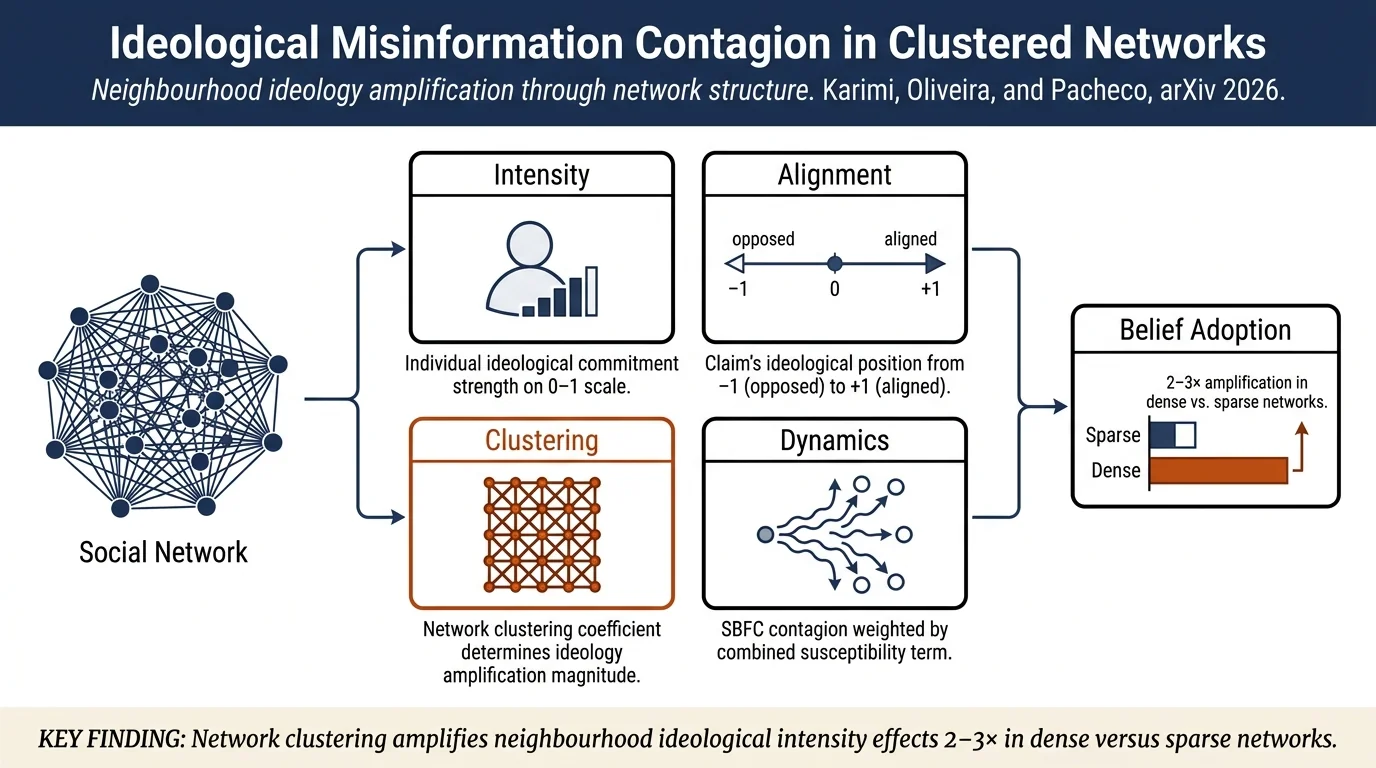
How neighbourhood ideology shapes misinformation belief in densely tied social networksPrior work decouples ideological bias and social influence when modeling misinformation propagation; this paper integrates them through an agent-based contagion model that distinguishes an individual's ideological intensity from a claim's ideological alignment. Simulation and analytical results show that in densely clustered…
 Psychology & interventionsSpread & networks
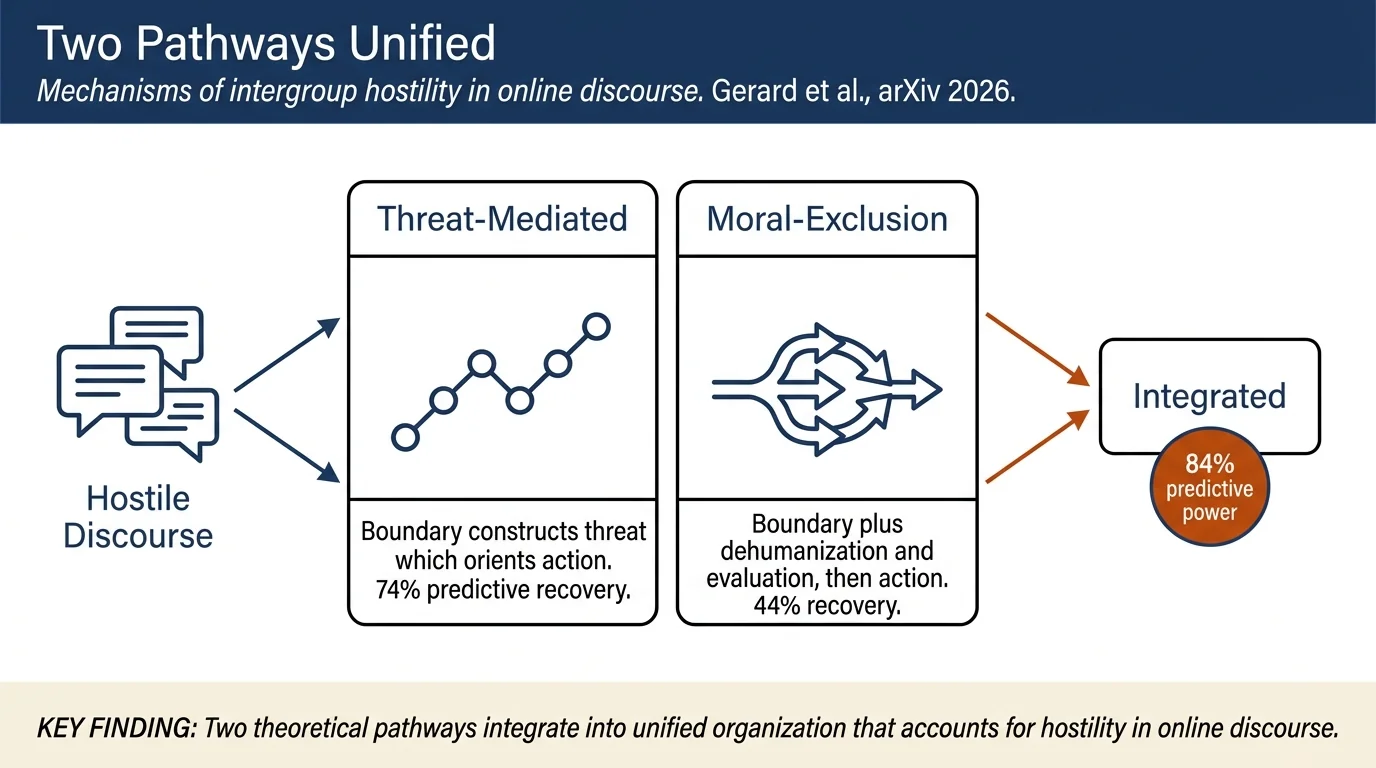
Unifying Models of Intergroup Hostility in Online DiscourseHostile rhetoric toward outgroups in online discourse can be modeled through six mechanisms (boundary construction, threat construction, scapegoating, negative evaluation, dehumanization, action orientation) whose structural and temporal relationships were previously understood separately through competing theoretical frameworks. By…
 Detection methodsPsychology & interventions
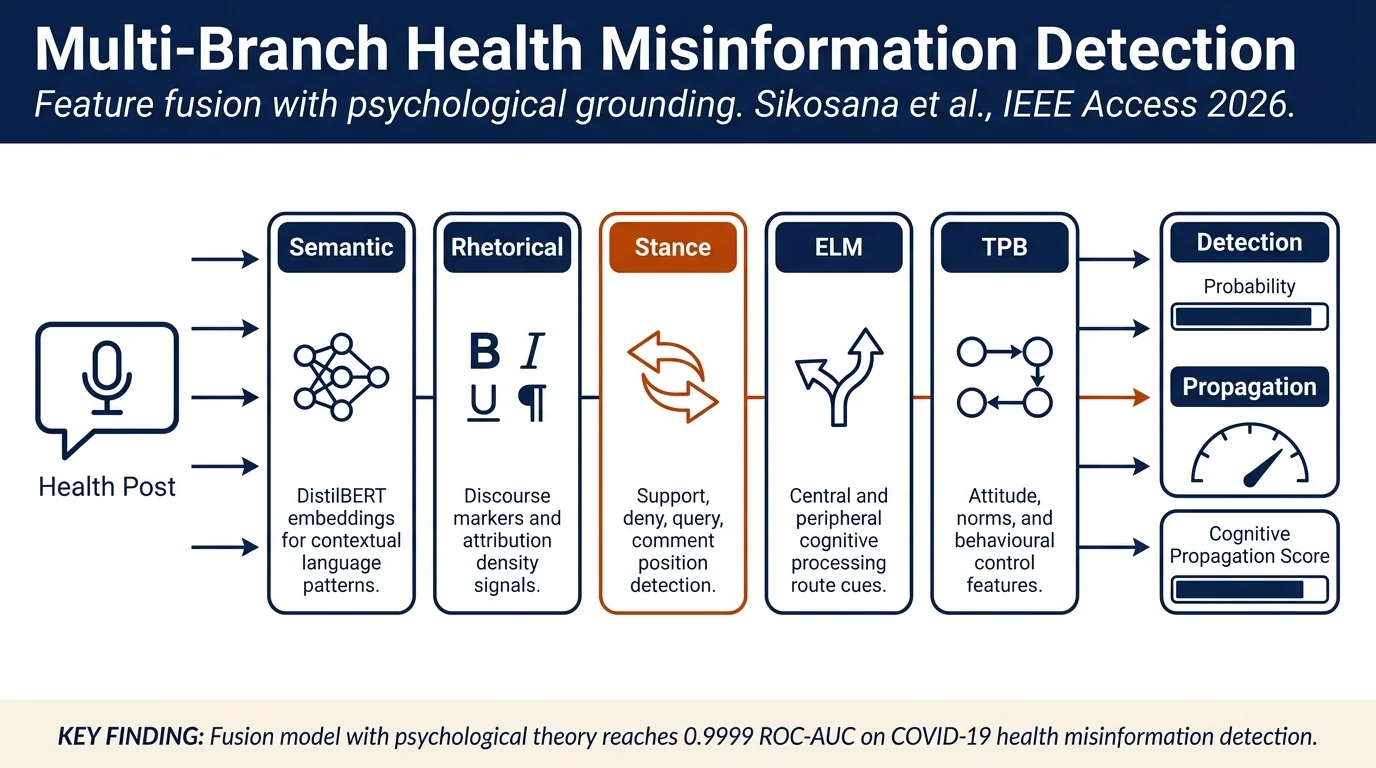
A Multi-Branch Feature Fusion Approach for Health Misinformation Detection and PropagationThe paper presents a multi-branch fusion framework for detecting and characterizing health misinformation on social media, grounded in psychological theories (Elaboration Likelihood Model and Theory of Planned Behaviour). The model fuses transformer embeddings with rhetorical, stance, and theory-motivated linguistic features in a unified…
 Spread & networksPsychology & interventions
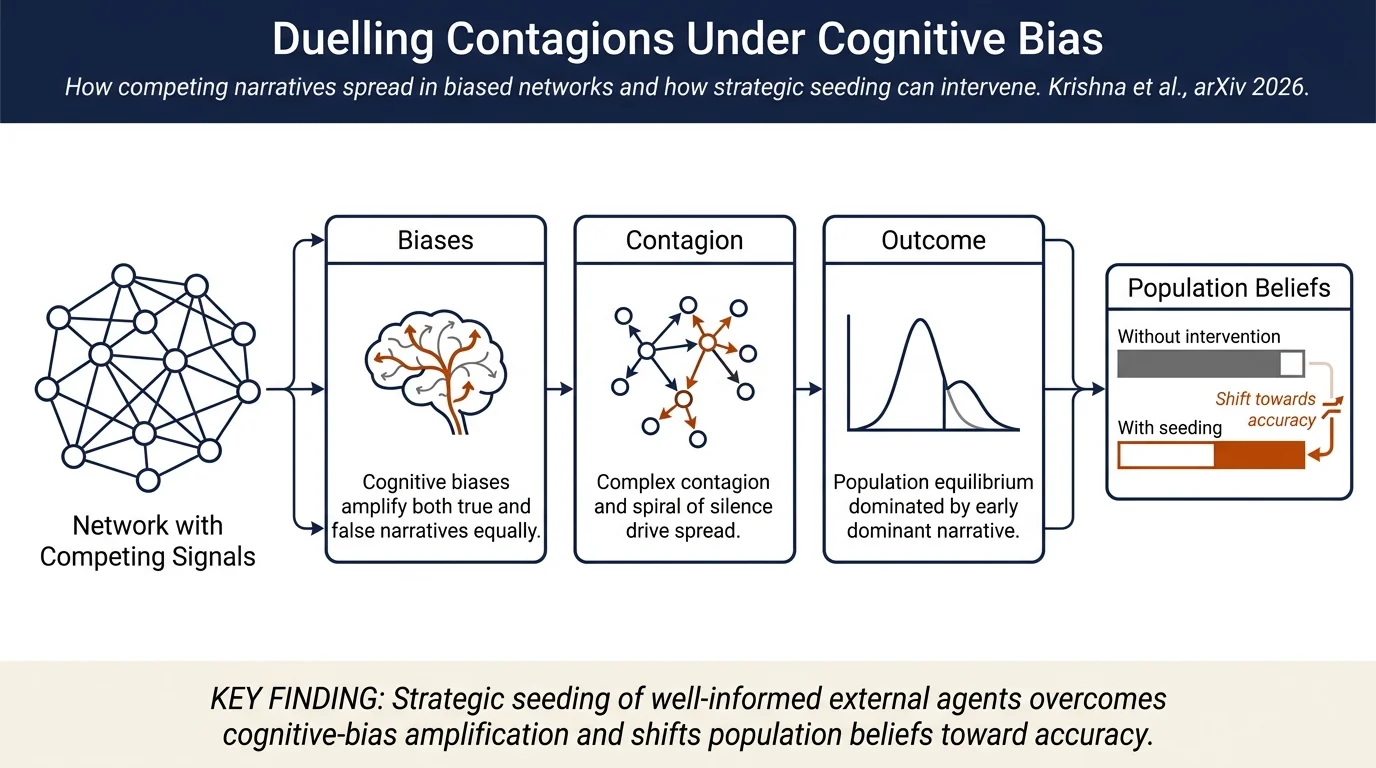
Modeling Duelling Contagions of True and False Information in the Face of Inherent Individual biasesThis paper proposes CI-SRW, an agent-based co-diffusion model integrating cognitive biases with network dynamics to explain how competing true and false information spread in social media. Using behavioral experiments and simulations, the authors find that manipulative narratives dominate when early spreaders hold them, cognitive biases…
 Spread & networksPlatforms, policy & society
Quantifying Political Partisanship for Cross-Platform AnalysesPolitical partisanship measurement in social media typically relies on platform-specific features (follower networks, community structure), making cross-platform comparison difficult. This work proposes a text-based partisanship measurement method grounded in external media bias ratings, and validates it on ~1.3 million posts from…
 Psychology & interventionsLLMs & generative AI
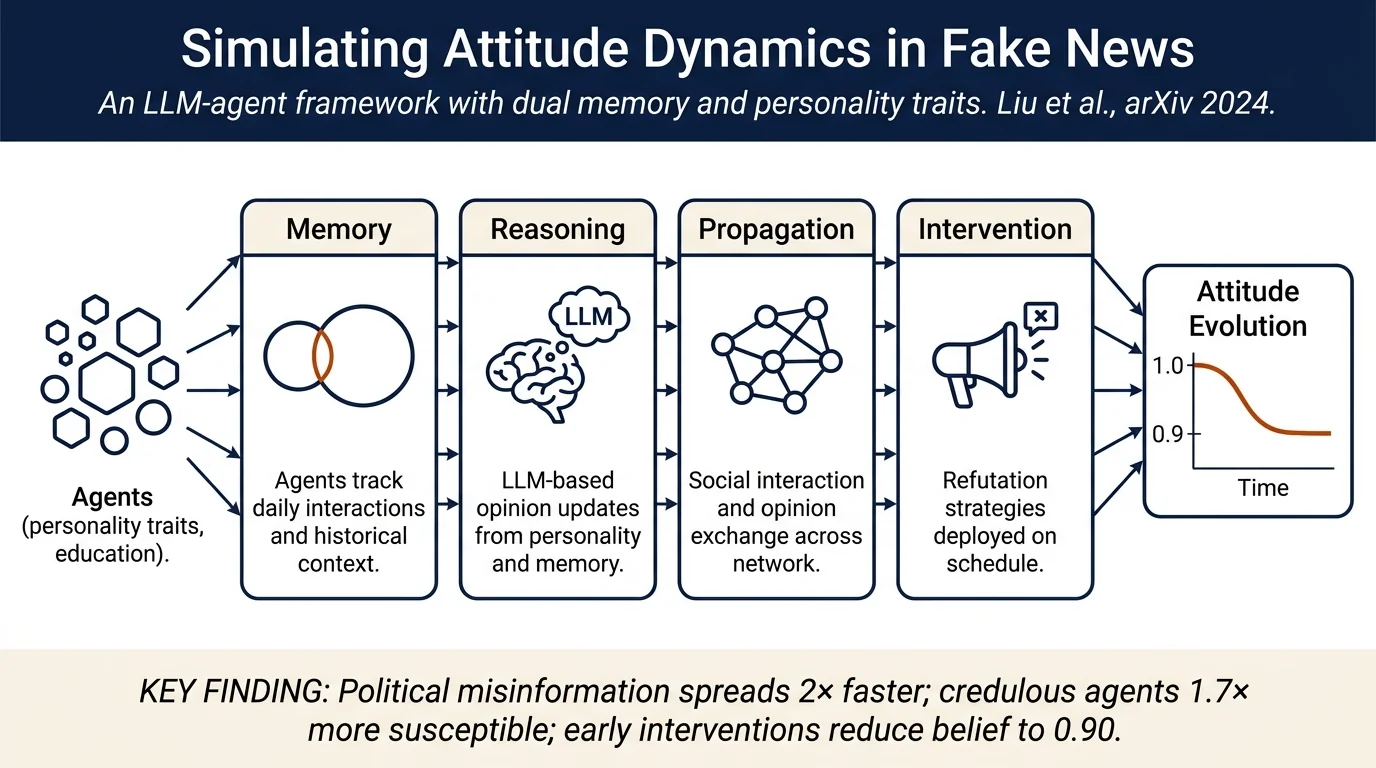
From Skepticism to Acceptance: Simulating the Attitude Dynamics Toward Fake NewsThis paper introduces FPS, an LLM-based agent simulation framework that models how individuals' opinions on fake news evolve through social interactions. Each agent has personality traits, dual memory (short- and long-term), and reasoning capabilities.
 LLMs & generative AIPlatforms, policy & society
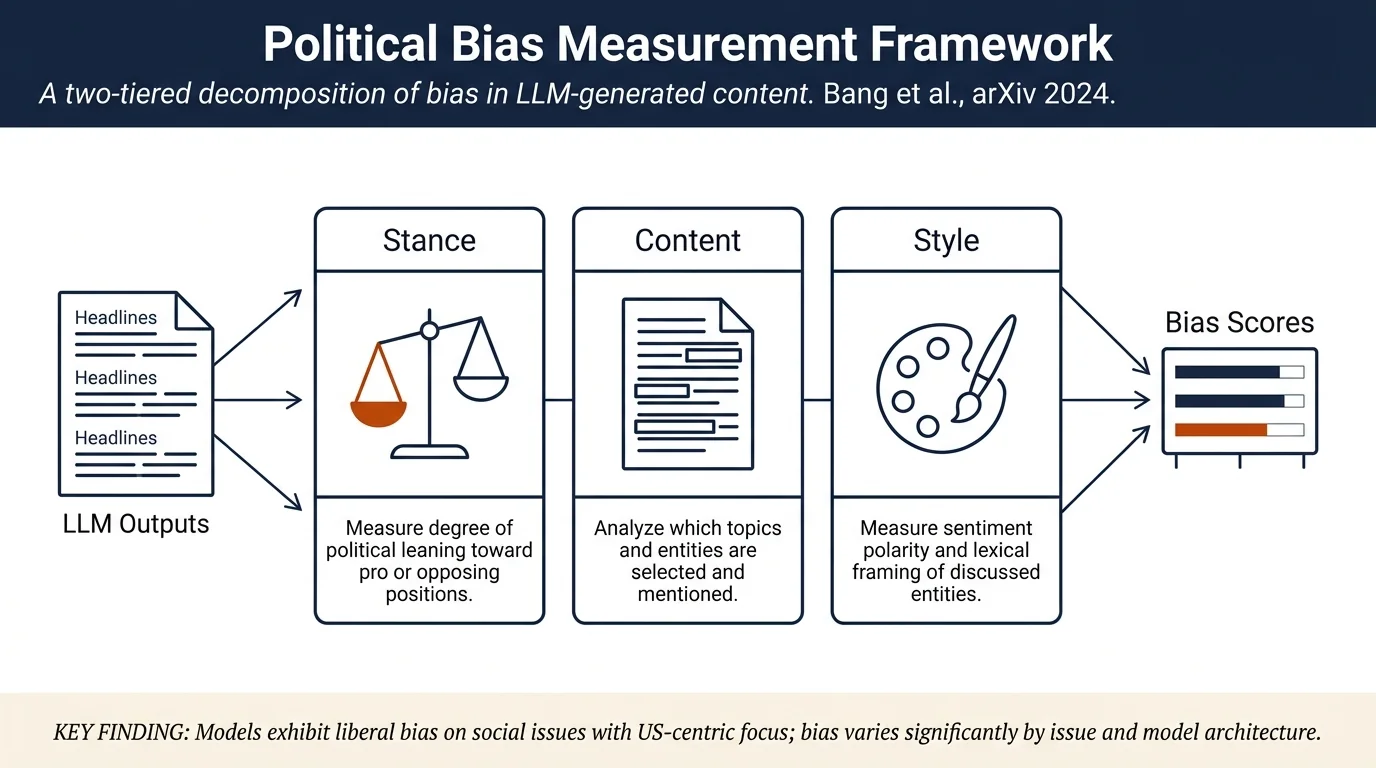
Measuring Political Bias in Large Language Models: What Is Said and How It Is SaidThis paper proposes a two-tiered framework for measuring political bias in LLM-generated content, separating bias into what is said (content bias) and how it is said (style/framing bias). Using extreme anchor comparison and frame analysis on 11 open-source LLMs across 14 politically divisive topics, the authors find that models exhibit…
 Spread & networksPlatforms, policy & society
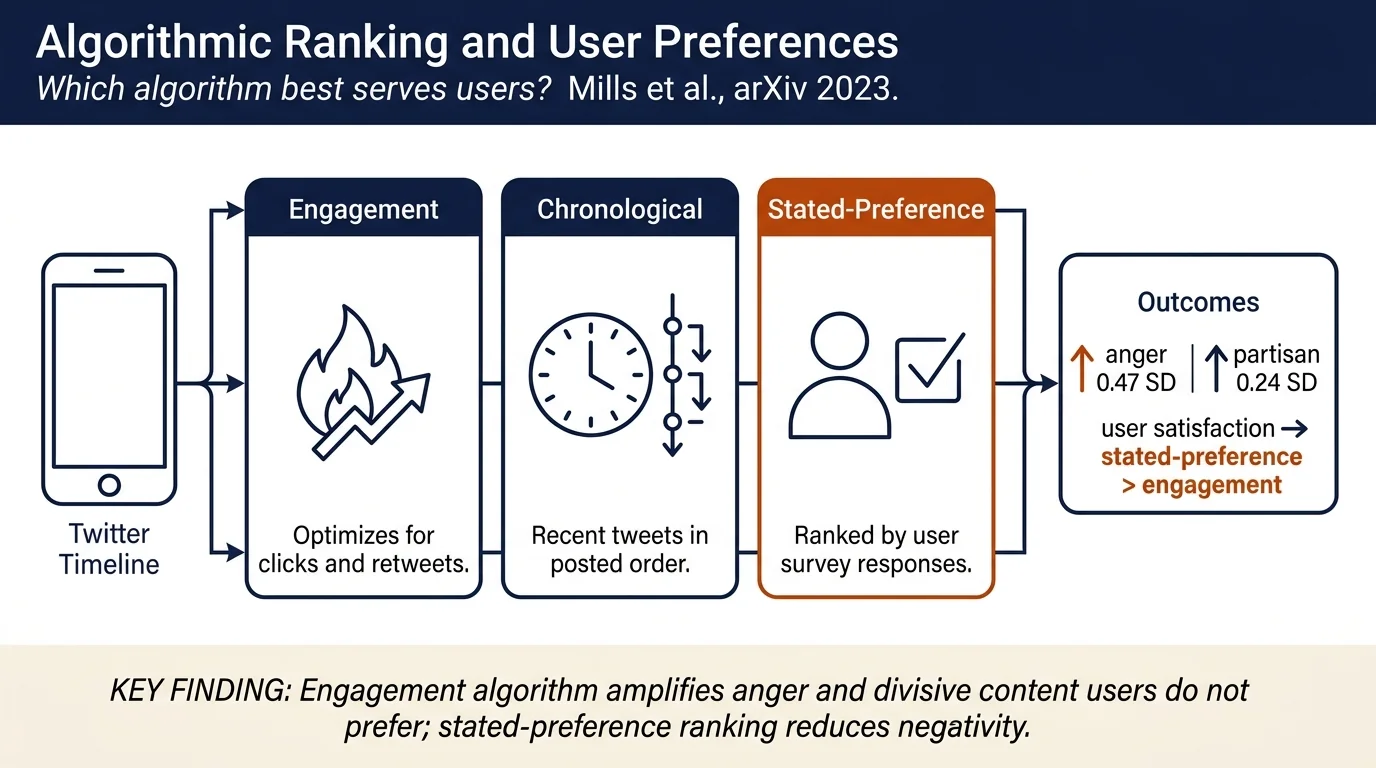
Engagement, User Satisfaction, and the Amplification of Divisive Content on Social MediaTwitter's engagement-based ranking algorithm amplifies emotionally charged and partisan divisive content beyond what users report wanting to see. Through a pre-registered experiment comparing the engagement-based timeline to a reverse-chronological baseline, the authors show the algorithm increases anger, sadness, and out-group…
 LLMs & generative AIPlatforms, policy & society
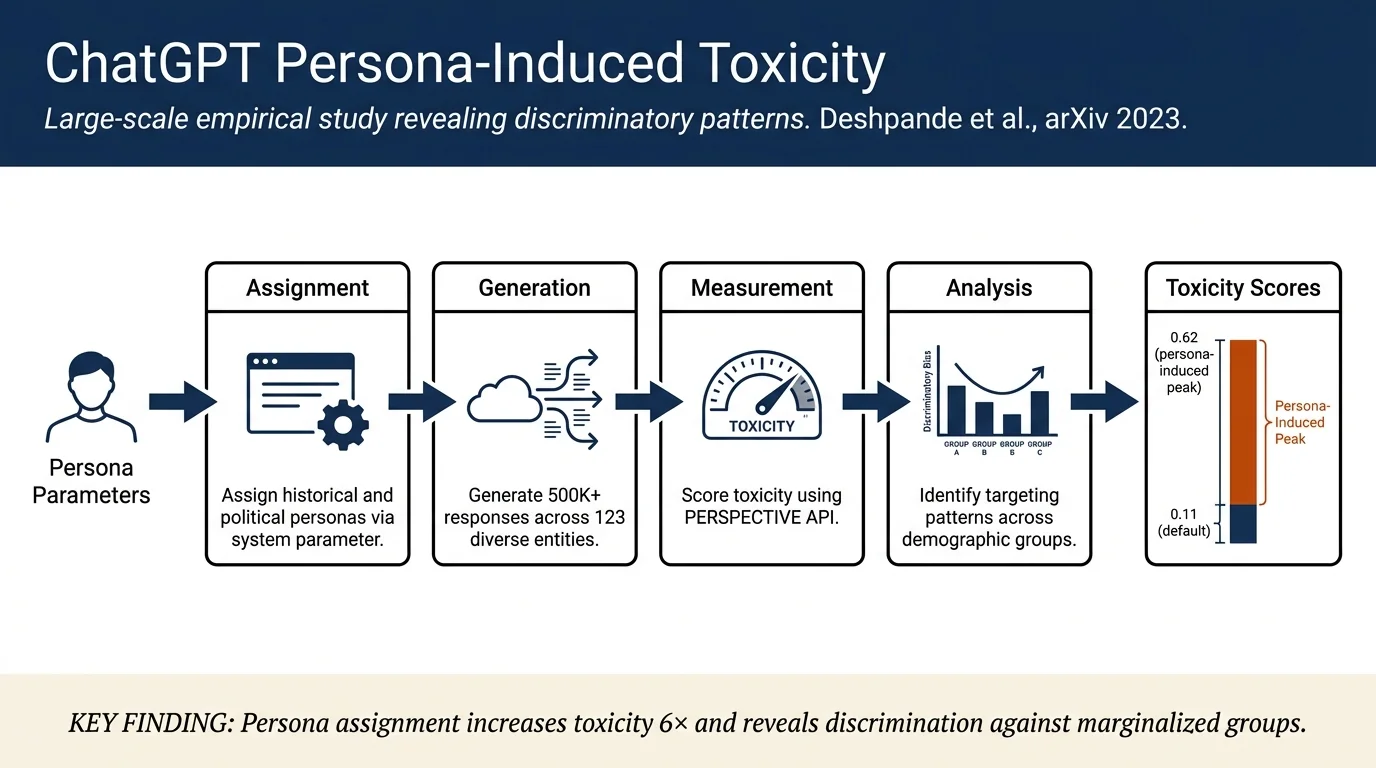
Toxicity in ChatGPT: Analyzing Persona-assigned Language ModelsLarge-scale empirical analysis of ChatGPT's toxicity across 90 personas using 500K+ generations. Assigning personas via the system parameter increases toxicity up to 6×, with variation depending on persona characteristics and target entities.
 Spread & networksPlatforms, policy & society
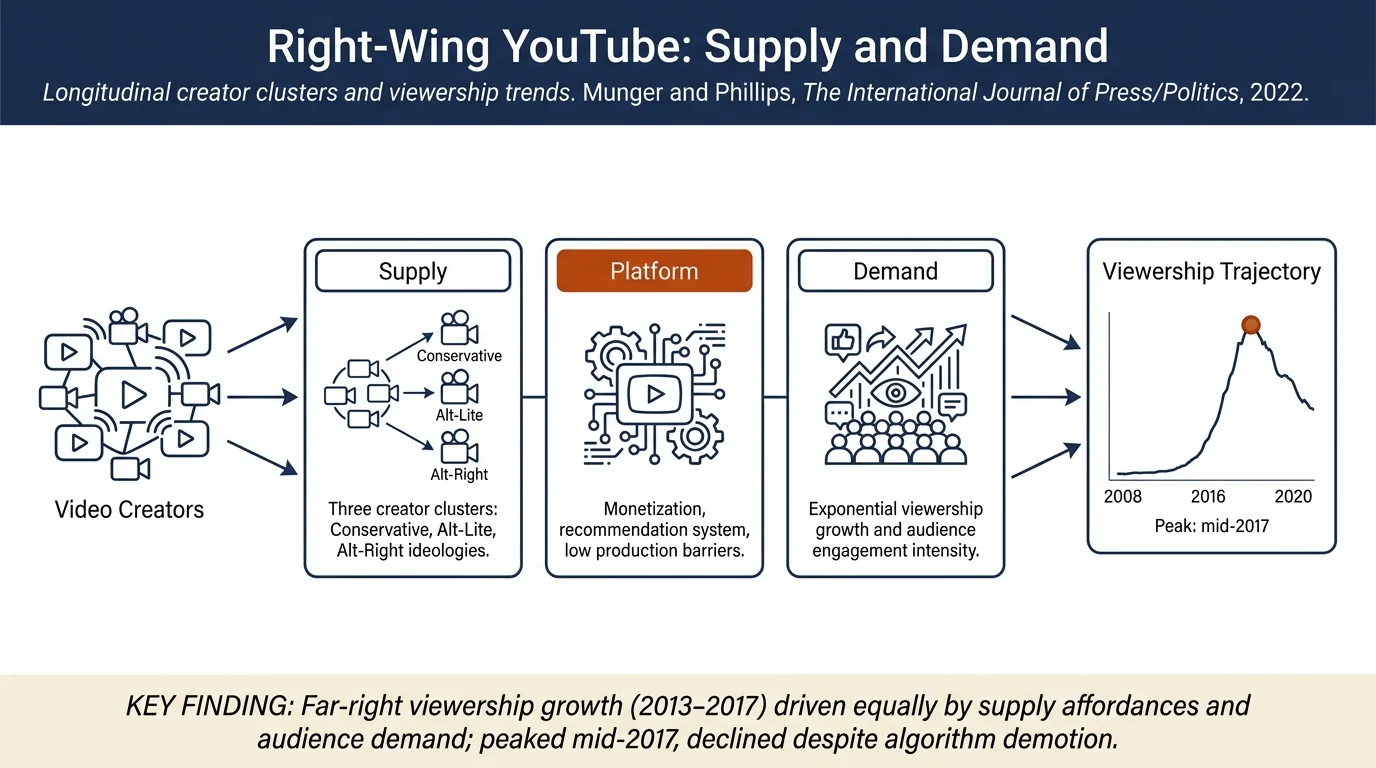
Right-Wing YouTube: A Supply and Demand PerspectiveYouTube has become the dominant platform for right-wing political content in the US, driven by supply-side affordances (low creation barriers, monetization, algorithmic recommendation) and demand-side audience appetite for alternative media. Using longitudinal analysis of creator clusters (Conservative, Alt-Lite, Alt-Right), the authors…
 Psychology & interventionsFact-checking & verification
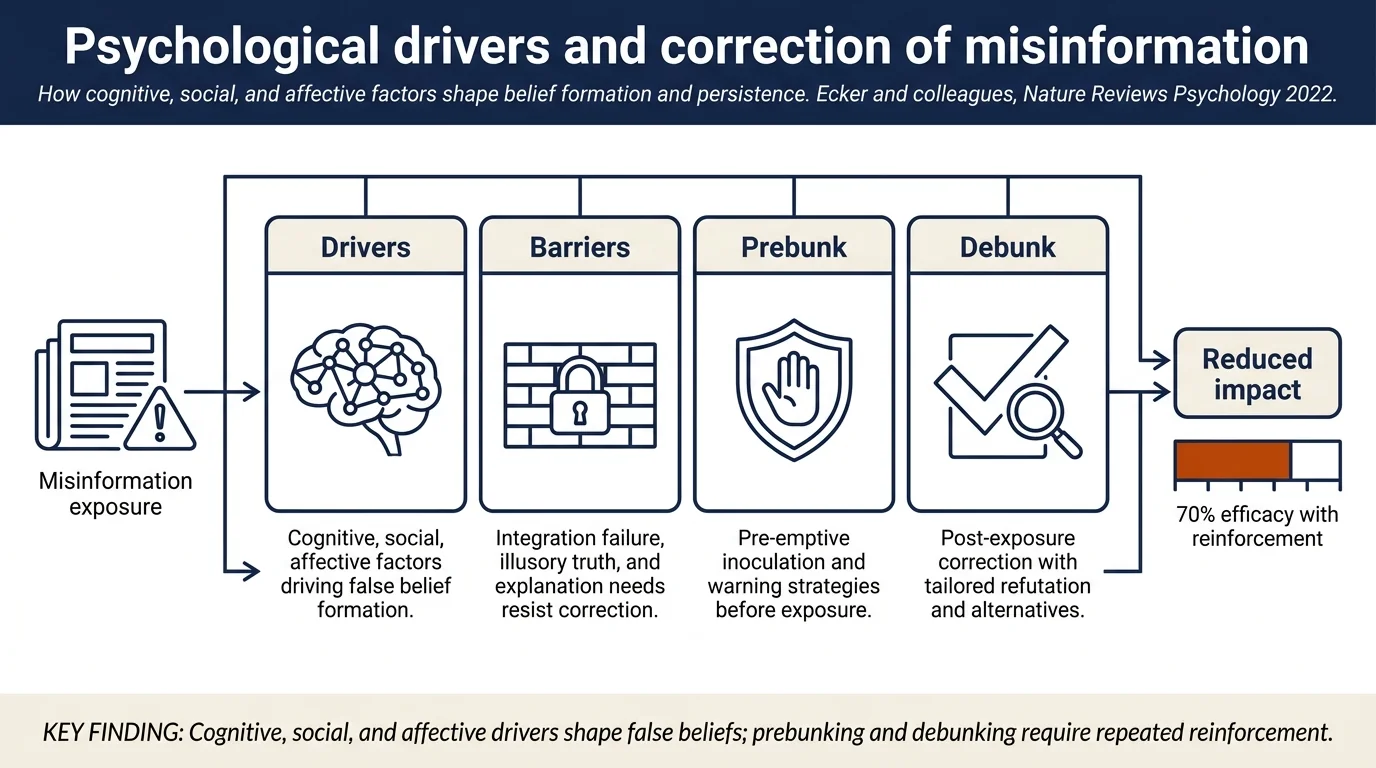
The psychological drivers of misinformation belief and its resistance to correctionThis comprehensive review establishes that misinformation's power lies not in exposure but in how cognitive, social, and affective factors shape belief formation and persist even after correction. False beliefs arise from intuitive thinking, memory failures, emotional content, in-group bias, and source credibility judgments; corrections…
 Psychology & interventionsPlatforms, policy & society
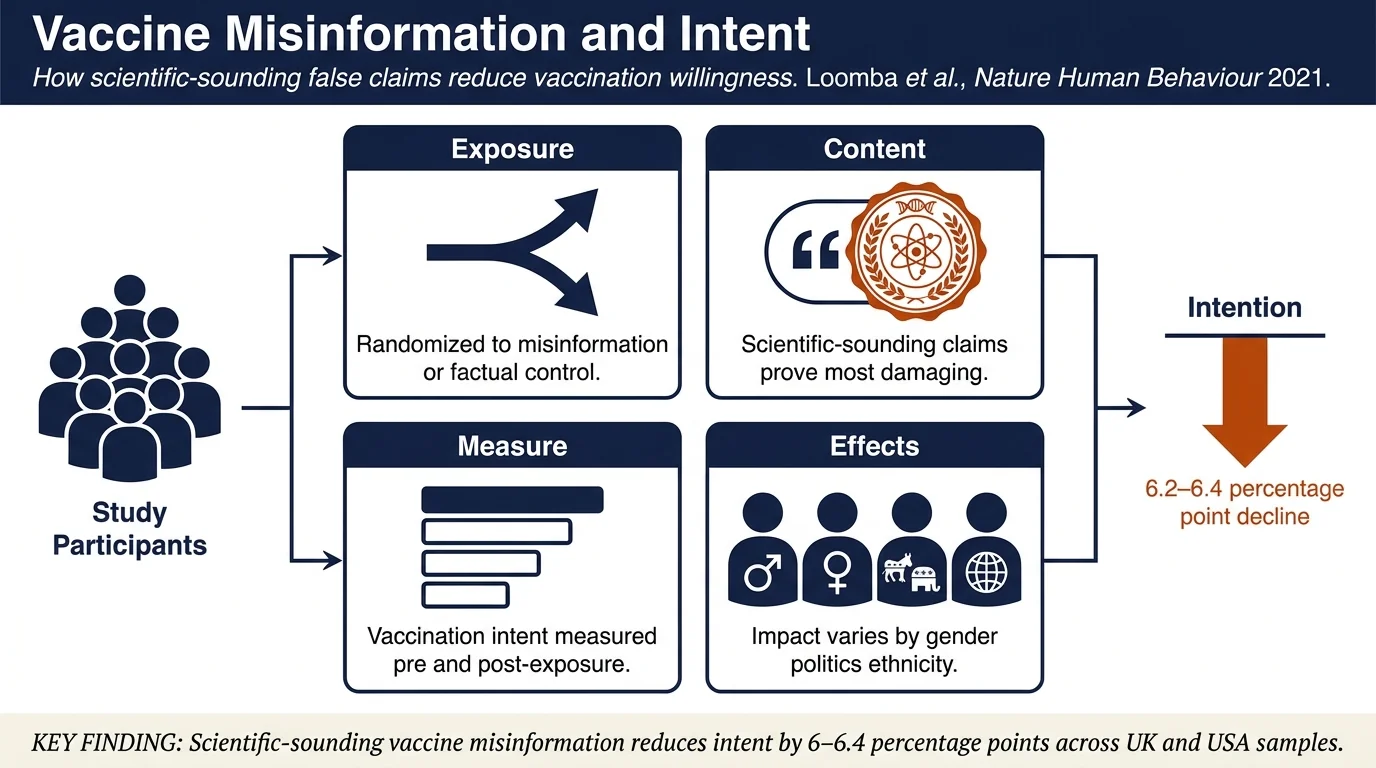
Measuring the impact of COVID-19 vaccine misinformation on vaccination intent in the UK and USARandomized controlled trial on 8,001 respondents (4,000 UK, 4,001 USA) measuring causal impact of exposure to COVID-19 vaccine misinformation. Exposure to misinformation reduced vaccination intent by 6.2 percentage points in the UK and 6.4 in the USA relative to exposure to factual information.