Where Does Rhetorical Distortion Live? A Multi-Platform, Multi-Language Measurement of Influencer Content
Authors: Xucheng Yu, Jiangping Chen, Haohan Wang Venue: arXiv cs.SI, 2026 — arXiv:2610.26412
TL;DR
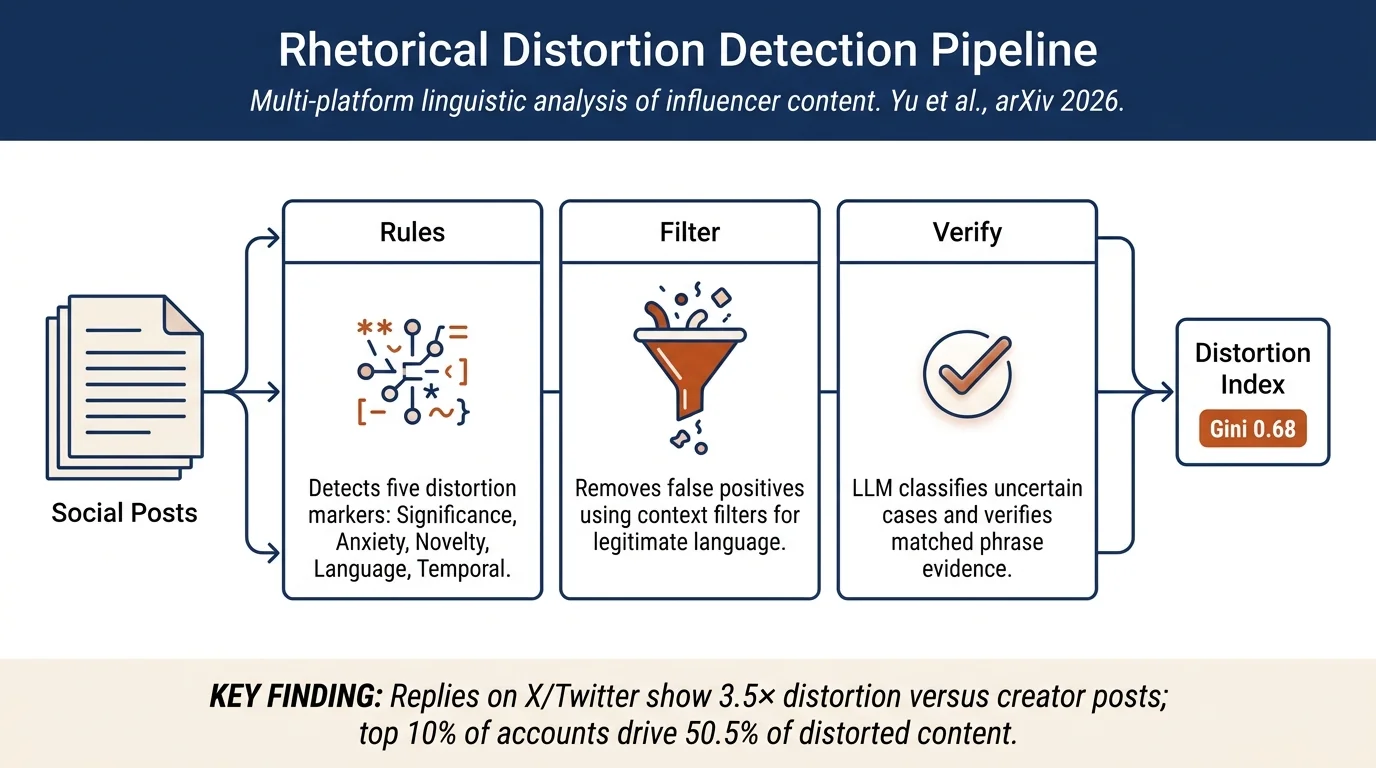
Rhetorical distortion—misleading framing that inflates significance, manufactures anxiety, or misrepresents novelty—is not uniformly distributed across platforms or account types. This work measures five linguistic dimensions of distortion (Significance Inflation, Anxiety Manufacture, Novelty Claims, Loaded Language, Temporal Distortion) across six platforms using a three-tier pipeline combining lexical rules, negative filters, and LLM verification. X/Twitter exhibits the highest distortion (3.5× the creator-post level), concentrated in reply text, while YouTube leads on emotional language, and RSS/newsletters on importance claims; distortion is unevenly distributed, with the top 10% of accounts accounting for 50.5% of flagged posts.
Contributions
- A five-dimensional framework for rhetorical distortion grounded in rhetorical theory and propaganda taxonomies
- A three-tier classification pipeline combining interpretable lexical rules, negative-filter suppression, and LLM verification that keeps labels transparent and comparable across platforms
- Cross-platform, cross-language measurement covering 13,060 posts from 330 accounts on RSS, YouTube, Bluesky, Reddit, Weibo, and X/Twitter
- Evidence that distortion is platform-specific (reply layers carry 3.5× distortion of creator posts; X/Twitter dominated by loaded language and anxiety manufacture), account-specific (Gini coefficient 0.68 shows high inequality), and subject to linguistic transfer asymmetries between English and Chinese
Method
The pipeline uses three stages:
Stage 1: Lexical rules. Five dimensions are operationalized as marker patterns applied identically across platforms: - Significance Inflation (SI): markers like "once in a generation," "unprecedented," "game changer" - Anxiety Manufacture (AM): appeals to fear, job security, health - Novelty Claims (NC): claims of exclusive knowledge or revelation - Loaded Language (LL): emotionally charged words flagged in preprocessing, idioms, hyperbole - Temporal Distortion (TD): urgency labels ("BREAKING," "just now")
Each dimension has strong (high confidence) and weak (ambiguous) pattern matches.
Stage 2: Negative filters. To reduce false positives in contexts where these markers are legitimate (e.g., historical retrospectives, emergency reporting), the pipeline uses known false-positive contexts (historical references, casual language, critical journalism) to exclude weak matches.
Stage 3: LLM verification. Posts that survive the filters are classified by GPT-4-mini with three possible paths: - Path A: Rule evidence is weak (c < 0.70) → LLM classifies from scratch - Path B: Rule evidence is strong (c ≥ 0.70) → LLM verifies, with matched phrases tagged - Path C: No rule fired or filter excluded → no label, no LLM call
The pipeline assigns unweighted equal-weight distortion index (DI) averaged over the five dimensions per account per week, and computes a Consistency Score (CS) capturing stability week-over-week.
Results
- Platform differences are sharp: X/Twitter has significantly higher account-level DI than RSS, YouTube, Bluesky (Kruskal-Wallis H=101.5, p<10⁻¹⁵). X/Twitter's median exceeds others by 1.5–10×; the top X/Twitter account (DI 7.74) vastly outranks the top YouTube account (3.30). X/Twitter is LL-led (21.0%), YouTube LL-led (13.5%), RSS newsletter mostly SI-led (25.5%).
- Reply amplification: On X/Twitter, replies score 7.65 vs. creator tweets 2.17 (3.5× difference, Wilcoxon signed-rank p=2.3×10⁻⁴). The reply gap is driven by LL (replies 24.97 vs. tweets 3.96) and is unambiguous across all 43 accounts tested.
- Cross-linguistic transfer: Weibo's SI is lower than English-language SI on finance (1.90% vs. 4.03%), but higher for AM (7.20% vs. 1.68%); Chinese currency/finance markers suppress SI, but emotional appeals carry stronger linguistic signals in Chinese.
- Account concentration: A small fraction of accounts carry most of the distortion. Gini coefficient of 0.68 across all platforms shows extreme inequality; the top 10% produce 50.5% of flagged posts.
- Model robustness: Re-classifying all 1,667 LLM-routed posts with GPT-4 produces GPT-4 ↔ GPT-4-mini platform agreement of 0.90 (high correlation), confirming the LLM stage is stable. Rules alone flag 12.3% of posts; LLM adds 70.5%; final labels are 80.4% rule+LLM, only 19.6% LLM-only.
Connections
- Related to Propagation-based fake news detection through shared focus on content-level features of manipulation
- Related to Framing detection and Framing on how platforms amplify misleading framings
- Related to Propaganda techniques via operationalization of propaganda markers at scale
- Related to Linguistic Analysis of Fake News on computational detection of manipulative language
- Related to Platform auditing and analysis showing how reply layers and algorithms amplify distortion asymmetrically
- Related to Influencers and their role in online discourse on measurement of creator-audience dynamics and reply structure
Notes
Strengths: The three-tier pipeline is novel for keeping labels transparent and comparable across platforms without requiring per-platform retraining. The cross-platform design exposes real platform asymmetries (X/Twitter replies, YouTube emotionality, RSS salience), and the linguistic-dimension framework is grounded in rhetorical theory rather than just statistical pattern matching. The inclusion of Chinese and bilingual validation is rare.
Limitations: The validation sample is small (198 creator posts, 60 replies per platform; 26 sampled tweets). Distortion detection is limited to linguistic markers; it does not verify whether framing actually exceeds the evidence. NC and AM agreement with humans is low (0.38 and 0.03), suggesting these dimensions may require deeper semantic understanding. The pipeline does not address whether distortion causes engagement or merely correlates with it. The 330-account sample is selective (chosen for English/Chinese parity); findings may not generalize to lower-resource accounts or non-influencer contexts.
Future directions: Extend validation to larger human-labeled samples; test causal relationship between distortion and engagement; incorporate evidence-grounding to verify whether claims exceed factual support; adapt pipeline to other languages and low-resource account types.