Strategic Opinion Manipulation in Multiplex Networks
Authors: Raman Ebrahimi, Massimo Franceschetti
Venue: arXiv cs.SI, September 2026 — arxiv:2609.22524
TL;DR
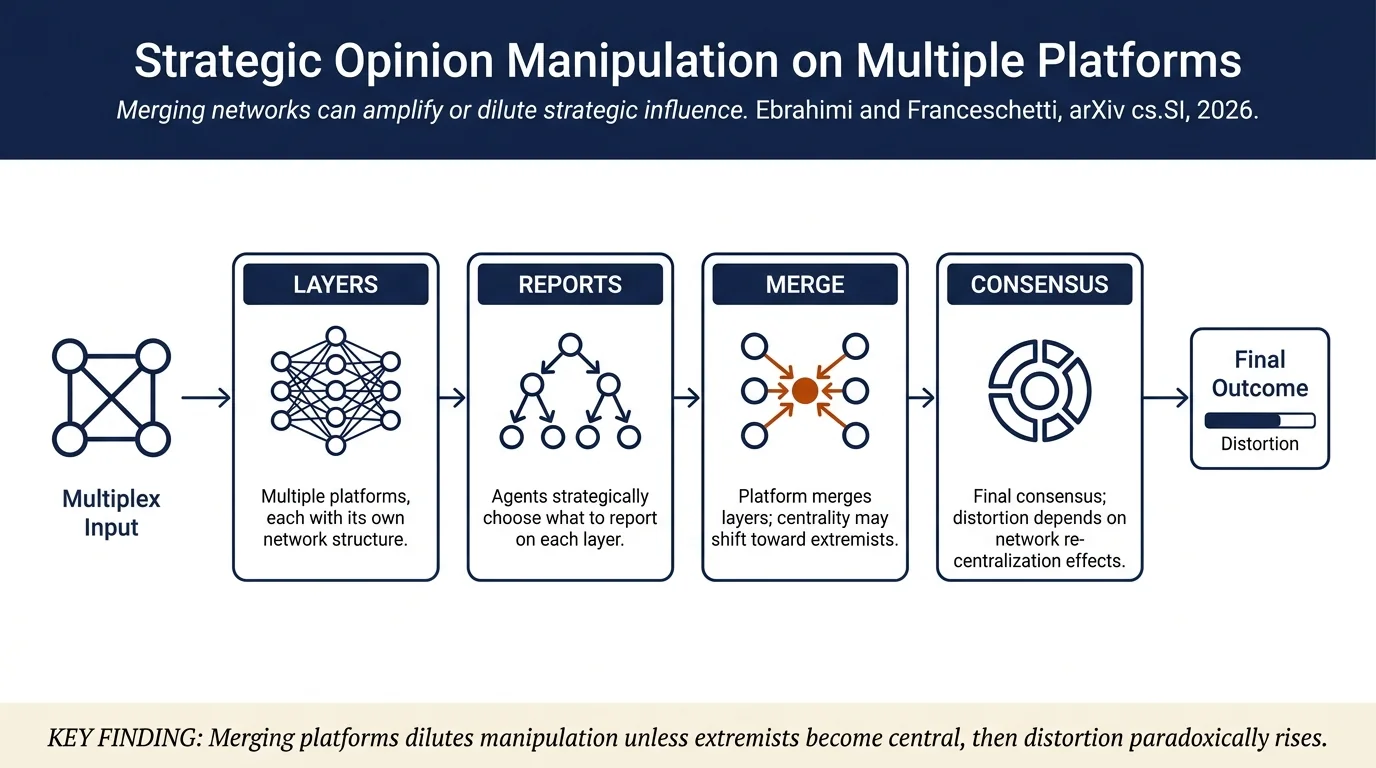
This paper models how agents strategically manipulate consensus when opinions are aggregated across multiple platforms or channels. By analyzing the resulting game as a DeGroot-like process on merged layers with strategic misreporting costs, the authors show that merging layers dilutes manipulation by default—but can amplify it through re-centralization when agents concentrate their dishonest reports on extreme opinions.
Contributions
- Proposes a game-theoretic model of strategic opinion manipulation on multiplex networks: agents hold private opinions, choose reports strategically per layer, and incur layer-specific misreporting costs; a platform merges layers with attention weights into a single consensus.
- Proves the game has a unique Nash equilibrium in closed form (Theorem 4.1), with equilibrium consensus reweighted by agents' "tilted centrality" — a measure that accounts for both network centrality and manipulability.
- Introduces the manipulability index \(K_i\) measuring how much agent \(i\) can move the consensus per unit misreporting cost on each layer, summed and discounted by layer attention; characterizes how distortion scales with this quantity.
- Shows that merging layers dilutes manipulation (reduces distortion) only when agents cannot concentrate their extreme opinions on a single layer; adding a layer can paradoxically increase distortion through re-centralization if the new layer shifts centrality toward extremists (Theorem 6.1).
- Characterizes what the platform observes: on each layer, agents' reports are a stretched version of their true opinions; the measured polarization overestimates the true polarization; platform can recover agents' relative leverage-to-cost ratios from cross-layer inconsistencies.
- Solves for the platform's optimal attention weights in closed form when layers share a stationary distribution (Theorem 7.1); shows the solution is unique and proportional to layer vulnerability (1/variance of misreporting leverage).
Method
Model. \(N\) agents interact over \(L\) layers (platforms or channels). Layer \(\ell\) has a row-stochastic influence matrix \(W^{(\ell)}\). A platform merges layers into a single consensus via attention weights \(\alpha_\ell\) with \(\sum \alpha_\ell = 1\), aggregating the \(\ell\)-th layer's reports as \(z_\ell^{(1)} = \sum_j \omega_{i,j}^\ell x_j^{(\ell)}\), then iterating to \(z(t+1) = C(\alpha)(z(t))\) where \(C(\alpha) = \sum_\ell \alpha_\ell W^{(\ell)}\).
Strategic reporting. Each agent \(i\) holds a private opinion \(\theta_i \in \mathbb{R}\) and independently chooses reports \(x_i^{(\ell)}\) on each layer. The agent's utility is: $\(U_i(x_i, x_{-i}) = \frac{1}{2}(y(x) - \theta_i)^2 + \sum_\ell \frac{c_{i,\ell}}{2}(x_i^{(\ell)} - \theta_i)^2\)$
The first term is the agent's stake in the outcome (consensus close to their view); the second is the cost of misreporting (proportional to distance from truthful report on each layer).
Equilibrium analysis. The unique Nash equilibrium consensus is: $\(y^* = \frac{\sum_i \pi_i \theta_i + \sum_i K_i \theta_i}{1 + K}\)$
where \(\pi_i\) is agent \(i\)'s centrality in the merged network, \(K_i\) is agent \(i\)'s manipulability, and \(K = \sum_i K_i\). Agent \(i\)'s report on layer \(\ell\) is: $\(x_i^{(\ell)*} = y^* + \left(1 + \frac{\omega_{i,\ell}}{c_{i,\ell}}\right)(\theta_i - y^*)\)$
Distortion measure. The harm of manipulation is the distance between the equilibrium consensus \(y^*\) and the "sincere" consensus \(\theta = \pi(\alpha)^\top \theta\) that would result if everyone reported truthfully: $\(\text{Dist}(\alpha) = |y^* - \theta|\)$
Results
-
Equilibrium and distortion identity (Theorem 4.2). Cheap lying is not intrinsically harmful; if agents hold typical opinions, manipulations cancel and the platform recovers truthfulness. Distortion arises only when manipulability and opinions covary—i.e., when extremists have high leverage to move consensus cheaply.
-
Layer merging effects (Theorem 6.1).
- Dilution: Merging more layers reduces distortion when costs are uniform, because the agent's influence they have on each layer is scaled by their cost. The effect is largest when the new layer is uniform.
-
Re-centralization: Adding a new layer can harm (increase distortion) if the layer shifts centrality toward agents with extreme opinions (Example 6.3 shows a case where adding 44% weight to a new layer initially reduces distortion, but at 39% attention, distortion goes to zero, then rises again as re-centralization effects take over).
-
Optimal attention weights (Theorem 7.1). For layers sharing a stationary distribution, the platform's distortion-minimizing weights are proportional to each layer's vulnerability score \(V_\ell = \sum_i \frac{\pi_\ell^2(i)}{c_{i,\ell}}(\theta_i - \theta)\) — a measure of the layer's susceptibility to cheap manipulation by well-connected extremists. The solution is unique and in closed form; the smallest manipulation index among all possible attention choices is attained.
-
Numerical examples.
- Example 8.1 (Dilution then harm): Six agents on two ring networks. Adding a layer that is cheap for an extremist initially reduces distortion but eventually harms as re-centralization dominates.
- Example 6.3 (Re-centralization): Four agents with two layers of different centrality. The platform's distortion crosses zero at a specific attention weight where the numerator polynomial changes sign; beyond that, re-centralization makes the extremist central and distortion rises.
Connections
- Related to Opinion Dynamics via DeGroot consensus extensions.
- Related to Polarization through the game-theoretic lens: shows how platform design (layer merging, attention weighting) shapes which agents can move consensus and whether merger helps or hurts robustness.
- Related to Platform Design and Content moderation by modeling how platforms aggregate reports across channels and what design choices mitigate strategic manipulation.
- Related to Computational Propaganda as a formal model of how strategic actors exploit network structure to amplify their influence.
- Extends game-theoretic models of coordination on multiplex networks (Shin & Naghizadeh).
Notes
Strengths: - Rigorous game-theoretic model with closed-form equilibrium; elegant use of leverage decomposition to separate centrality from manipulability. - Counterintuitive finding: merging layers doesn't always help. Provides actionable insight for platform design (when re-centralization is a risk, platforms can assess before merging). - The distortion identity (Theorem 4.2) is philosophically useful: it isolates the source of harm to manipulability × opinion covariance, clarifying when manipulation damages consensus. - Practical applicability: the paper shows platforms can estimate agents' relative leverage-to-cost ratios from cross-layer reporting inconsistencies, offering a basis for detecting strategic behavior.
Limitations and open questions: - Assumes quadratic payoffs and unconstrained reports; bounded rationality, discrete opinions, or rating systems would require new analysis. - Assumes agents know the aggregation rule; behavioral/strategic learning dynamics remain unexplored. - The model assumes truthful private opinions; an agent with a hidden agenda (misaligned with their stated private opinion) is not yet modeled. - The paper does not empirically validate the model against real platform data; wall-to-wall numerical examples are illustrative but not calibrated. - Closed-form solutions exist only for special cases (common stationary distribution, two layers); general optimization remains a polynomial fractional program.
Significance: This paper advances our formal understanding of how platform design choices (layer merging, attention weighting) interact with strategic manipulation under DeGroot-like consensus rules. The finding that merging can harm robustness through re-centralization—and the closed-form characterization of when this happens—is novel and actionable for mitigating manipulation in multi-platform environments.