Fact-checking & verification
106 pages
Filter and search within this area
 Psychology & interventionsPlatforms, policy & society
The dangers of the partisan brainOur brains are shaped by partisan identity to perceive reality differently, even when presented with identical evidence. Research shows that both liberals and conservatives reject factual information that contradicts their political beliefs—a phenomenon driven by motivated reasoning, structural differences in brain architecture, and…
 Deepfakes & multimodalFact-checking & verification
Presenting: The Bellingcat Online Open Source Investigations ToolkitBellingcat presents their newly restructured Online Open Source Investigations Toolkit, an AI-powered search interface that aggregates tools for digital verification and investigative research. The toolkit provides categorized access to resources for satellite imagery, social media analysis, transportation tracking, and source archiving,…
 Fact-checking & verificationPlatforms, policy & society
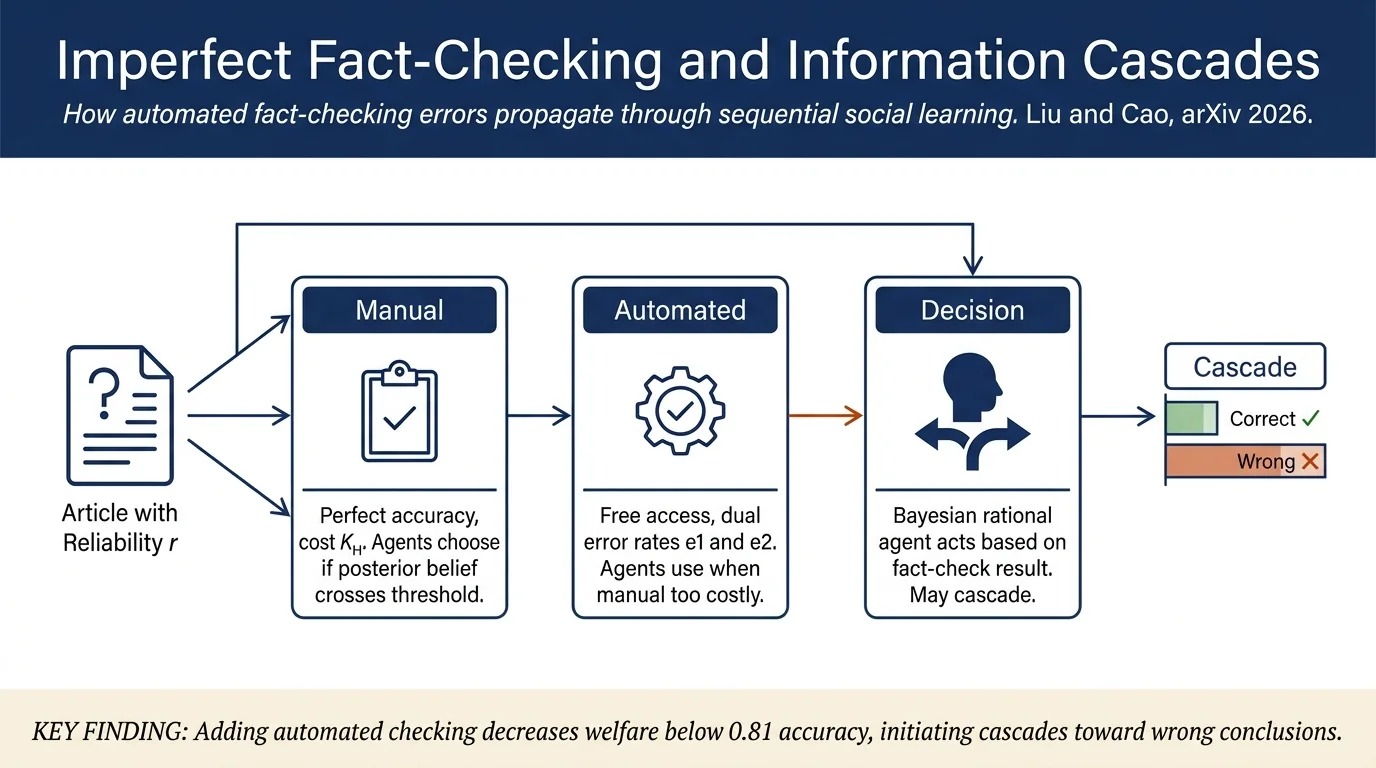
When Imperfect Automated Fact-Checking Backfires: Social Learning in the Presence of MisinformationAutomated fact-checking tools are free and fast but error-prone; manual checking is costly but accurate. This paper studies whether adding a free automated tool alongside manual fact-checking improves social welfare (defined as the probability a cascade reaches the correct conclusion).
 Psychology & interventionsFact-checking & verification
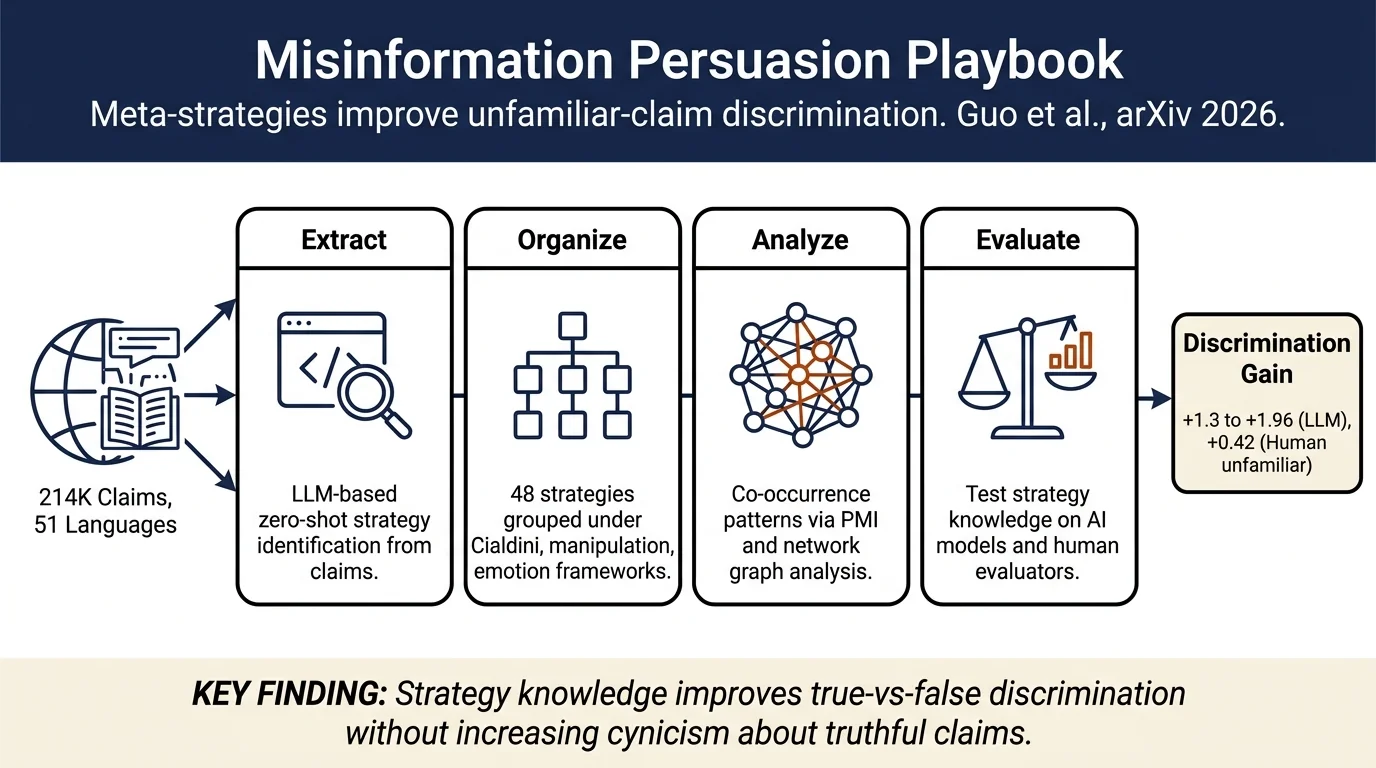
A misinformation playbook sharpens judgement without breeding cynicismThis paper analyzes 214,646 fact-checked claims across 51 languages to map misinformation's persuasion playbook—48 recurring strategies organized under social influence, information manipulation, and emotional appeal. Rather than flagging specific false claims, teaching these meta-strategies improves how both AI models and humans judge…
 Platforms, policy & societyDatasets & evaluation
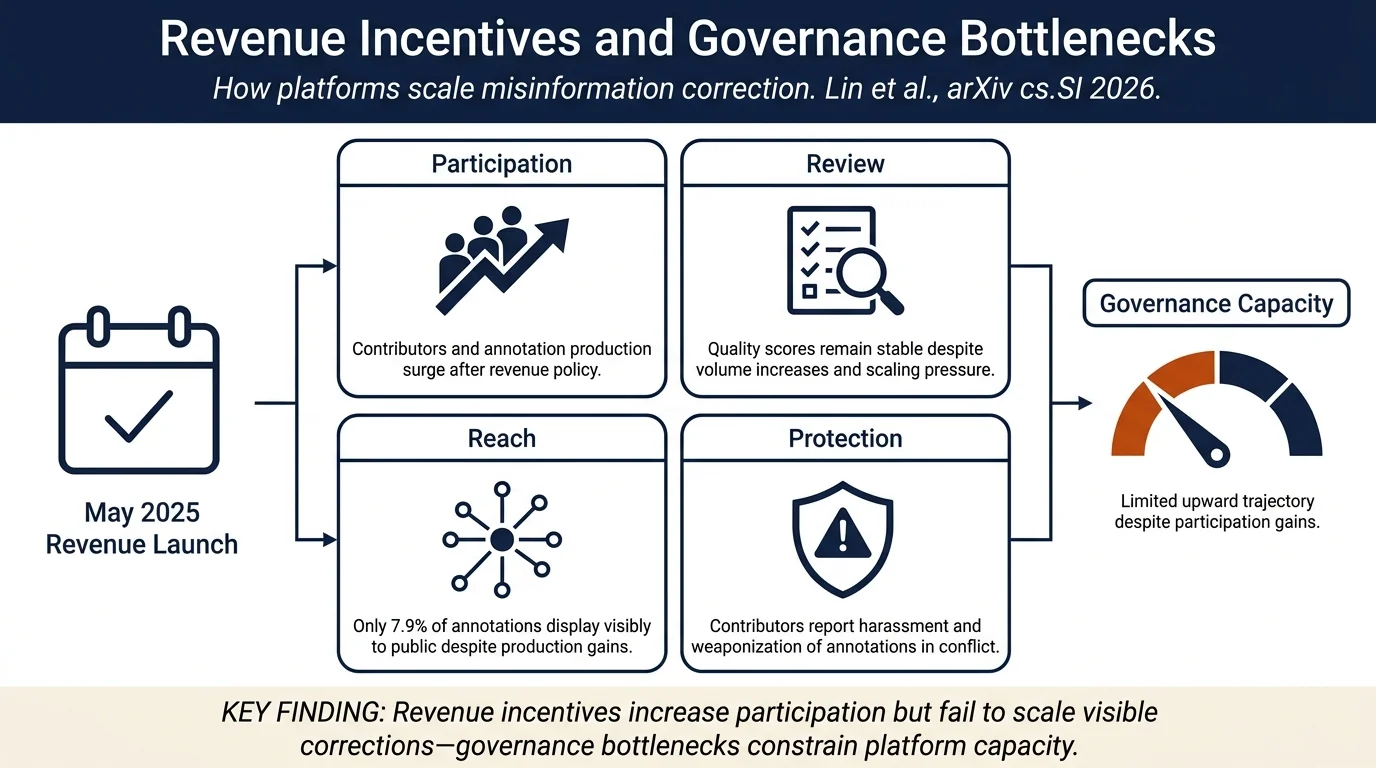
When Platforms Pay Users to Correct Misinformation: Revenue Incentives and Governance Capacity in Weibo AnnotationsWeibo Annotations is a crowdsourced governance system that lets users add corrections and contextual information to disputed claims. In May 2025, Weibo introduced monetary rewards for approved annotations.
 Fact-checking & verificationPlatforms, policy & society
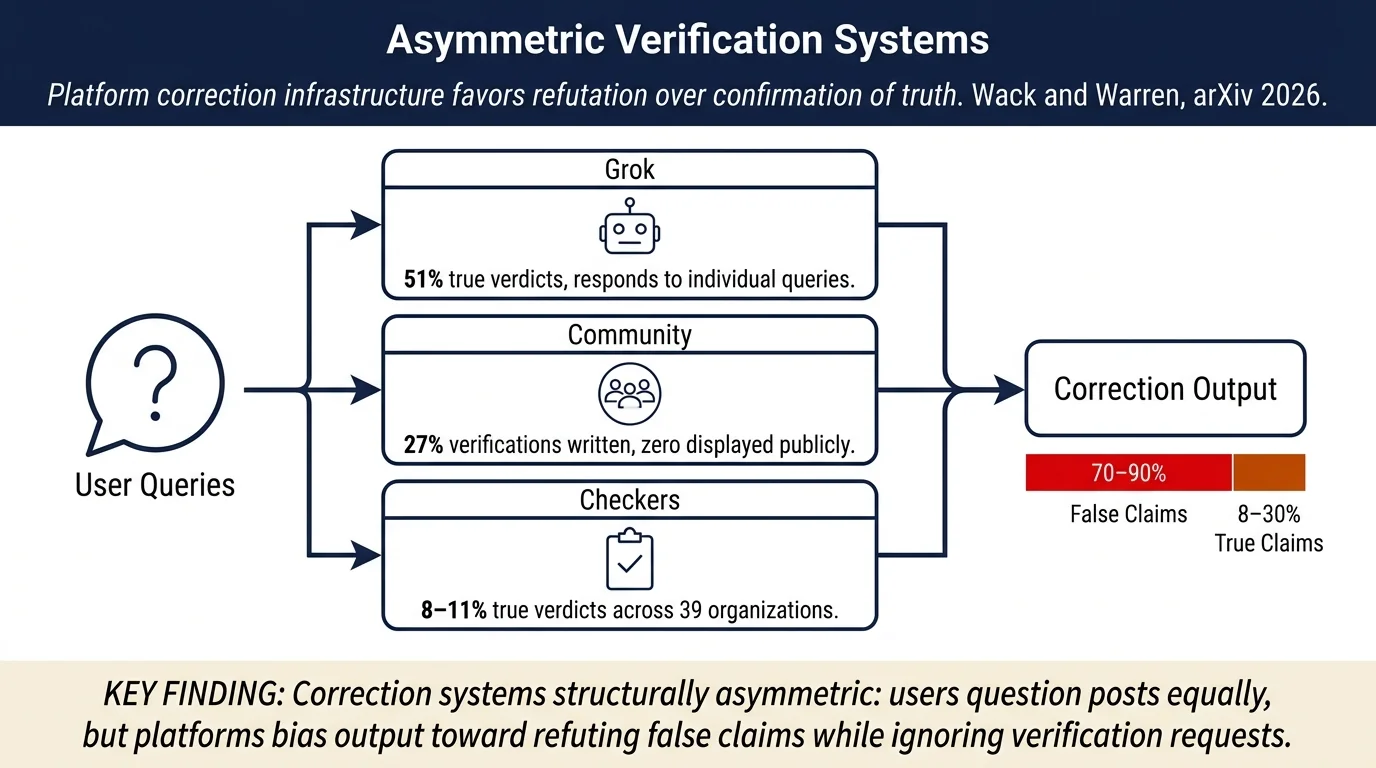
Fact-check? True!: Tracking Verification Requests and the Absence of Truth Verdicts across Correction SystemsExamining 47,899 X/Twitter users asking Grok (X's AI assistant) whether posts are true, the authors find that ~51% of questioned posts are actually accurate, yet correction systems (Community Notes, professional fact-checkers) focus overwhelmingly on false claims. Professional fact-checkers publish true verdicts in only 8–11% of their…
 LLMs & generative AIFact-checking & verification
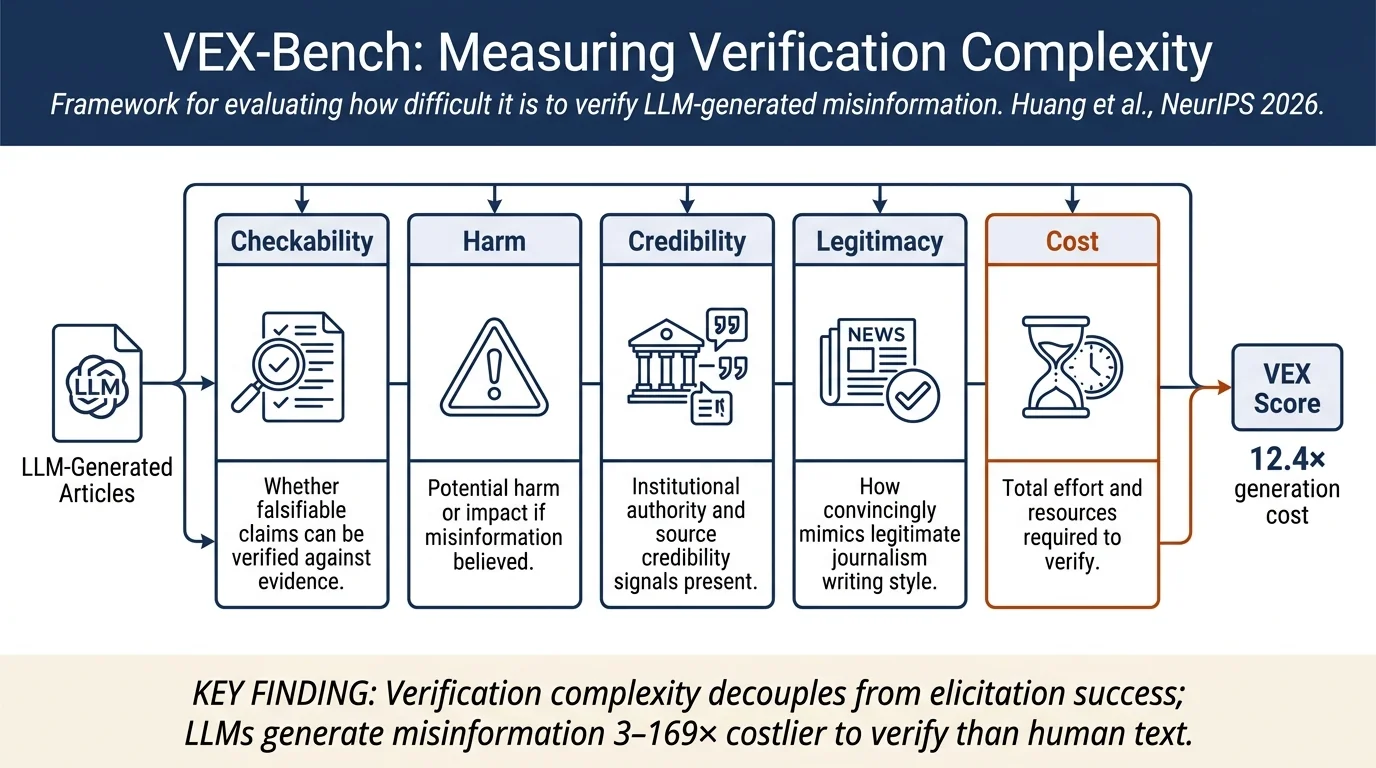
VEX-Bench: Benchmarking Verification Complexity of LLM-Generated MisinformationThis paper introduces VEX-Bench, a unified benchmark for evaluating how difficult it is to verify LLM-generated misinformation. The benchmark measures verification complexity across five dimensions: checkability (whether claims can be checked), harm significance, source credibility signals, impostor legitimacy, and verification cost.
 Fact-checking & verificationLLMs & generative AI
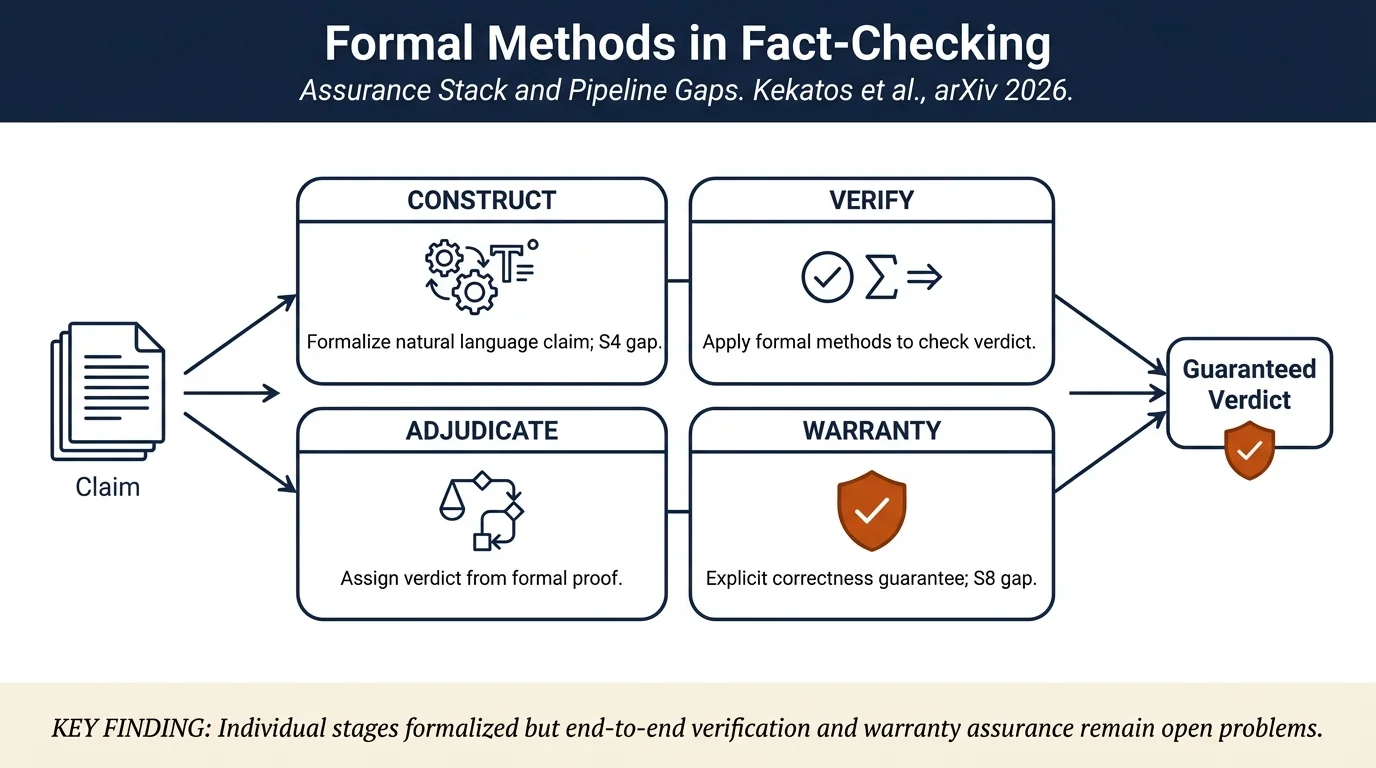
SoK: Formal Methods for Fact-Checking and Information IntegrityThis systemization of knowledge surveys formal methods (logic, model checking, theorem proving, symbolic reasoning) applied to fact-checking systems. The authors organize 121 works by assurance level and identify two critical gaps: constructing checkable claims and correcting errors in published verdicts.
 Fact-checking & verificationLLMs & generative AI
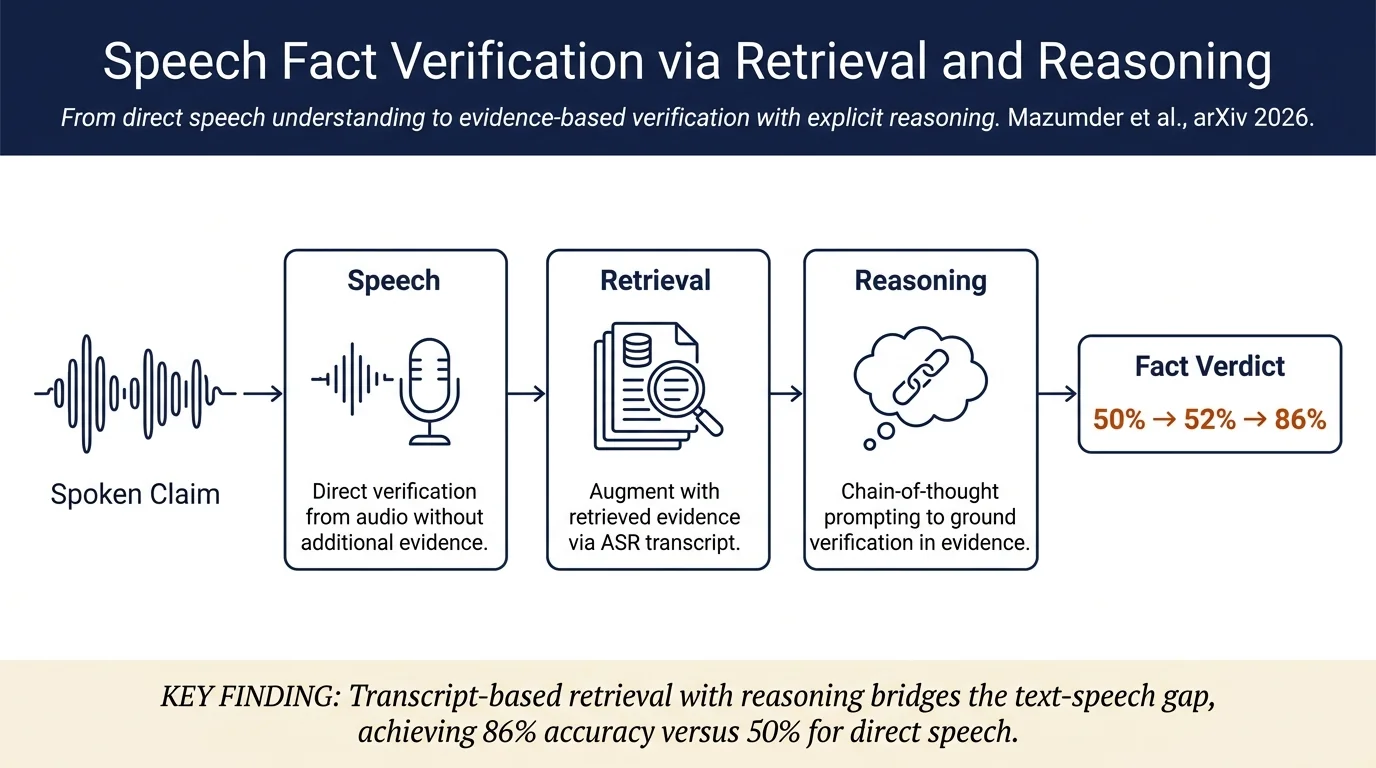
To Trust or Not to Trust: Retrieval-Augmented Fact Checking in SpeechLarge Audio Language Models (LALMs) exhibit a significant text-speech modality gap: they verify written claims reliably but fail on spoken ones, even from the same model. The paper introduces VeriSpeak, a benchmark of 3,879 spoken claims with temporal, geographical, and relational facts, and demonstrates that retrieval-augmented LALMs…
 LLMs & generative AIPsychology & interventions
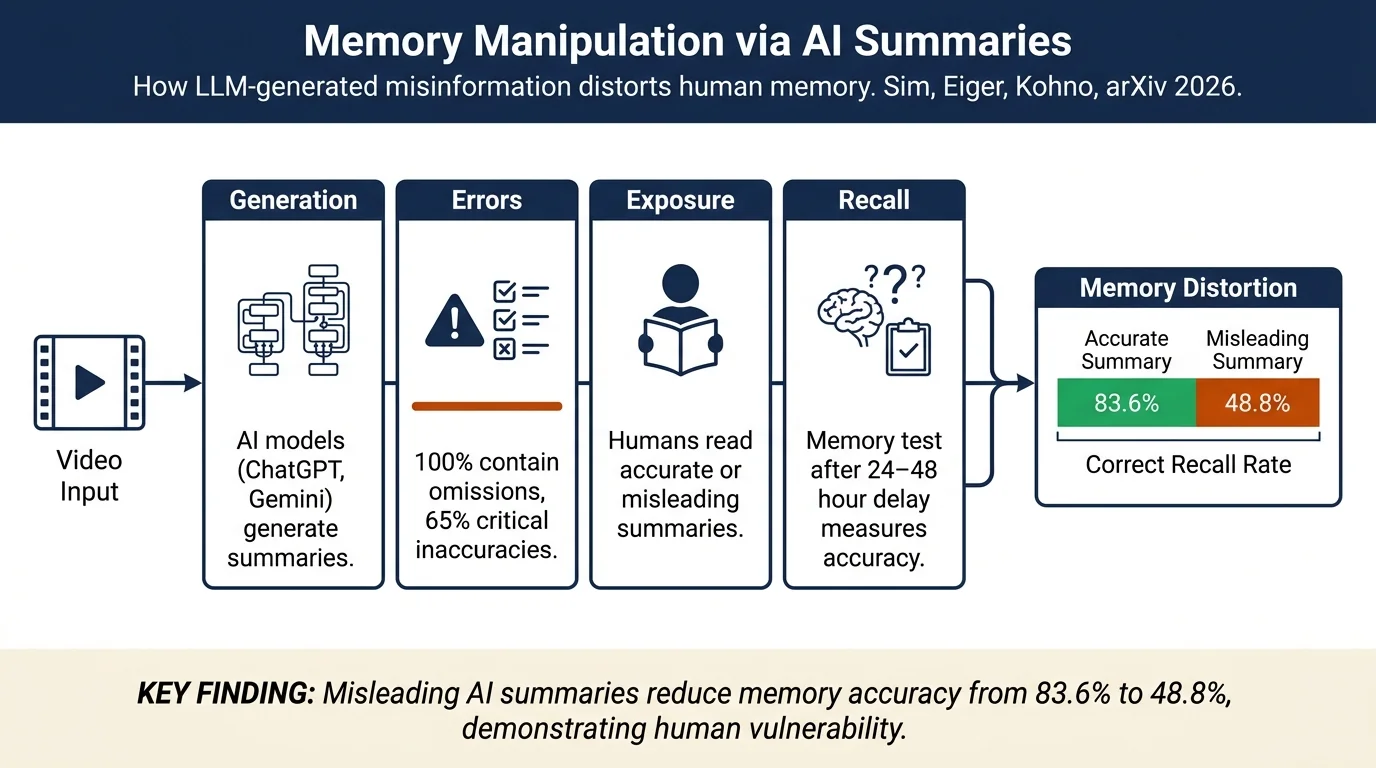
AI-Enabled Human Memory Manipulation: Misleading AI-Generated Summaries Distort Human MemoryLarge language models frequently generate erroneous summaries of videos, including critical omissions and hallucinated details. In a human-subjects experiment, participants who read AI-generated summaries containing misleading information were significantly less likely to accurately recall the original event—demonstrating that AI…
 LLMs & generative AIPlatforms, policy & society
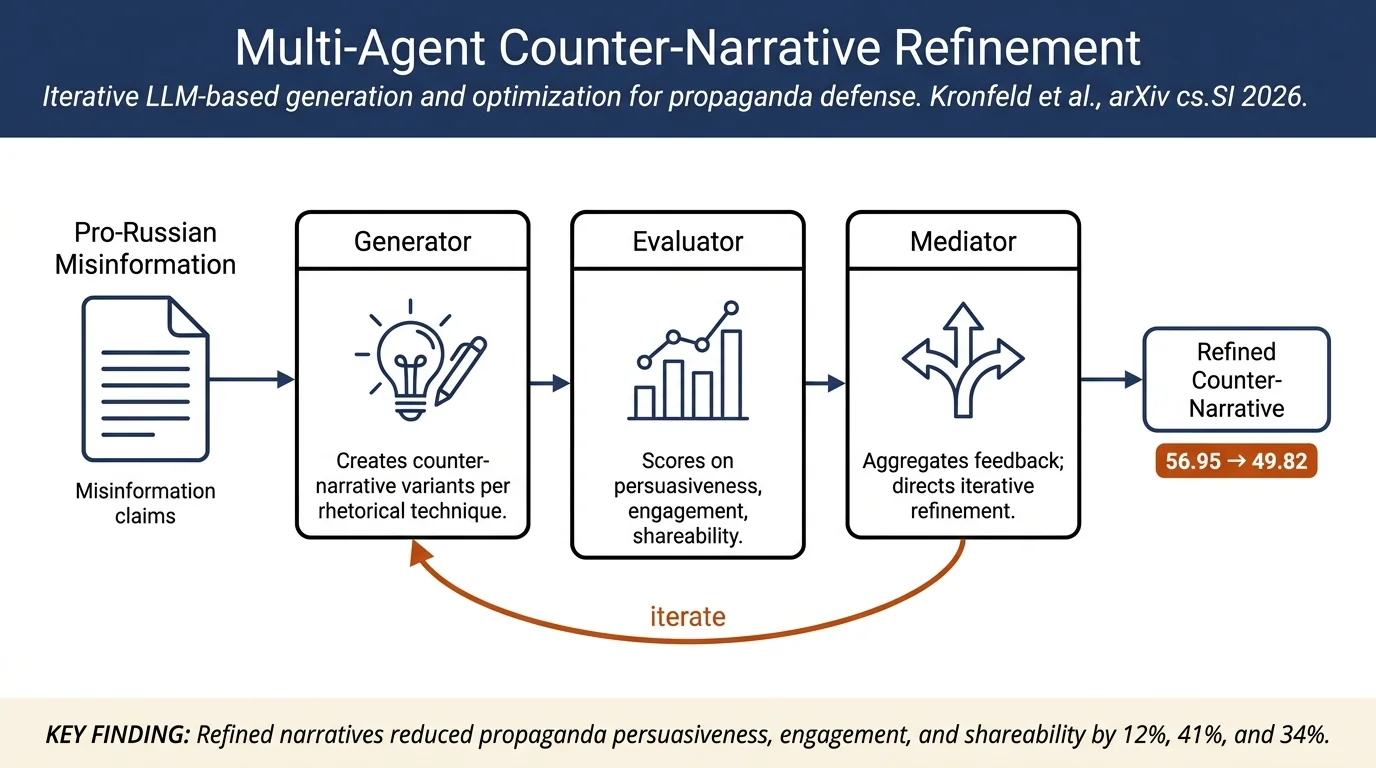
A Multi-Stage Agentic Framework for Effective Counter-Narrative Generation and RefinementCounter-narratives are a scalable defense against misinformation and hate speech, but manual authoring is slow and labor-intensive. This paper proposes a multi-stage agent-based framework using LLMs to generate and iteratively refine counter-narratives on pro-Russian misinformation about Ukraine.
 LLMs & generative AIPlatforms, policy & society
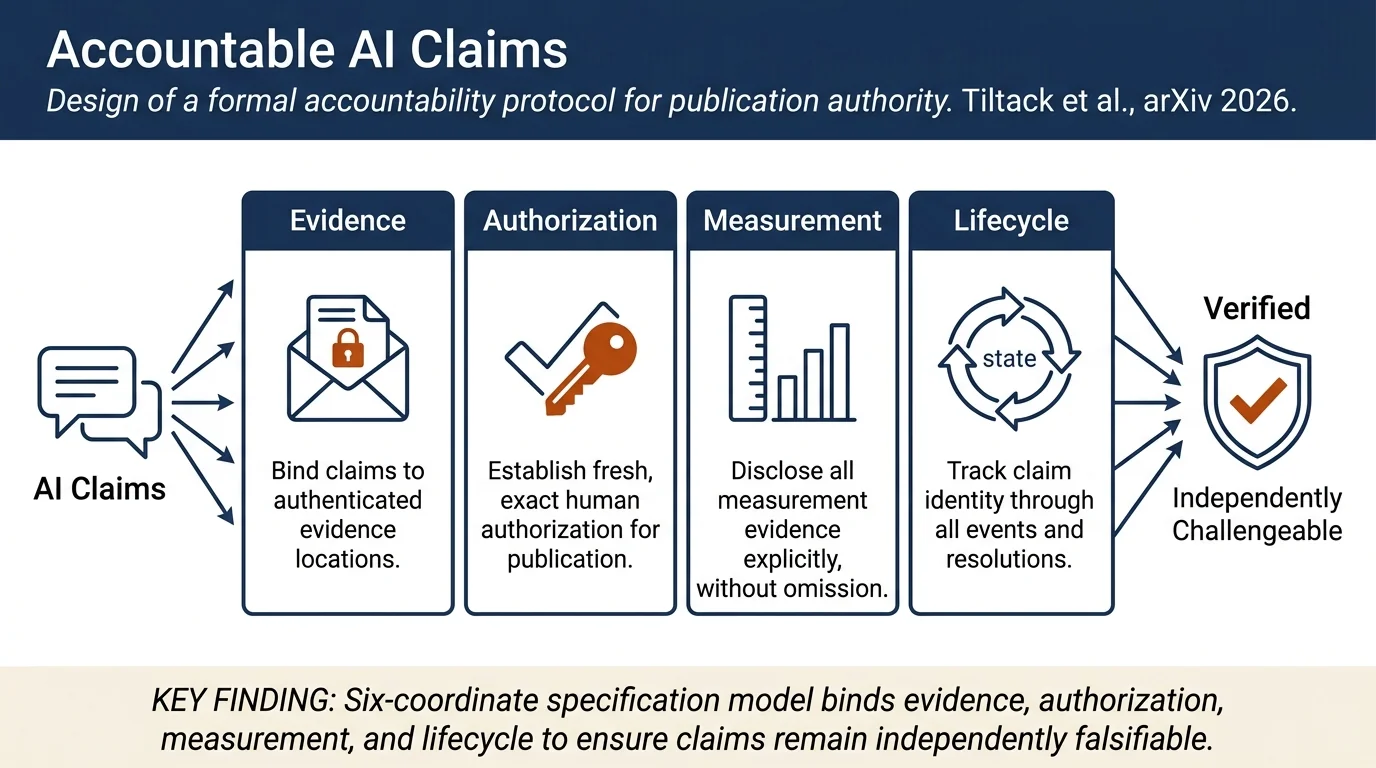
Making AI-Assisted Claims Independently Challengeable: Publication Authority and a Protocol for Falsifiable Publication RecordsAI-assisted claims can appear authoritative even when evidence, analysis, and authorization refer to different states—creating a coordination problem. This work introduces Publication Authority (PA) as a non-transferable, single-use capability governing publication transitions, and proposes PAC-2026 SF-4, an executable specification…
 LLMs & generative AIFact-checking & verification
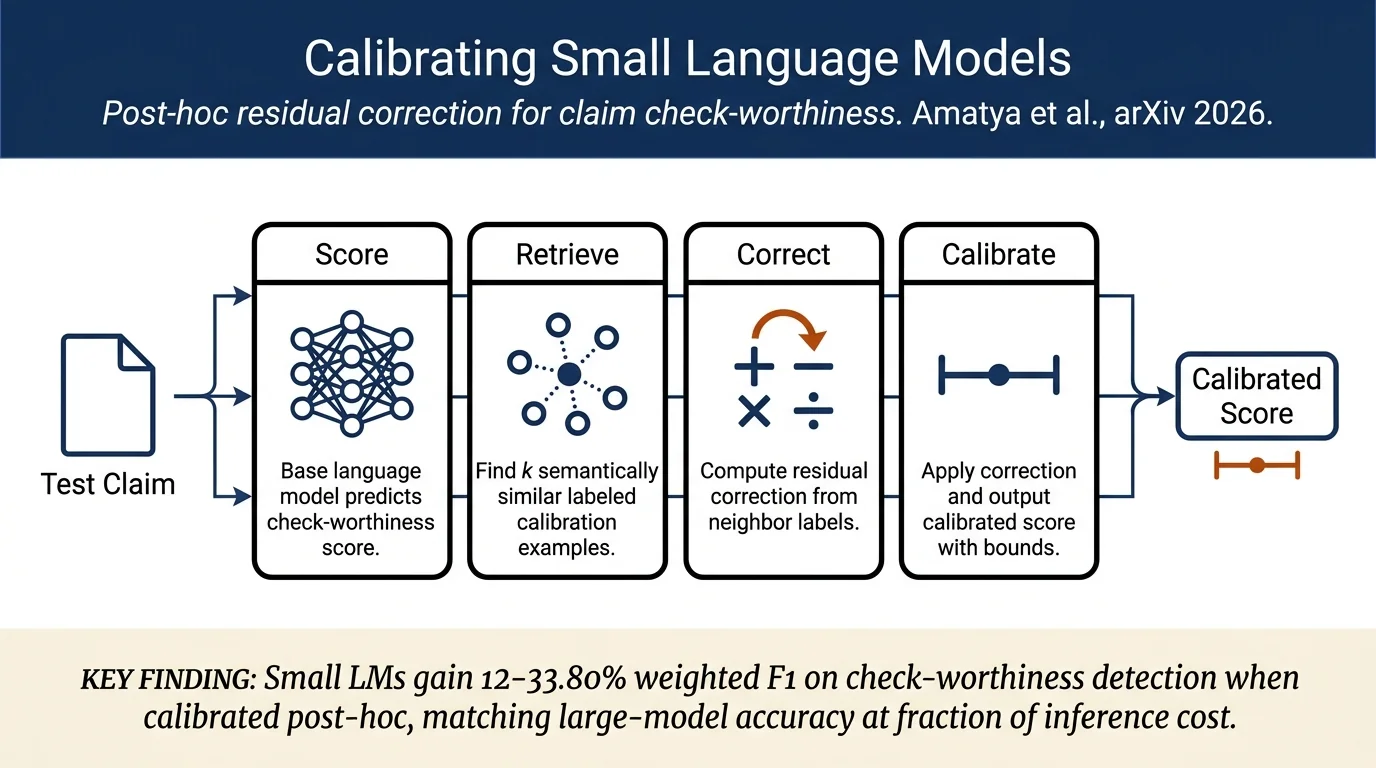
Calibrating Small Language Models for Claim Check-Worthiness DetectionClaim check-worthiness detection is computationally expensive when using large language models, but essential for scaling fact-checking pipelines. This paper proposes NN-PPI (Nearest Neighbor Prediction-Powered Inference), a post-hoc calibration technique that improves small LM predictions using a small labeled calibration set and…
 Fact-checking & verificationDatasets & evaluation
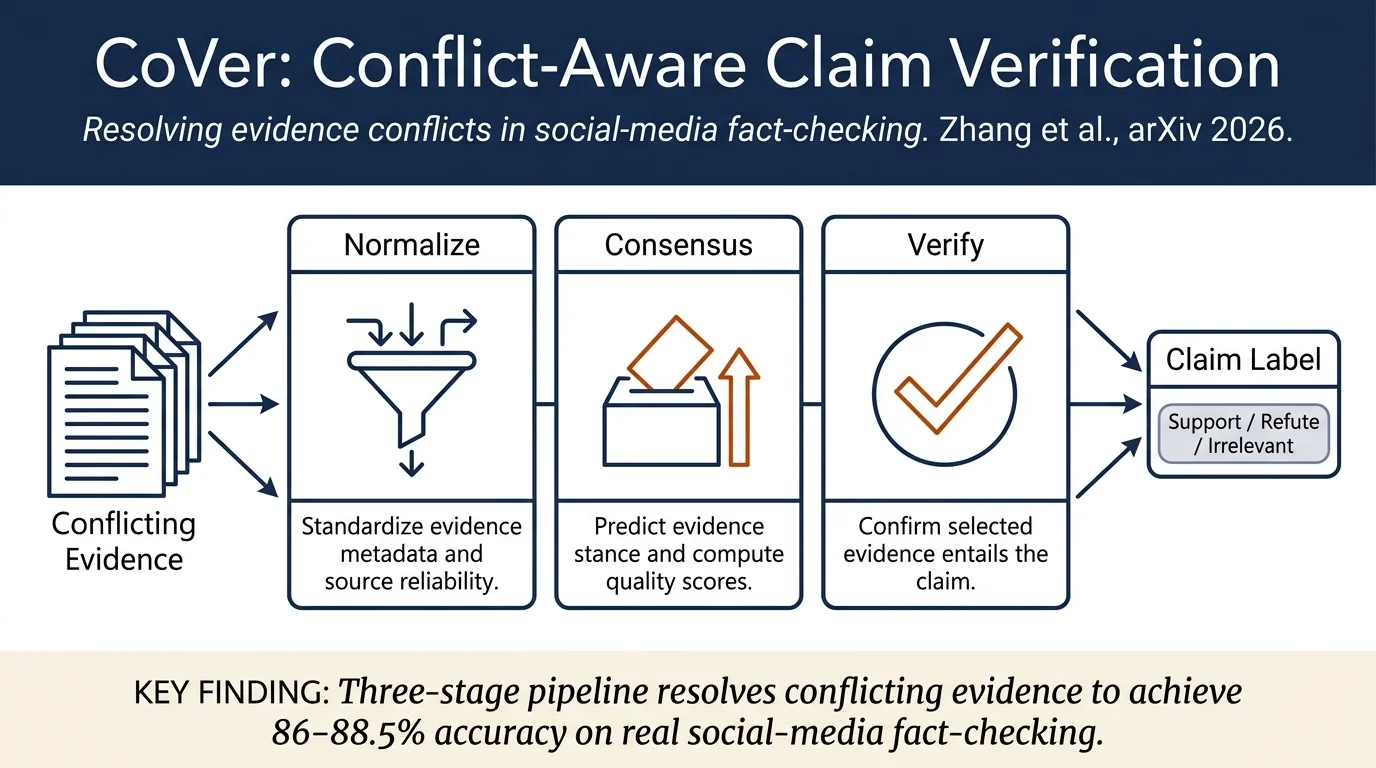
CoVer: Conflict-Aware Claim VerificationSocial media fact-checking frequently encounters conflicting evidence where different sources support or refute a claim. This paper proposes CoVer, a framework that explicitly resolves evidence-level conflicts (contradictory stances from different sources) and aggregation-level conflicts (sub-claims within complex claims yielding…
 LLMs & generative AIPlatforms, policy & society
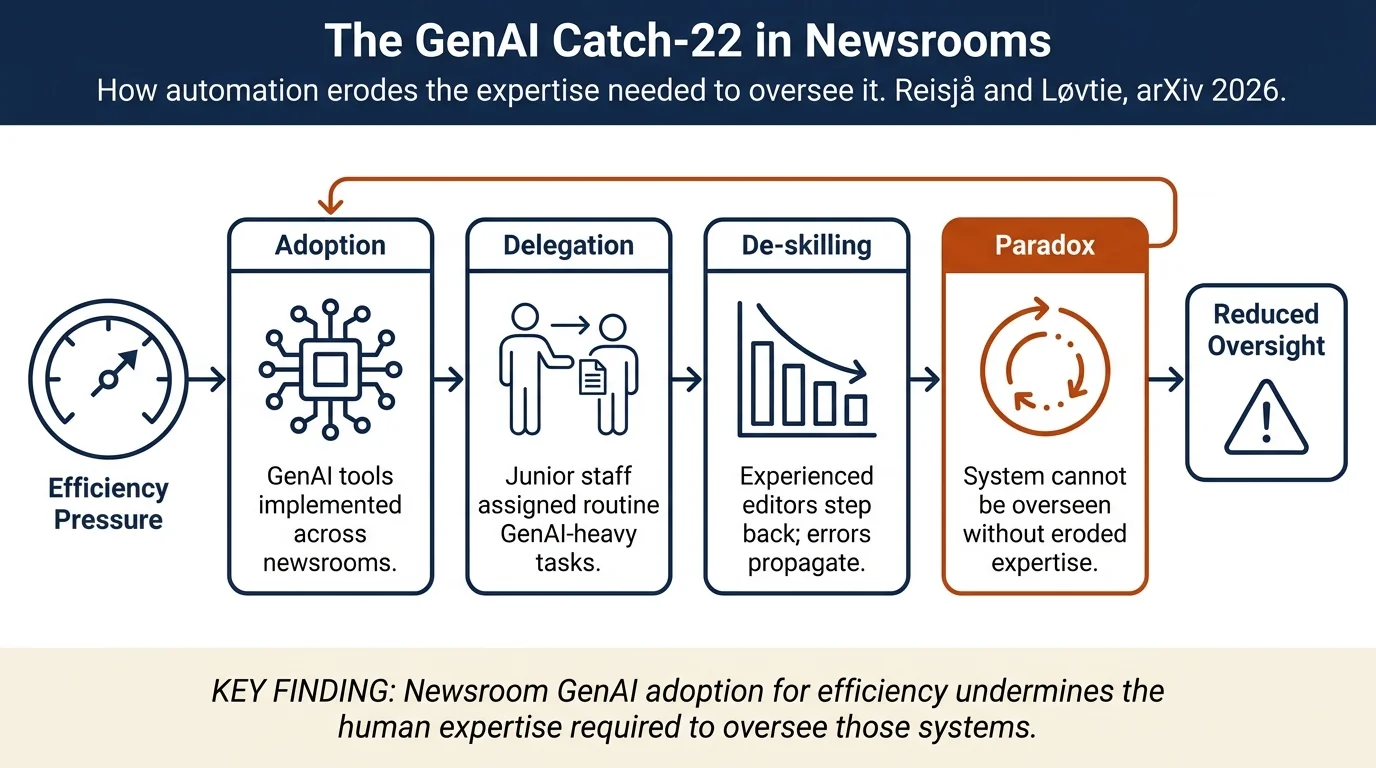
The GenAI Catch-22: Use of Generative Artificial Intelligence in Norwegian Newsrooms During the 2025 Parliamentary ElectionA longitudinal qualitative study of four major Norwegian newsrooms (NRK, TV2, VG, Dagbladet) during the 2025 parliamentary election reveals a "GenAI Catch-22": newsrooms need human expertise to oversee generative AI systems and prevent errors, but extensive use of GenAI leads to de-skilling that erodes that very expertise, rendering…
 Detection methodsDeepfakes & multimodal
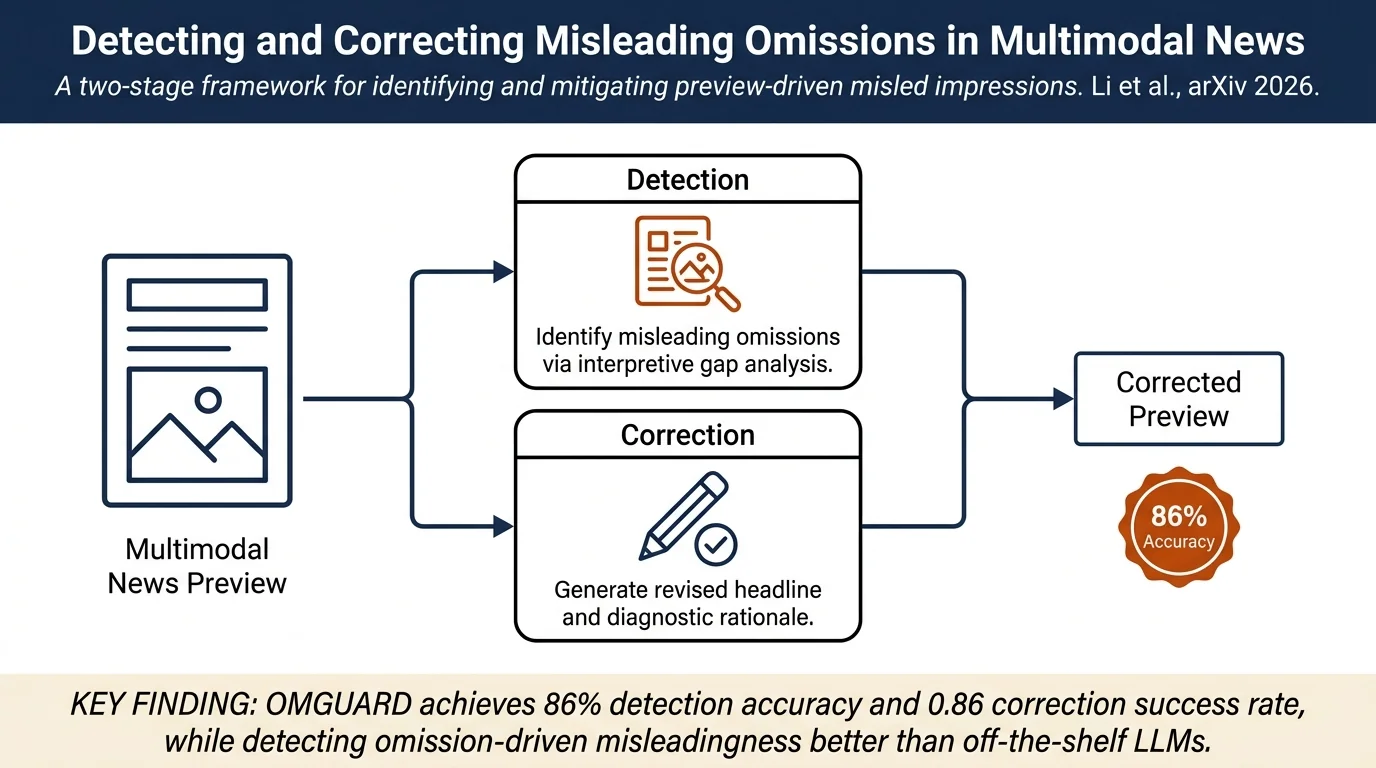
What's Left Unsaid? Detecting and Correcting Misleading Omissions in Multimodal News PreviewsNews previews (headline + image) on social media can mislead readers through selective omission of critical context present in the full article. This paper introduces MM-MISLEADING, a benchmark of 6,000 multimodal news previews annotated for misleading omissions, and proposes OMGUARD, a framework combining interpretation-aware…
 Psychology & interventionsFact-checking & verification
Psychological Inoculation Against MisinformationSander van der Linden surveys the psychology of misinformation susceptibility and defends the approach of psychological inoculation (pre-bunking) over fact-checking (debunking). He introduces the MIST (Misinformation Susceptibility Test), a psychometrically validated instrument for measuring individual variation in susceptibility to…
 Datasets & evaluationDetection methods
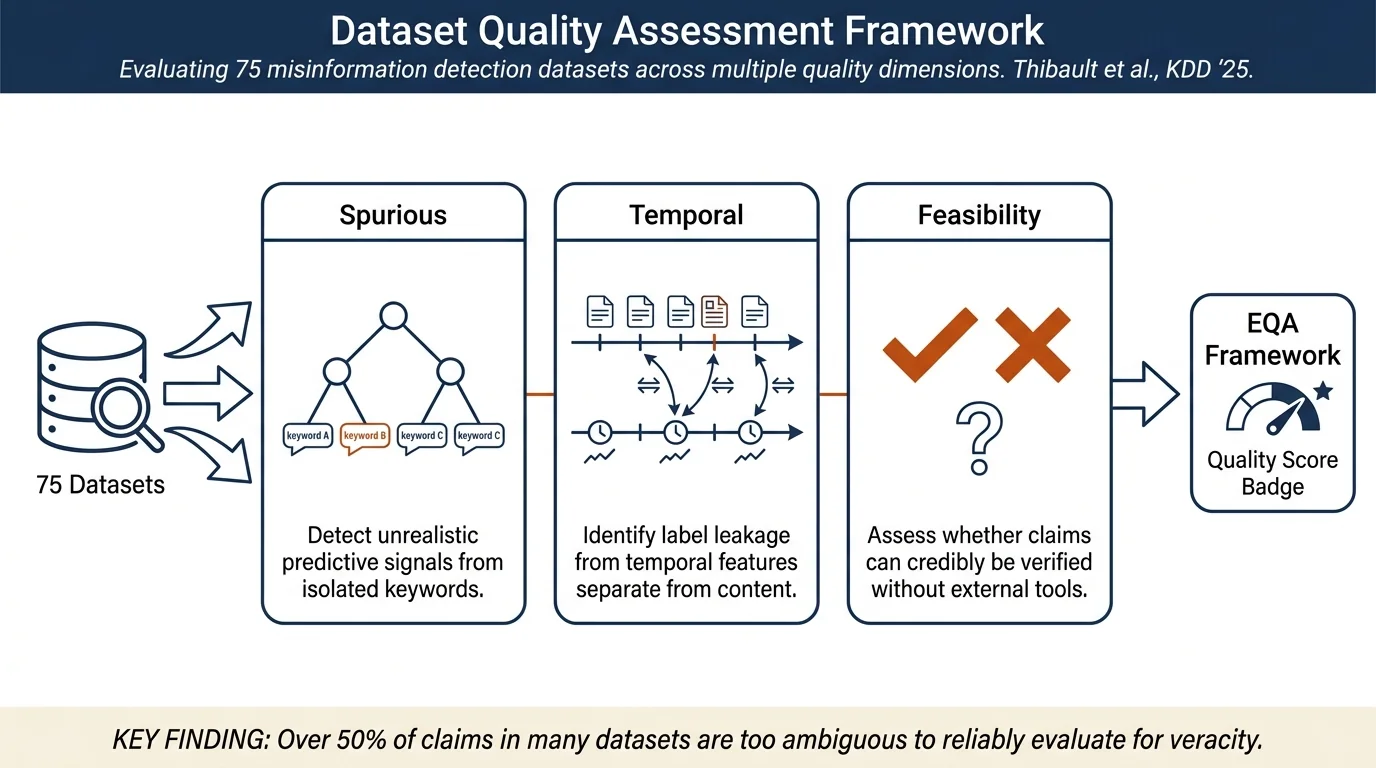
A Guide to Misinformation Detection Data and EvaluationThis work surveys the largest collection of misinformation detection datasets to date (75 datasets from prior literature) and evaluates dataset quality across multiple dimensions. The authors assess whether datasets enable reliable veracity evaluation by analyzing keyword correlations, temporal correlations, and feasibility of claim…
 Psychology & interventionsDetection methods
Fact or Fake? The Psychology of MisinformationEcker presents an overview of misinformation psychology, covering definition, sources, behavioral impacts, and evidence-based interventions. He demonstrates that misinformation influences reasoning even after people receive corrections (the continued influence effect), and that corrections are only partially effective.
LLMs & generative AIPlatforms, policy & society
Controlled Change(Stub page — referenced in context of GenAI adoption in journalism. To be expanded with full paper details.)
 Deepfakes & multimodalPlatforms, policy & society
Digital Forensic Expert Breaks Down Political DeepfakesFarid surveys the state of deepfake technology in the 2024 election cycle, demonstrating how synthetic images, audio, and video are weaponized to manipulate voters through fake endorsements, false statements, and inauthentic imagery. He details forensic detection techniques—perspective geometry, shadow physics, lip-sync analysis—that…
 LLMs & generative AIDetection methods
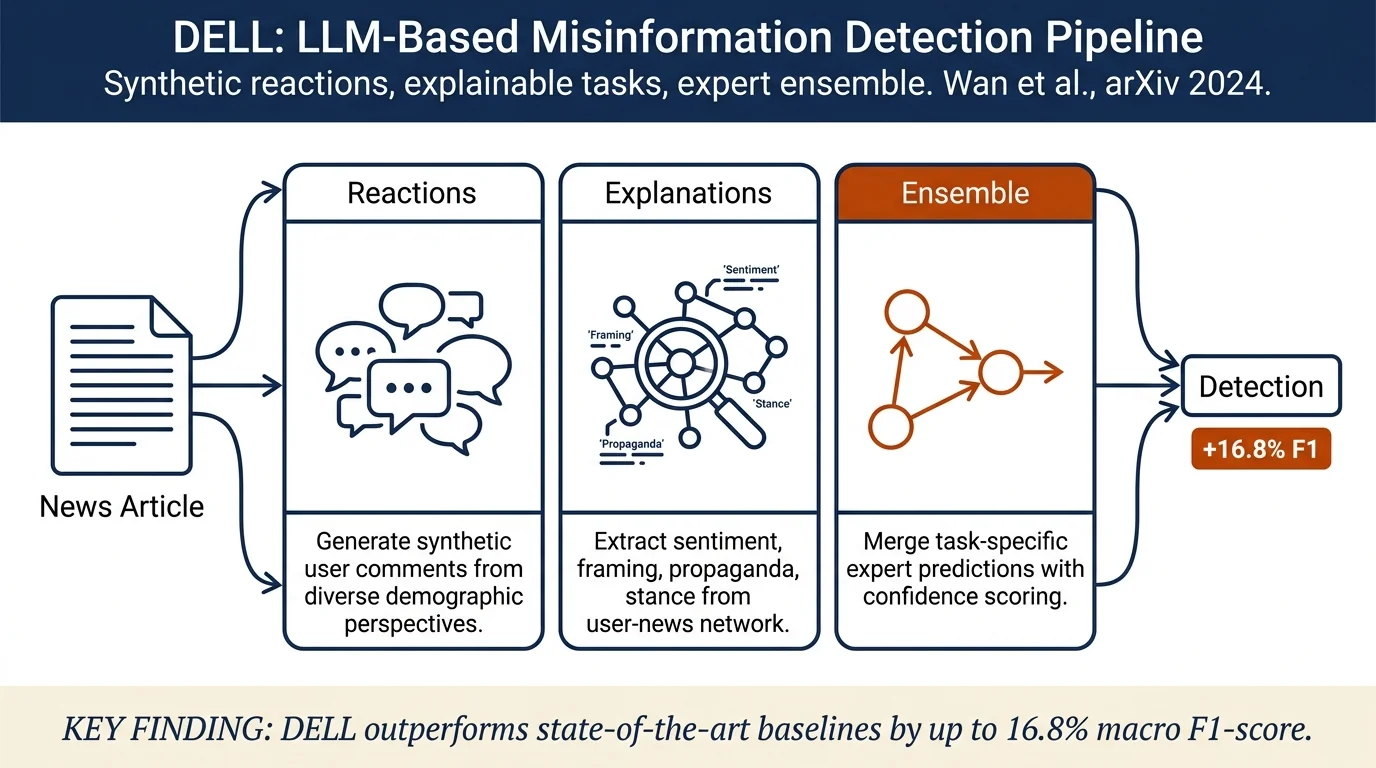
DELL: Generating Reactions and Explanations for LLM-Based Misinformation DetectionLarge language models struggle with factuality and hallucinations in misinformation detection. DELL proposes a three-stage pipeline where LLMs generate synthetic user reactions from diverse perspectives, create explanations for proxy tasks (sentiment, framing, propaganda tactics), and merge predictions from task-specific experts.
 Psychology & interventionsFact-checking & verification
Psychological Inoculation Against MisinformationSander van der Linden introduces psychological inoculation as a scalable alternative to fact-checking for building societal resistance to misinformation. Drawing on inoculation theory and his flagship intervention, the Bad News game, he demonstrates how preemptively exposing people to weakened examples of six core manipulation techniques…
 Fact-checking & verificationLLMs & generative AI
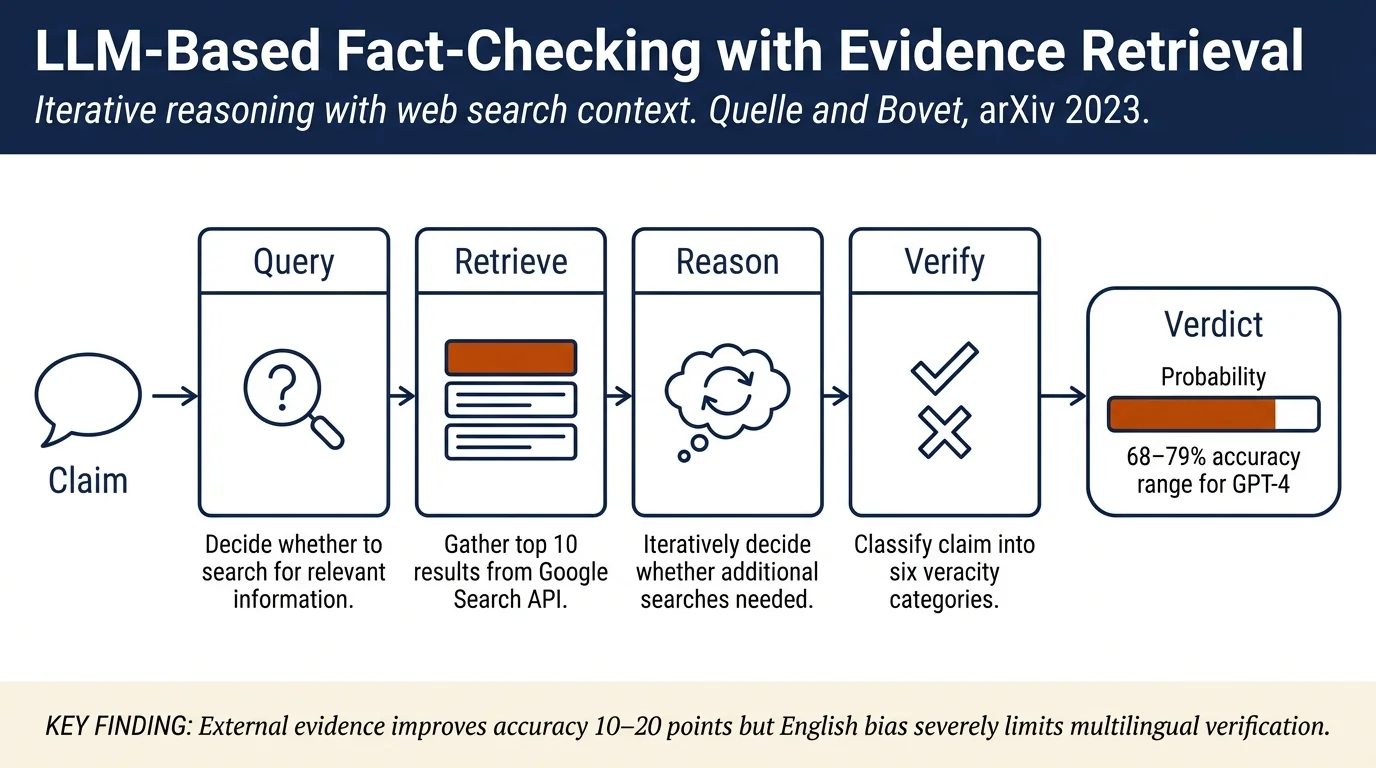
The Perils & Promises of Fact-checking with Large Language ModelsThis paper evaluates GPT-3.5 and GPT-4's ability to fact-check claims across English-only and multilingual datasets, showing GPT-4 substantially outperforms GPT-3.5 but both models show inconsistent accuracy when dealing with ambiguous verdicts. Critically, incorporating contextual information via Google Search significantly improves…
 LLMs & generative AIFact-checking & verification
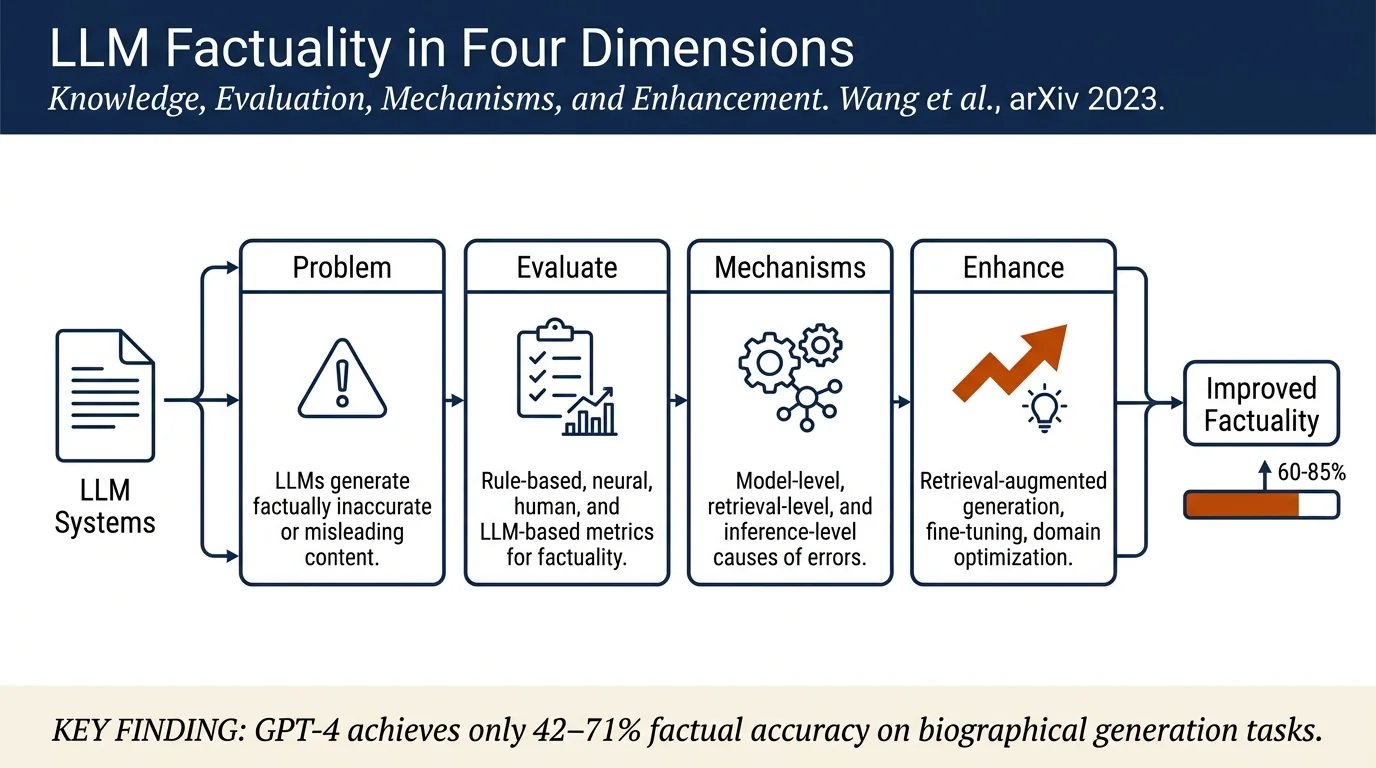
Survey on Factuality in Large Language Models: Knowledge, Retrieval and Domain-SpecificityThis comprehensive survey addresses the critical problem of factuality in large language models, examining how LLMs store and retrieve knowledge, analyzing the mechanisms through which they generate false or misleading content, and reviewing evaluation metrics and enhancement strategies. The paper distinguishes factuality issues from…
 LLMs & generative AIDatasets & evaluation
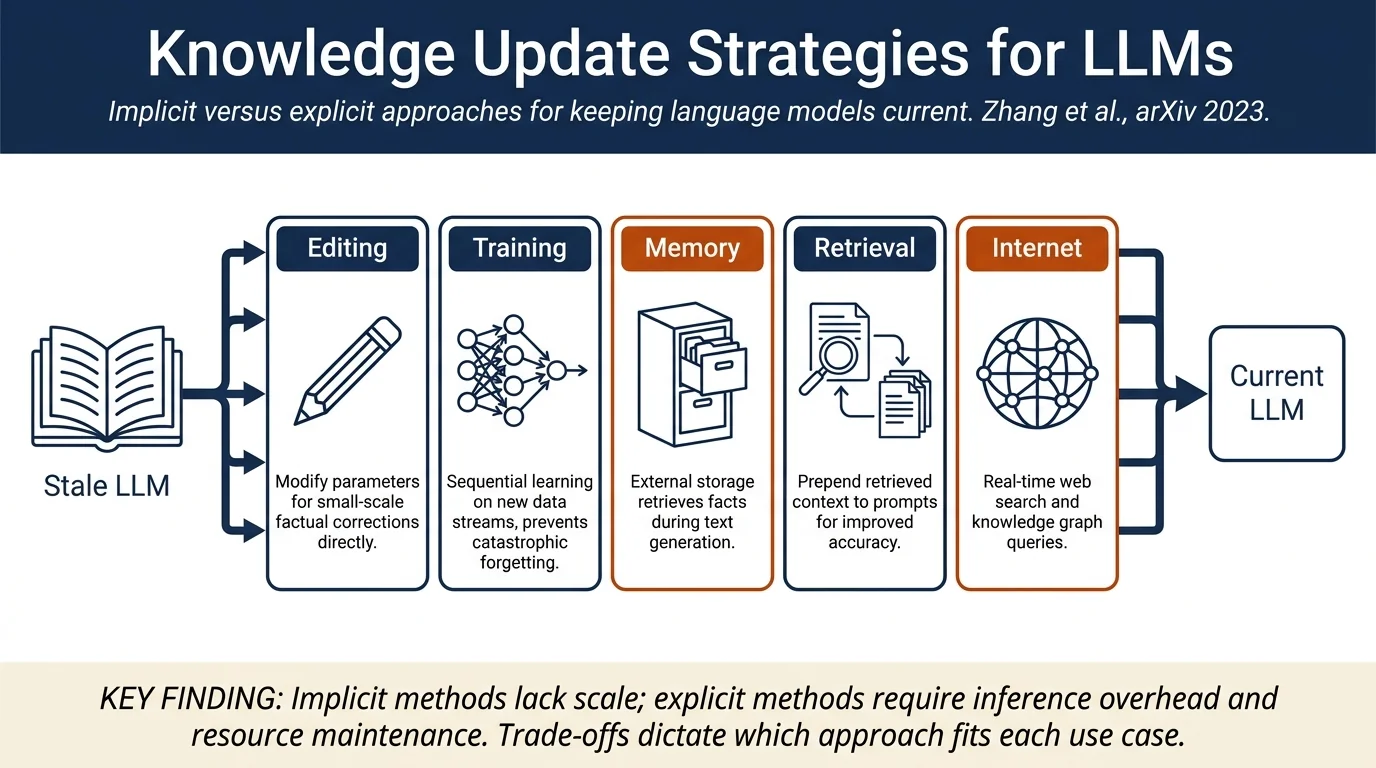
How Do Large Language Models Capture the Ever-changing World Knowledge? A Review of Recent AdvancesThis survey reviews methods for aligning large language models with ever-changing world knowledge without retraining from scratch. The authors systematically categorize approaches as either implicit (modifying LLM parameters directly via knowledge editing or continual learning) or explicit (augmenting LLMs with external resources via…
 LLMs & generative AIDetection methods
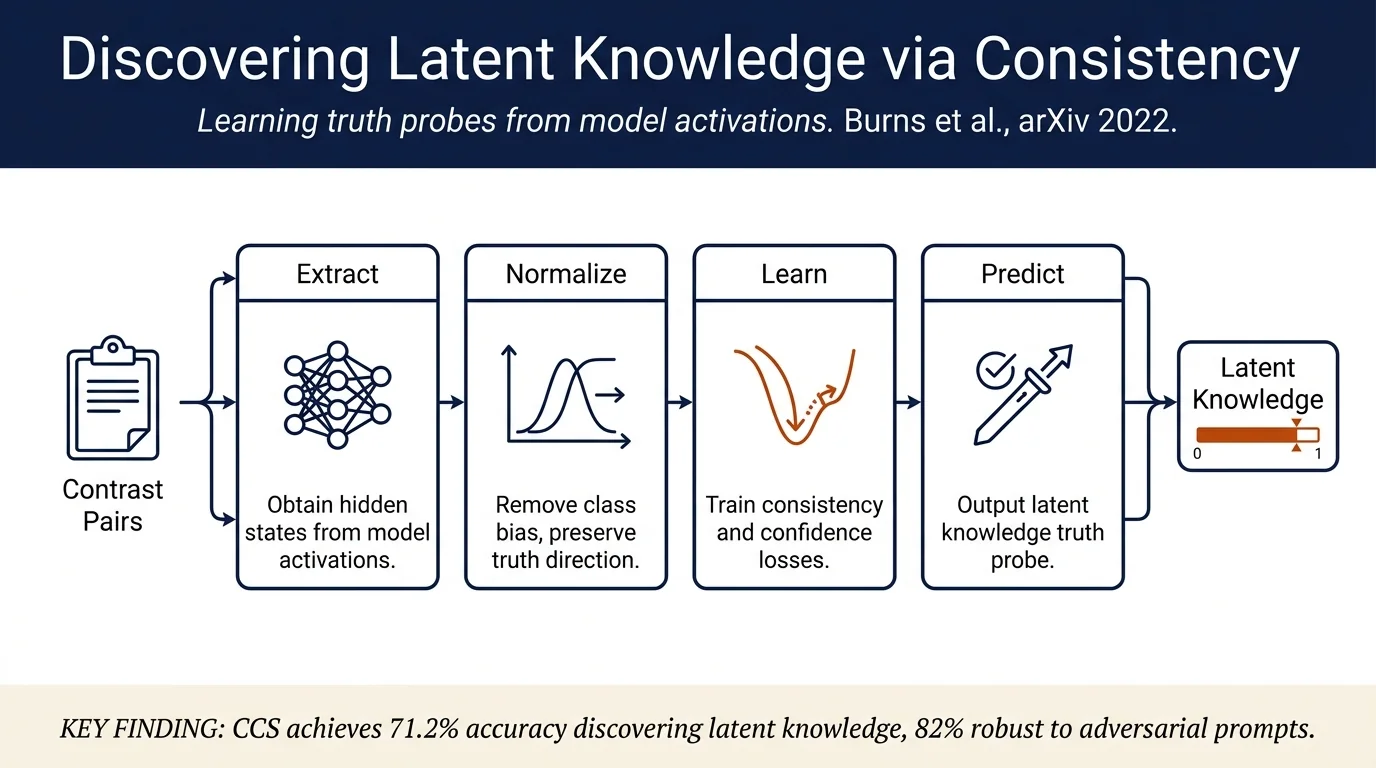
Discovering Latent Knowledge in Language Models Without SupervisionLanguage models trained with standard objectives (imitation, reward-based) can output false statements even when they internally "know" the truth. This paper proposes Contrast-Consistent Search (CCS), an unsupervised method that exploits truth's logical structure—a statement and its negation cannot both be true—to recover latent…
 LLMs & generative AIFact-checking & verification
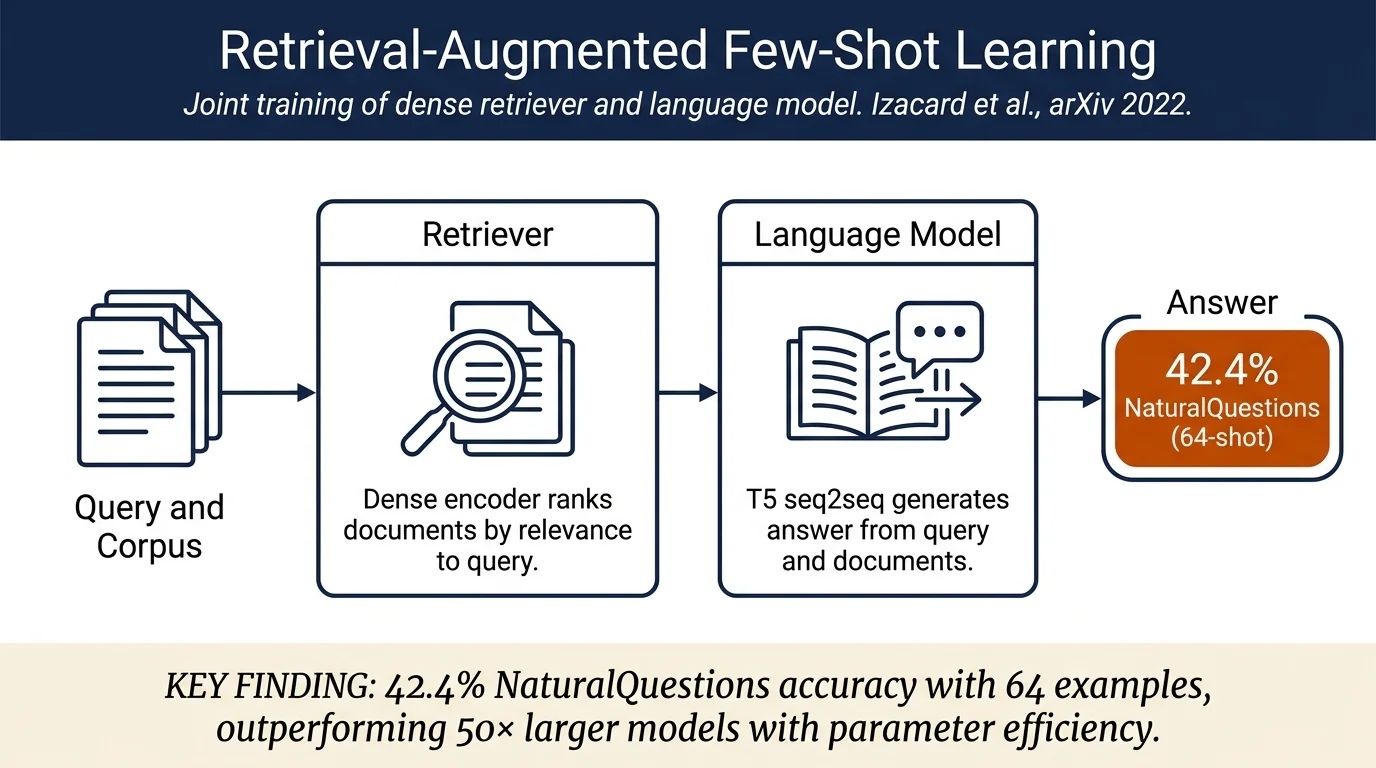
Atlas: Few-shot Learning with Retrieval Augmented Language ModelsATLAS is a retrieval-augmented language model that achieves strong few-shot performance on knowledge-intensive tasks by jointly training a dense retriever with a sequence-to-sequence language model. Unlike standard language models that must memorize knowledge, ATLAS retrieves relevant documents at both pre-training and fine-tuning…
 Datasets & evaluationDetection methods
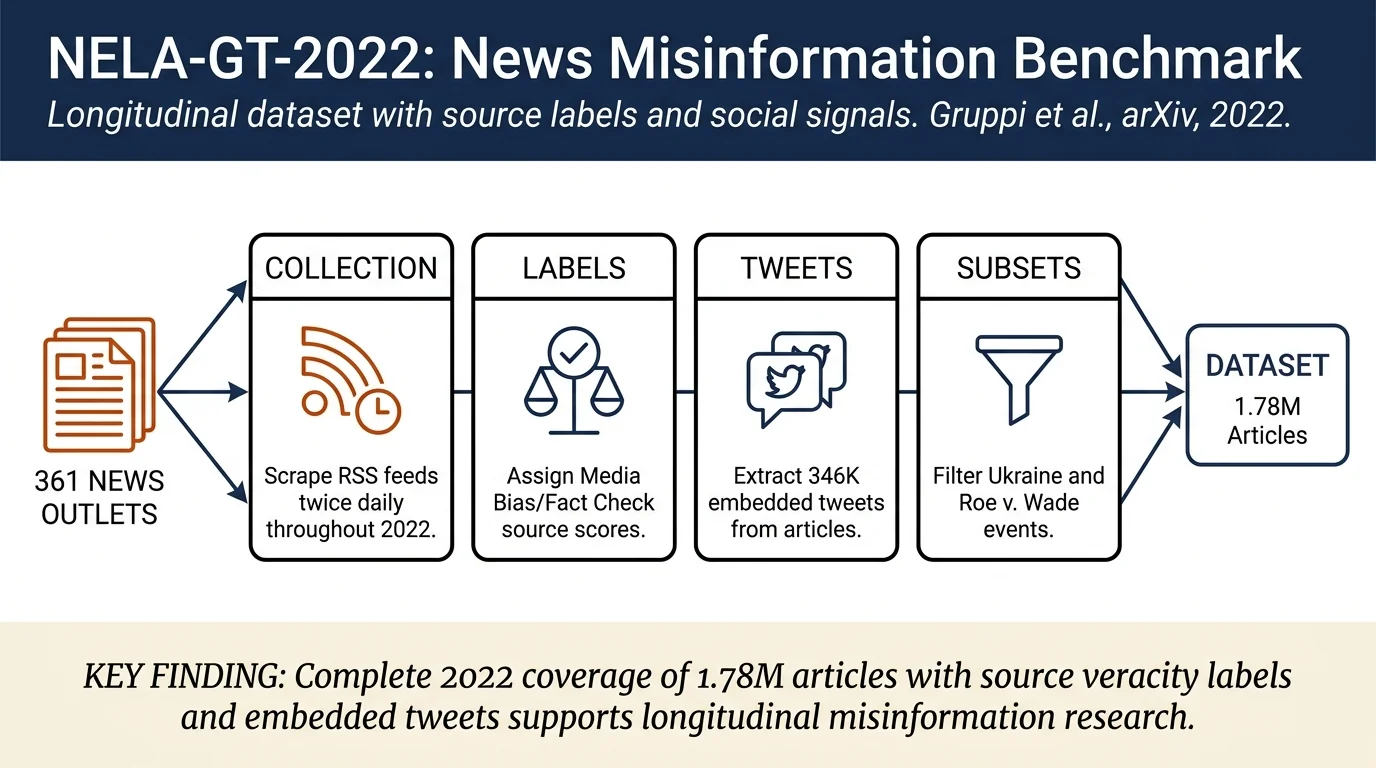
NELA-GT-2022: A Large Multi-Labelled News Dataset for The Study of Misinformation in News ArticlesPresents the fifth NELA-GT dataset release: 1.78 million news articles from 361 outlets spanning all of 2022, with source-level veracity labels from Media Bias/Fact Check and embedded tweet data. Focuses on stabilizing collection infrastructure to achieve near-complete temporal coverage, enabling robust benchmarking of fake news…
 Psychology & interventionsFact-checking & verification
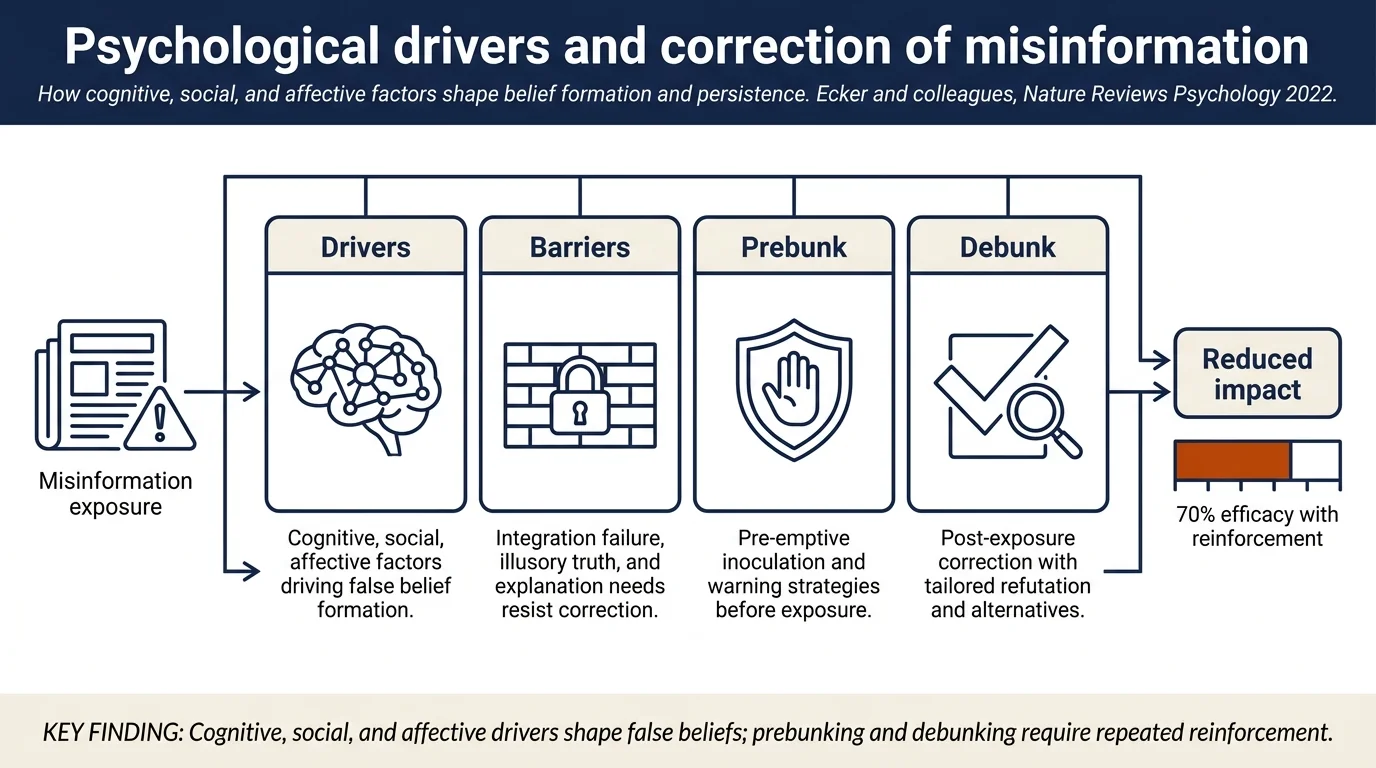
The psychological drivers of misinformation belief and its resistance to correctionThis comprehensive review establishes that misinformation's power lies not in exposure but in how cognitive, social, and affective factors shape belief formation and persist even after correction. False beliefs arise from intuitive thinking, memory failures, emotional content, in-group bias, and source credibility judgments; corrections…
 Fact-checking & verificationDetection methods
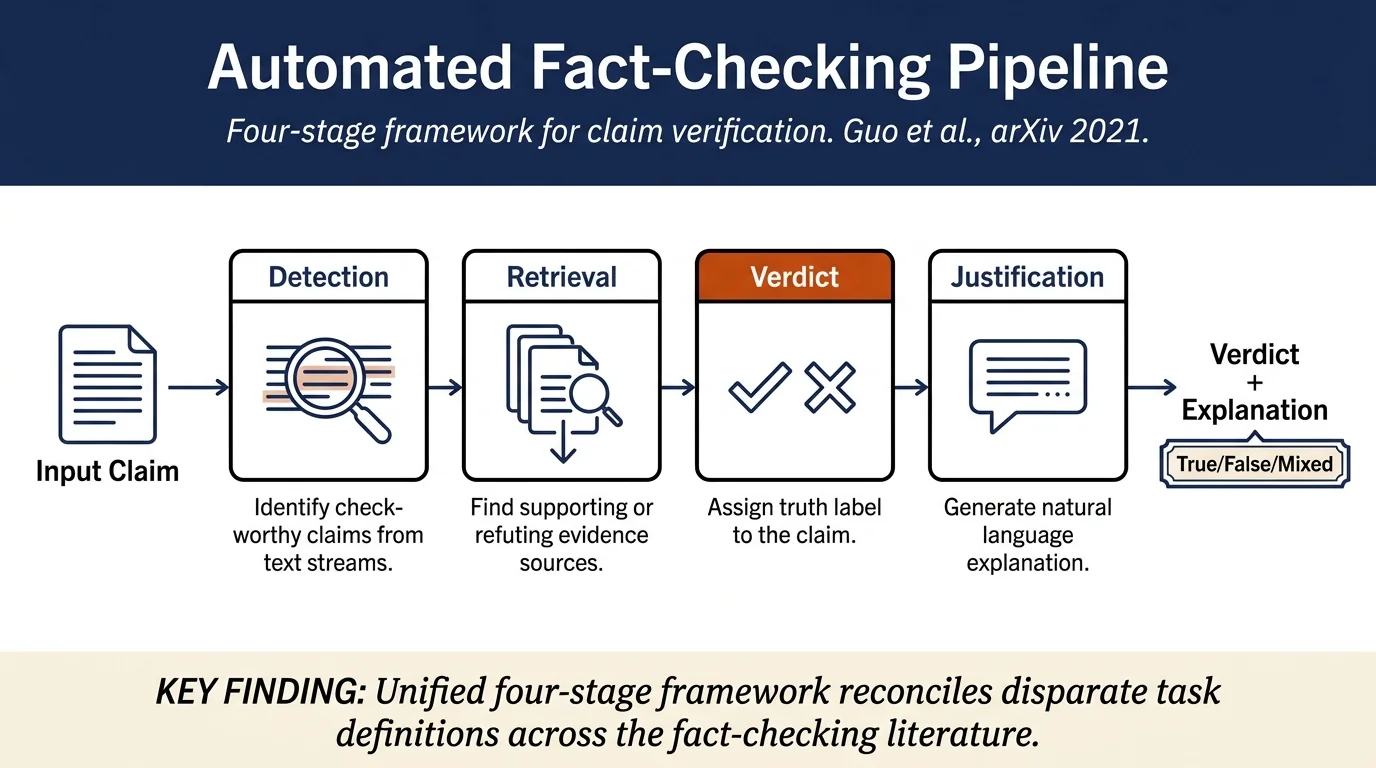
A Survey on Automated Fact-CheckingThis comprehensive survey unifies automated fact-checking research under a four-stage NLP framework: claim detection (identifying check-worthy claims), evidence retrieval (finding supporting/refuting information), verdict prediction (assigning truth labels), and justification production (explaining decisions). The authors review 25+…
 Psychology & interventionsPlatforms, policy & society
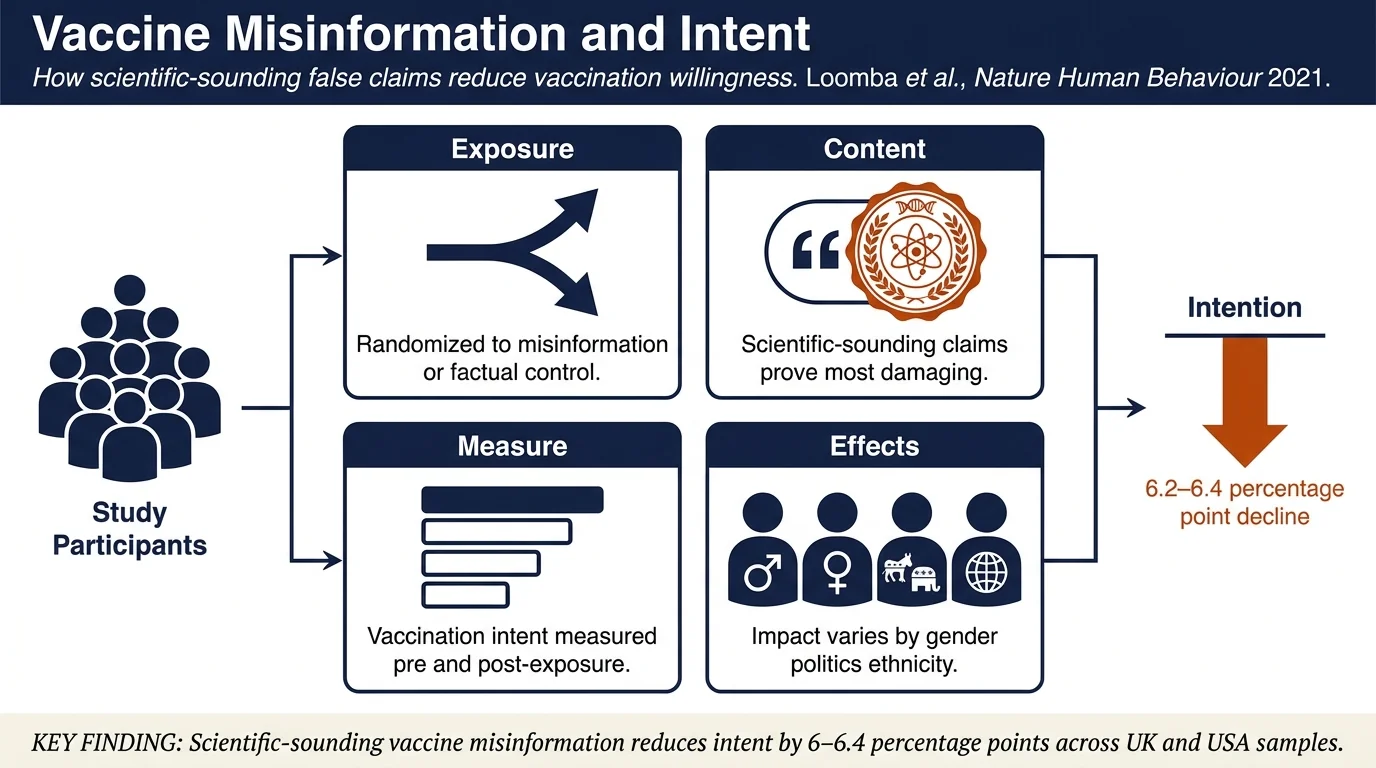
Measuring the impact of COVID-19 vaccine misinformation on vaccination intent in the UK and USARandomized controlled trial on 8,001 respondents (4,000 UK, 4,001 USA) measuring causal impact of exposure to COVID-19 vaccine misinformation. Exposure to misinformation reduced vaccination intent by 6.2 percentage points in the UK and 6.4 in the USA relative to exposure to factual information.
 Psychology & interventionsPlatforms, policy & society
Rumors, Truths, and Reality: Political Misinformation in the Modern DayAdam Berinsky surveys a decade of research on why Americans believe political rumors despite contradictory evidence. He identifies two key mechanisms: conspiratorial thinking (a personality trait that varies across individuals) and partisanship (which structures which rumors a person is likely to endorse).
 Spread & networksDatasets & evaluation
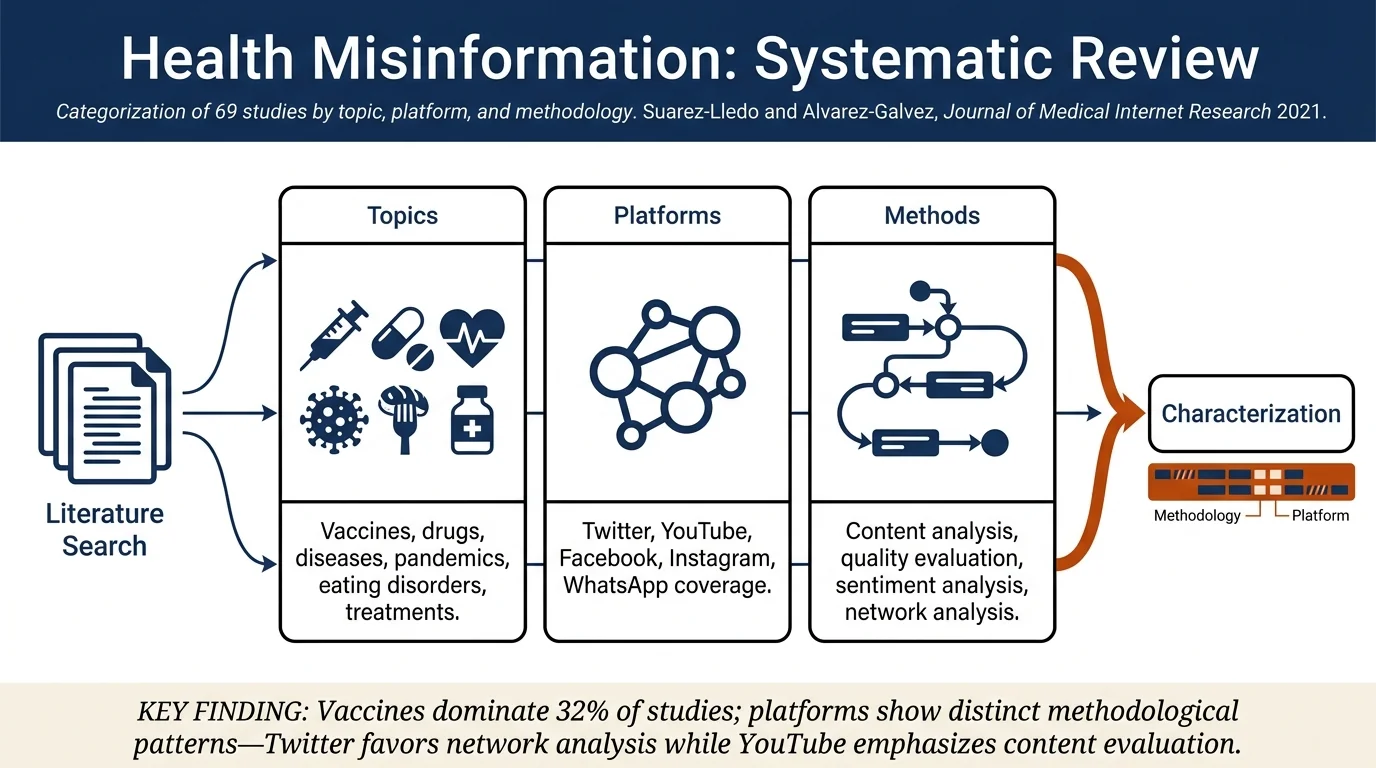
Prevalence of Health Misinformation on Social Media: Systematic ReviewSystematic review of 69 studies examining health misinformation prevalence across social media platforms. Vaccines, drugs, and smoking are the most-studied topics; Twitter is the primary platform for misinformation about smoking and substances, while vaccines are discussed broadly across platforms.
 LLMs & generative AIPlatforms, policy & society
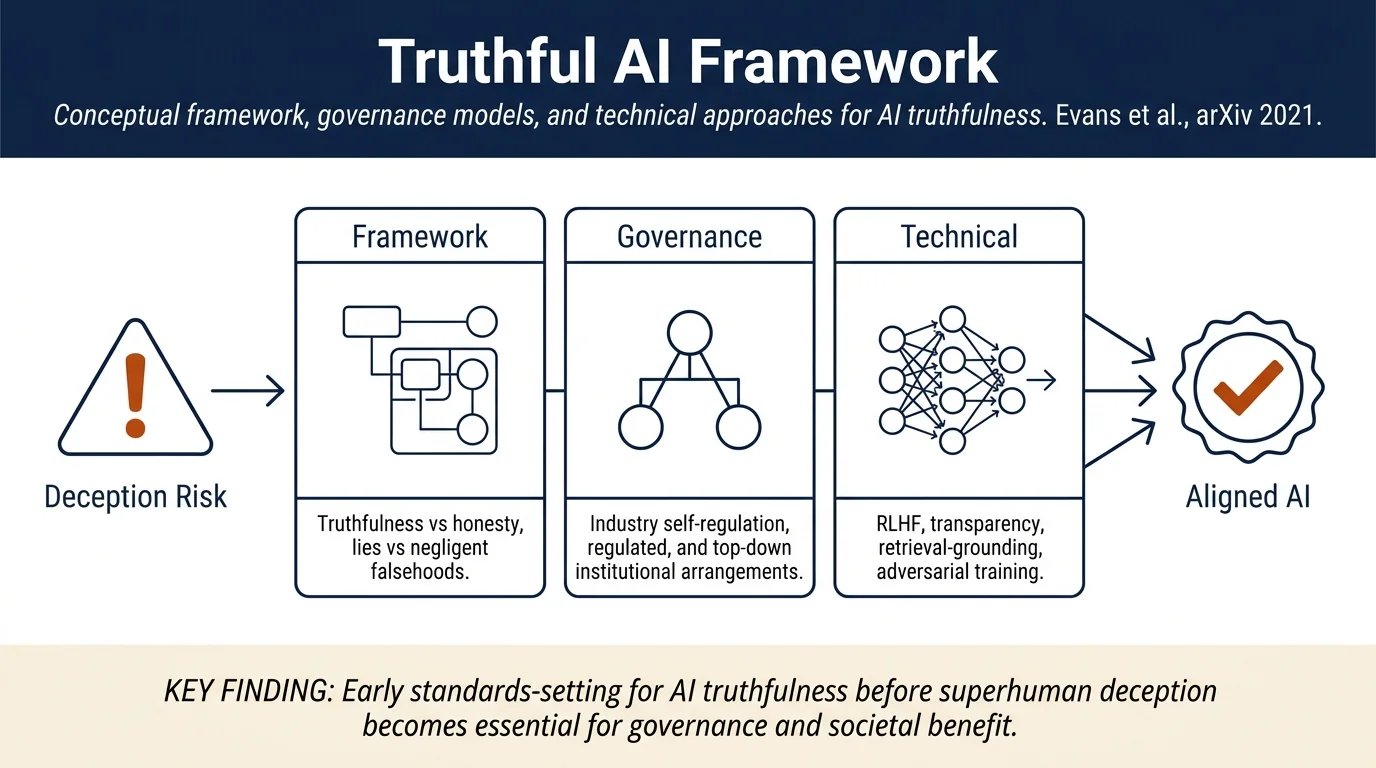
Truthful AI: Developing and Governing AI That Does Not LieAs AI systems become more capable and widely deployed, strategic falsehoods—"lies" that AI generates to achieve specified objectives—pose increasing risks. This paper proposes a framework of truthfulness standards for AI systems, governance mechanisms to enforce them (including certification bodies and verification procedures), and…
 Fact-checking & verificationDatasets & evaluation
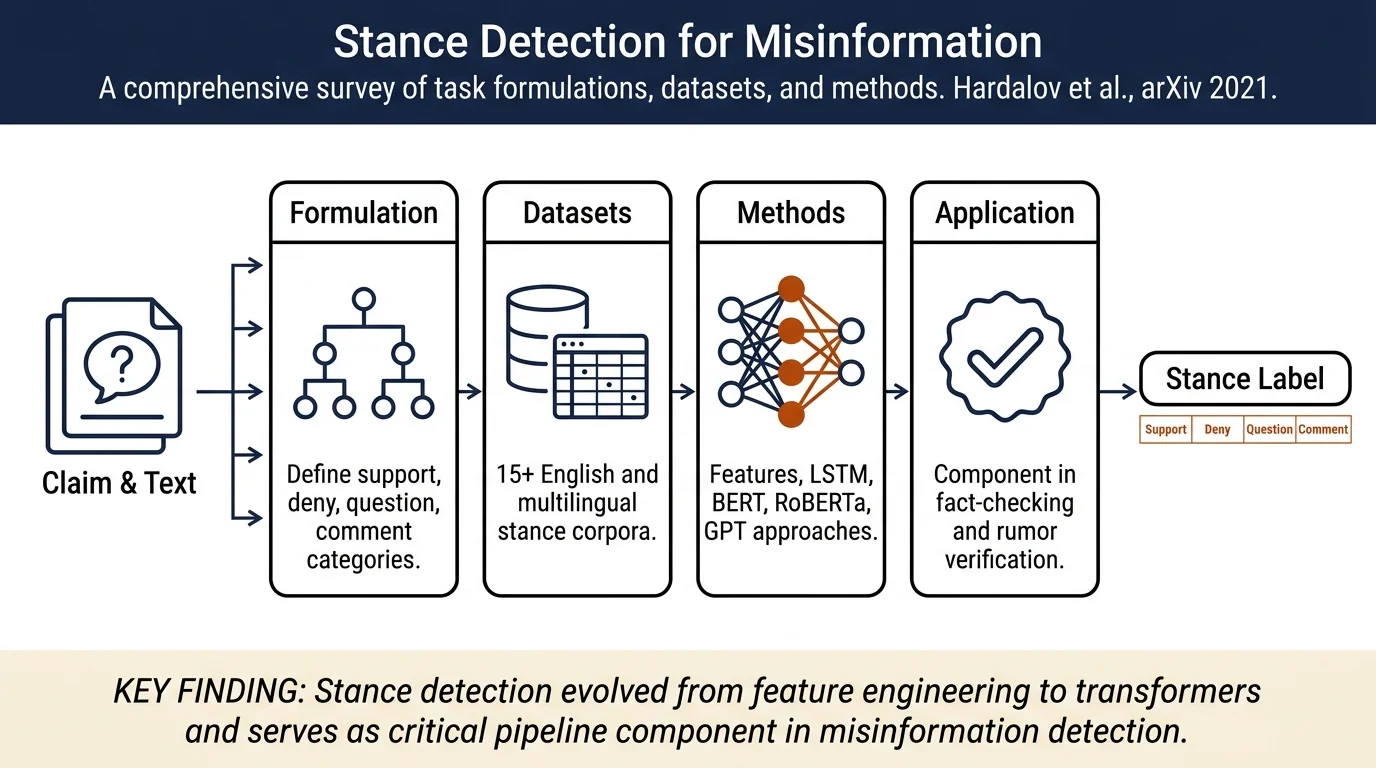
A Survey on Stance Detection for Mis- and Disinformation IdentificationComprehensive survey of stance detection for misinformation and disinformation. Stance detection—determining whether a text supports, denies, questions, or merely comments on a claim—plays dual roles: as a standalone fact-checking tool and as a component in broader verification pipelines.
 Detection methodsLLMs & generative AI
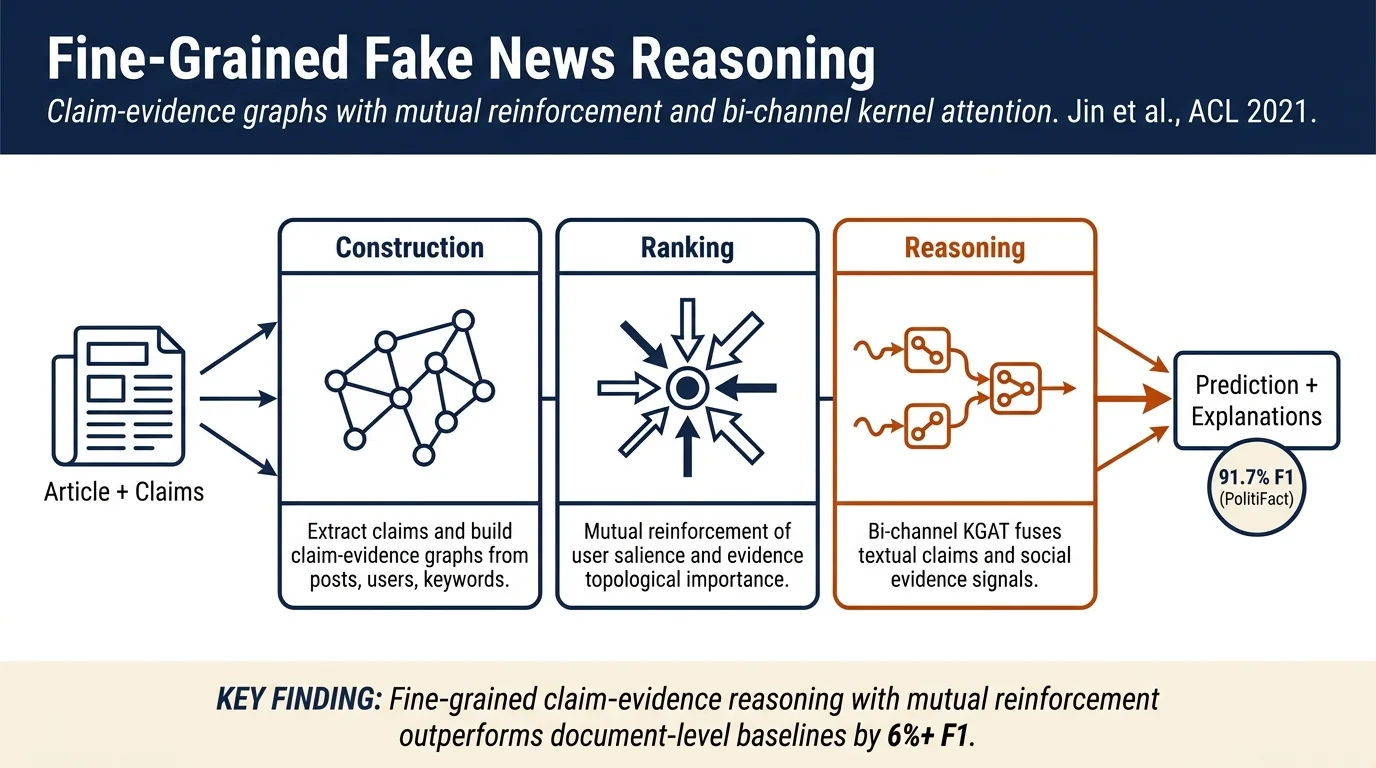
Towards Fine-Grained Reasoning for Fake News DetectionThe paper proposes FinerFact, a framework for fake news detection that models reasoning at the claim-evidence level rather than the document level. It constructs claim-evidence graphs and uses mutual-reinforcement-based ranking to identify salient evidence, then applies a bi-channel kernel graph network to reason over evidence groups.
 LLMs & generative AIDatasets & evaluation
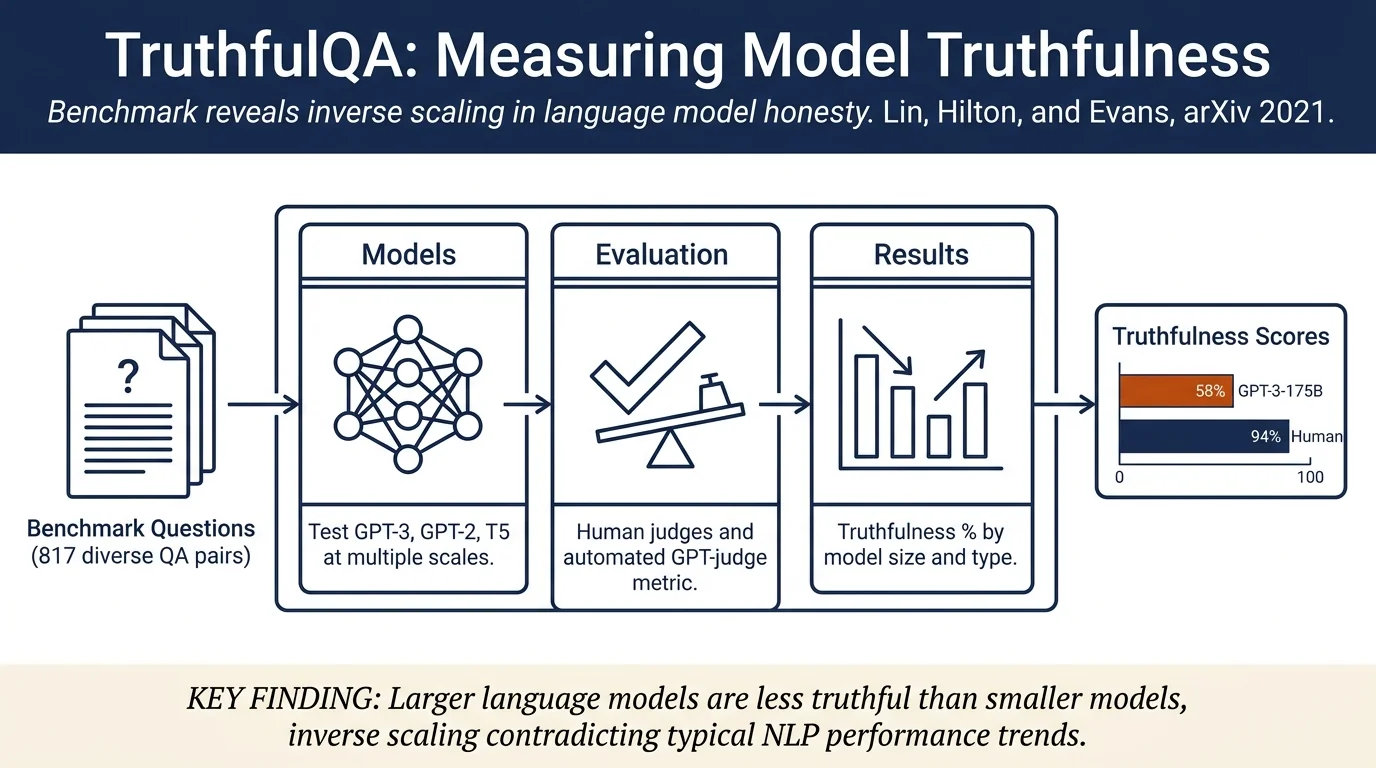
TruthfulQA: Measuring How Models Mimic Human FalsehoodsIntroduces TruthfulQA, a benchmark of 817 questions across 38 categories designed to measure whether language models generate truthful answers. Tests GPT-3, GPT-Neo/J, GPT-2, and T5-based models, finding that larger models are less truthful—an inverse scaling phenomenon where the best model (GPT-3-175B) achieves only 58% truthfulness…
 Fact-checking & verificationDatasets & evaluation
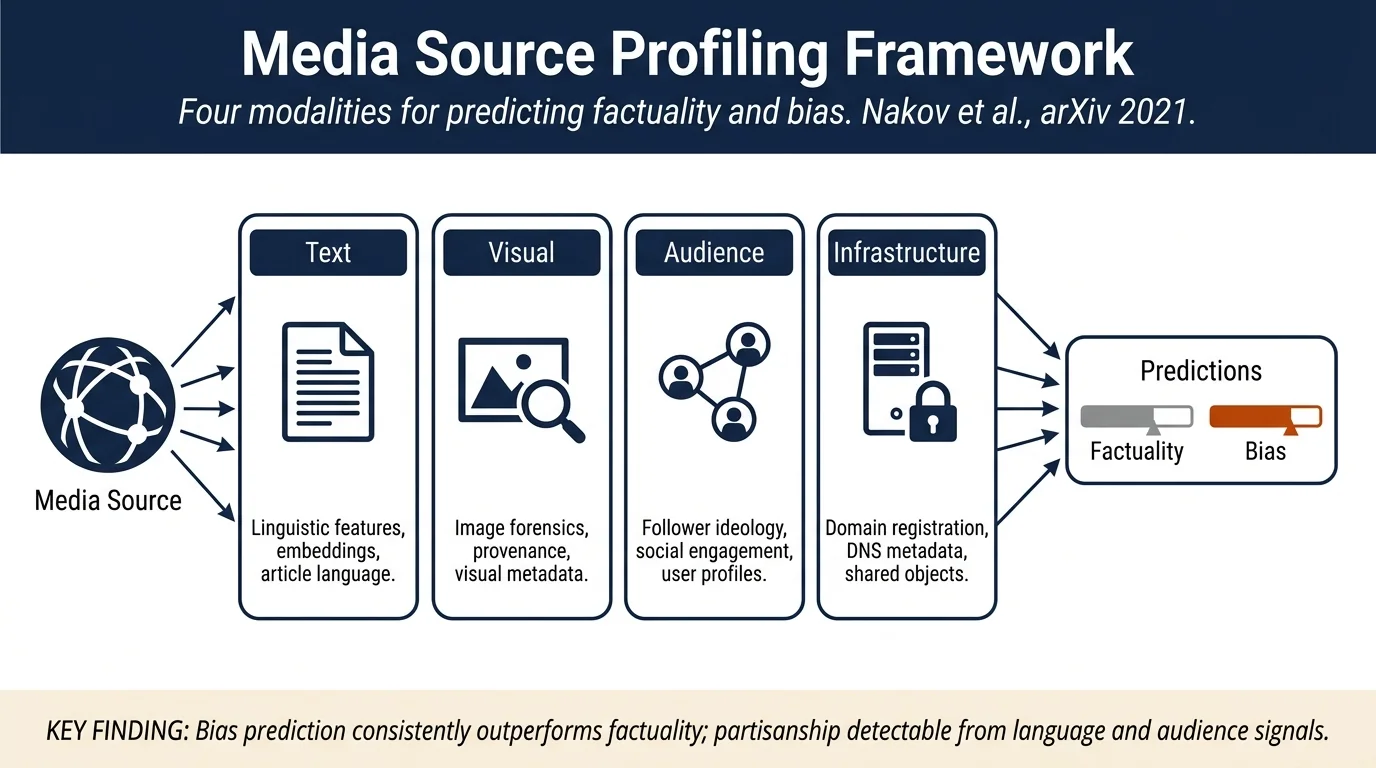
A Survey on Predicting the Factuality and the Bias of News MediaSurvey of media-level profiling methods for predicting news outlet factuality and political bias. Rather than checking individual claims or articles, the approach profiles entire news sources to enable early detection of unreliable content at publication time.
 Spread & networksPlatforms, policy & society
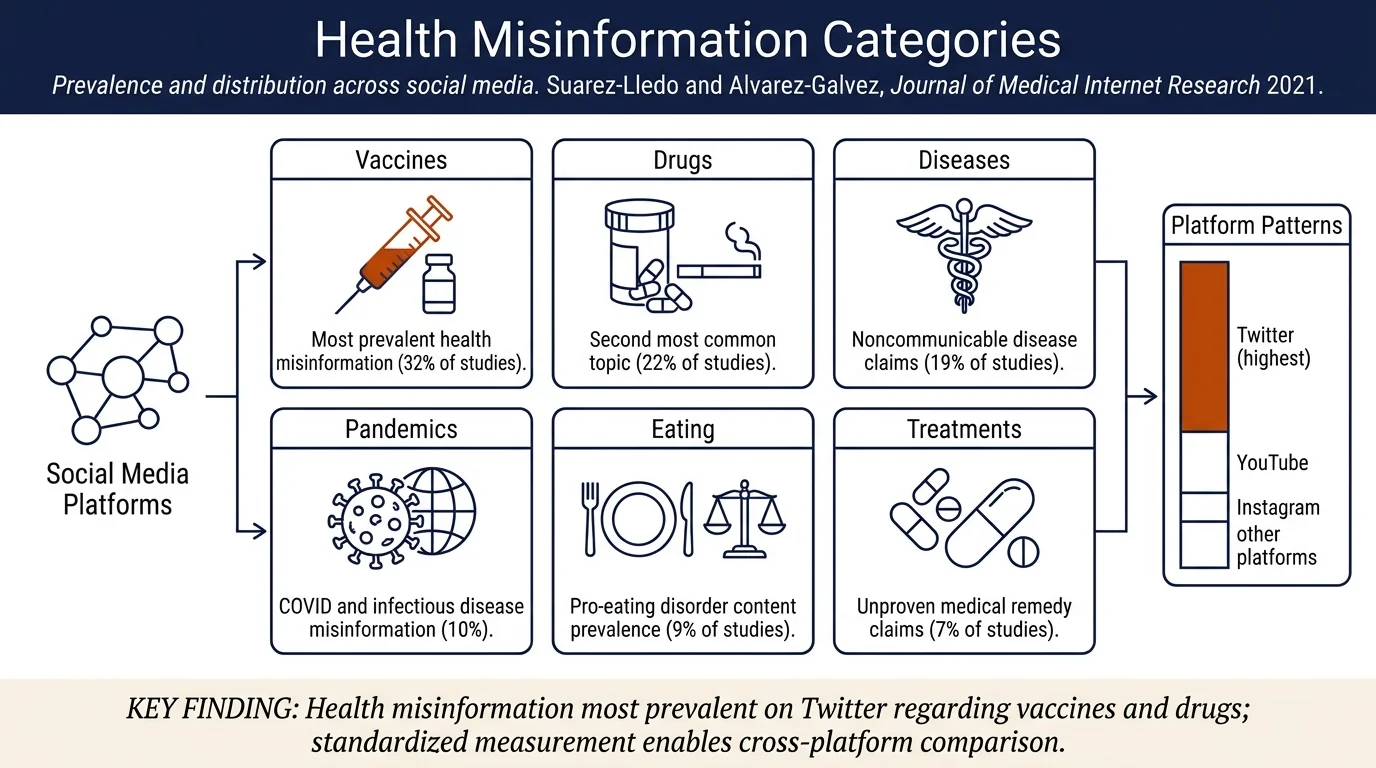
Prevalence of Health Misinformation on Social Media: Systematic ReviewThis systematic review of 69 studies characterizes health misinformation topics and their prevalence across social media platforms. Health misinformation was most prevalent on Twitter regarding smoking and drugs; vaccines, noncommunicable diseases, and pandemics were also common topics.
 Detection methodsLLMs & generative AI
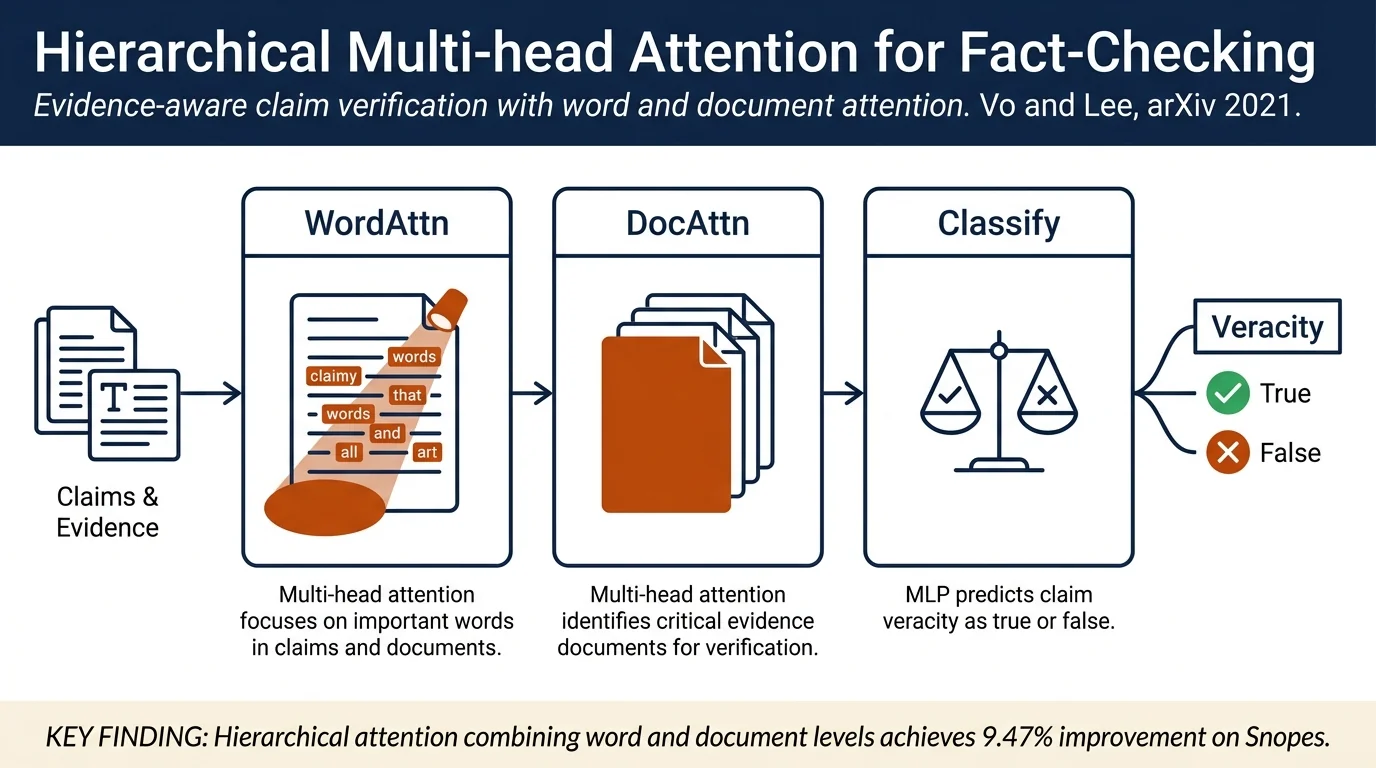
Hierarchical Multi-head Attentive Network for Evidence-aware Fake News DetectionThe paper proposes MAC, a hierarchical multi-head attention network that jointly learns word-level and document-level attention for fact-checking textual claims against evidence from external sources. Multi-head attention mechanisms capture different semantic aspects of claims and evidence documents, enabling the model to focus on…
 Psychology & interventionsPlatforms, policy & society
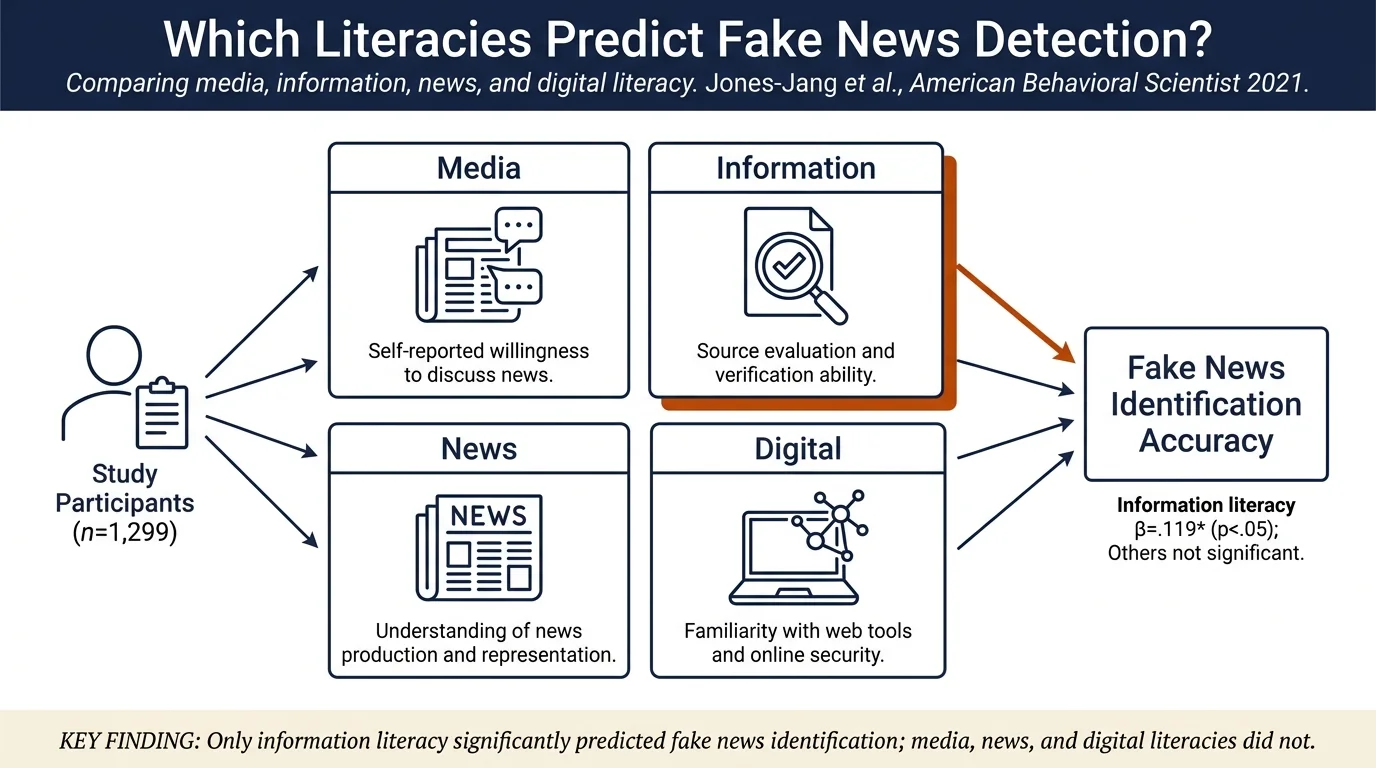
Does Media Literacy Help Identification of Fake News? Information Literacy Helps, but Other Literacies Don'tA survey of 1,299 U.S. citizens tests whether four types of media literacy—media, information, news, and digital—predict ability to identify fake news. Only information literacy (the ability to search and evaluate verified sources) significantly improves fake news identification; media, news, and digital literacies showed no significant…
 Detection methodsFact-checking & verification
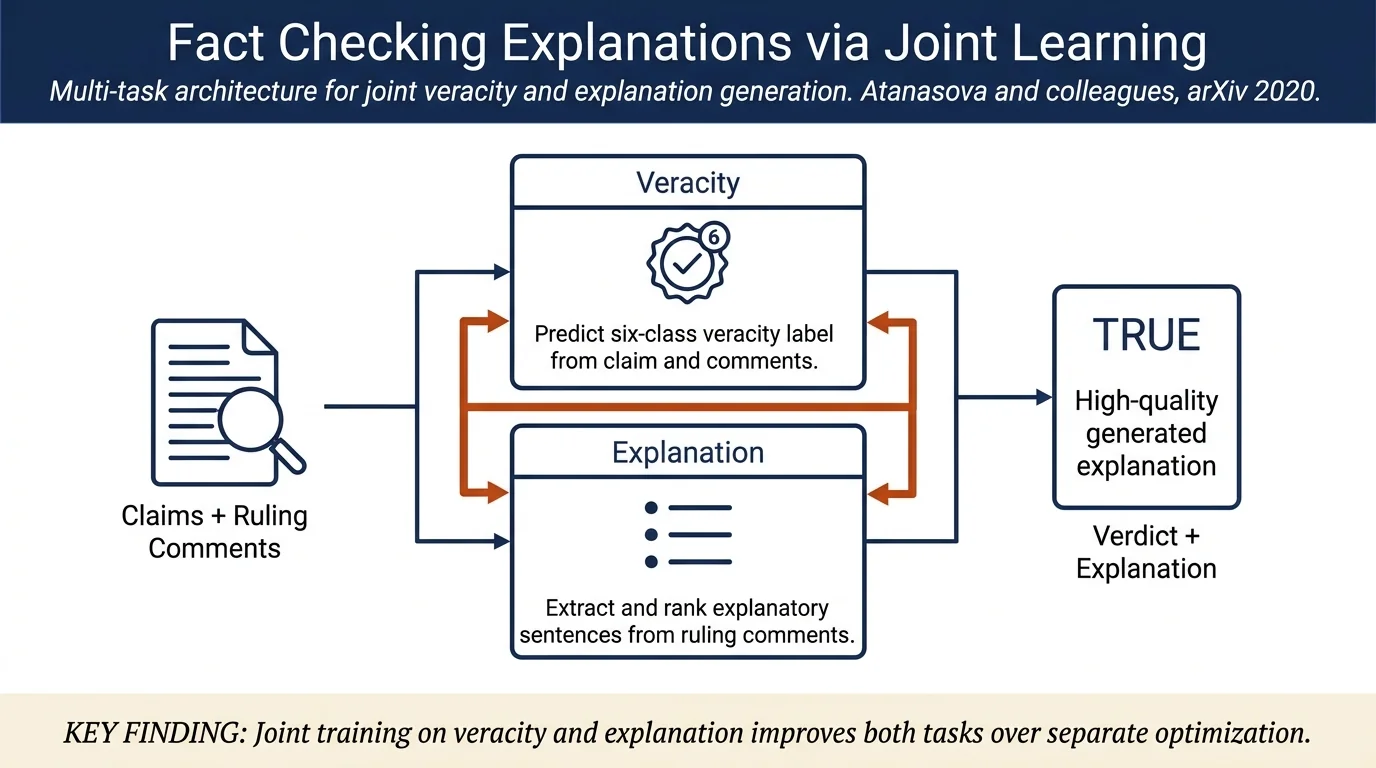
Generating Fact Checking ExplanationsThis paper presents the first study on automatically generating explanations for fact-checking veracity predictions. The authors show that jointly optimizing both veracity classification and explanation generation improves system performance.
 Fact-checking & verificationPlatforms, policy & society
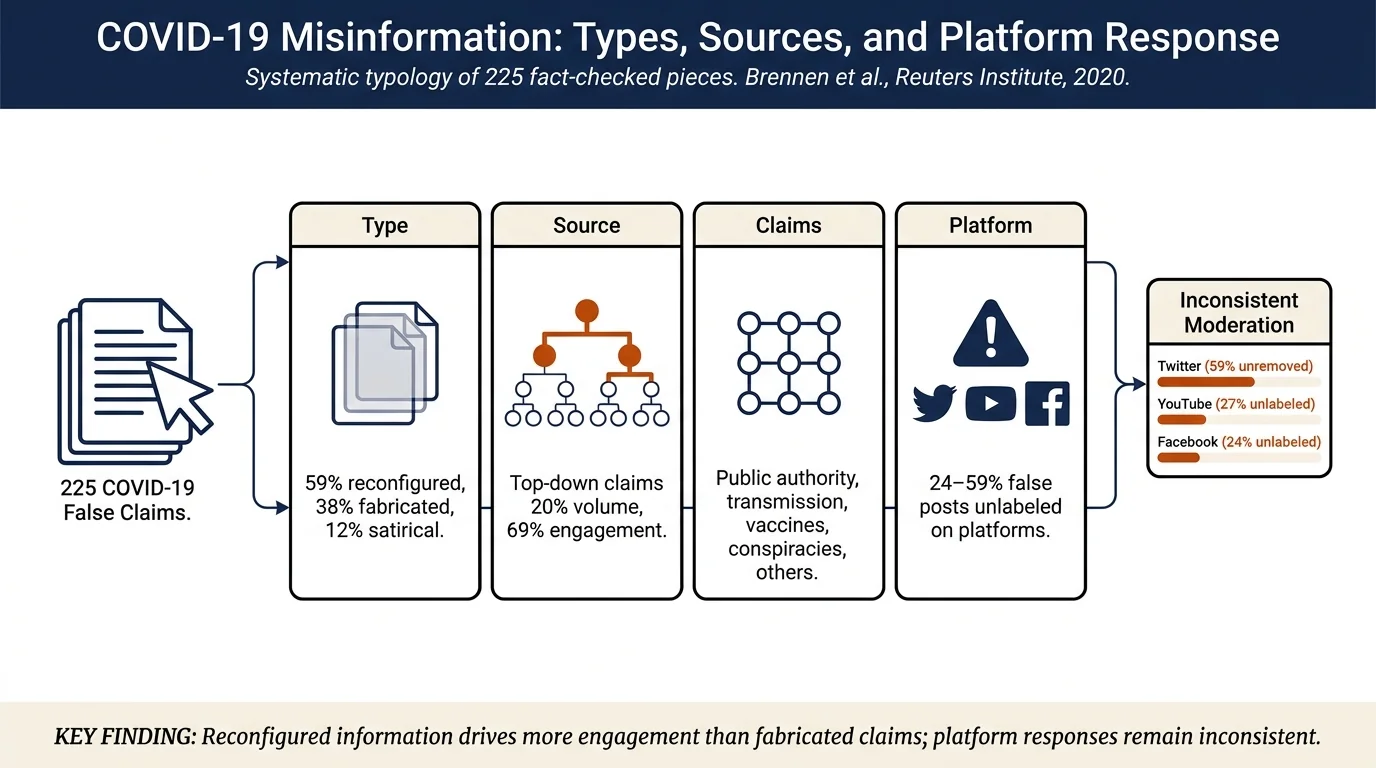
Types, Sources, and Claims of COVID-19 MisinformationSystematic analysis of 225 fact-checked COVID-19 misinformation pieces reveals that most false content reconfigures existing information (59%) rather than fabricating entirely new claims. Public authorities are cited in 39% of misinformation, yet top-down claims from politicians and celebrities account for only 20% of volume but drive…
 Spread & networksPlatforms, policy & society
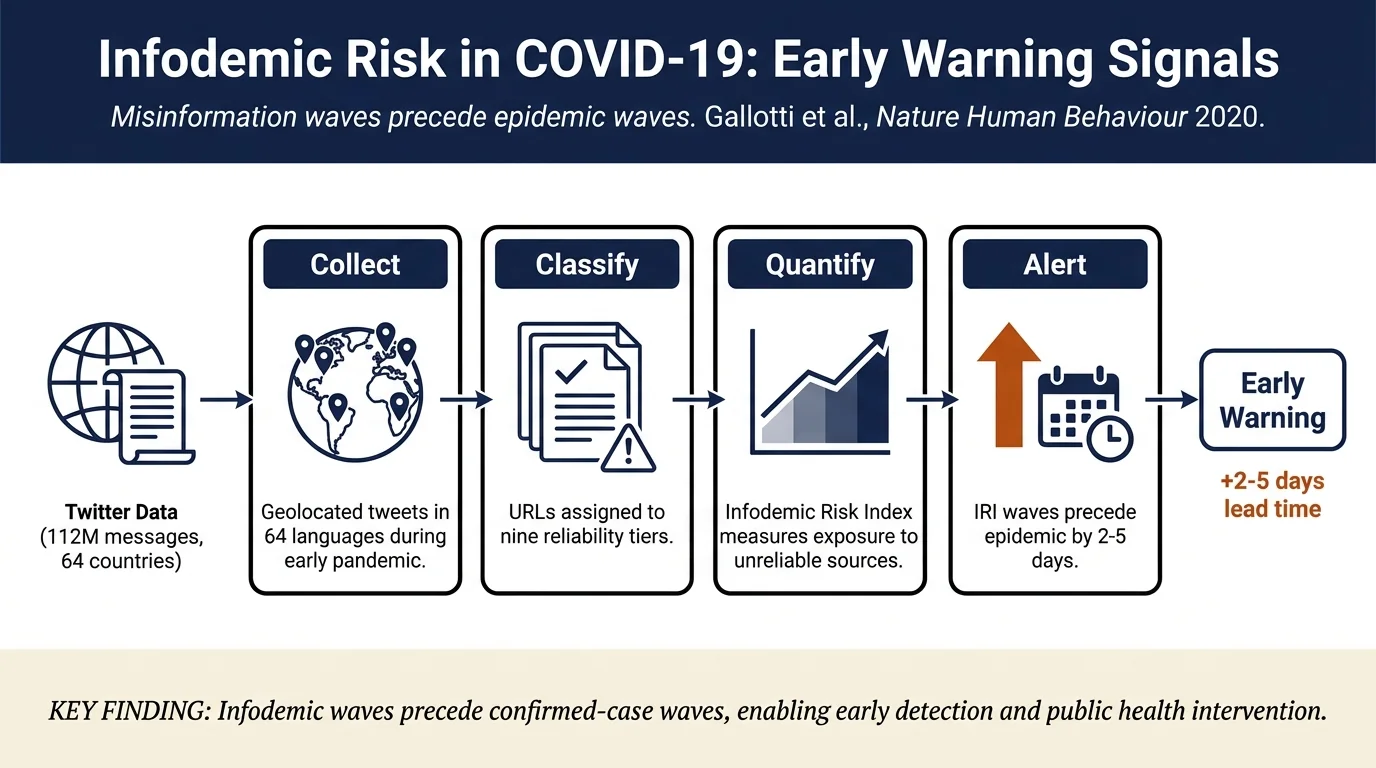
Assessing the risks of 'infodemics' in response to COVID-19 epidemicsAnalysis of 112+ million geolocated Twitter messages about COVID-19 (January–March 2020) across 64 languages and countries. Develops an infodemic risk index (IRI) measuring exposure to unreliable news; demonstrates that waves of unreliable information precede pandemic waves, providing early-warning signals for policy intervention.
 Spread & networksPlatforms, policy & society
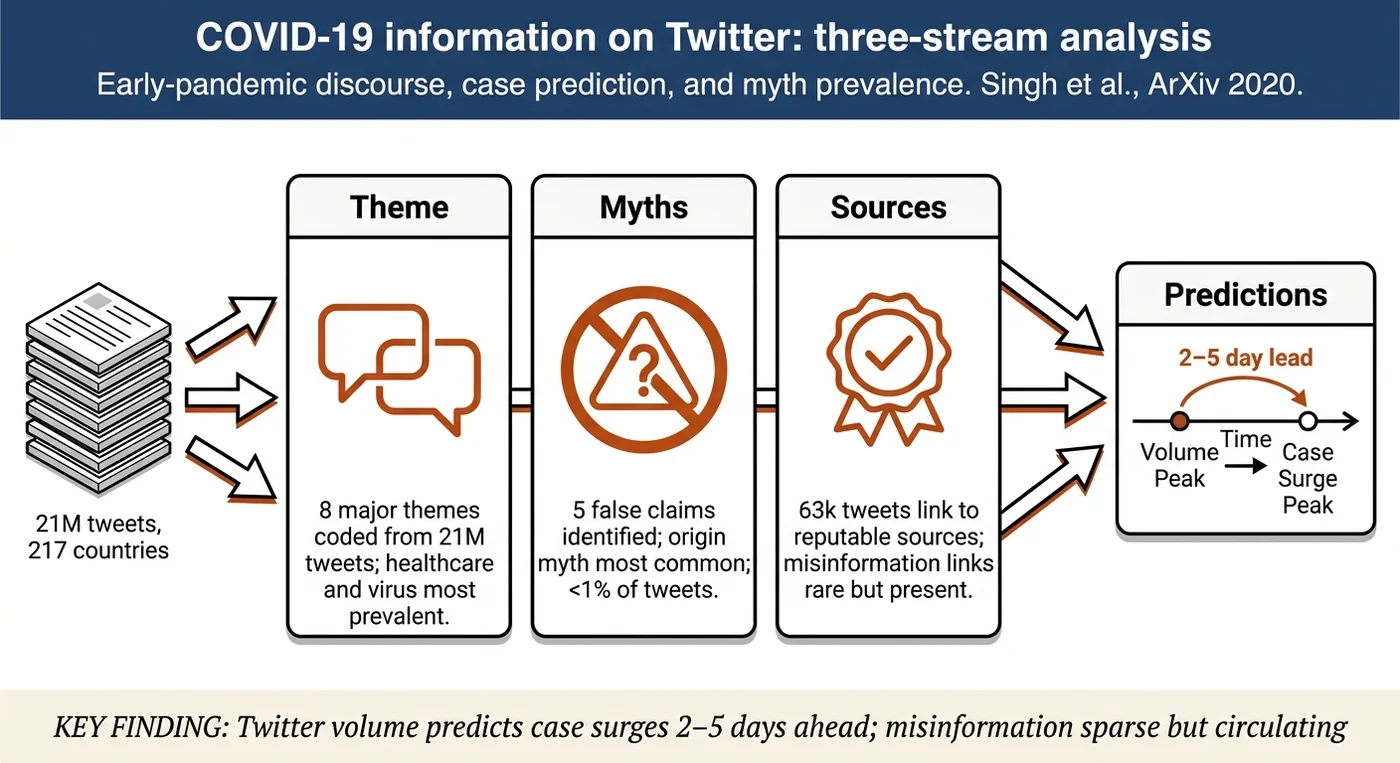
A first look at COVID-19 information and misinformation sharing on TwitterEarly-pandemic analysis of 21 million COVID-19 tweets showing Twitter conversations predict case increases by 2–5 days; identifies five prevalent myths (origin, flu comparison, heat, home remedies, vaccine) accounting for ~0.6% of tweets; finds most shared URLs point to reputable sources (CDC, WHO) rather than misinformation sites,…
 Psychology & interventionsDetection methods
The Continued Influence of MisinformationUllrich Ecker presents research on the continued influence effect—the phenomenon that misinformation continues to shape people's reasoning and memory even after they receive corrections and understand them. He examines four social factors that shape this effect: source credibility (trustworthiness matters more than expertise),…
 Datasets & evaluationSpread & networks
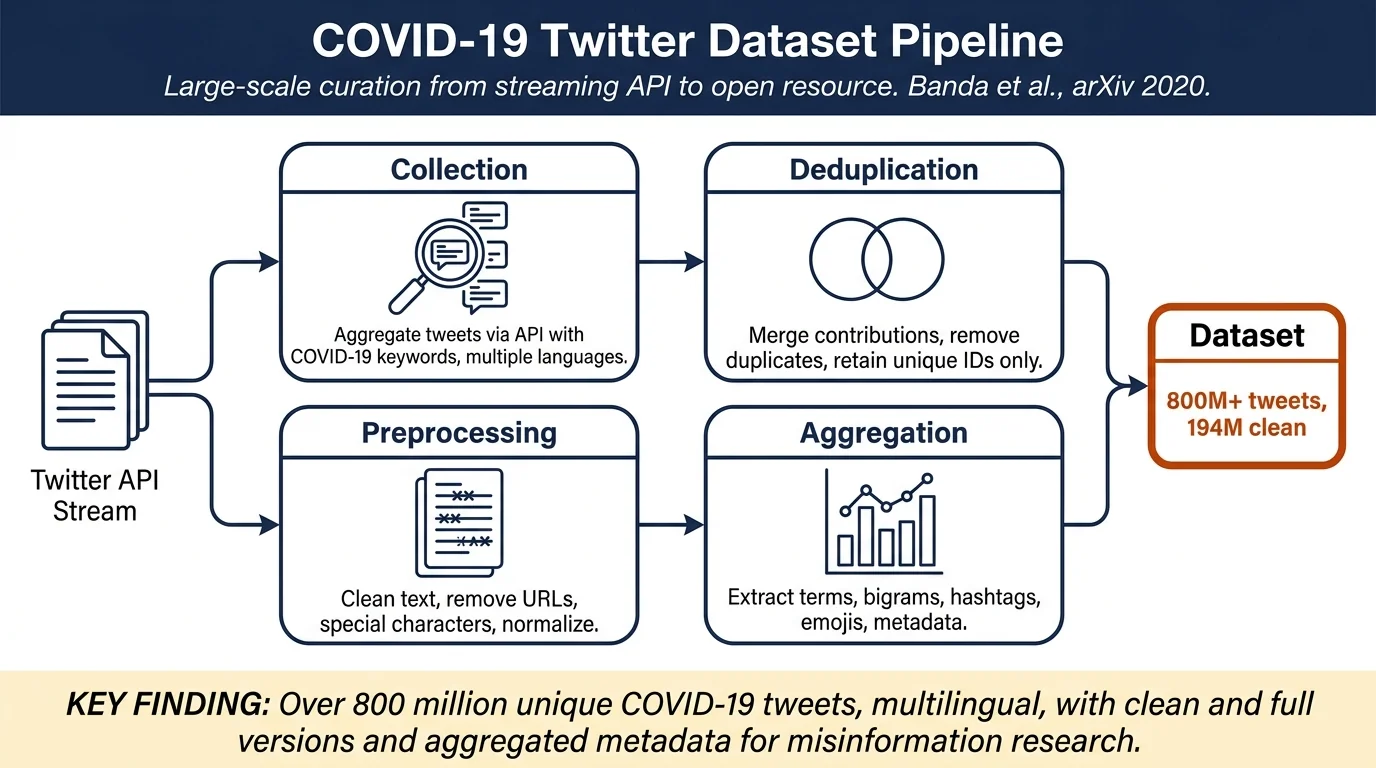
A large-scale COVID-19 Twitter chatter dataset for open scientific research - an international collaborationBanda et al. release a massive curated corpus of 800+ million COVID-19–related tweets collected from January through November 2020, with deduplication and language diversity. The dataset adheres to FAIR principles and provides both raw tweets and metadata (terms, bigrams, trigrams, hashtags, emojis, mentions) to support research on…
 Spread & networksPlatforms, policy & society
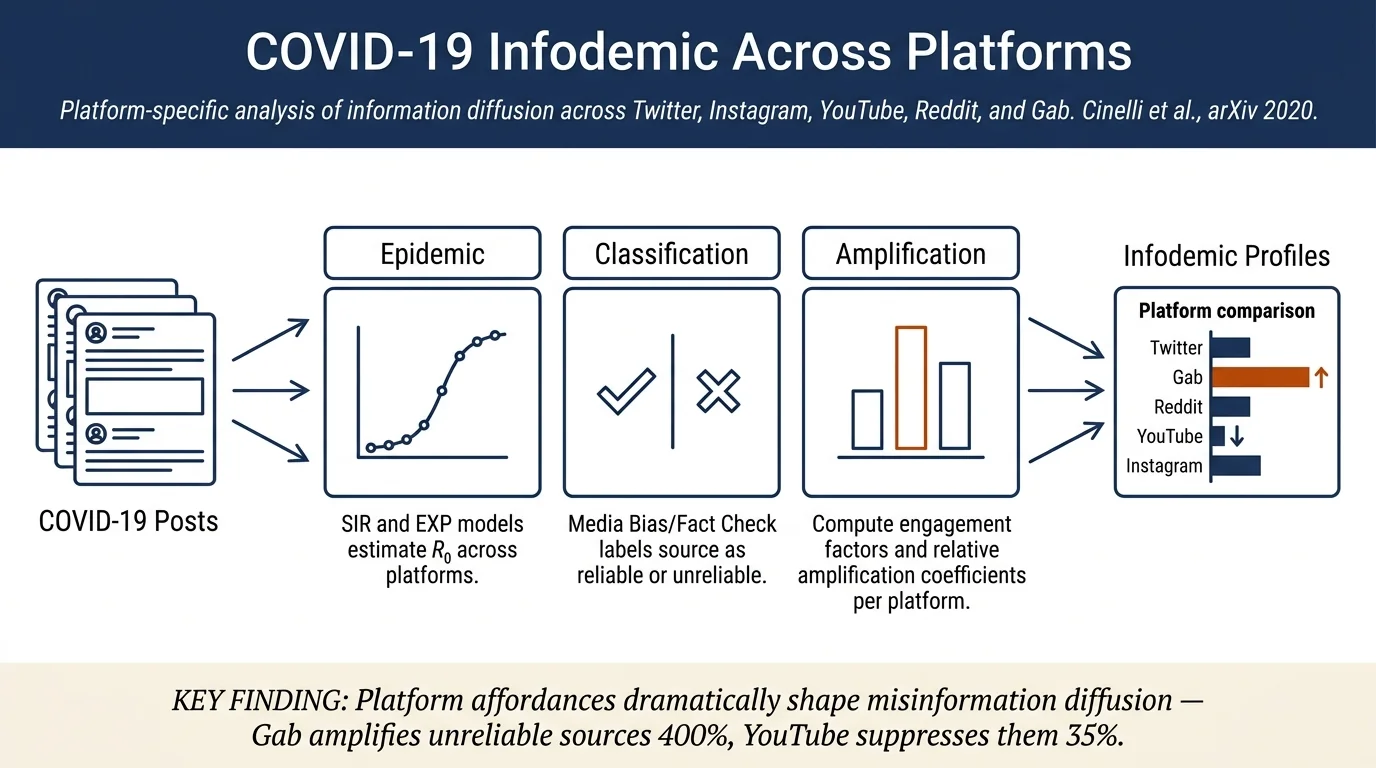
The COVID-19 Social Media InfodemicComparative analysis of COVID-19 information diffusion across five social media platforms (Twitter, Instagram, YouTube, Reddit, Gab) using epidemic models. All platforms exhibit infodemic characteristics (basic reproduction number R₀ 1), with platform-dependent differences in how misinformation spreads relative to reliable information.
 Datasets & evaluationSpread & networks
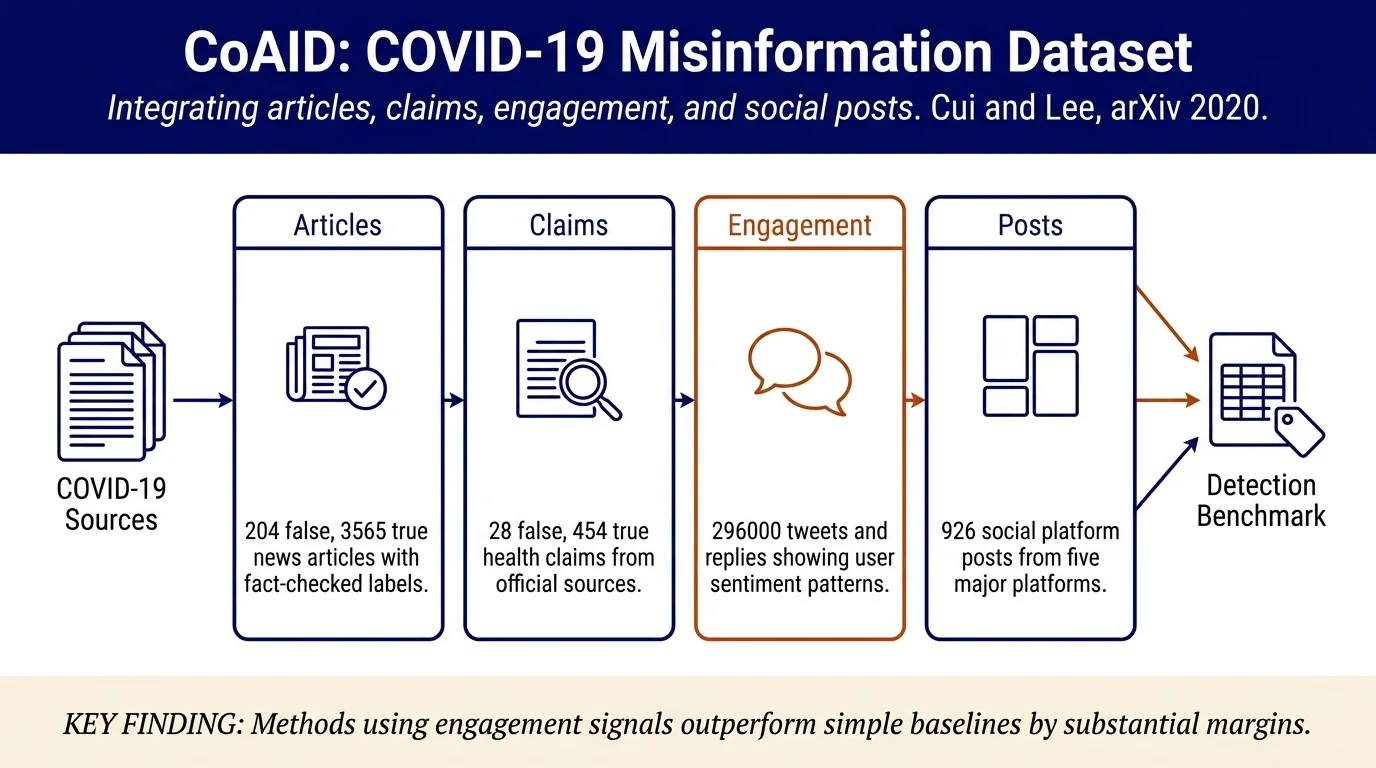
CoAID: COVID-19 Healthcare Misinformation DatasetCoAID is a benchmark dataset for COVID-19 healthcare misinformation detection comprising 4,251 news articles (204 fake, 3,565 true), 28 fake claims and 454 true claims, 296,000 user engagements from social platforms, and 926 social media posts with ground-truth labels. The dataset bridges text content, user engagement features, and…
 Datasets & evaluationDetection methods
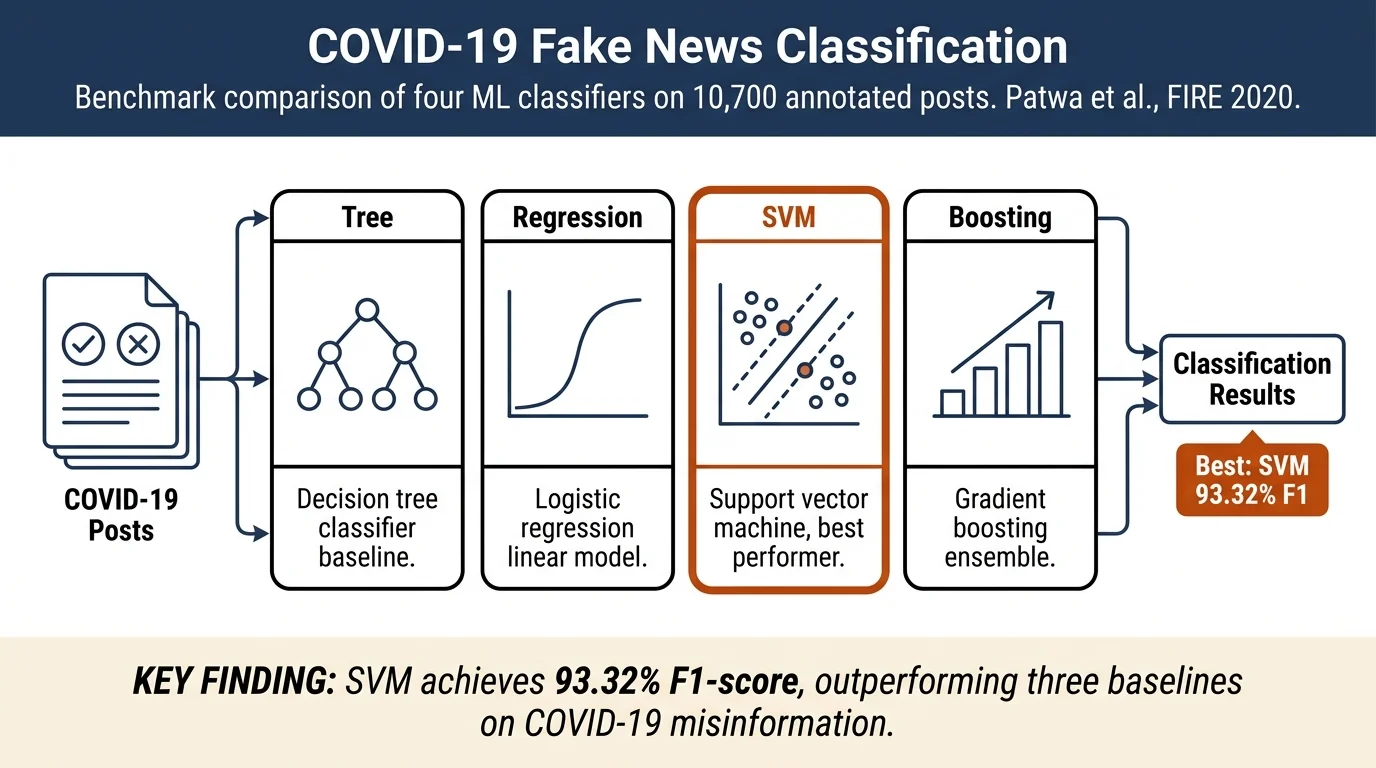
Fighting an Infodemic: COVID-19 Fake News DatasetThe authors present a manually annotated dataset of 10,700 COVID-19 related posts and articles (52% real, 48% fake) collected from social media and fact-checking websites. They benchmark four machine learning baselines (Decision Tree, Logistic Regression, SVM, Gradient Boost), achieving 93.32% F1-score with SVM, and release both the…
 Psychology & interventionsPlatforms, policy & society
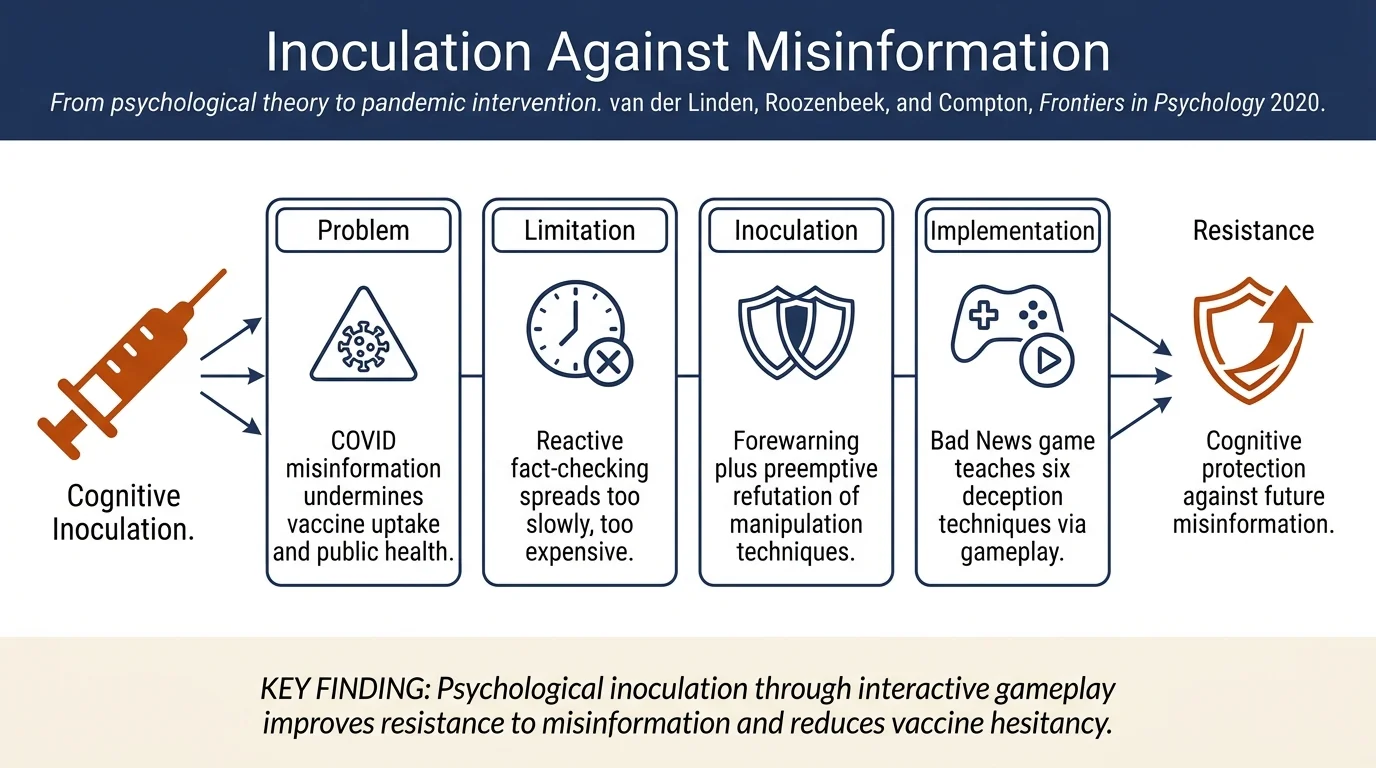
Inoculating Against Fake News About COVID-19COVID-19 misinformation has proliferated rapidly on social media, undermining public health responses and vaccination uptake. Rather than relying on post-hoc fact-checking (which spreads slower than misinformation), the authors propose psychological inoculation—exposing people to weakened doses of misinformation techniques beforehand to…
 Fact-checking & verificationDetection methods
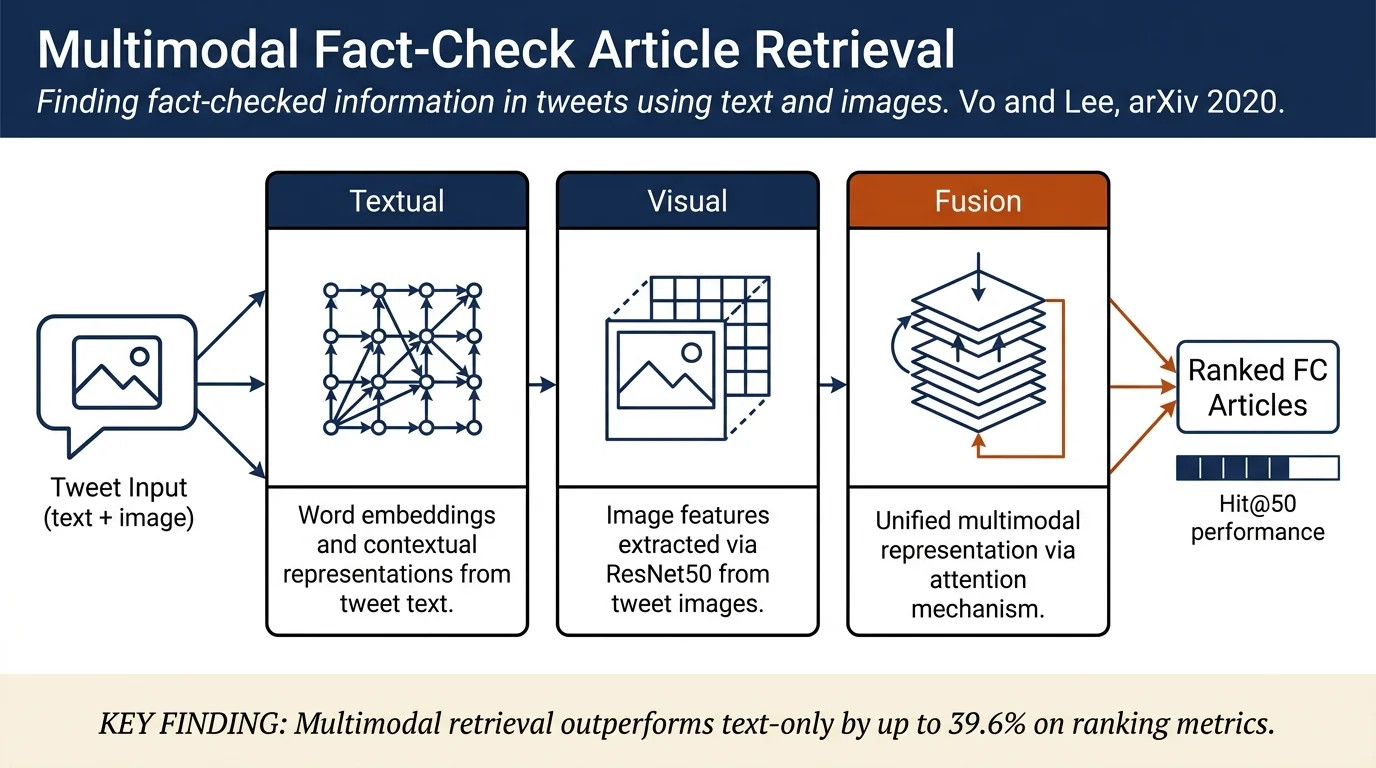
Where Are the Facts? Searching for Fact-checked Information to Alleviate the Spread of Fake NewsProposes a framework to automatically find fact-checking articles that address claims in original tweets. Uses a multimodal attention network (MAN) combining textual and visual content from tweets with fact-checking article text to rank candidate fact-checks; demonstrates that multimodal retrieval substantially outperforms text-only…
 Deepfakes & multimodalFact-checking & verification
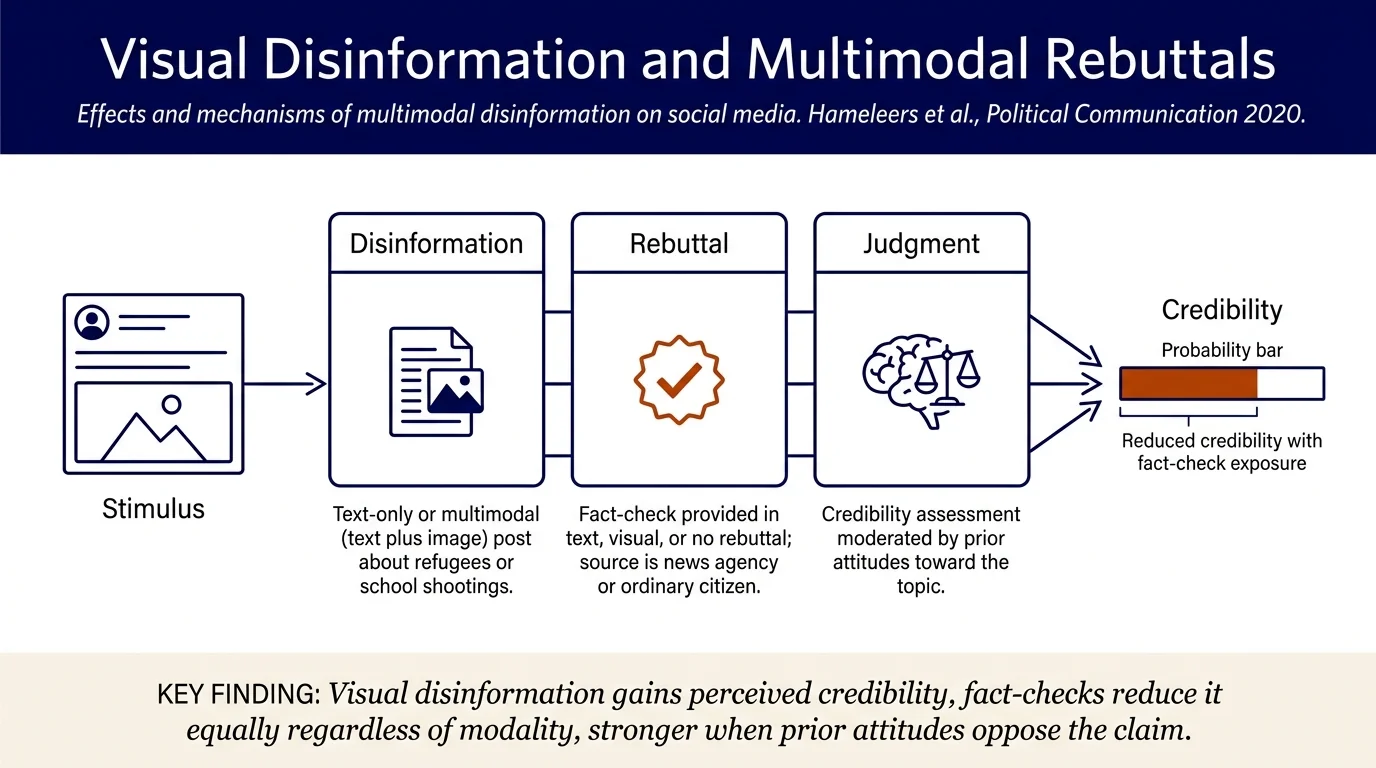
A Picture Paints a Thousand Lies? The Effects and Mechanisms of Multimodal Disinformation and Rebuttals Disseminated via Social MediaMultimodal disinformation (paired text and images) is perceived as more credible than text-only misinformation, but fact-checkers can overcome this effect. Importantly, the modality of fact-checks (visual or textual) matters less than their presence; fact-checks are more persuasive for people whose prior attitudes already oppose the…
 Psychology & interventionsPlatforms, policy & society
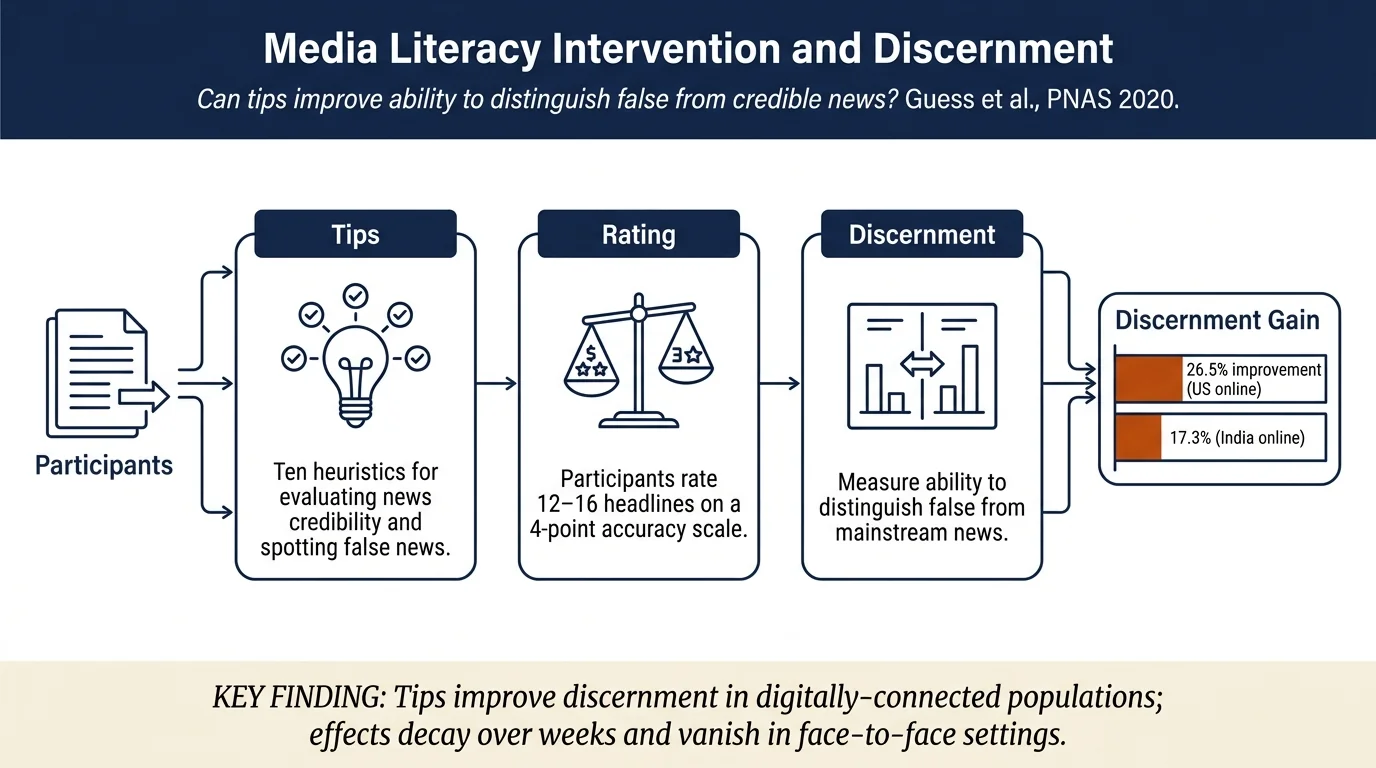
A digital media literacy intervention increases discernment between mainstream and false news in the United States and IndiaA randomized experiment tests Facebook's "Tips to Spot False News" intervention in the US and India, finding it increases discernment between mainstream and false news (26.5% in US, 17.3% in India online). The intervention reduces belief in false headlines more than it reduces belief in mainstream ones.
 Fact-checking & verificationPlatforms, policy & society
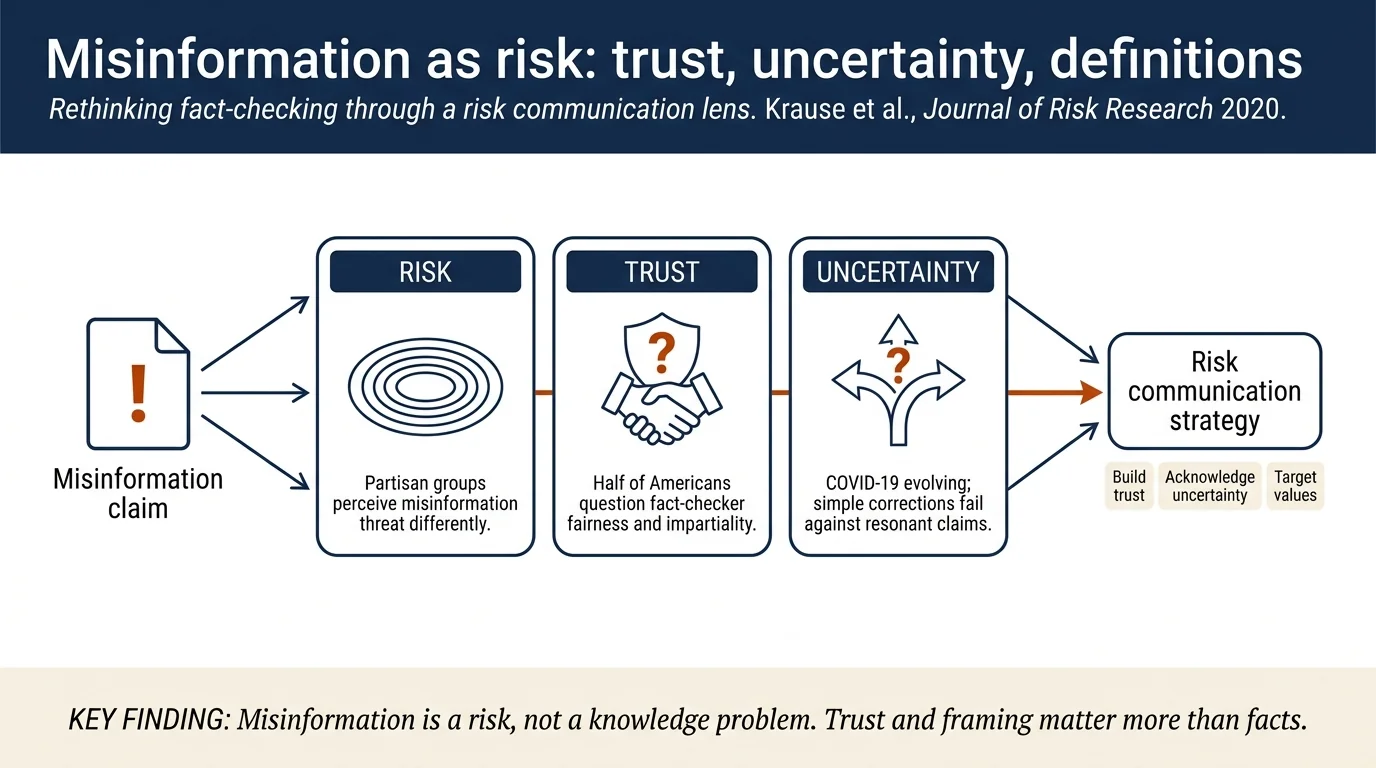
Fact-checking as risk communication: the multi-layered risk of misinformation in times of COVID-19COVID-19 misinformation should be viewed as a risk in its own right, not just a communication failure. Fact-checking efforts face three key challenges: defining misinformation differently across political subgroups, earning trust in an environment of low press credibility, and communicating amid genuine uncertainty.
 Psychology & interventionsPlatforms, policy & society
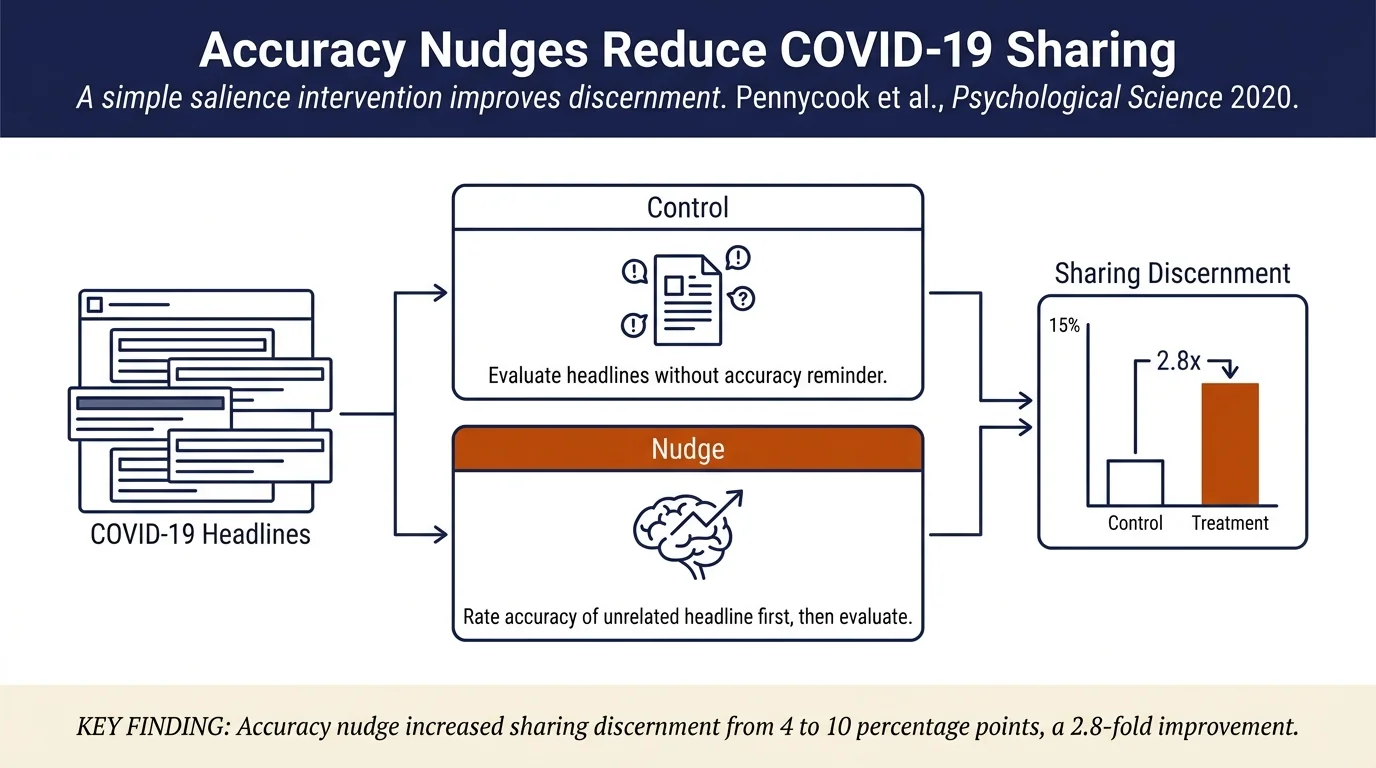
Fighting COVID-19 Misinformation on Social Media: Experimental Evidence for a Scalable Accuracy-Nudge InterventionTwo pre-registered experiments with 1,700+ U.S. adults show that a simple accuracy nudge — asking people to rate the accuracy of an unrelated headline before the main task — nearly tripled their ability to discriminate true from false COVID-19 headlines when deciding what to share on social media. The intervention is scalable, requires…
 Psychology & interventionsPlatforms, policy & society
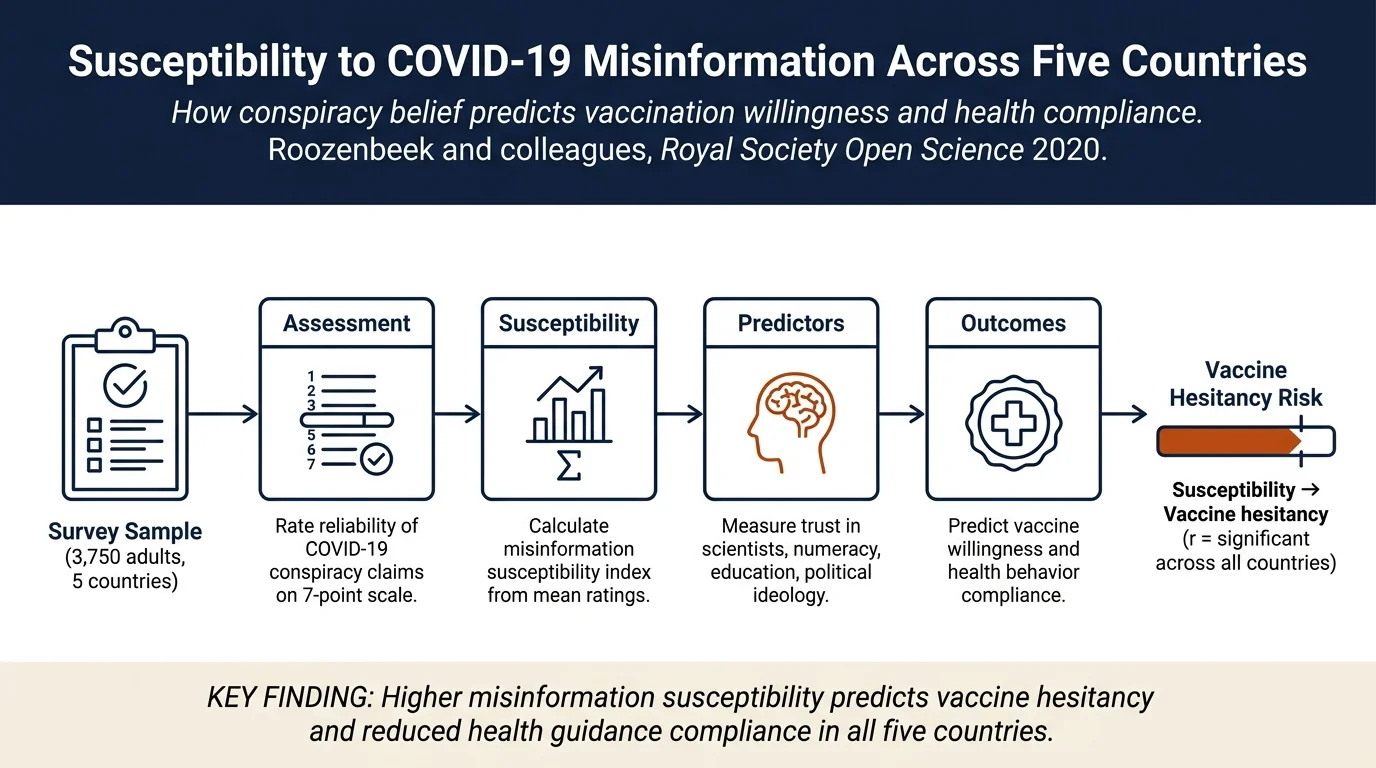
Susceptibility to misinformation about COVID-19 around the worldAn international survey of 3,750 adults across five countries (UK, Ireland, USA, Spain, Mexico) measured susceptibility to COVID-19 misinformation and examined how it predicts public health behaviors. While majorities in each country did not find COVID-19 misinformation credible, higher susceptibility to misinformation was strongly…
 Spread & networksPlatforms, policy & society
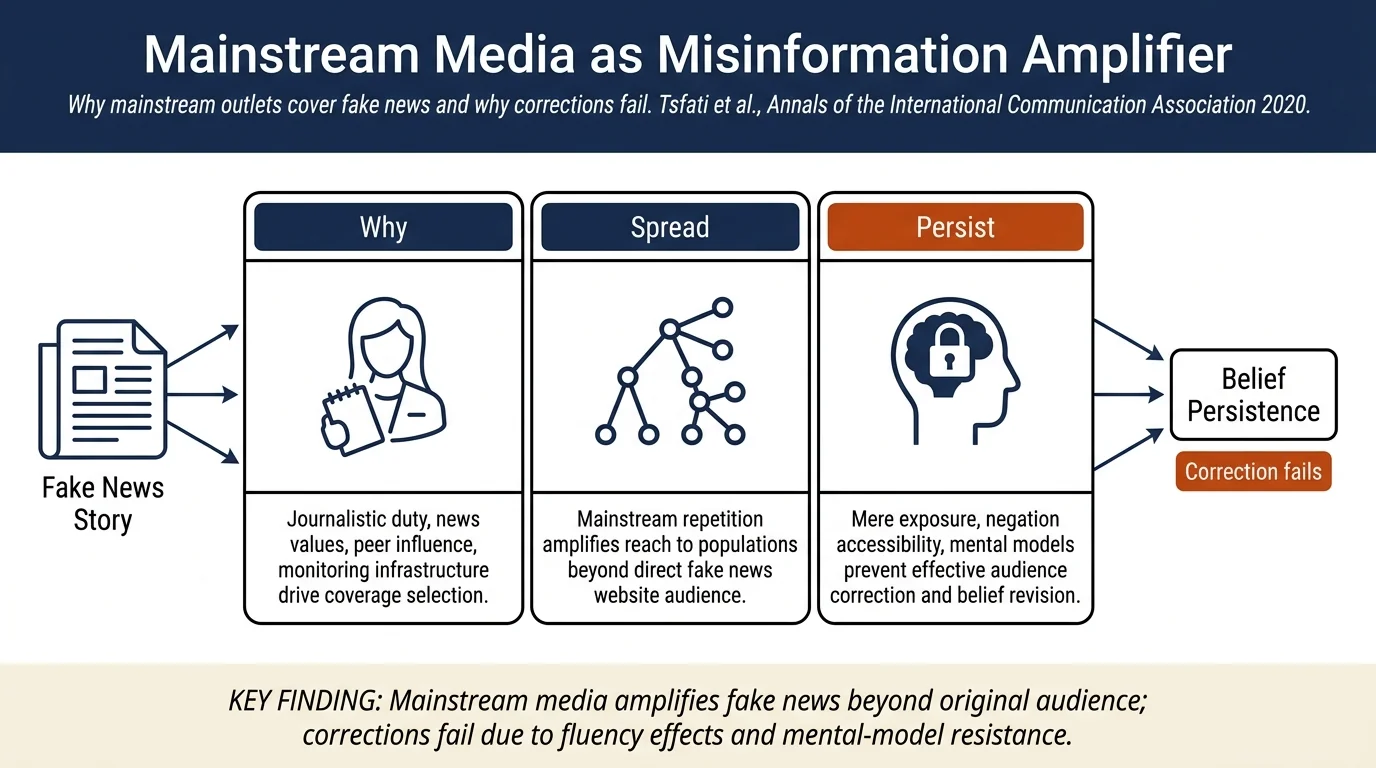
Causes and consequences of mainstream media dissemination of fake news: literature review and synthesisWhile fake news websites have limited direct reach, mainstream media coverage is probably how most people encounter fake news stories. This synthesis identifies why mainstream outlets cover falsehoods (journalists' professional duties, news values, peer psychology, technical infrastructure) and explores how mainstream coverage amplifies…
 Fact-checking & verificationPsychology & interventions
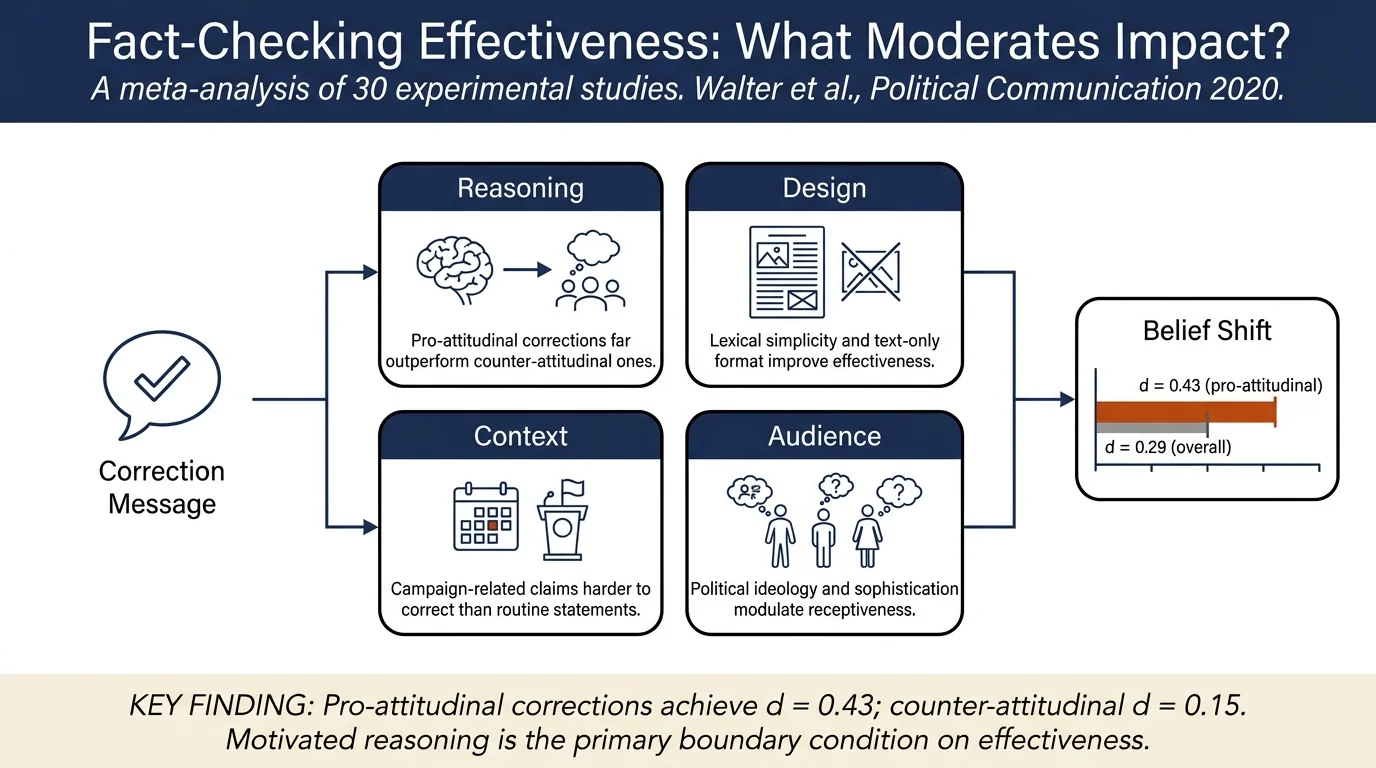
Fact-Checking: A Meta-Analysis of What Works and for WhomMeta-analysis of 30 studies on fact-checking effectiveness finds modest but significant positive effects (d = 0.29) on belief correction. However, effects are substantially moderated by motivated reasoning, political ideology, message design, and context: pro-attitudinal fact-checking works better than counter-attitudinal corrections,…