The echo chamber effect on social media
Authors: Matteo Cinelli, Gianmarco De Francisci Morales, Alessandro Galeazzi, Walter Quattrociocchi, Michele Starnini
Venue: Proceedings of the National Academy of Sciences, Vol. 118, No. 9, e2023301118, February 23, 2021
TL;DR
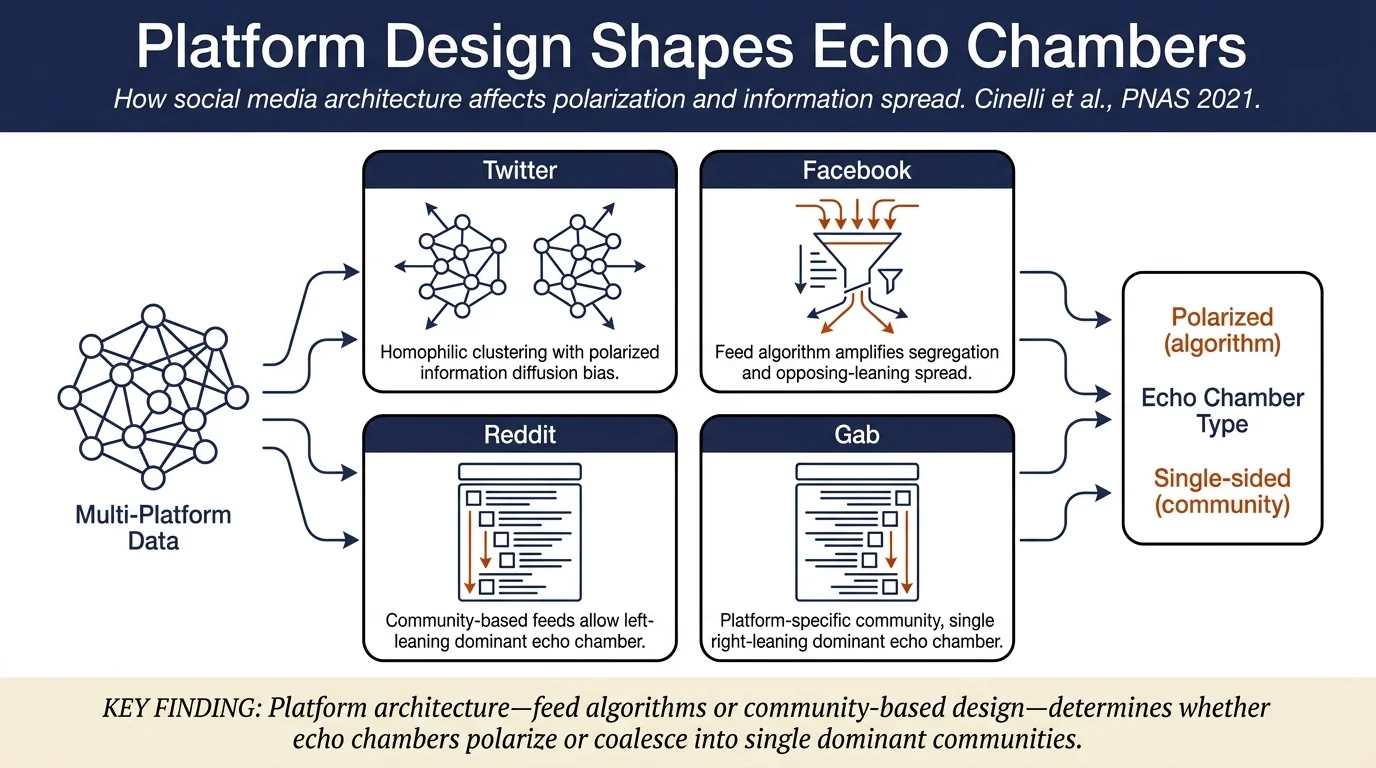
Comparative analysis of 100+ million posts across Twitter, Facebook, Reddit, and Gab on controversial topics shows echo chambers operate differently by platform: Facebook and Twitter exhibit strong homophilic clustering and polarized information diffusion, while Reddit and Gab show single-sided communities without the biased diffusion pattern. Platform design—specifically feed algorithms vs. community-based feeds—drives these differences.
Contributions
- Operational definition of echo chambers grounded in two quantifiable aspects: 1) homophily in interaction networks (users connecting to like-minded peers), 2) bias in information diffusion toward same-leaning recipients
- Comparative empirical analysis of four major platforms with 100+ million pieces of content, revealing platform-specific echo chamber dynamics not apparent from single-platform studies
- Distinction between platform architectures: Feed-algorithm platforms (Facebook, Twitter) amplify echo chambers through homophilic clustering and polarized diffusion; community-based platforms (Reddit) show less segregation despite polarization
- Methodology for platform comparison using user political leaning inference, network reconstruction, community detection, and SIR epidemic modeling to assess information spreading bias
Method
The authors operationalize echo chambers as two independent, measurable phenomena:
User leaning inference — Infer each user's political position on a topic by averaging the political bias scores (extreme left to extreme right, from Media Bias/Fact Check) of news outlets they engage with. For Twitter/Reddit: news links in posts. For Facebook: news page categories users like. For Gab: news links in posts. This yields a leaning value \(x_i \in [-1, +1]\) per user.
Homophily measurement — Assess whether users with similar leanings connect to each other. For each user, compute the average leaning of their neighbors (\(x^N_i\)). Plot individual leaning (\(x\)) vs. neighbor leaning (\(x^N\)) as a joint distribution. Strong correlation indicates homophily. Also apply Louvain community detection and measure average leaning per community.
Information diffusion bias — Use SIR (susceptible–infected–recovered) epidemic models on the interaction networks to simulate information spread. Starting from a single user "seed," measure which users ultimately receive the message (the influence set). Compute the average leaning of the influence set as a function of seed leaning (\(\mu(x)\)). If \(\mu(x) \approx x\) (message reaches recipients with same leaning), diffusion is biased. If \(\mu(x)\) is constant across \(x\) (message reaches all users regardless of leaning), diffusion is unbiased.
Datasets — Three networks per platform: Twitter (gun control, abortion, Obamacare), Facebook (vaccines, science vs. conspiracy, news), Reddit (r/Politics, r/the_donald, r/News), Gab (all posts on political topics). Altogether, 1+ million users, 100+ million posts, span 5–14 years per platform.
Results
Homophily and network structure:
- Facebook and Twitter show strong positive correlation between individual leaning and neighbor leaning (Figure 1A/C): users cluster into two opposing camps. Communities span left-to-right spectrum (Figure 2A/C).
- Reddit and Gab show single-peak distributions (Figure 1B/D): users do not split into opposing groups but congregate in one community (left for Reddit, right for Gab). No left–right bifurcation visible.
Information diffusion bias:
- Facebook and Twitter: Users with a given leaning are far more likely to receive information propagated by similarly-leaning seeds (\(\mu(x) \approx x\), Figure 3A/C). Polarized users reach polarized audiences.
- Reddit and Gab: Average leaning of influence sets is constant across seed leaning (\(\mu(x)\) flat). All users receive similar-leaning information regardless of their own leaning, suggesting a single dominant echo chamber rather than competing polarized ones.
Direct Facebook–Reddit comparison on news consumption (Figure 4):
All three metrics (homophily correlation, community structure, influence set leaning) confirm higher segregation on Facebook. Reddit shows much lower separation between left and right-leaning news consumers.
Connections
- Contributes to Echo Chambers empirical evidence of platform differences in homophily and polarization mechanisms
- Extends Polarization research by isolating platform-specific vs. user-driven factors in echo chamber formation
- Related to Homophily by providing large-scale empirical validation of homophilic clustering across platforms
- Relevant to Facebook and Twitter studies on feed algorithms' role in segregation
- Complements Reddit research showing community-based feeds reduce (but do not eliminate) polarization
- Cites Vosoughi et al. (2017) on fake news spreading faster than true news, proposing echo chambers and polarization as explanatory mechanisms
- Builds on Coordinated Inauthentic Behavior literature by examining structural mechanisms independent of coordinated actors
Notes
Strengths: - Unprecedented scale: 100+ million pieces of content across four platforms with >1 million users, making findings difficult to attribute to idiosyncratic datasets - Clear operational definitions grounded in network science and information spreading models; eschews vague "echo chamber" terminology - Surprising finding: homophily and polarized diffusion are not universal across platforms; platform architecture matters more than user psychology alone - Methodology is reproducible and platform-agnostic, allowing future studies on other platforms or topics - Visual presentations (heatmaps, community size distributions, SIR diffusion curves) effectively communicate complex network dynamics
Weaknesses: - Political leaning classification depends on Media Bias/Fact Check labels, which are subjective and updated retrospectively; not immune to systematic bias - Snapshot analysis: does not model temporal evolution of echo chambers (how they form, strengthen, weaken over time) - SIR model parameters (infection and recovery rates) chosen for illustrative purposes; results are robust to variation, but absolute values of \(\mu(x)\) are sensitive - Does not distinguish between platform-driven echo chambers (feed algorithms, recommendation systems) and user-driven ones (selective exposure, homophilic tie formation); observes the aggregate effect only - Gab and Reddit analysis may reflect specific subreddits or time windows; generalization to other communities uncertain - Causality unclear: Does platform design cause homophily, or do users with homophilic preferences self-select into platforms?
Follow-ups: - Temporal analysis: How do echo chambers form and evolve? Do feed algorithm changes measurably shift homophily? - Causal identification: Randomized feed interventions (e.g., showing users opposing-leaning content) to measure whether algorithm or homophilic behavior drives clustering - Topic heterogeneity: Do echo chamber patterns differ across topics (politics vs. health vs. science) within the same platform? - Multi-modal: Extend to video content, images, and other media beyond text-based news - Non-Western platforms: Generalize beyond Twitter/Facebook to platforms dominant in Asia, Europe, Latin America where political structures and user demographics differ