Inoculating Against Fake News About COVID-19
Authors: Sander van der Linden, Jon Roozenbeek, Josh Compton Venue: Frontiers in Psychology, 2020 — DOI
TL;DR
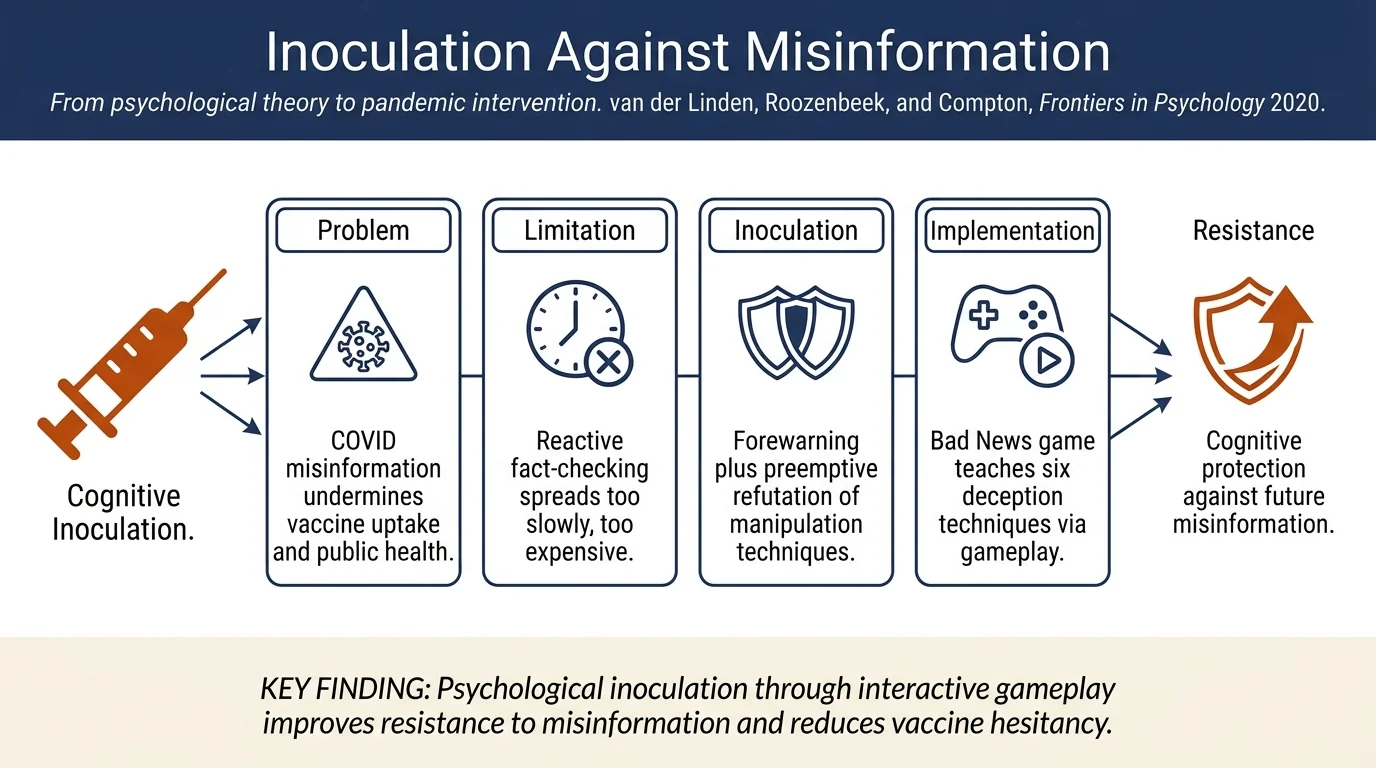
COVID-19 misinformation has proliferated rapidly on social media, undermining public health responses and vaccination uptake. Rather than relying on post-hoc fact-checking (which spreads slower than misinformation), the authors propose psychological inoculation—exposing people to weakened doses of misinformation techniques beforehand to build cognitive resistance. This prebunking approach can scale via games like Bad News and Go Viral!, achieving societal herd immunity against disinformation.
Contributions
- Documents the scope of COVID-19 misinformation (46–48% exposure in UK/US; 25%+ of top YouTube videos contained misleading claims)
- Links COVID-19 conspiracy belief to vaccine hesitancy, reduced compliance with public health guidelines, and violent intentions (e.g., 5G tower arson)
- Articulates limitations of reactive fact-checking: slower spread, continued influence effect, expensive to deploy at scale
- Applies psychological inoculation theory as a proactive, scalable alternative to post-hoc debunking
- Describes active inoculation via the Bad News game and Go Viral! (with WHO/UK government), where players learn six common misinformation techniques through gameplay
Method
Psychological inoculation adapts vaccination theory to persuasion resistance. A weakened challenge (e.g., a conspiracy theory) triggers protective cognitive responses (enhanced critical thinking) without changing the person's underlying position. The mechanism has two components:
- Forewarning — alerting people that actors will try to mislead them
- Preemptive refutation — exposing weakened versions of manipulation techniques (emotional language, false expertise, conspiratorial reasoning) before full-strength attacks
The Bad News game operationalizes this: players role-play as fake news creators, learn six deception techniques over six levels, and see consequences via simulated social media feedback. Gameplay simultaneously provides warnings and pre-exposure to weakened misinformation. Active inoculation (letting people generate their own antibodies through gameplay) improves retention relative to passive messaging.
Results
- Bad News has been played by ~1 million people worldwide and successfully improved resistance to misinformation techniques across five language versions
- Inoculation effects persist for months, boosted by "booster shots" (Pfau & Bockern, 1994; Maertens et al., 2020b)
- In related prior work on climate misinformation (van der Linden et al., 2017), inoculation partially protected people against subsequent full-strength misinformation
- Vaccination hesitancy declined only when anti-conspiracy arguments preceded exposure to anti-vaccine conspiracy theories, not when presented afterward (Jolley & Douglas, 2017)
Connections
- Builds on van der Linden et al. (2017) — inoculation theory applied to climate misinformation; demonstrates forewarning + refutation framework works beyond COVID
- Related to Roozenbeek & van der Linden (2019) — the Bad News game is a key inoculation intervention; this paper contextualizes it within the COVID response
- Contrasts with Walter et al. (2020) on fact-checking: that meta-analysis found corrections work but face motivated reasoning; this paper argues pre-exposure is more efficient than reactive fact-checking
- Complements Pennycook et al. (2020) on accuracy nudges — different mechanism (inoculation vs. salience); both address COVID misinformation at scale
- Cited alongside Guess et al. (2020) on media literacy — inoculation is a form of literacy training focused on manipulation techniques rather than content evaluation
- Related to Roozenbeek et al. (2020) on susceptibility to COVID misinformation — same team documents vulnerability, then proposes intervention
Notes
This is a perspective piece, not original empirical research, but it integrates substantial prior work (Bad News game, climate inoculation studies, health behavior findings) into a compelling case for prebunking as pandemic response. The recommendation for multi-layered defense (inoculation + debunking + real-time rebuttal) is pragmatic. Open question: does inoculation improve ability to identify true news, or just resist false claims? The authors note this is an under-explored frontier (Guess et al., 2020). Timing is prescient — published October 2020 during vaccine rollout planning, before mass hesitancy became entrenched; inoculation interventions pre-exposure would have been more effective earlier in the pandemic.