Algorithmic Intervention Decreases Polarization in Content Moderation
Authors: Anna Bertani, Saeedeh Mohammadi, Taha Yasseri Venue: arXiv cs.CY — arXiv:2611.03072
TL;DR
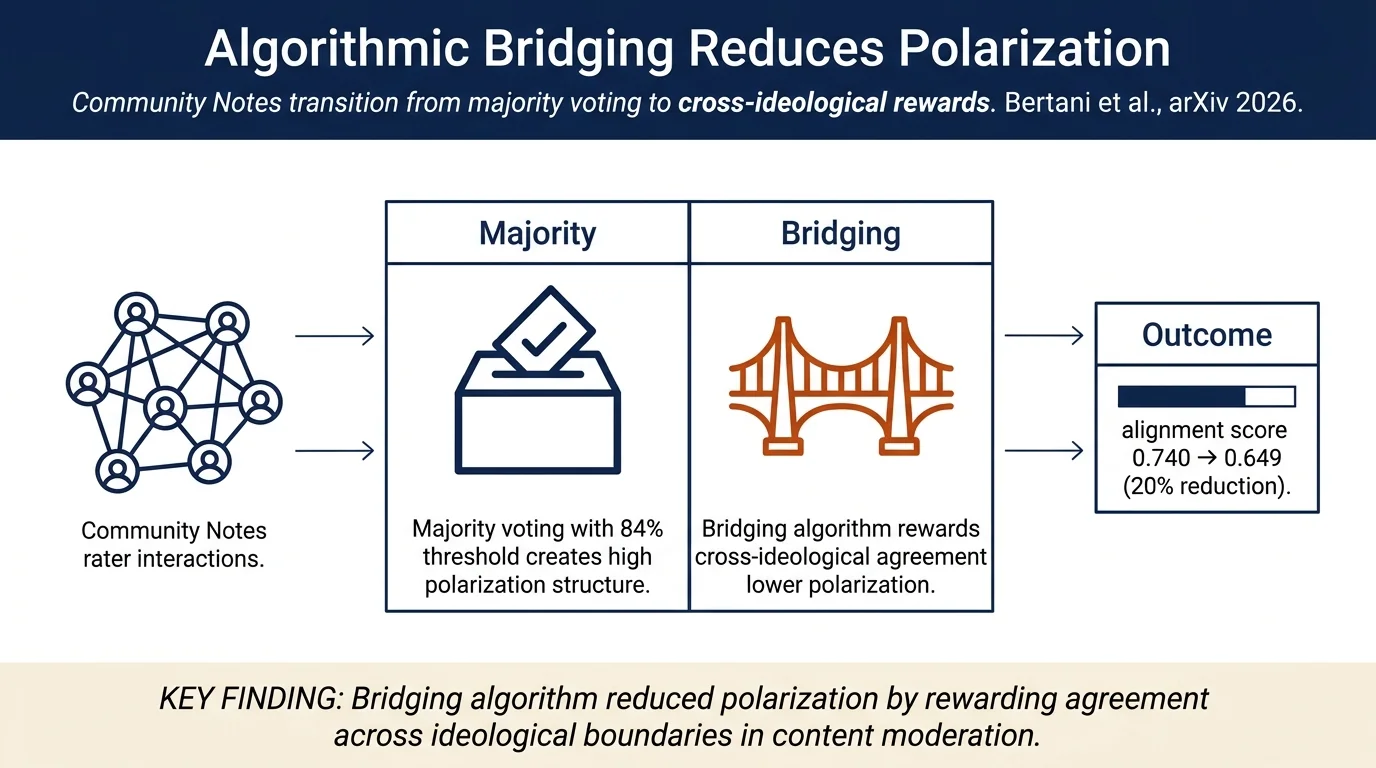
X's Community Notes transitioned from simple majority voting to a bridging algorithm that rewards agreement across ideologically diverse contributors. Comparing 8,805 notes and 4,367 contributors before and after this change (July 2021–September 2022), ideological polarization in both contributor and note positions decreased significantly, though negative interactions increased. Importantly, these negative interactions became less organized along partisan lines, suggesting the algorithm reshaped the structure of social conflict rather than eliminating it.
Contributions
- Empirical evaluation of a real-world algorithmic redesign in a major content moderation platform, quantifying effects on both note quality and contributor behavior.
- Mixed-sign network analysis showing that while antagonism increased, structural polarization (alignment into opposing camps) decreased.
- Matrix factorization model estimating latent ideological positions of contributors and notes, revealing less bimodal distributions post-algorithm change.
- External validation via 160 crowdsourced evaluations confirming that post-transition notes scored higher on perceived helpfulness.
Method
The authors compared two periods around Community Notes' algorithmic transition on 28 February 2022:
- Period 1 (Jul 2021–Feb 2022): Majority-rule aggregation — notes displayed when ≥84% positive ratings.
- Period 2 (Mar–Sep 2022): Bridging algorithm — a matrix factorization model that estimates latent ideological positions (\(f_u\) for raters, \(f_n\) for notes) and weights agreement higher when it crosses ideological boundaries.
For each period:
- Filtering pipeline: Applied platform filters to yield scored notes (majority: 4,139 before, 4,666 after; raters: 2,196 before, 2,171 after).
- Latent position estimation: Fitted Matrix Factorization model \(\hat{r}_{un} = \mu + i_u + i_n + f_u \cdot f_n\) via SGD, where the interaction term captures ideological alignment. Used bimodality coefficient (BC > 0.555 indicates bimodal distribution) to quantify polarization.
- Network construction: Built signed directed networks from rater–note interactions, retaining edges with high confidence in the Bayesian model (E[p] ≥ 0.6 for positive edges, ≤ 0.4 for negative).
- Polarization metrics:
- Antagonism: Share of negative edges in the signed network.
-
Alignment: Frustration score — how cleanly contributors organize into two opposing groups (measured via simulated annealing; higher alignment = clearer binary split).
-
External evaluation: Recruited 10 independent raters per note (160 notes, 80 from each period) to judge helpfulness, controlling for coverage and timing effects.
Results
Ideological polarization decreased significantly: - Contributor latent positions: Bimodality coefficient declined from 0.128 to 0.142 (KS test, D = 0.128, p < 0.001). - Note latent positions: BC declined from 0.142 to even less pronounced bimodality (D = 0.142, p < 0.001). - Effect was gradual over time (March–September 2022) rather than a step change, consistent with behavioral adaptation to the new incentive structure.
Structural alignment decreased: - Alignment score (proportional frustration reduction) fell from 0.740 to 0.649 (p < 0.001), indicating looser organization into opposing clusters.
Antagonism increased but less polarized: - Share of negative interactions rose from 0.320 to 0.390 (p < 0.001). - However, negative edges became less cleanly partisan-aligned (modularity comparison).
Note helpfulness improved (external validation): - Post-transition notes scored higher on average (mean 28.8 vs. 15.5, median 40 vs. 20, Mann-Whitney U = 2786.5, p = 0.155; not stat. sig., but trend favorable). - Fitted threshold (\(i_n\) ≥ 0.40 for Helpful) increased decisiveness over time.
Contributor leniency and raw note quality unchanged: - No significant shift in per-rater tendency to vote Helpful (p = 0.200). - No significant change in raw note quality metrics (p = 0.645).
Connections
- Related to Polarization via algorithmic incentives reshaping ideological structure.
- Cited alongside Community notes as a foundational empirical study of the bridging algorithm's effects.
- Extends work on political polarization in social media by showing platform interventions can reduce polarization metrics in practice.
- Contributes to broader discussions of Content moderation as a social-technical system, showing trade-offs between coverage and consensus.
- Related to Algorithmic bias in content systems and Platform governance: demonstrating how algorithm design can intentionally redirect user behavior.
Notes
Strengths: - Real-world natural experiment at scale (8,805 notes, 4,367 contributors, 91,006 raw interactions before; 101,394 after). - Combination of latent-variable models (matrix factorization) and network analysis (signed graphs) provides complementary perspectives on polarization. - External human evaluation grounds the algorithmic findings in actual note quality. - Clear communication of trade-offs: reduced polarization structure did not eliminate conflict, only its organization—a nuanced finding often missed in algorithmic intervention papers.
Limitations: - Observational design: cannot fully rule out concurrent platform changes (user base growth, content topic shifts) as confounds. Fixed-pool reanalysis partially addresses this. - English-language Community Notes only; generalization to multilingual contexts unknown. - Latent dimensions estimated by matrix factorization may capture non-ideological variation (e.g., topic affinity, expertise). - Only ~13% of posts receive notes; coverage bias means findings apply to the subset of content deemed note-worthy, not representative of all posts. - Note display delay (~26 hours) means intervention effectiveness depends on temporal dynamics not fully analyzed.
Future directions: - Investigate heterogeneous effects by topic, political region, or user experience level. - Examine whether reduced polarization persists as the system expands to non-English markets. - Analyze causal mechanisms: do contributors adapt their behavior in response to changed algorithmic incentives, or does the algorithm select different notes for display?