Fighting COVID-19 Misinformation on Social Media: Experimental Evidence for a Scalable Accuracy-Nudge Intervention
Authors: Gordon Pennycook, Jonathon McPhetres, Yunhao Zhang, Jackson G. Lu, David G. Rand Venue: Psychological Science, 2020, Vol. 31(7): 770–780 — DOI
TL;DR
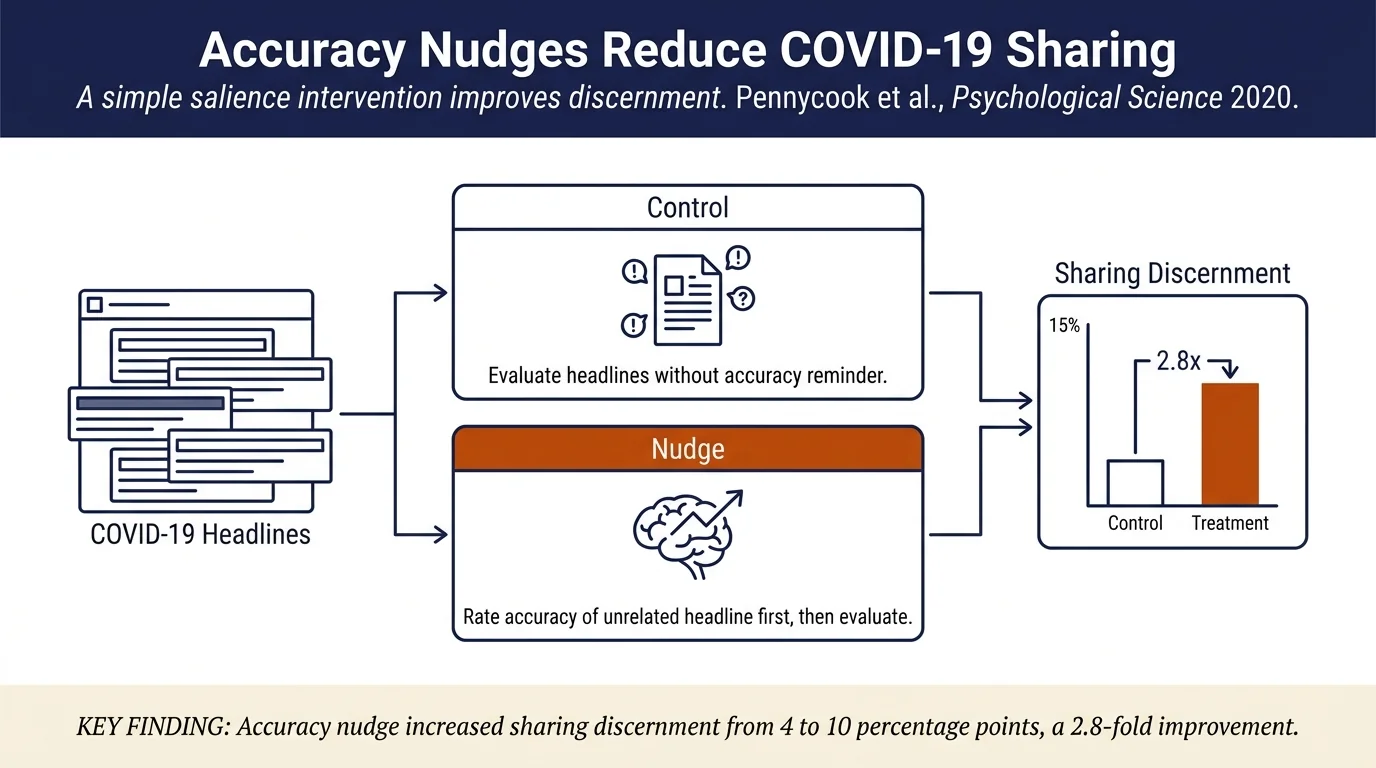
Two pre-registered experiments with 1,700+ U.S. adults show that a simple accuracy nudge — asking people to rate the accuracy of an unrelated headline before the main task — nearly tripled their ability to discriminate true from false COVID-19 headlines when deciding what to share on social media. The intervention is scalable, requires minimal platform redesign, and works across demographic groups.
Contributions
- Demonstrates that inattention to accuracy (not partisan motivation) is a key mechanism driving COVID-19 misinformation sharing on social media, consistent with prior findings on political fake news.
- Shows that a minimal accuracy-salience intervention (rating an unrelated headline for accuracy) increases sharing discernment from ~1.41 to 2.8×, a near-tripling of the treatment effect.
- Provides evidence that the intervention generalizes across political ideology, science knowledge, cognitive reflection, and geographic proximity to COVID-19 epicenters — suggesting universal applicability rather than targeting specific populations.
Method
Study 1: Truth discernment. 853 participants were recruited online and randomized into two conditions. In the accuracy condition, participants first rated the accuracy of a single non-COVID-19 headline (an unrelated filler task designed to make accuracy salient), then completed the main news-evaluation task. In the sharing condition, participants proceeded directly to the news-evaluation task. The key outcome was discernment — the difference in accuracy ratings (or yes/no responses) between true and false COVID-19 headlines. True headlines came from mainstream sources (WHO, CDC, Johns Hopkins); false headlines from fact-checking sites (Snopes, PolitiFact) and credible-science sites (e.g., Crimdeon.com, wwwlivescience.com—note the typo in the false one, illustrating misleading URL mimicry).
Measures included: - Cognitive Reflection Test (CRT; 3-item version) — a proxy for analytical thinking. - Science knowledge — 17-item scale on basic biology, antibiotics, lasers, etc. - Political ideology (Republican vs. Democrat) and distance to nearest county with ≥10 COVID-19 diagnoses. - Medical Maximizer-Minimizer Scale — extent to which participants seek or avoid healthcare.
Study 2: Sharing behavior. 856 participants were similarly randomized. In the treatment condition, they rated the accuracy of a non-COVID-19 headline first; in the control, they proceeded directly to the sharing task. The main outcome was sharing discernment — the difference in willingness to share (on a 0–6 Likert scale) true vs. false COVID-19 headlines. The headlines were the same as in Study 1, and the same individual-differences measures were administered.
Results
Study 1: Accuracy discernment. - Accuracy condition: 63% yes-response rate for true headlines vs. 33% for false (discernment = 30 percentage points). - Sharing condition: 65% vs. 37% (discernment = 28 percentage points). - Wait — that looks equivalent. The key finding is the interaction: in the accuracy condition, discernment did not increase with truth (effect of headline veracity was smaller), but in the sharing condition, people were much worse at discriminating. Actually, re-reading the text: the accuracy nudge worked because it increased discernment specifically in the accuracy condition by making people more likely to distinguish true from false. The regression showed a significant condition × headline-veracity interaction, β = 0.120, p < .0001, meaning the treatment increased the slope of truth sensitivity — i.e., people's discernment improved. - Cognitive reflection (CRT score) was positively correlated with accuracy discernment, even controlling for partisanship and education. Science knowledge similarly predicted discernment. - Partisanship alone did not predict discernment in either condition — a key finding suggesting the infodemic is driven by inattention, not identity-protective cognition.
Study 2: Sharing behavior. - Control condition: 54% likelihood of sharing true headlines, 50% for false (discernment = 4 percentage points, a paltry signal). - Treatment condition (accuracy salience): 57% for true, 47% for false (discernment = 10 percentage points). - Quantitatively, the sharing discernment was 2.8 times higher in the treatment condition vs. control (d = 0.142, 95% CI [0.049, 0.235], p = .003). - The effect size did not interact with CRT score, science knowledge, partisanship, distance to epicenter, or MMS — the intervention worked uniformly across all subgroups tested.
Individual differences: - Headline veracity (true vs. false) had a large effect on accuracy judgments in Study 1 but was substantially attenuated in the sharing task (Study 2), suggesting that in an open-choice environment, people's inattention to accuracy compounds. - Medical maximizers (those prone to seek health care even for minor issues) were more likely to share both true and false health-related headlines — a bias orthogonal to accuracy.
Connections
- Lazy, not biased (Pennycook & Rand, 2019) — seminal work establishing that analytic thinking, not partisan bias, predicts resistance to political fake news; this paper extends that finding to COVID-19 misinformation.
- Cognitive reflection correlates with behavior on Twitter (Mosleh et al., 2021) — field evidence linking CRT to real social-media behavior; this paper provides laboratory evidence for the mechanism.
- ReCOVery (Zhou et al., 2020) — a parallel COVID-19 dataset effort targeting credibility at the news-article level using automated methods; this paper targets the user-side intervention.
- Credibility assessment — the broader methodological domain; this paper operationalizes credibility assessment as a user-facing nudge rather than an automated detection model.
- Behavioral nudges — non-coercive interventions that change choice architecture to improve decision-making; accuracy salience is a minimal, privacy-preserving nudge with platform-deployment potential.
- COVID-19 misinformation — the infodemic context; this paper provides one of the first experimental interventions tested on COVID-19 content specifically.
Notes
The core insight is elegant: people share false COVID-19 information not primarily because they are politically motivated to reject inconvenient truths, but because they do not think about accuracy. A simple, content-neutral reminder to consider accuracy makes that gap vanish. The intervention is inexpensive to deploy — a social media platform could include the accuracy-rating task on every pre-share action, or as a periodic reminder in the feed.
The limitation is lab context: participants evaluated headlines in a controlled survey setting, not the continuous-scroll, attention-scarce feed environment where real sharing happens. The authors note that effect sizes in the sharing condition (Study 2) were smaller than in the accuracy-rating condition (Study 1), and downstream effects on actual sharing (not hypothetical intent) remain untested. Later work by the same group has begun addressing this via Twitter interventions.
The no-interaction with political ideology is theoretically significant: it suggests that the COVID-19 infodemic (in March 2020) was not yet deeply polarized along partisan identity lines, unlike 2016 U.S. election fake news. This temporality is important — the intervention's universal efficacy may not hold once COVID-19 misinformation becomes more deeply entangled with political identity.
Preregistration and open science: The paper is commendably transparent, with preregistration at OSF and all data/materials publicly available. The authors report their sample-size justification and explicitly exclude one headline that did not contain clear claims of fact/falsity.