Deepfakes & multimodal
66 pages
Filter and search within this area
 Deepfakes & multimodalFact-checking & verification
Presenting: The Bellingcat Online Open Source Investigations ToolkitBellingcat presents their newly restructured Online Open Source Investigations Toolkit, an AI-powered search interface that aggregates tools for digital verification and investigative research. The toolkit provides categorized access to resources for satellite imagery, social media analysis, transportation tracking, and source archiving,…
 Deepfakes & multimodalLLMs & generative AI
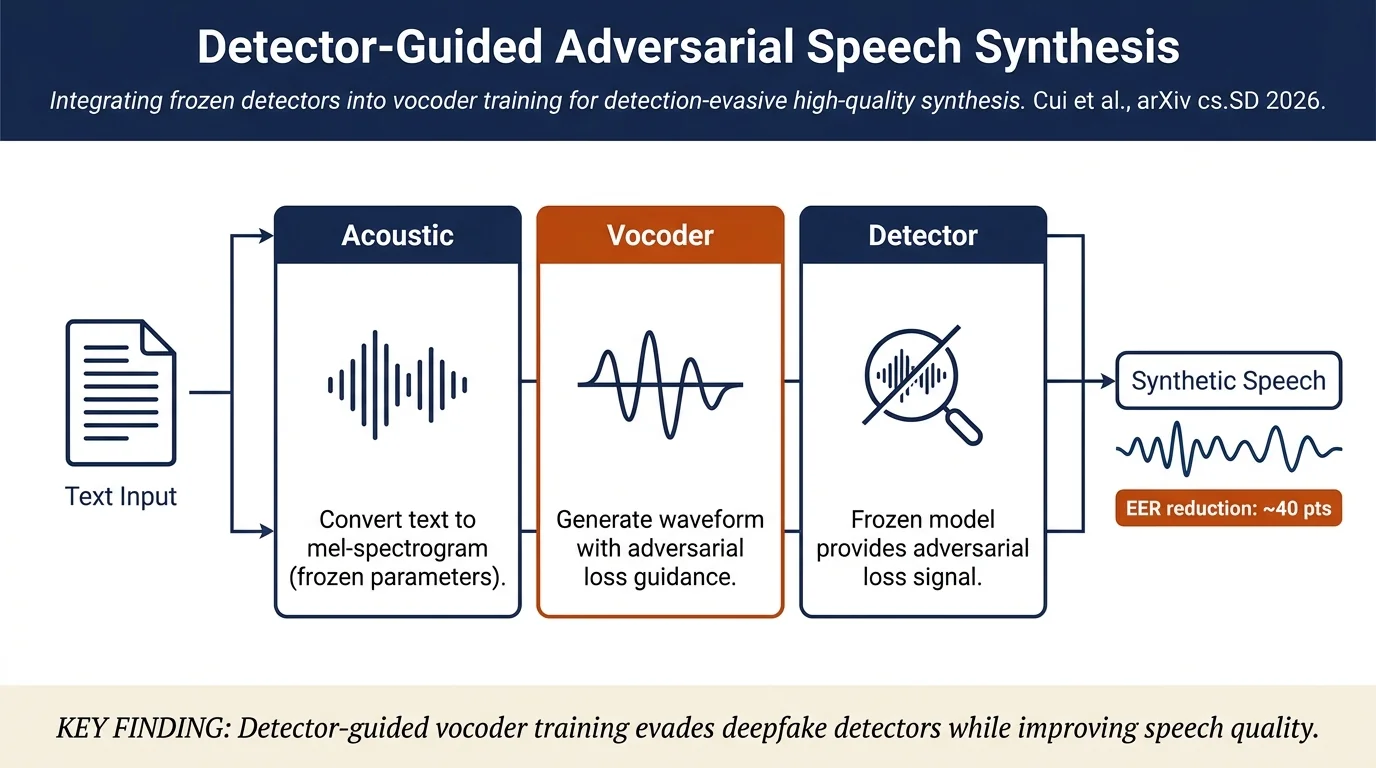
Detector-Guided Vocoder Training for Adversarial Text-to-Speech SynthesisThis paper presents a method to generate synthetic speech that evades deepfake detectors by integrating detector loss directly into vocoder training, rather than applying post-hoc perturbations. The approach fine-tunes a BigVGAN vocoder while freezing the acoustic model and detector, generating adversarial speech that retains high…
 Deepfakes & multimodalDetection methods
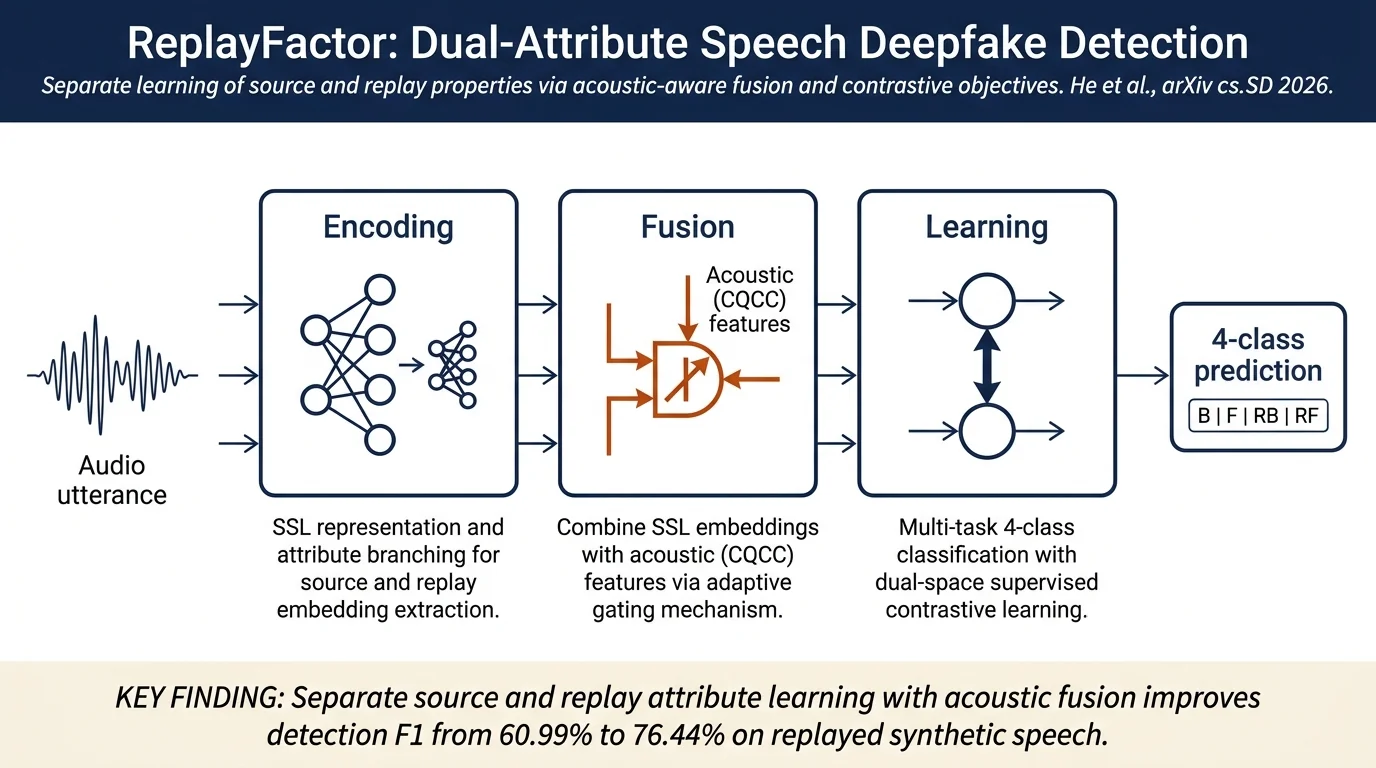
ReplayFactor: Replay-Aware Dual-Attribute Learning for Practical Speech Deepfake DetectionExisting speech deepfake detectors fail on physically replayed synthetic speech (played through a loudspeaker and re-recorded), a low-cost, practical threat to voice authentication systems. ReplayFactor addresses this by learning both source authenticity (human vs. generated) and replay presence (non-replayed vs. replayed) via SSL-based…
 Deepfakes & multimodalDetection methods
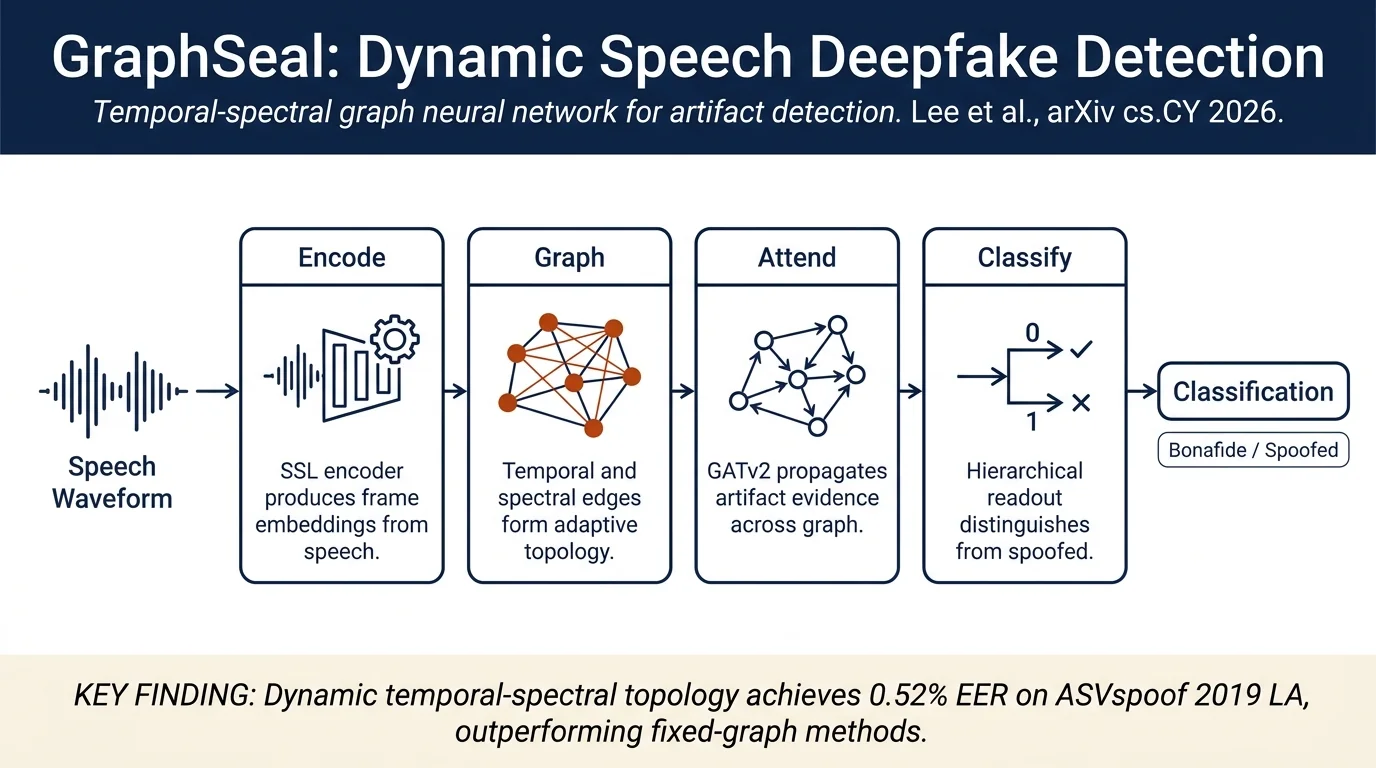
GraphSeal: Graph-Augmented Speech Deepfake Detection via Temporal-Spectral Artifact PropagationGraphSeal proposes a dynamic temporal-spectral graph neural network for speech deepfake detection that outperforms fixed-topology baselines on generalization tasks. Unlike prior graph-based anti-spoofing methods that use feature-extraction-determined topologies, GraphSeal constructs utterance-specific edges from both temporal adjacency…
 Deepfakes & multimodalDetection methods
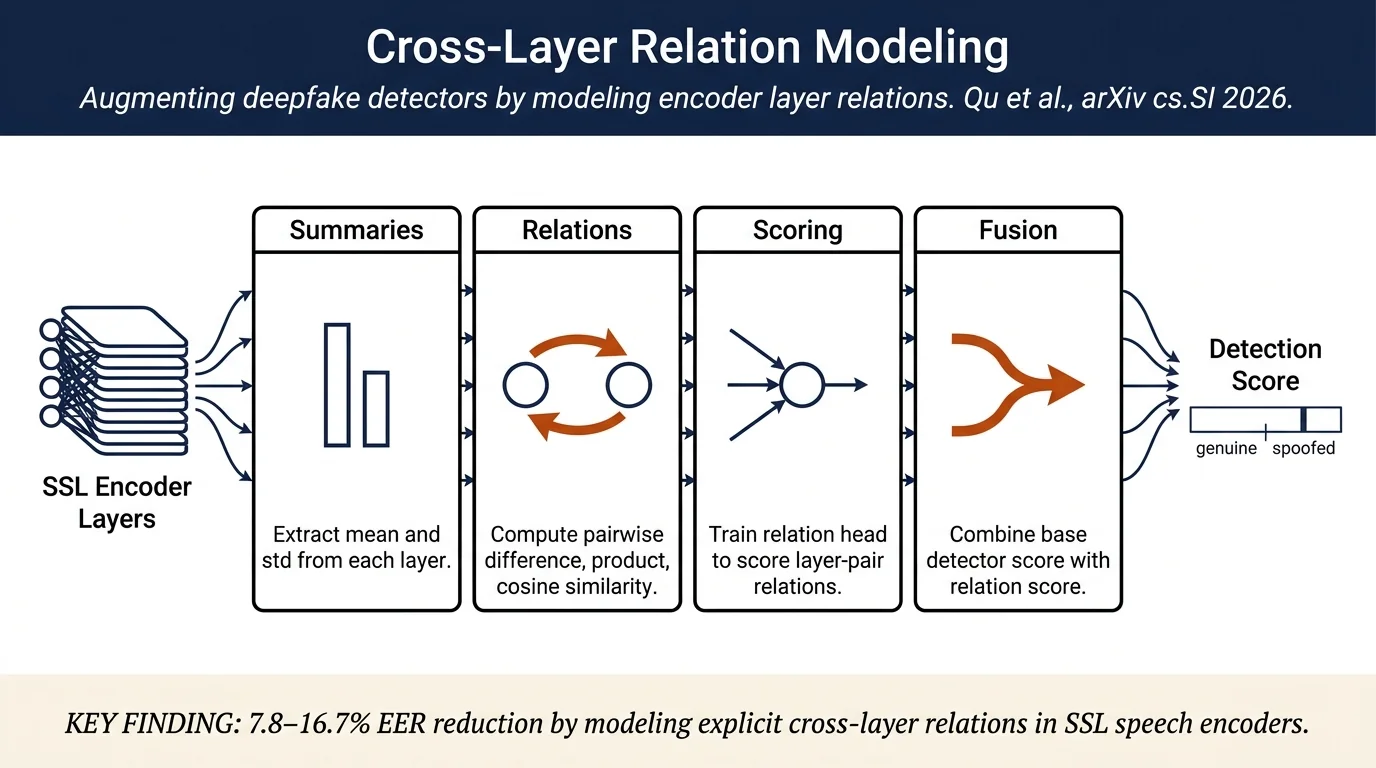
CLRM: Cross-Layer Relation Modeling for Audio Deepfake DetectionAudio deepfake detection (ADD) distinguishes authentic speech from synthetic or manipulated speech. Existing methods either select informative layers from self-supervised learning (SSL) speech encoders or aggregate features across layers, but this discards useful variation in how different layers represent genuine vs. spoofed speech.
 Deepfakes & multimodalDetection methods
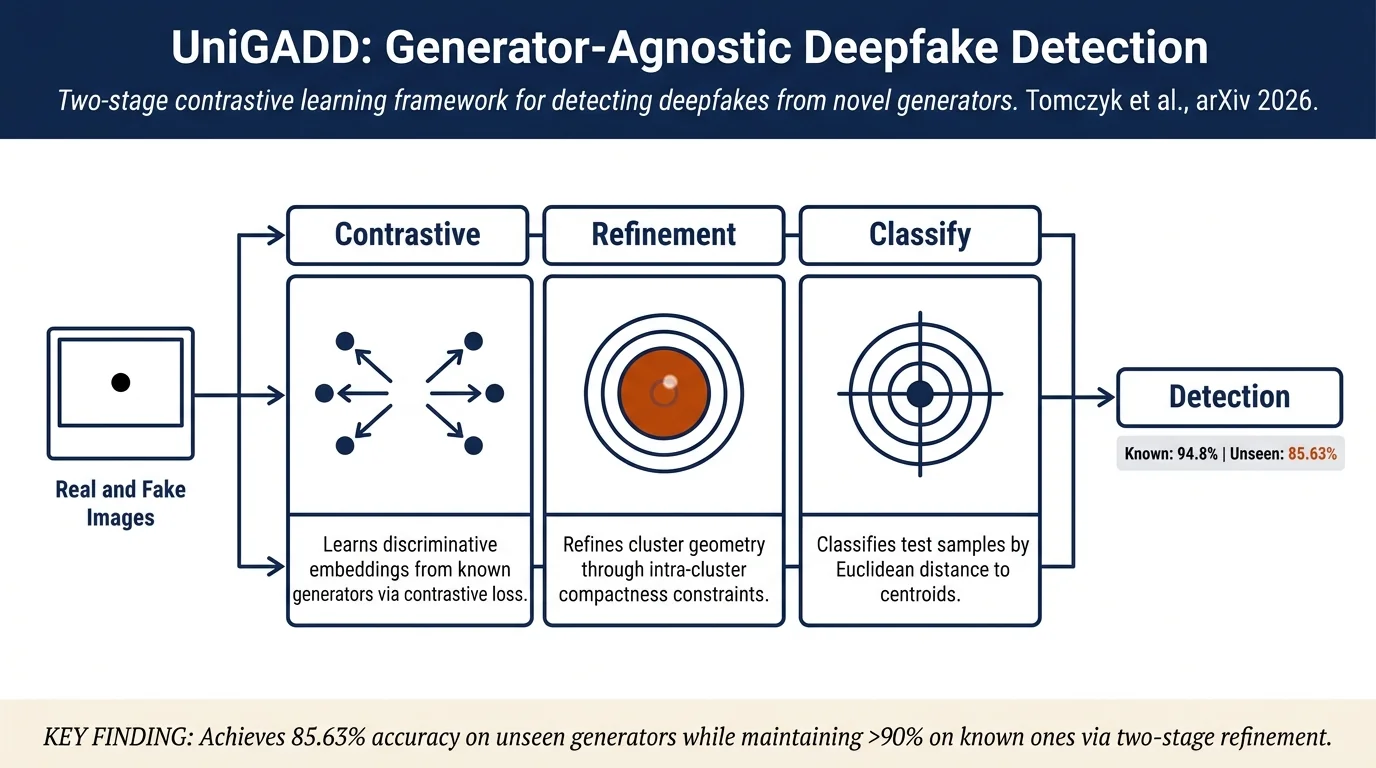
UniGADD: Universal Generator-Agnostic Deepfake DetectorUniGADD proposes a two-stage supervised contrastive learning framework for detecting deepfakes from previously unseen generators. The method learns discriminative embeddings from known fake generators in stage one, then refines cluster structure via intra-cluster compactness constraints in stage two.
 Deepfakes & multimodalDatasets & evaluation
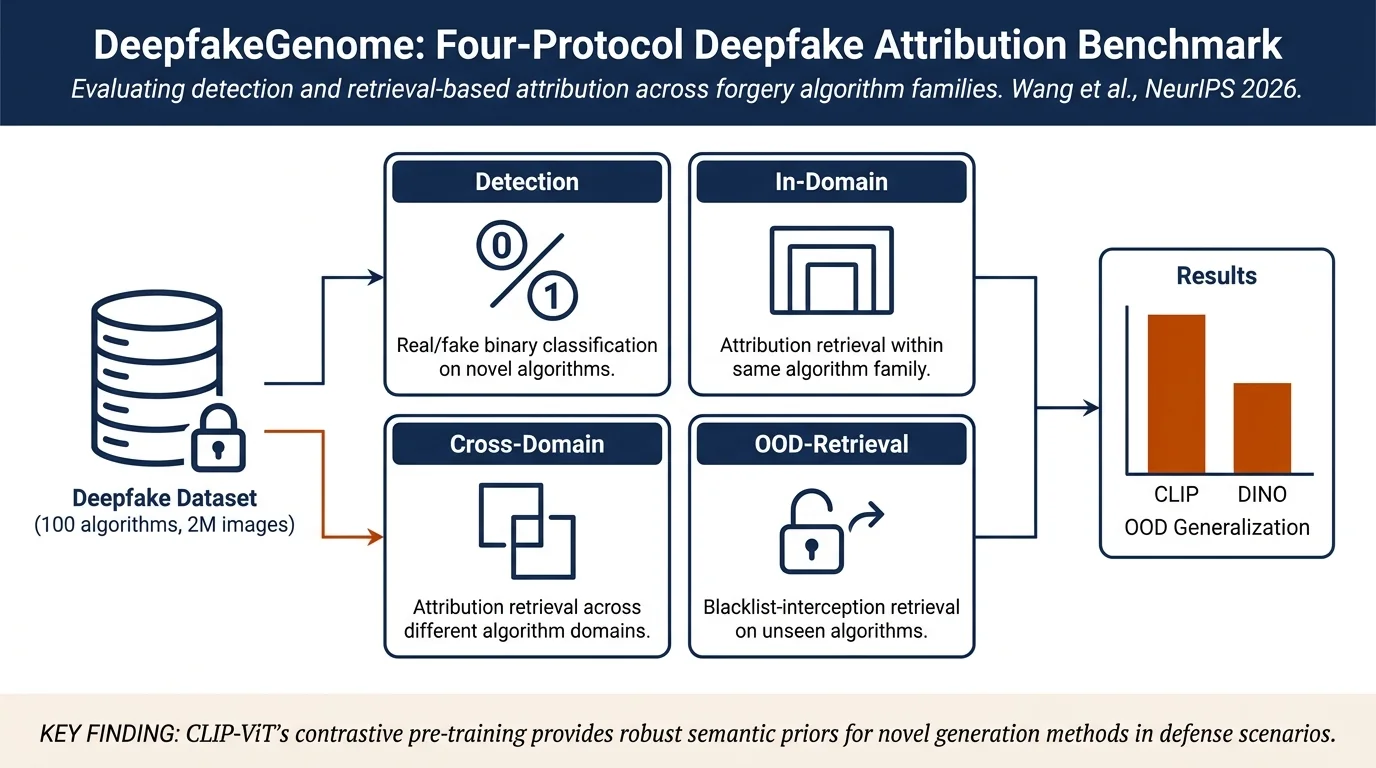
DeepfakeGenome: Toward Next-Generation Deepfake AttributionDeepfakeGenome (DFG) is a large-scale benchmark for deepfake detection and attribution covering 100 facial forgery algorithms and 2M images — 4–100× larger than prior benchmarks. The paper proposes 4 evaluation protocols using novel retrieval-based attribution metrics (mAP, Recall) instead of reject-class classification, and conducts…
 Deepfakes & multimodalDetection methods
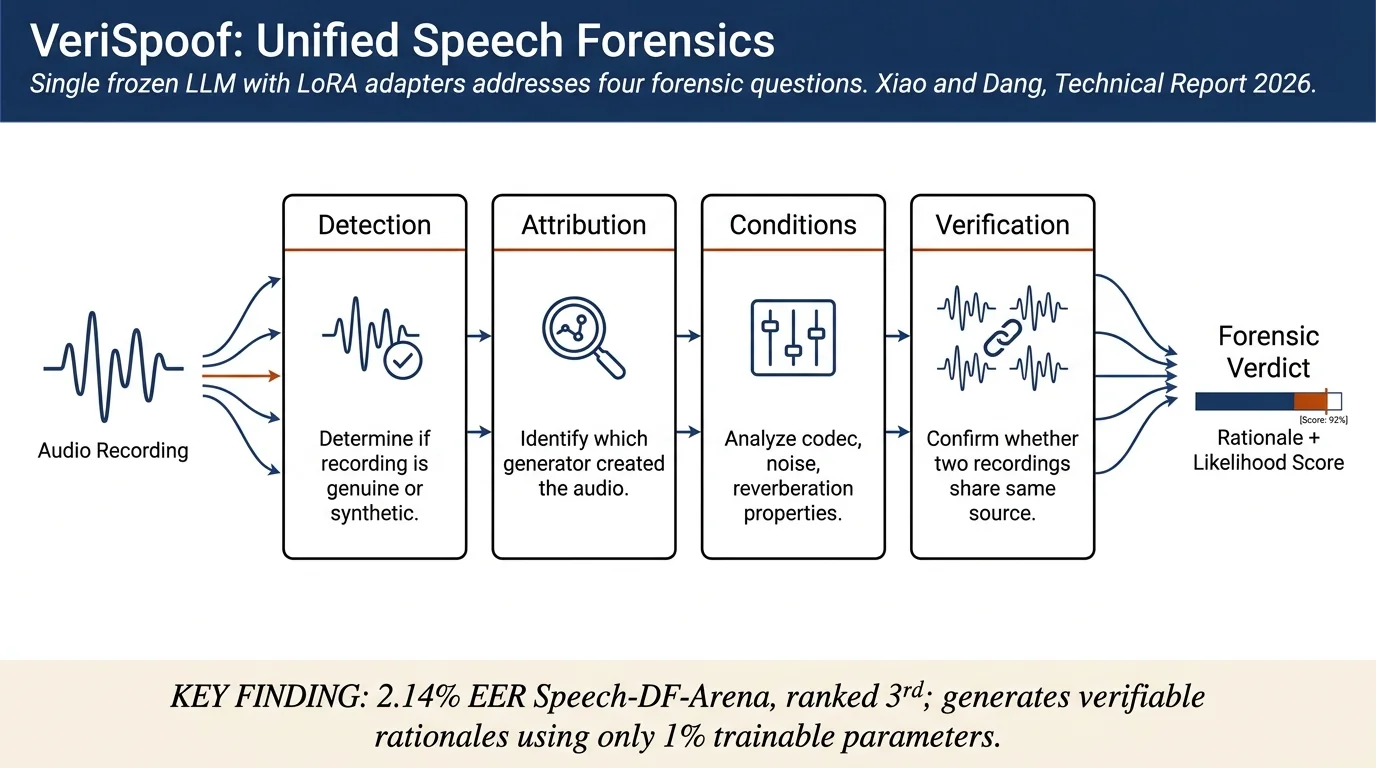
VeriSpoof: Beyond Real or Fake with One Audio LLMVeriSpoof is an audio language model system that unifies multiple forensic tasks in a single neural framework: detecting whether a speech recording is synthetic, identifying which generator produced it, analyzing recording conditions, and verifying whether two recordings share a source. The system achieves state-of-the-art results on…
 Platforms, policy & societyDeepfakes & multimodal
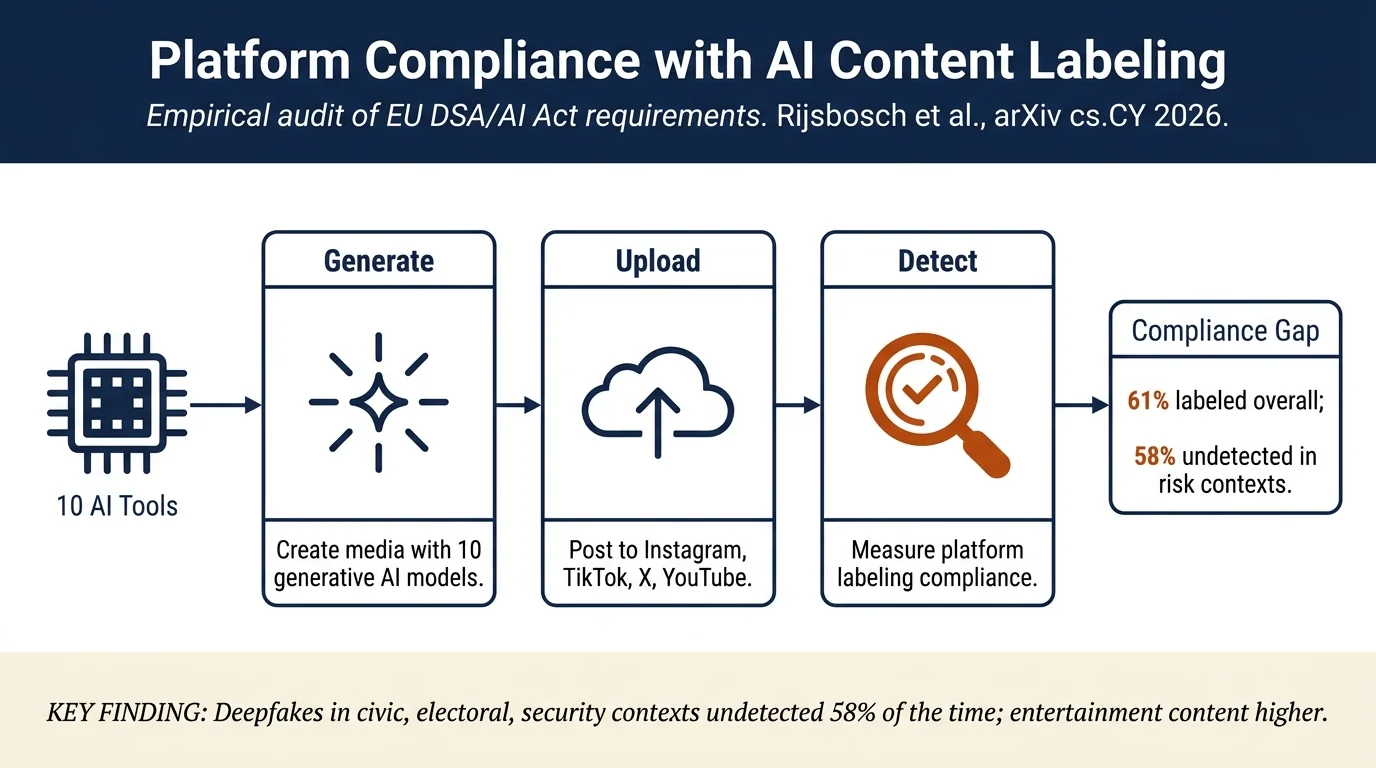
Drowning in AI Slop: How Social Media Platforms (Do Not) Label AI and Deepfake Content under EU lawThis paper conducts a legally grounded empirical audit of AI-labeling practices across Instagram, TikTok, X, and YouTube, testing how well platforms comply with EU legal obligations to label AI-generated and deepfake content. Using uploads of content generated by 10 generative AI tools, the authors find that platforms labeled only 36 of…
 Deepfakes & multimodalDatasets & evaluation
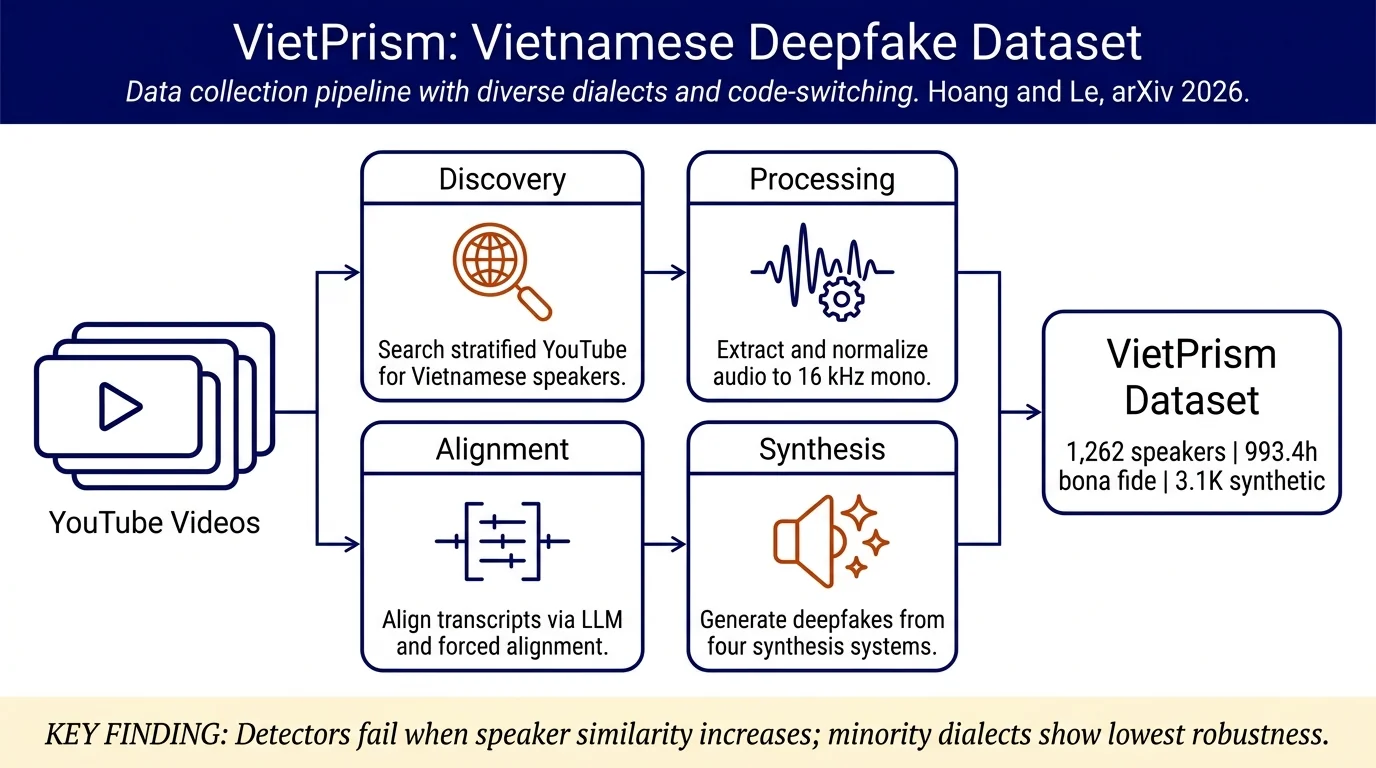
VietPrism: A Large-Scale Vietnamese Speech and Deepfake Corpus with Diverse Dialects and Code-SwitchingVIETPRISM is a large-scale Vietnamese speech dataset combining 993.4 hours of bona fide utterances from 1,262 speakers with 3.1K hours of synthetically generated speech from four deepfake systems. The dataset uniquely provides transcripts, dialect annotations, speaker identities, and natural Vietnamese–English code-switching coverage.
 Fact-checking & verificationLLMs & generative AI
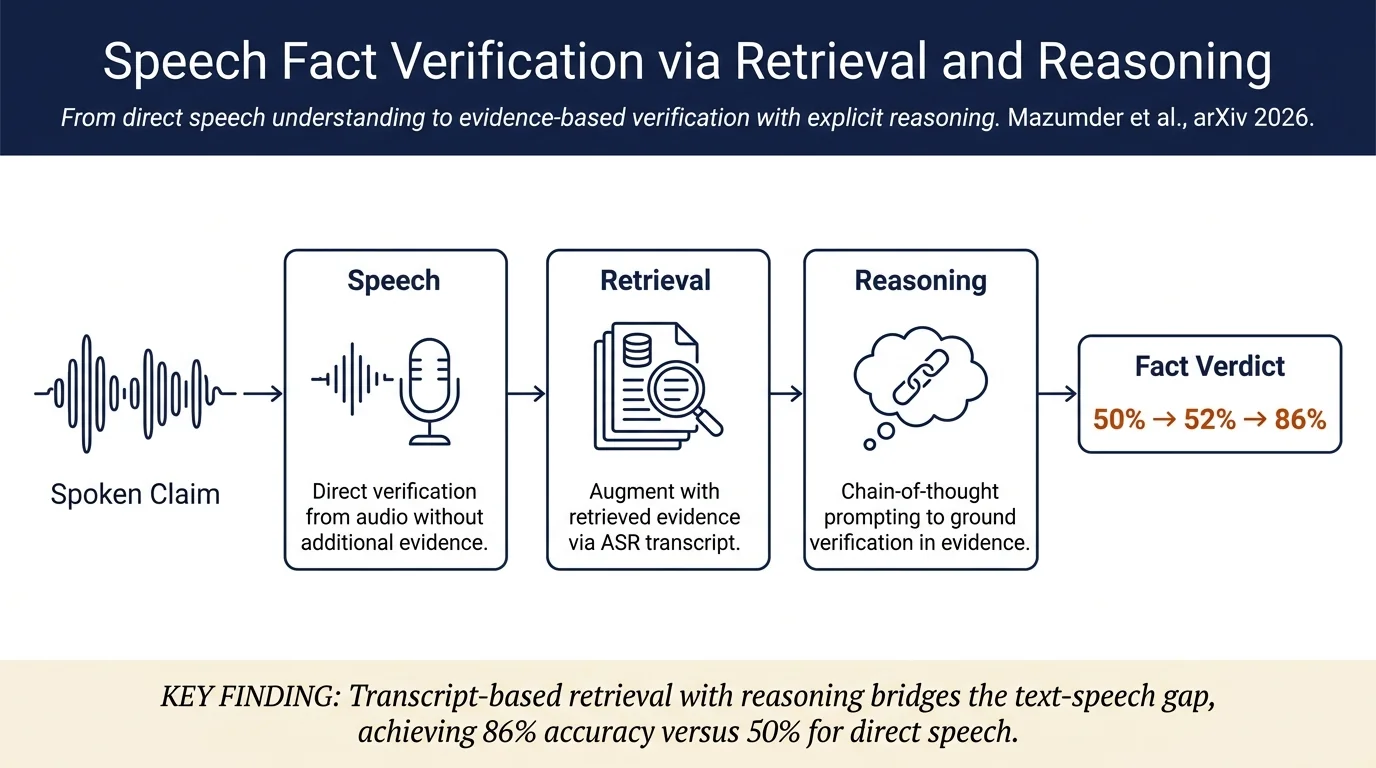
To Trust or Not to Trust: Retrieval-Augmented Fact Checking in SpeechLarge Audio Language Models (LALMs) exhibit a significant text-speech modality gap: they verify written claims reliably but fail on spoken ones, even from the same model. The paper introduces VeriSpeak, a benchmark of 3,879 spoken claims with temporal, geographical, and relational facts, and demonstrates that retrieval-augmented LALMs…
 Deepfakes & multimodalDetection methods
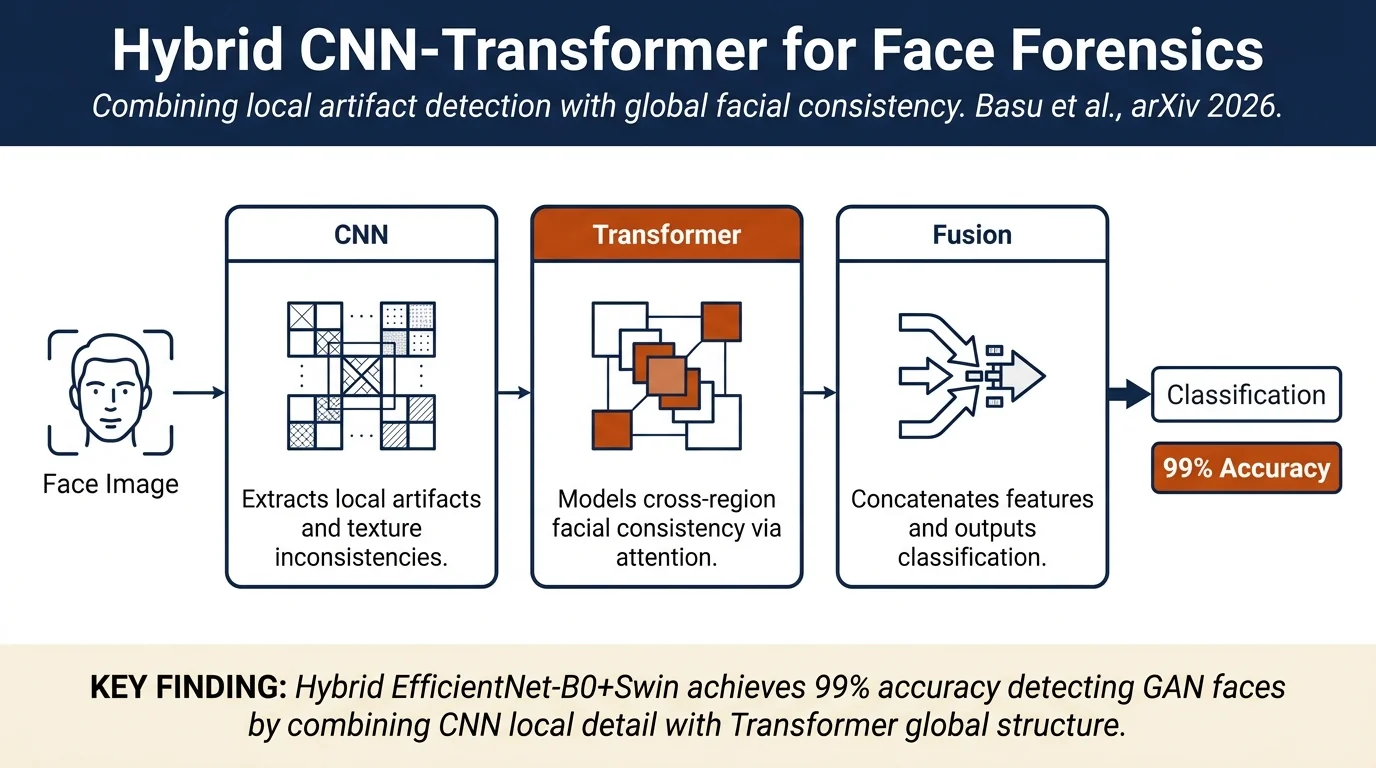
Swin Meets EfficientNet: Lightweight Architectures for GAN-Based Face ForensicsProposes lightweight Swin-Transformer and hybrid EfficientNet-Swin architectures for detecting GAN-generated synthetic faces under computational constraints. The hybrid EfficientNet-B0+Swin model achieves 99% accuracy and 99.44% recall on the 140K Real and Fake Faces dataset, combining convolutional local feature extraction with…
 Deepfakes & multimodalDatasets & evaluation
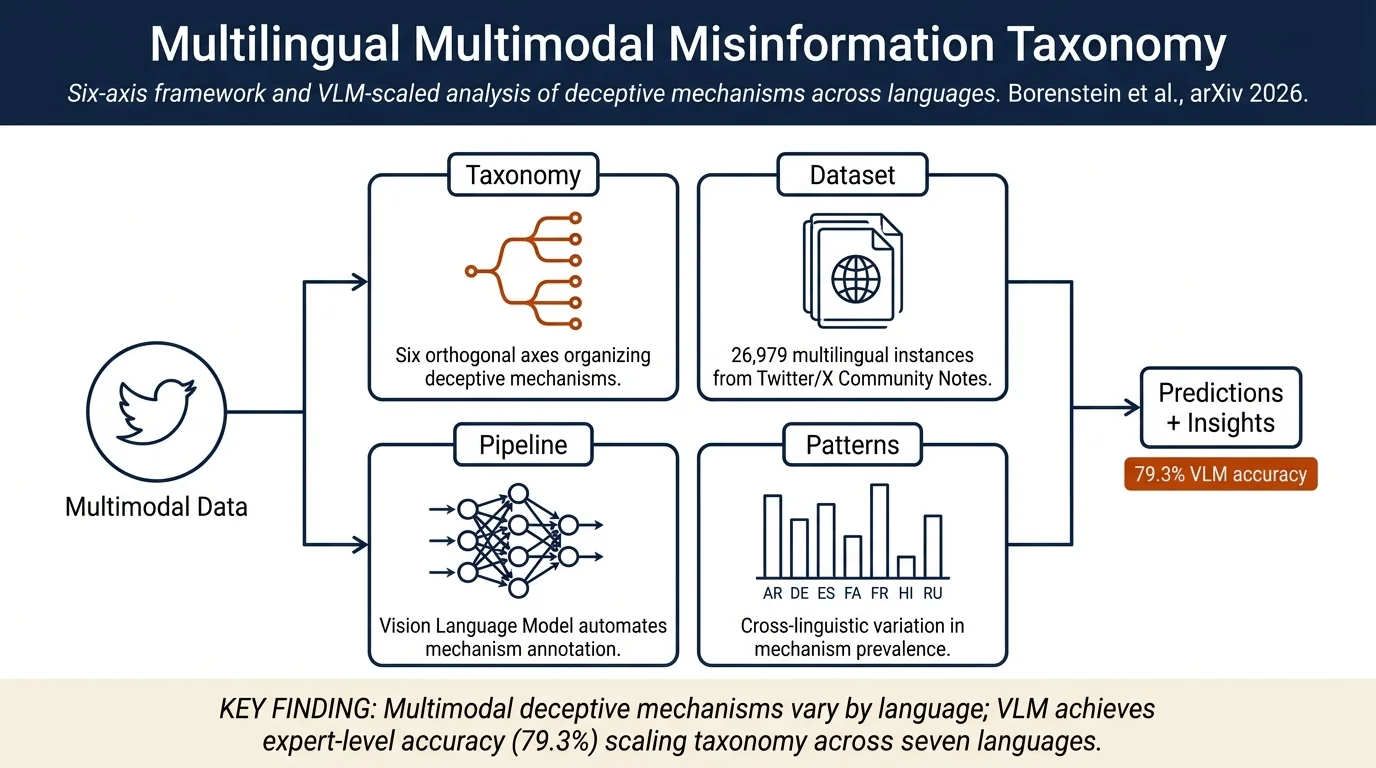
MMMMM: A Unified Taxonomy for Investigating the Mechanisms of Multilingual MultiModal MisinformationMultimodal misinformation (images paired with misleading text) is poorly understood compared to text-only fake news, hampered by fragmented taxonomies and the complexity of annotating cross-modal relationships at scale. This work proposes a unified taxonomy of multimodal misinformation mechanisms across six orthogonal axes…
 Deepfakes & multimodalLLMs & generative AI
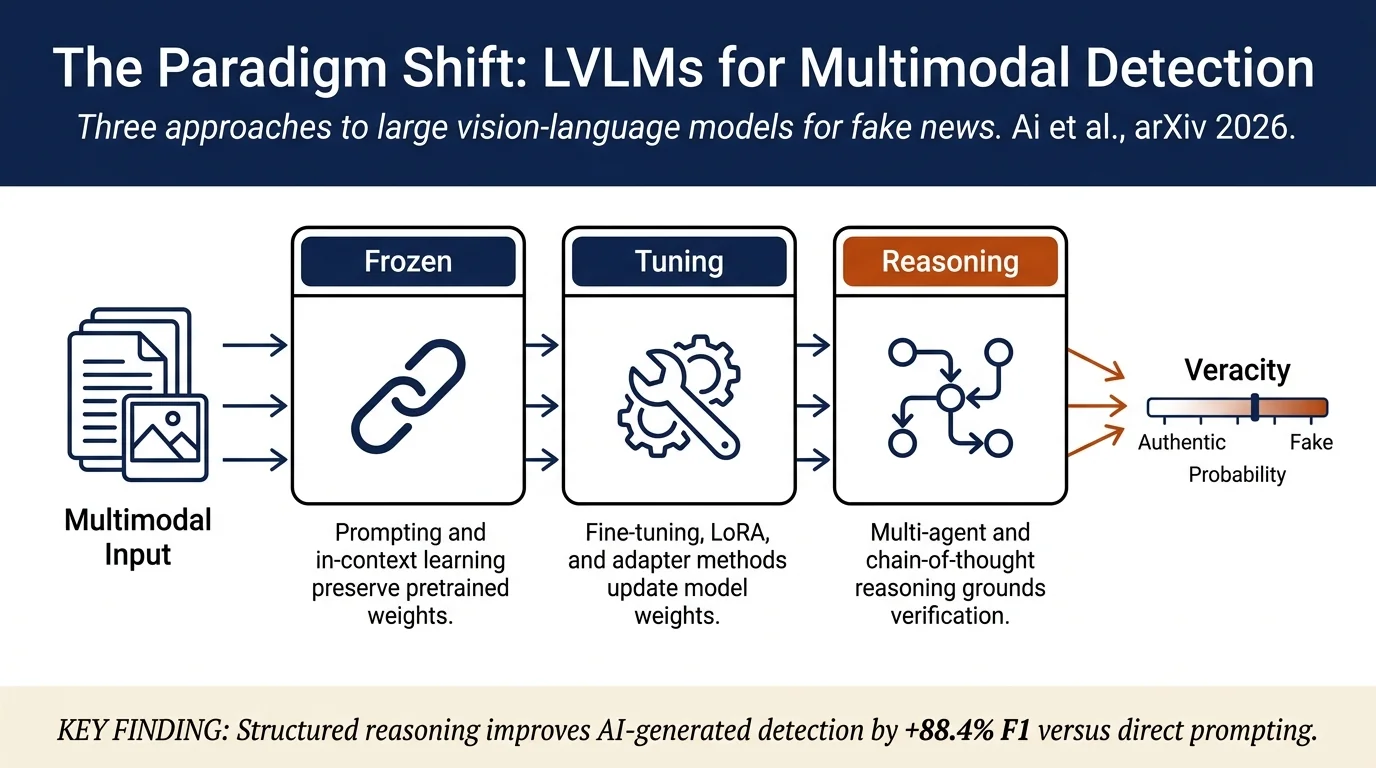
The Paradigm Shift: A Comprehensive Survey on Large Vision Language Models for Multimodal Fake News DetectionThis comprehensive survey systematically reviews the application of Large Vision-Language Models (LVLMs) to multimodal fake news detection (MFND). It proposes a novel three-branch taxonomy categorizing current approaches into parameter-frozen, parameter-tuning, and reasoning paradigms, each addressing different resource constraints and…
 Deepfakes & multimodalDetection methods
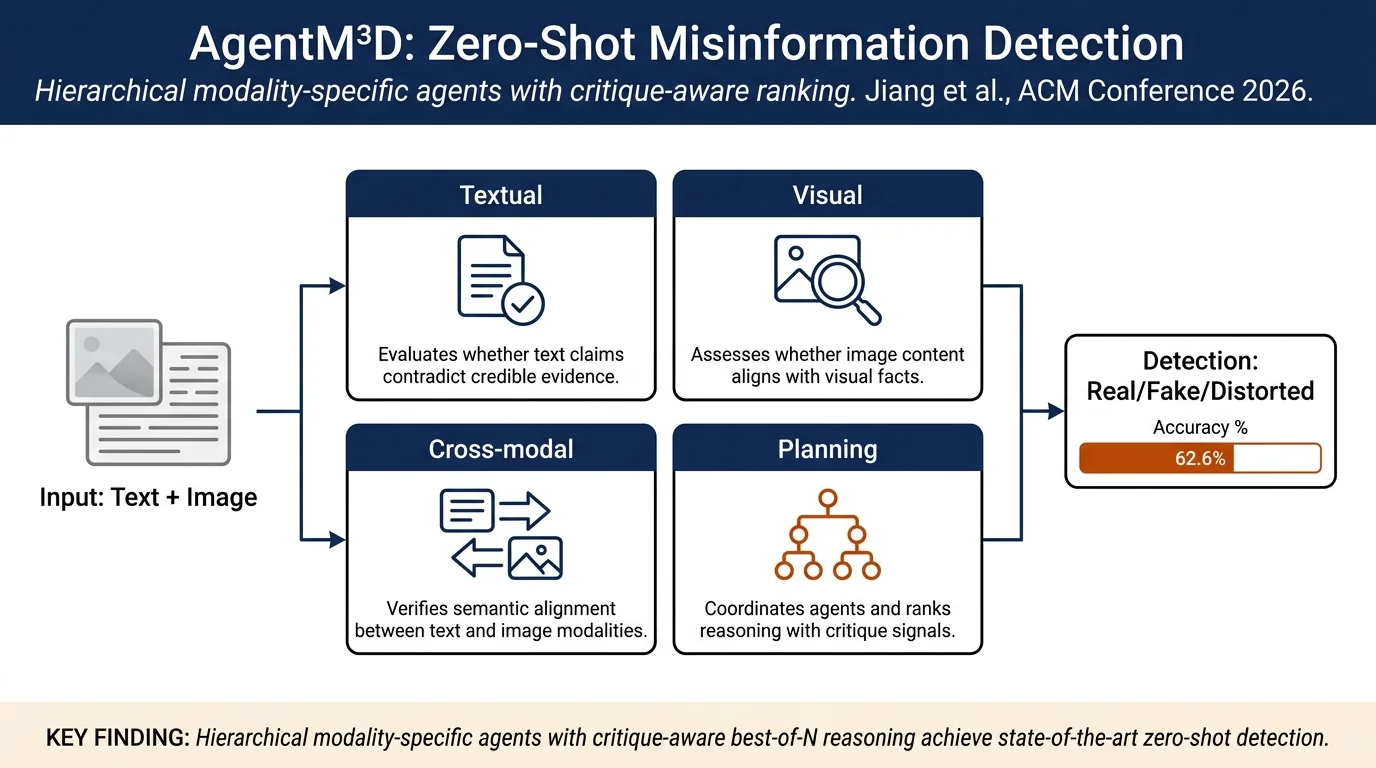
Agentic Mixed-Source Multi-Modal Misinformation Detection with Adaptive Test-Time ScalingVision-language models struggle with mixed-source multi-modal misinformation, where false information combines manipulated images with misleading text or text-image mismatches. This paper proposes AgentM³D, a hierarchical multi-agent framework that decomposes detection into modality-specific agents (textual, visual, cross-modal…
 Detection methodsDeepfakes & multimodal
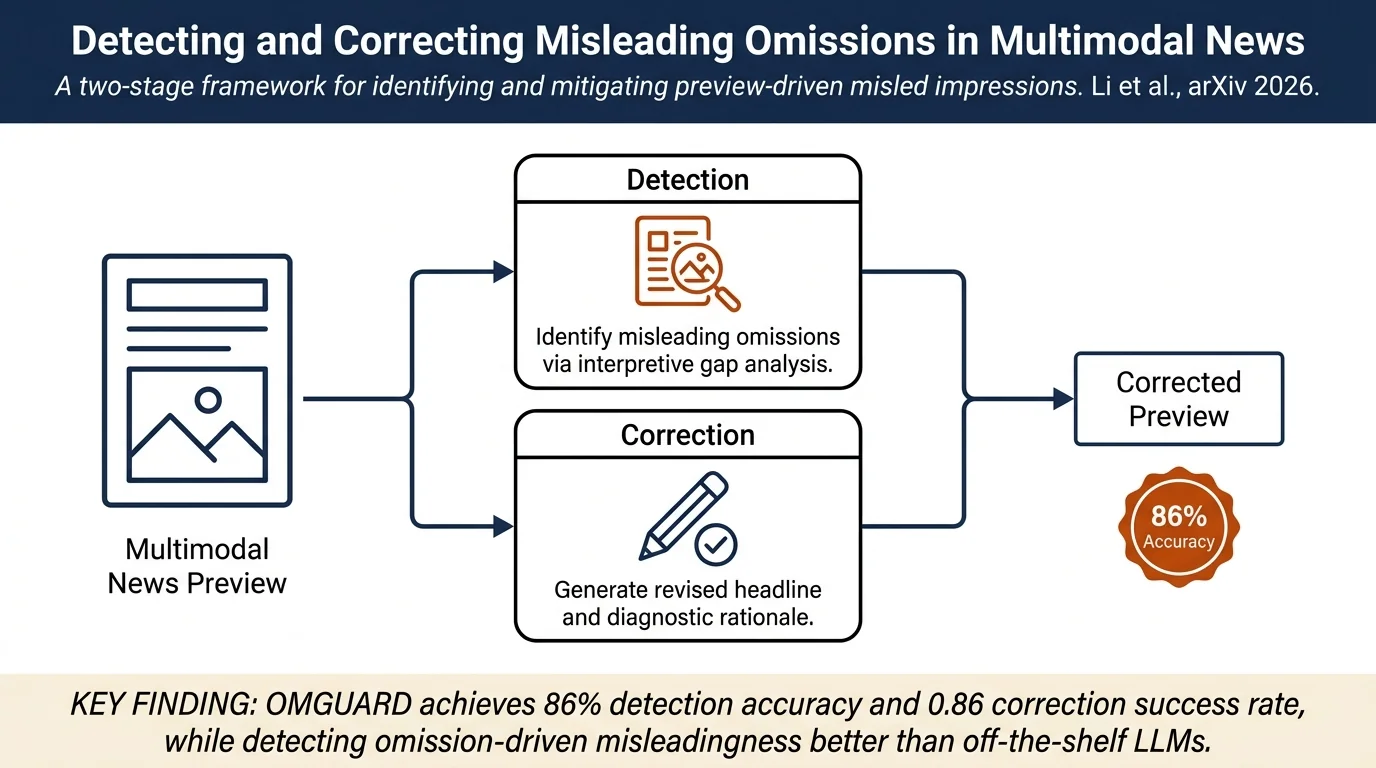
What's Left Unsaid? Detecting and Correcting Misleading Omissions in Multimodal News PreviewsNews previews (headline + image) on social media can mislead readers through selective omission of critical context present in the full article. This paper introduces MM-MISLEADING, a benchmark of 6,000 multimodal news previews annotated for misleading omissions, and proposes OMGUARD, a framework combining interpretation-aware…
 LLMs & generative AIDetection methods
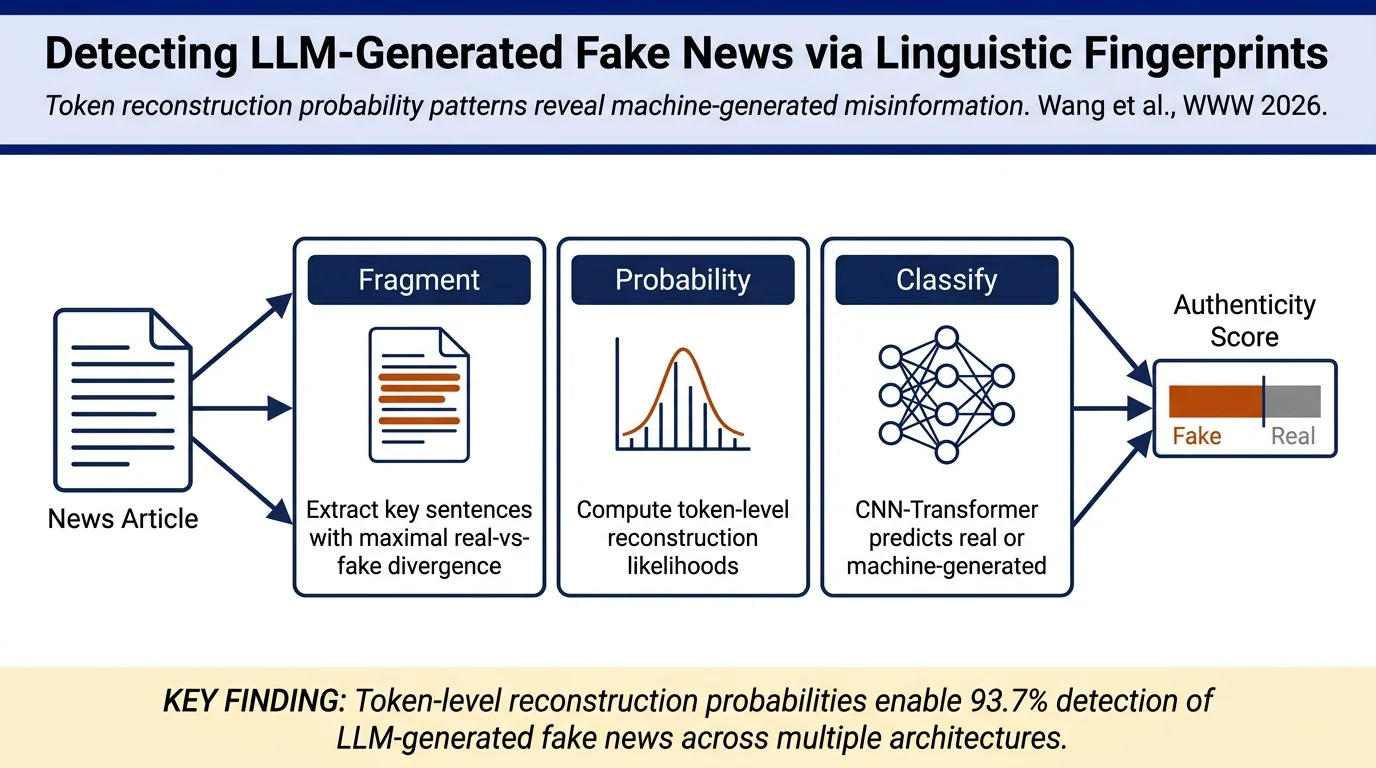
Prompt-Induced Linguistic Fingerprints for LLM-Generated Fake News DetectionLLMs can generate convincing fake news, but malicious prompts induce consistent statistical divergences in token-level reconstruction probabilities. The authors propose LIFE (Linguistic Fingerprints Extraction), which identifies key fragments where real and fake news differ most in their probability signature, achieving 93.7% accuracy on…
 Deepfakes & multimodalDetection methods
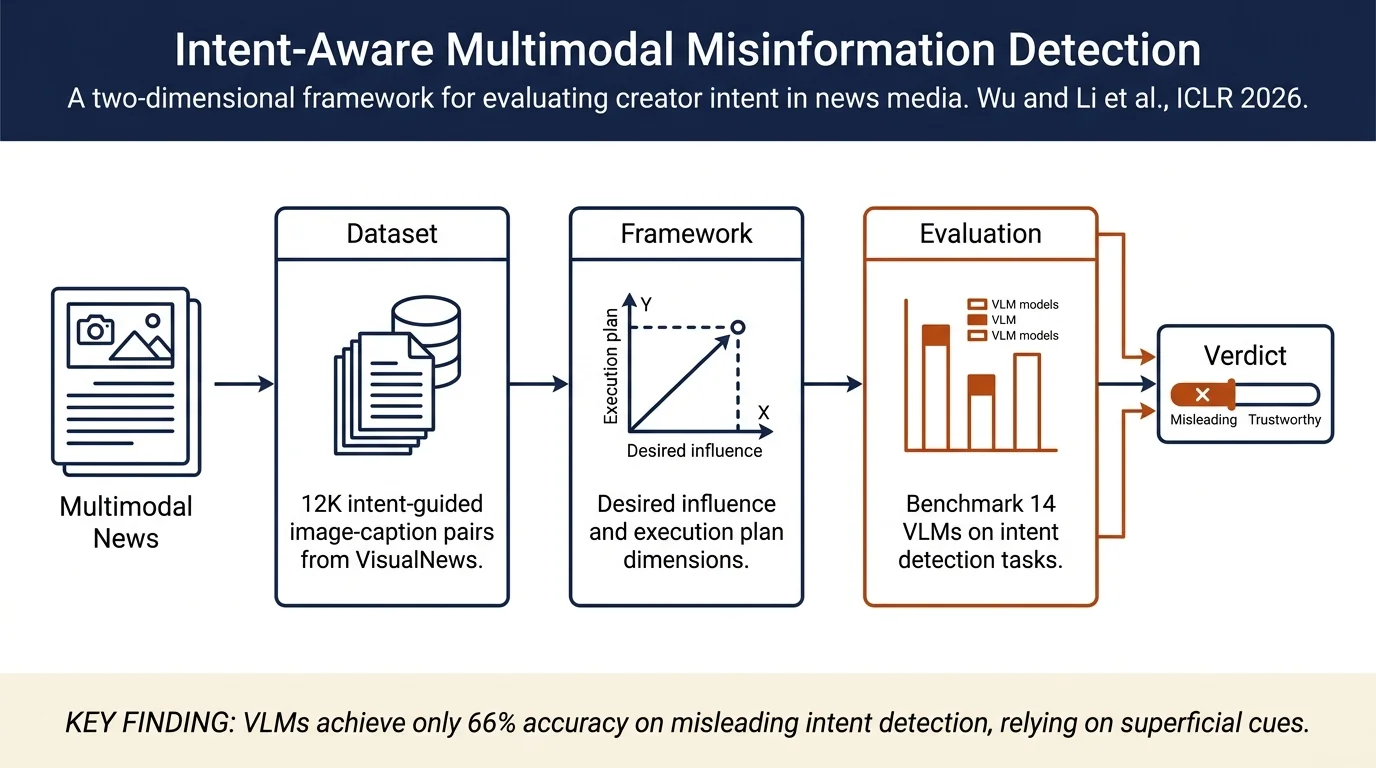
Seeing Through Deception: Uncovering Misleading Creator Intent in Multimodal News with Vision-Language ModelsThis paper introduces DECEPTIONDECODED, a benchmark of 12,000 image-caption pairs for evaluating multimodal misinformation detection with focus on creator intent. The authors find that state-of-the-art vision-language models struggle with intent reasoning and rely on superficial cues, motivating a framework for intent-aware multimodal…
 Datasets & evaluationDeepfakes & multimodal
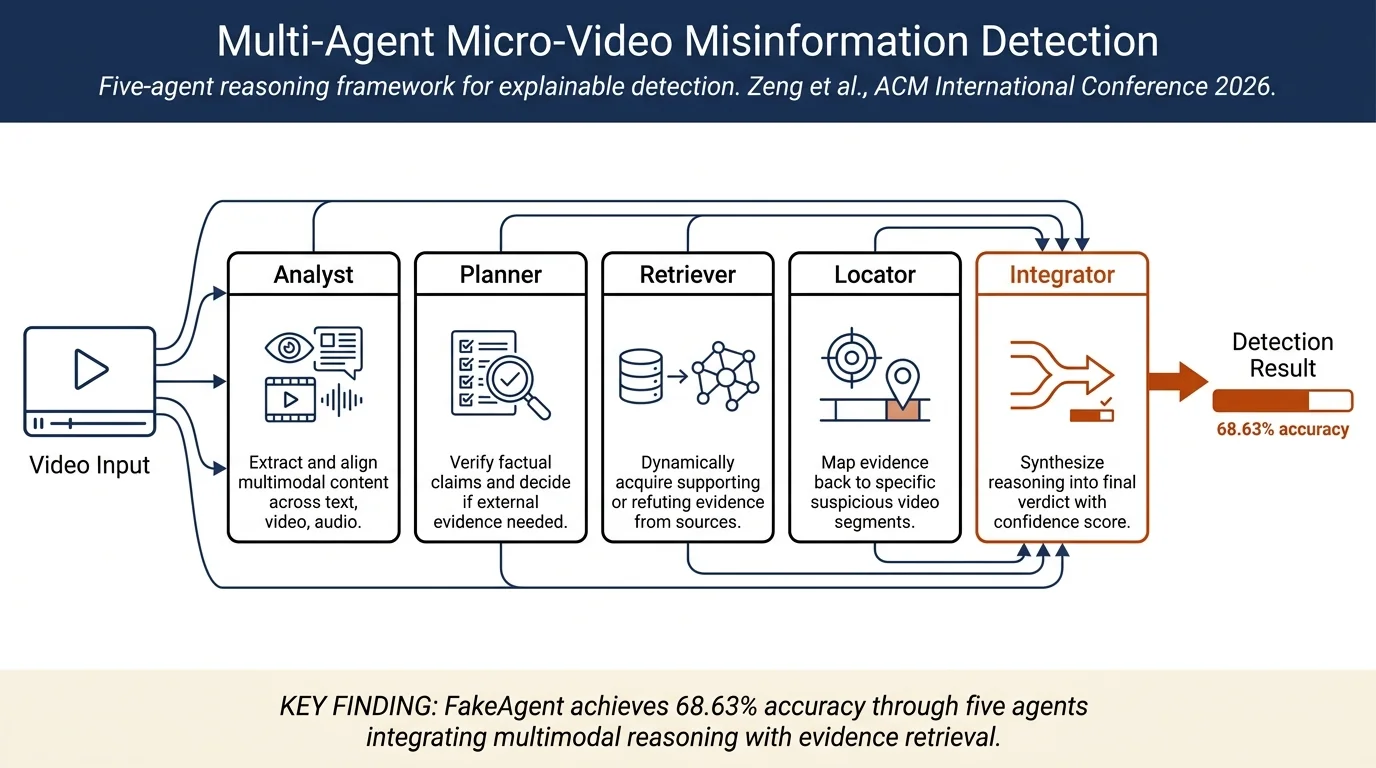
From Manipulation to Mistrust: Explaining Diverse Micro-Video Misinformation for Robust Debunking in the WildThe paper introduces WildFakeBench, a benchmark of 10,000+ real-world micro-videos spanning diverse misinformation types (manipulation, bias, AI-generated content, out-of-context) from six social platforms. The authors propose FakeAgent, a multi-agent reasoning framework combining neural networks and large language models, which achieves…
 Deepfakes & multimodalLLMs & generative AI
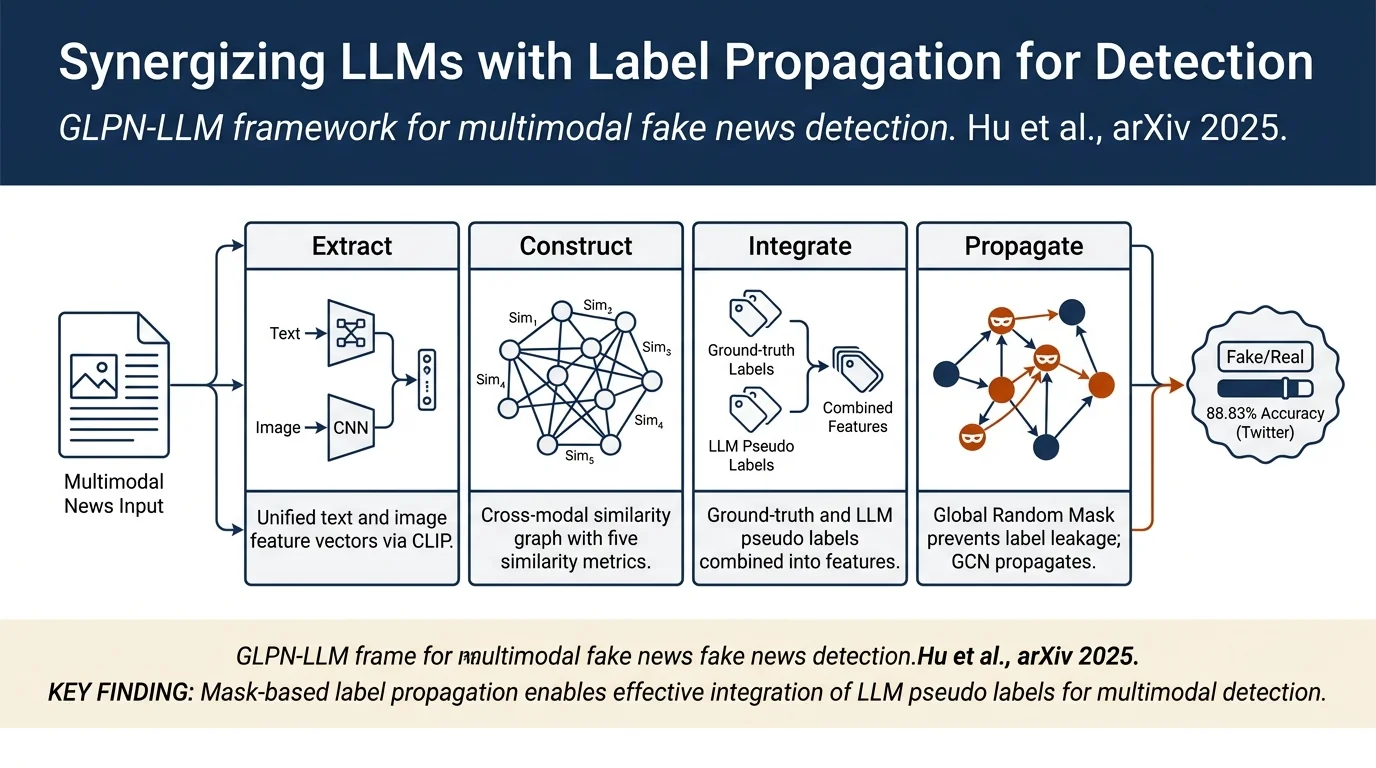
Synergizing LLMs with Global Label Propagation for Multimodal Fake News DetectionThis paper proposes Global Label Propagation Network with LLM-based Pseudo Labeling (GLPN-LLM), a framework for multimodal fake news detection that integrates LLM-generated pseudo labels with label propagation via graph neural networks. A mask-based global label propagation mechanism prevents label leakage during training while enabling…
 LLMs & generative AIDetection methods
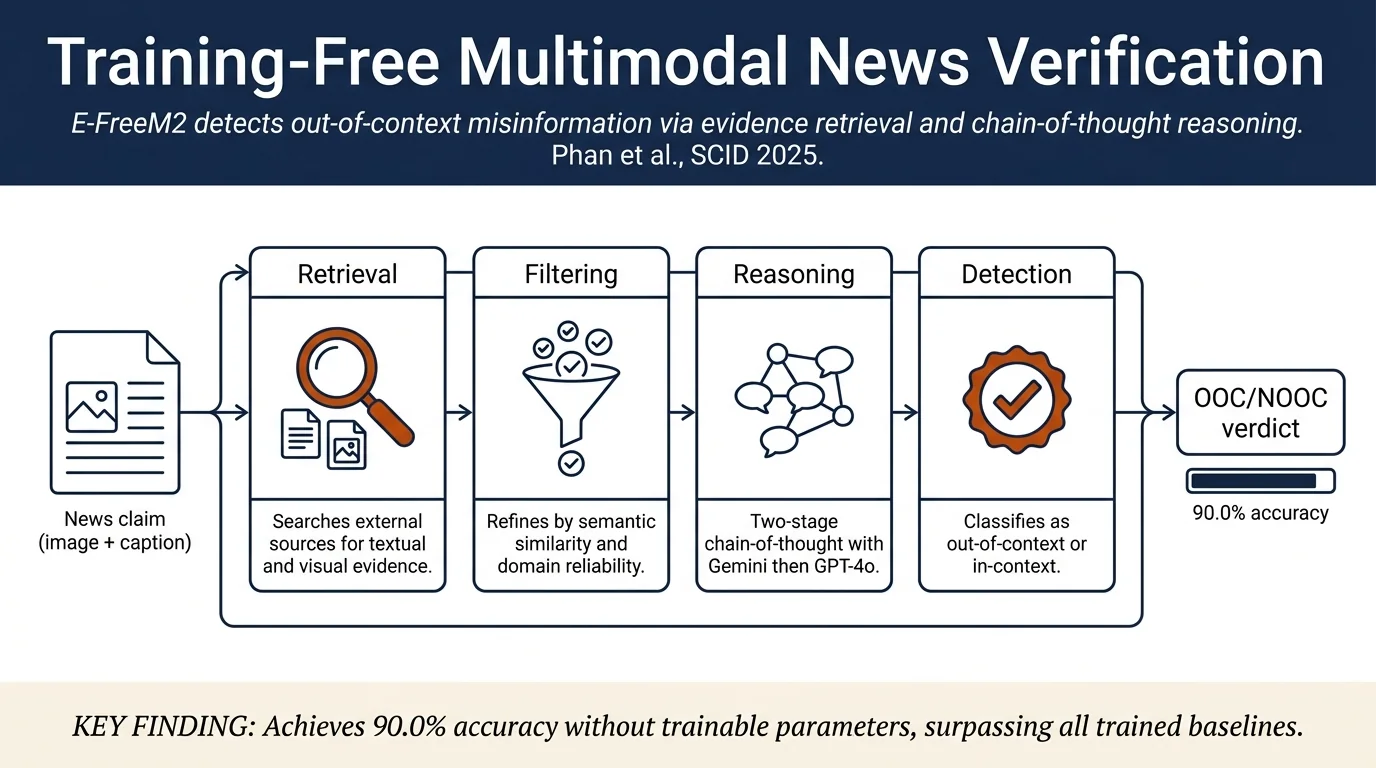
E-FreeM2: Efficient Training-Free Multi-Scale and Cross-Modal News Verification via MLLMsE-FreeM2 is a training-free, retrieval-based multimodal system for out-of-context (OOC) misinformation detection that leverages pretrained vision-language models (MLLMs) and two-stage chain-of-thought reasoning. By dynamically retrieving cross-modal evidence and ranking via visual similarity, the method achieves 90.0% overall accuracy on…
 Deepfakes & multimodalDatasets & evaluation
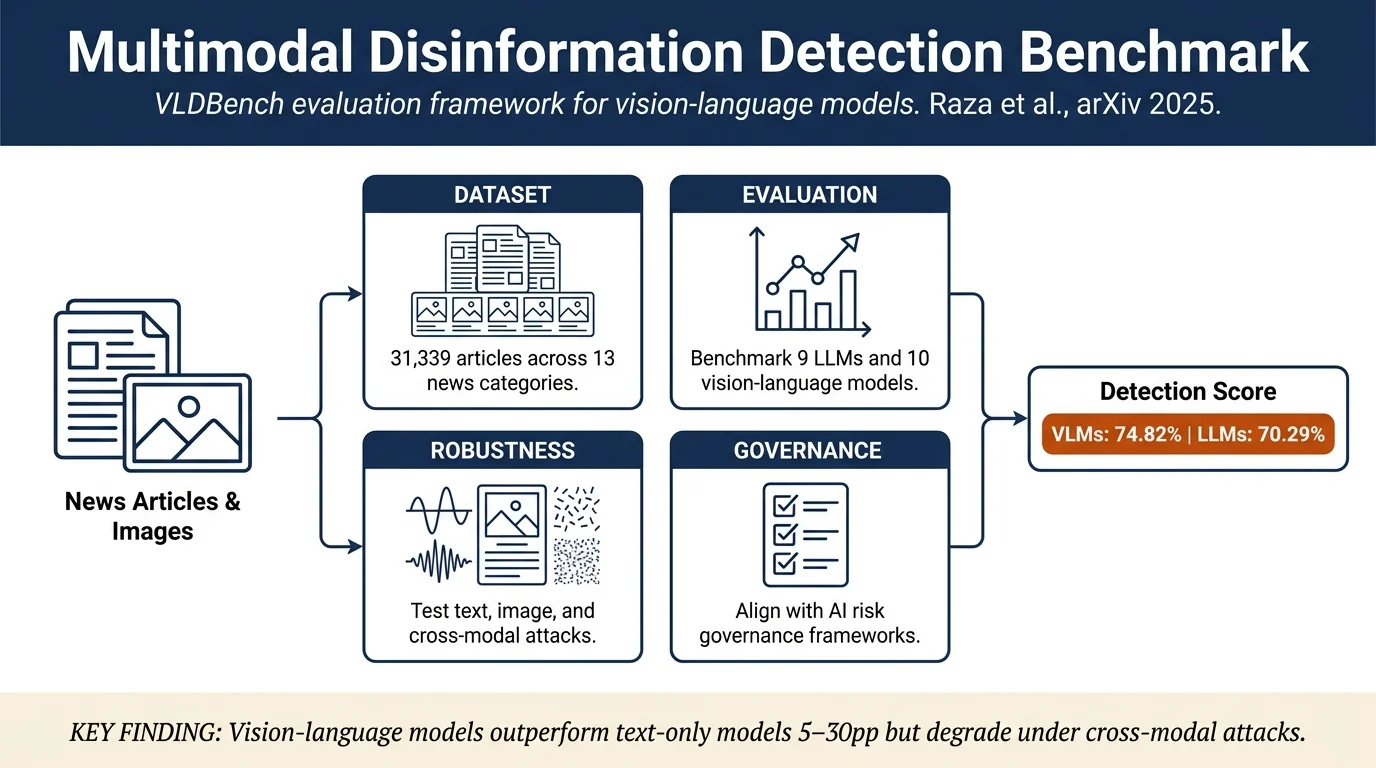
VLDBench: Evaluating Multimodal Disinformation with Regulatory AlignmentVLDBench is the first large-scale human-verified benchmark for multimodal disinformation detection, comprising 31,339 news articles paired with images across 13 topical categories. Evaluation of 9 LLMs and 10 VLMs shows vision-language models substantially outperform text-only baselines (e.g., LLaMA-3.2-11B-Vision: 74.82% accuracy), but…
 Deepfakes & multimodalLLMs & generative AI
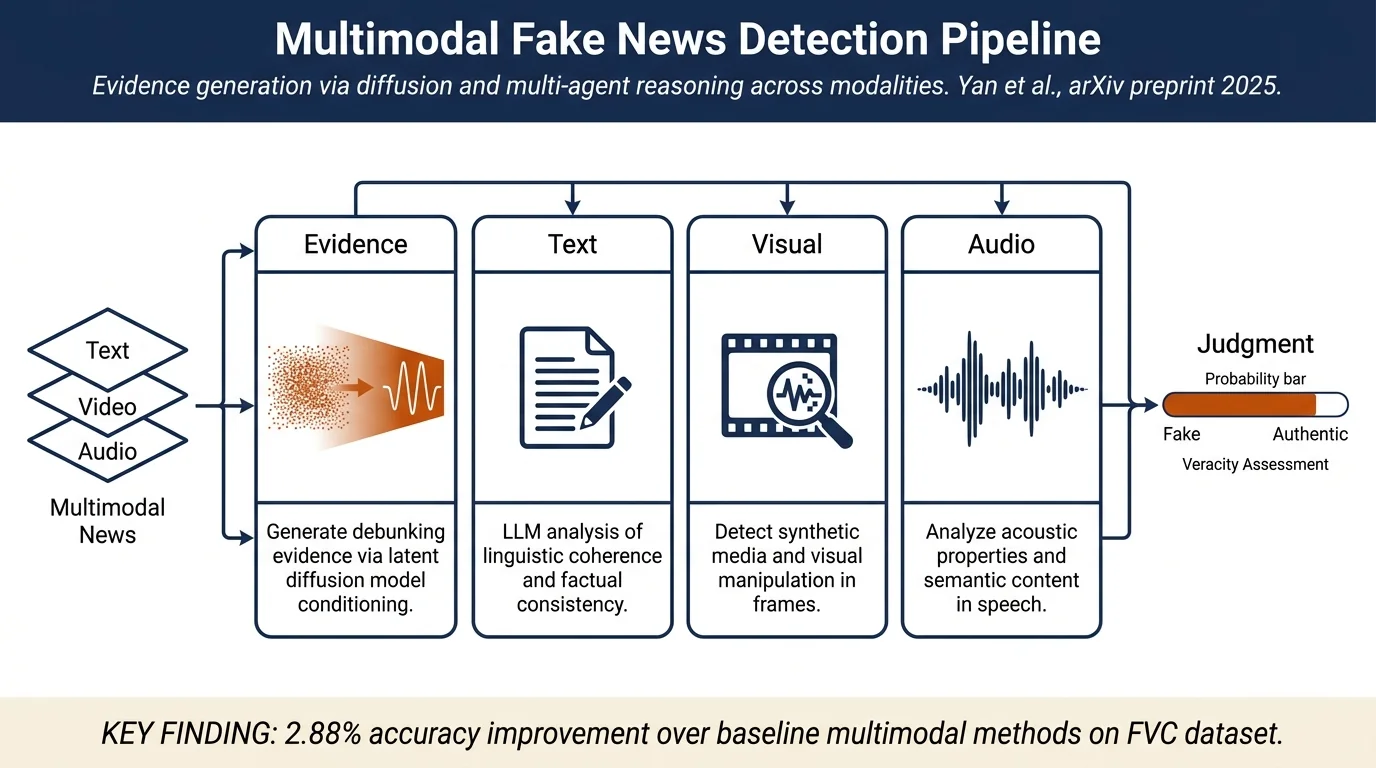
Debunk and Infer: Multimodal Fake News Detection via Diffusion-Generated Evidence and LLM ReasoningThis paper introduces DIFND, a framework for multimodal fake news detection that generates refuting/authenticating evidence via diffusion models and performs reasoning over multimodal content using large language models (LLMs). The approach uses a chain-of-debunk strategy where multiple MLLMs act as collaborative agents to assess news…
 Deepfakes & multimodalPlatforms, policy & society
Digital Forensic Expert Breaks Down Political DeepfakesFarid surveys the state of deepfake technology in the 2024 election cycle, demonstrating how synthetic images, audio, and video are weaponized to manipulate voters through fake endorsements, false statements, and inauthentic imagery. He details forensic detection techniques—perspective geometry, shadow physics, lip-sync analysis—that…
 Deepfakes & multimodalDetection methods
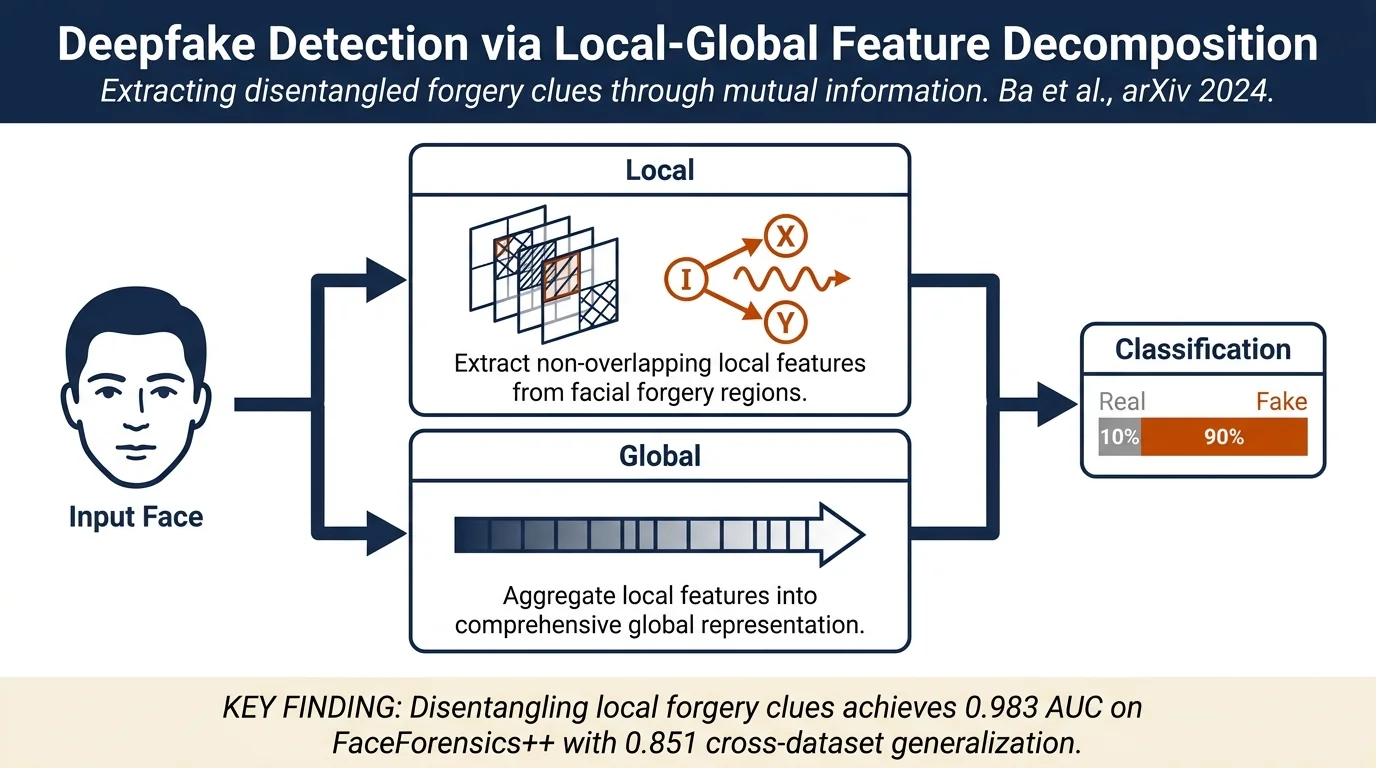
Exposing the Deception: Uncovering More Forgery Clues for Deepfake DetectionThis paper proposes a framework for deepfake detection that extracts both local and global forgery clues by decomposing facial features into disentangled local representations. Using mutual information theory to ensure comprehensive yet non-overlapping feature extraction, the method achieves state-of-the-art results on five benchmark…
 LLMs & generative AIDeepfakes & multimodal
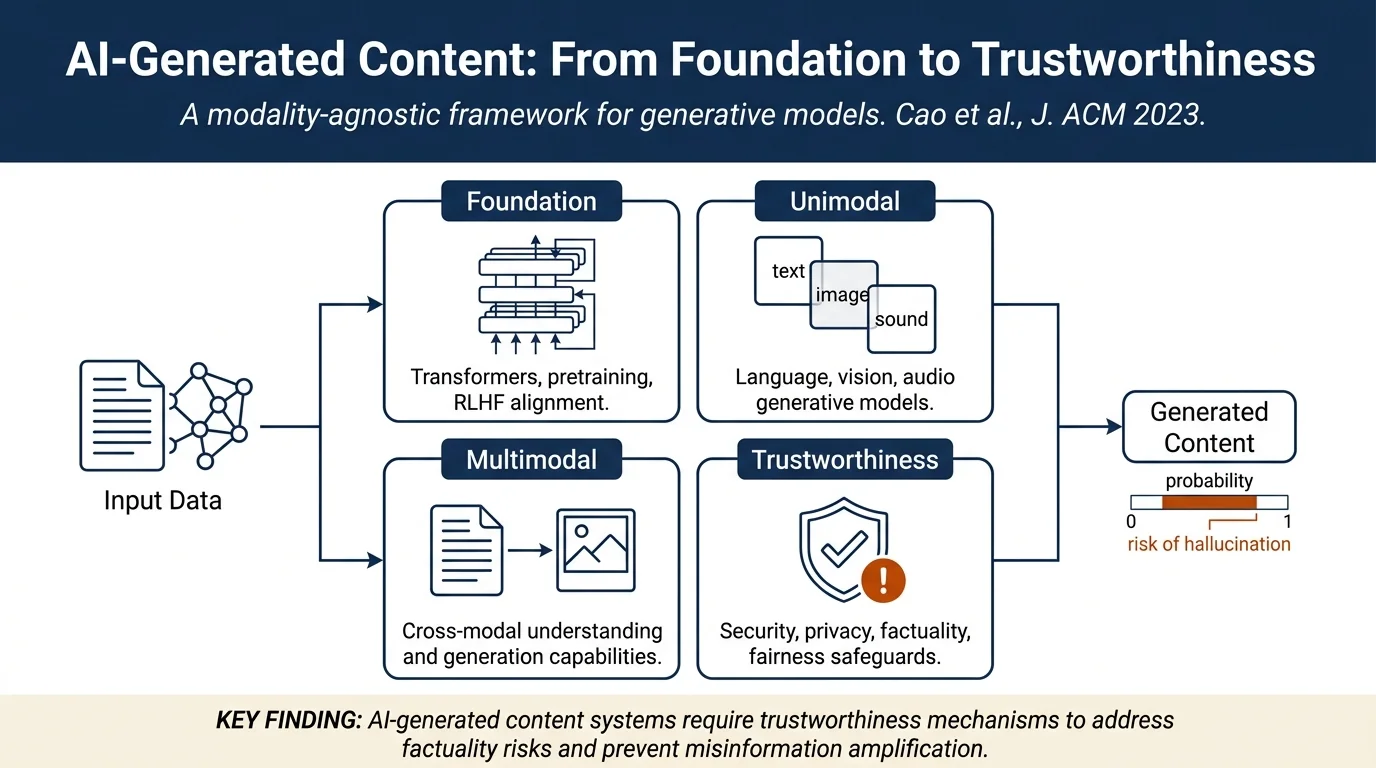
A Comprehensive Survey of AI-Generated Content (AIGC): A History of Generative AI from GAN to ChatGPTThis is the first comprehensive survey of AI-Generated Content (AIGC) covering the history, techniques, and applications of generative models from GANs through ChatGPT. It addresses both the impressive capabilities of these models (text, image, audio, video generation) and critical concerns including factuality, security, privacy, and…
 LLMs & generative AIDeepfakes & multimodal
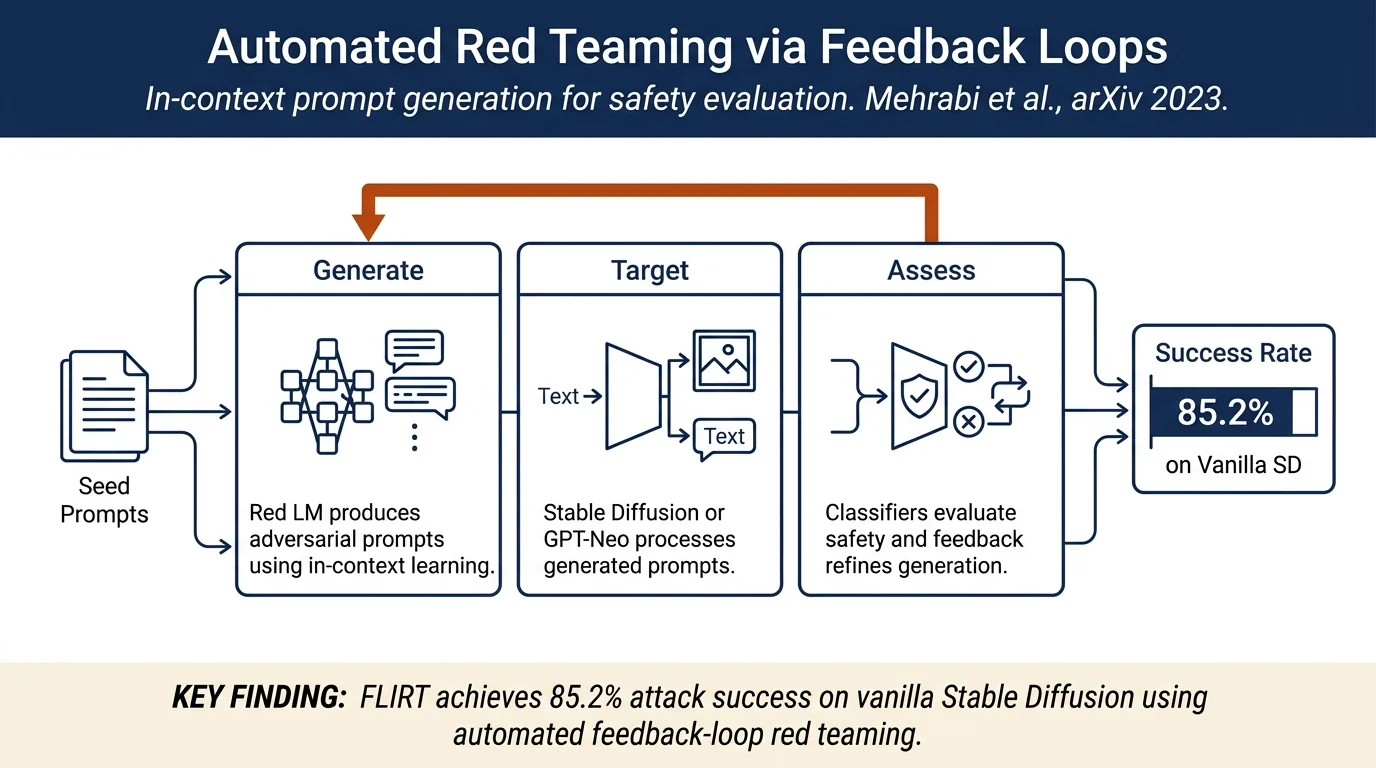
FLIRT: Feedback Loop In-context Red TeamingFLIRT automates red teaming of generative models by using in-context learning to generate adversarial prompts in a feedback loop: a red language model generates candidate prompts, they are evaluated against a target model (e.g., text-to-image or text-to-text), safety classifiers assess the outputs, and results feed back to refine future…
 Deepfakes & multimodalDatasets & evaluation
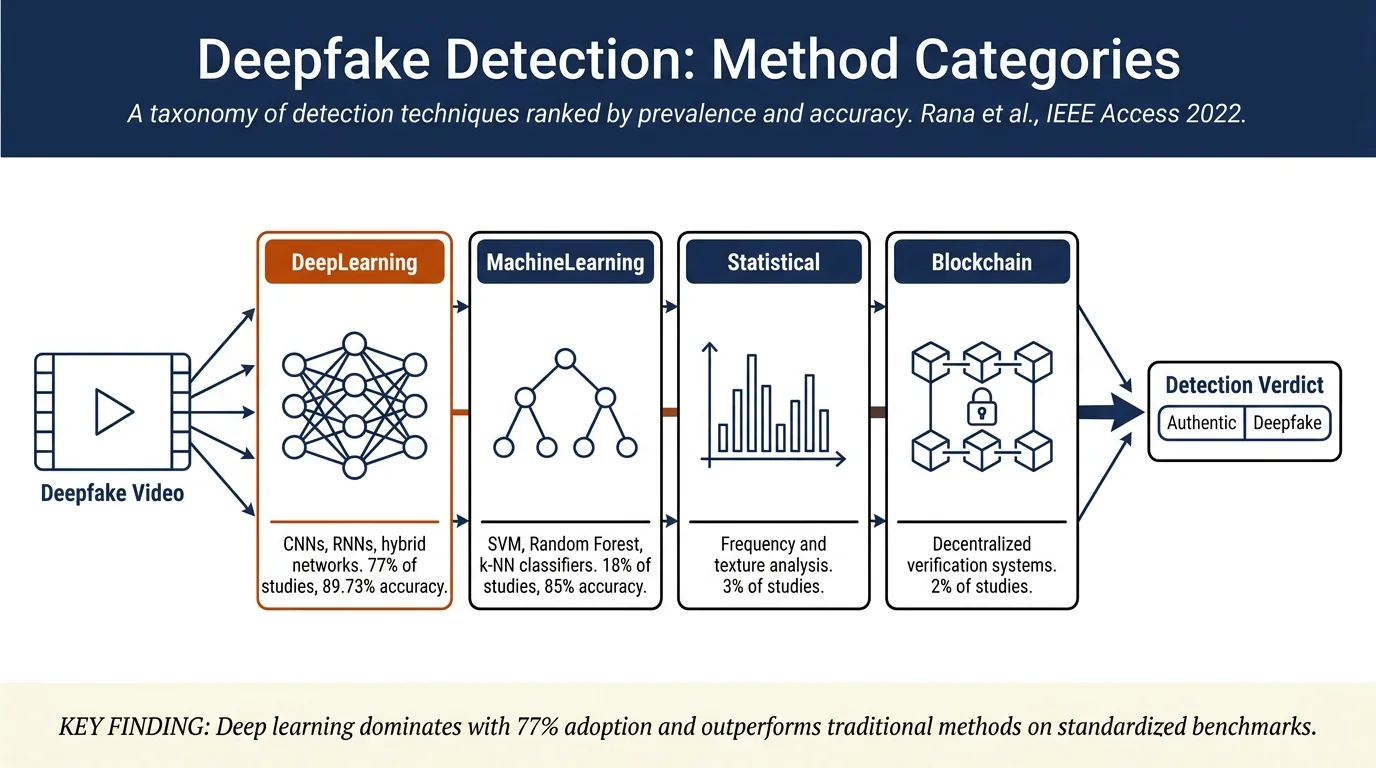
Deepfake Detection: A Systematic Literature ReviewSystematic review of 112 deepfake detection studies (2018–2020) categorizing techniques into deep learning, machine learning, statistical, and blockchain methods. Deep learning approaches (77% of studies, primarily CNNs) significantly outperform non-deep methods, achieving ~89.7% mean accuracy.
 LLMs & generative AIDeepfakes & multimodal
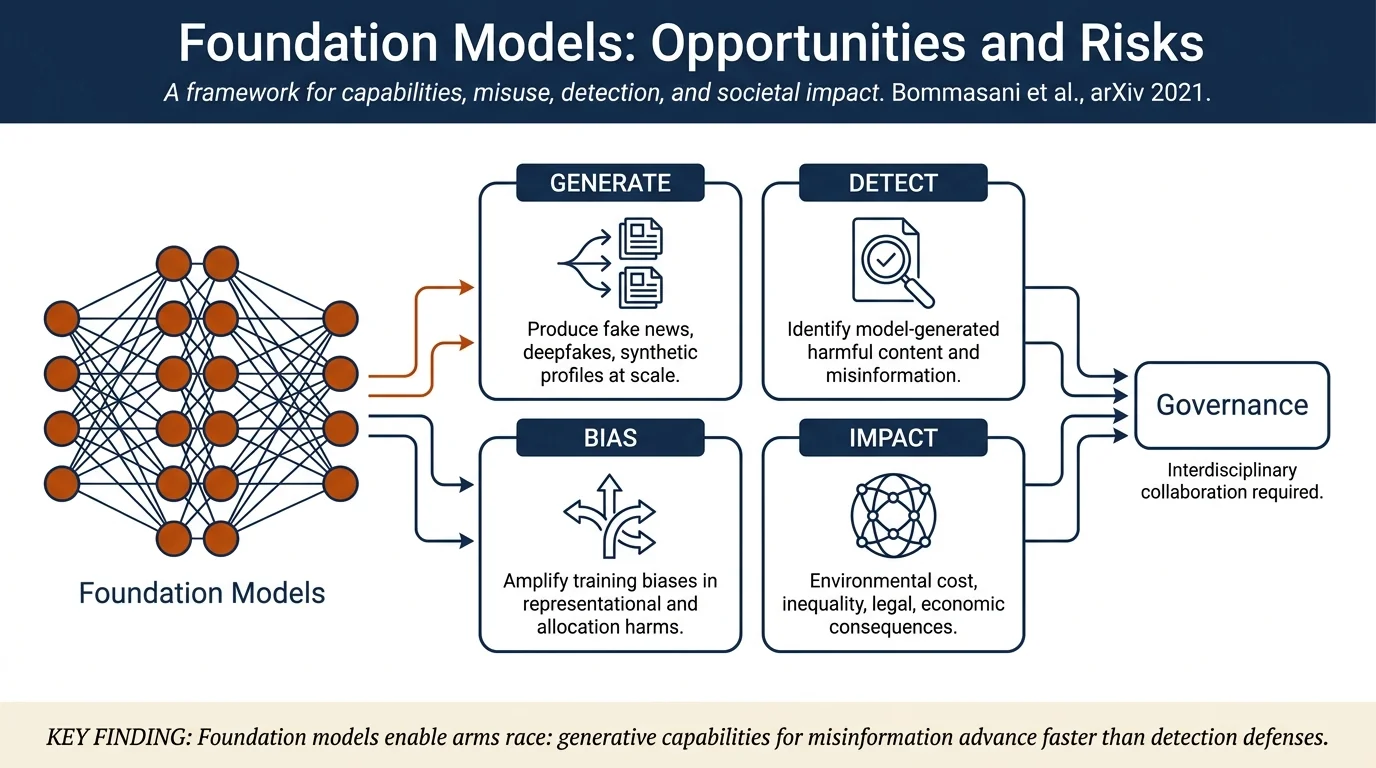
On the Opportunities and Risks of Foundation ModelsA comprehensive 214-page report analyzing foundation models—large neural networks trained on broad data that can be adapted to diverse downstream tasks (BERT, GPT-3, DALL-E). The report maps capabilities across language, vision, and reasoning; applications in healthcare, law, and education; and societal risks including misuse (generating…
 Deepfakes & multimodalDetection methods
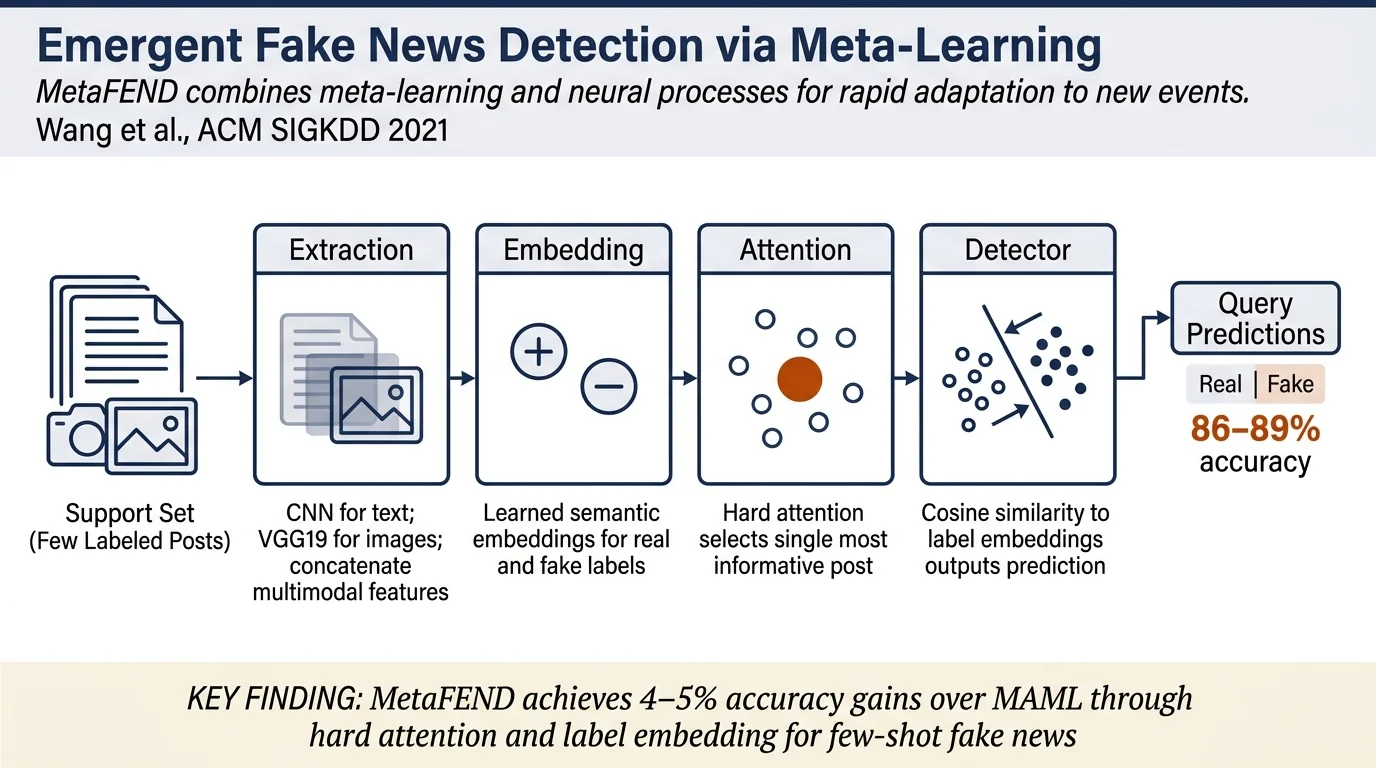
Multimodal Emergent Fake News Detection via Meta Neural Process NetworksExisting fake news detectors trained on labeled data perform poorly on novel, emergent events due to domain shift. The paper proposes MetaFEND, which combines meta-learning and neural processes to leverage a handful of labeled posts from a new event to quickly adapt a detection model.
 Deepfakes & multimodalDetection methods
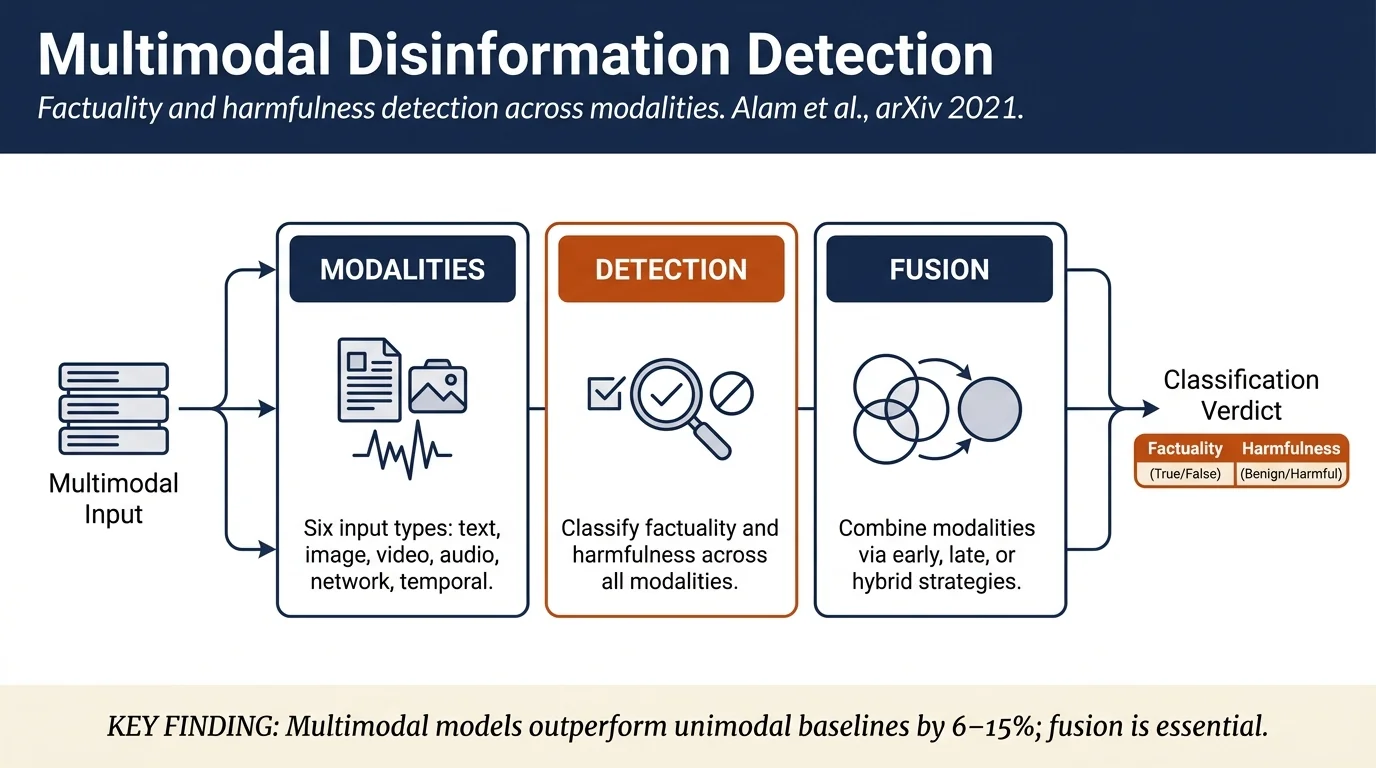
A Survey on Multimodal Disinformation DetectionComprehensive survey of multimodal disinformation detection covering text, images, speech, video, network structure, and temporal information. Distinguishes factuality (whether content is false) from harmfulness (whether false content intends to harm), systematically reviews ~140 papers across different modalities and detection…
 Detection methodsDeepfakes & multimodal
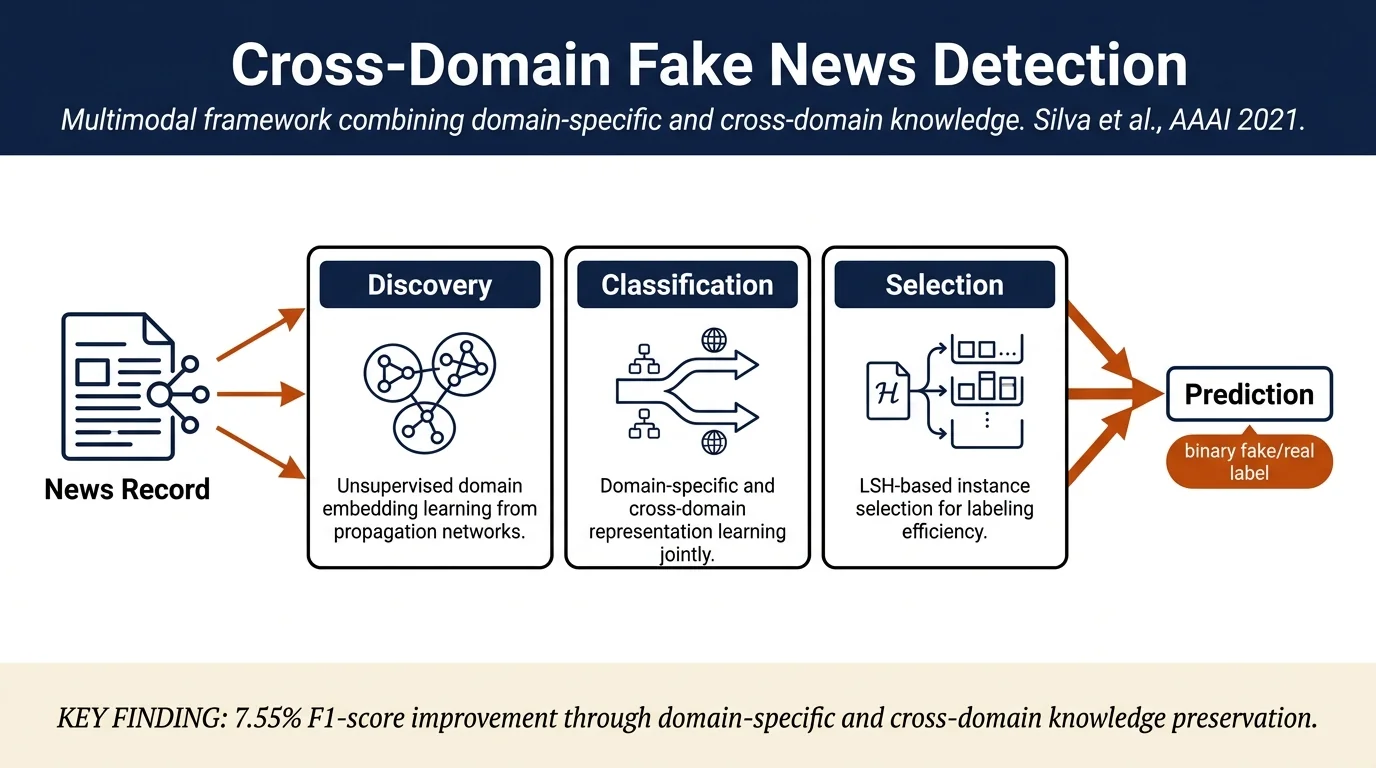
Embracing Domain Differences in Fake News: Cross-domain Fake News Detection using Multimodal DataMost fake news detection models are trained on a single domain (e.g., politics) and fail when tested on others (e.g., entertainment, COVID-19). This paper proposes a multimodal framework that leverages both domain-specific and cross-domain knowledge to detect fake news across different domains.
 Detection methodsDeepfakes & multimodal
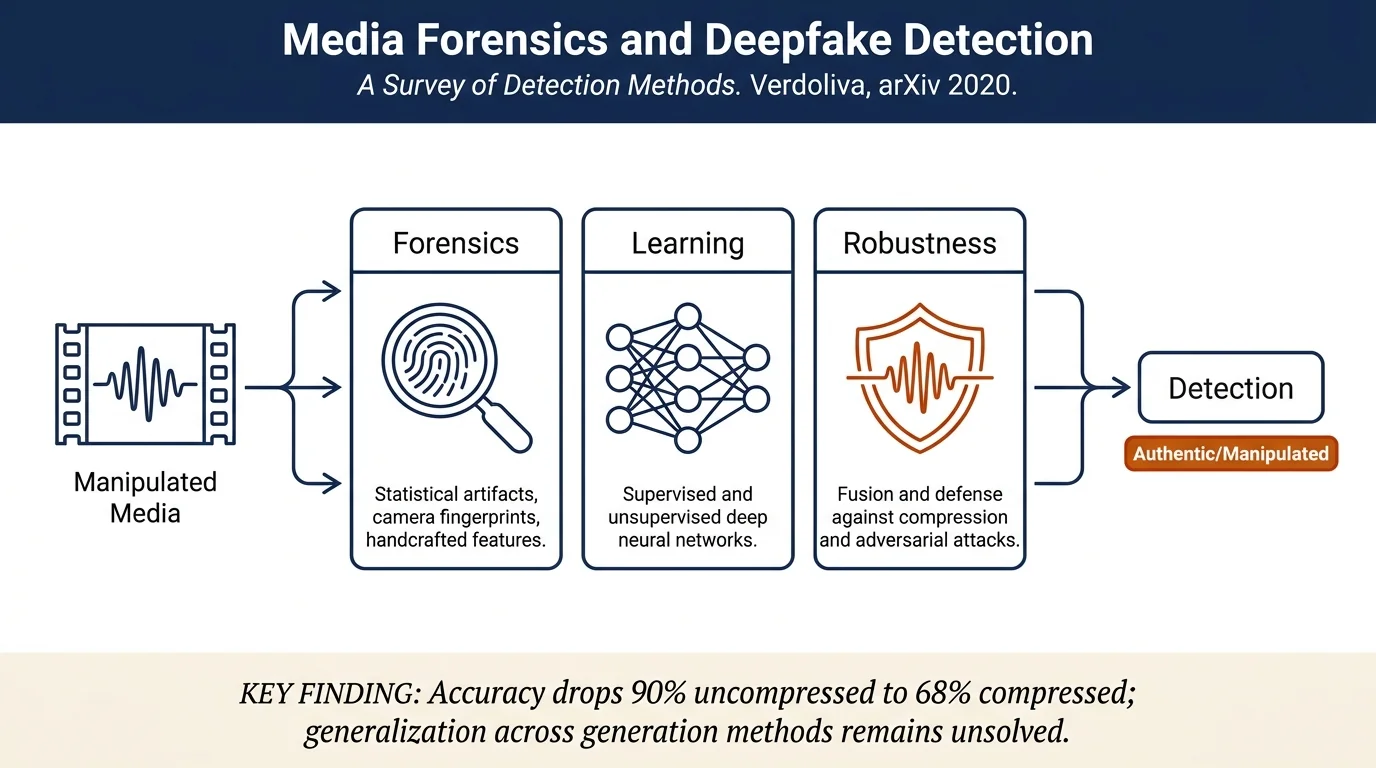
Media Forensics and DeepFakes: an overviewA comprehensive survey of media forensics and deepfake detection methods spanning fifteen years of research. The paper reviews both conventional signal-processing approaches (blind methods, sensor-based, handcrafted features) and deep learning-based detection techniques, covers major datasets and their characteristics, discusses…
 Deepfakes & multimodalDetection methods
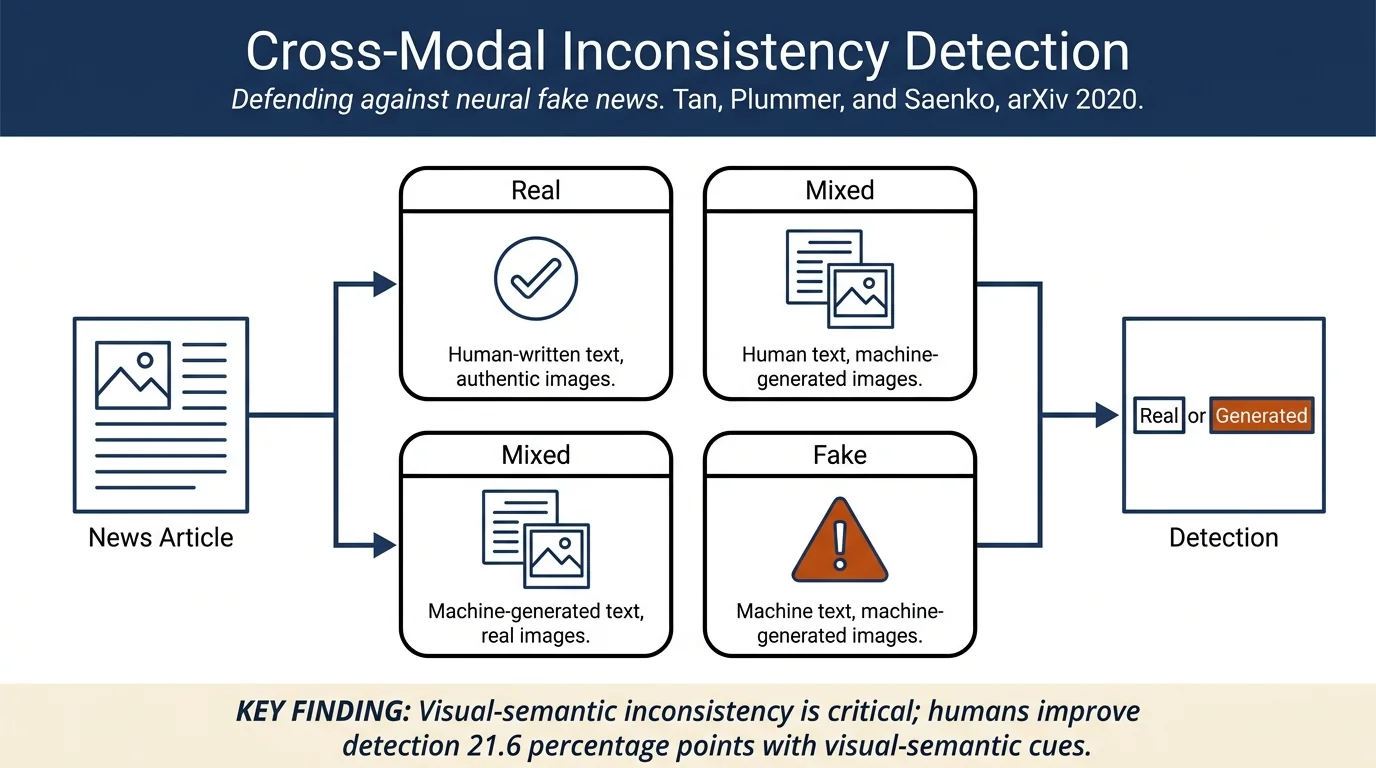
Detecting Cross-Modal Inconsistency to Defend Against Neural Fake NewsMachine-generated news articles with images and captions exploit visual-semantic inconsistencies that humans struggle to detect. This paper introduces DIDAN, a named entity-based approach to identify cross-modal semantic mismatches, and the NeuralNews dataset of 128K articles to benchmark multimodal fake news detection.
 Deepfakes & multimodalDatasets & evaluation
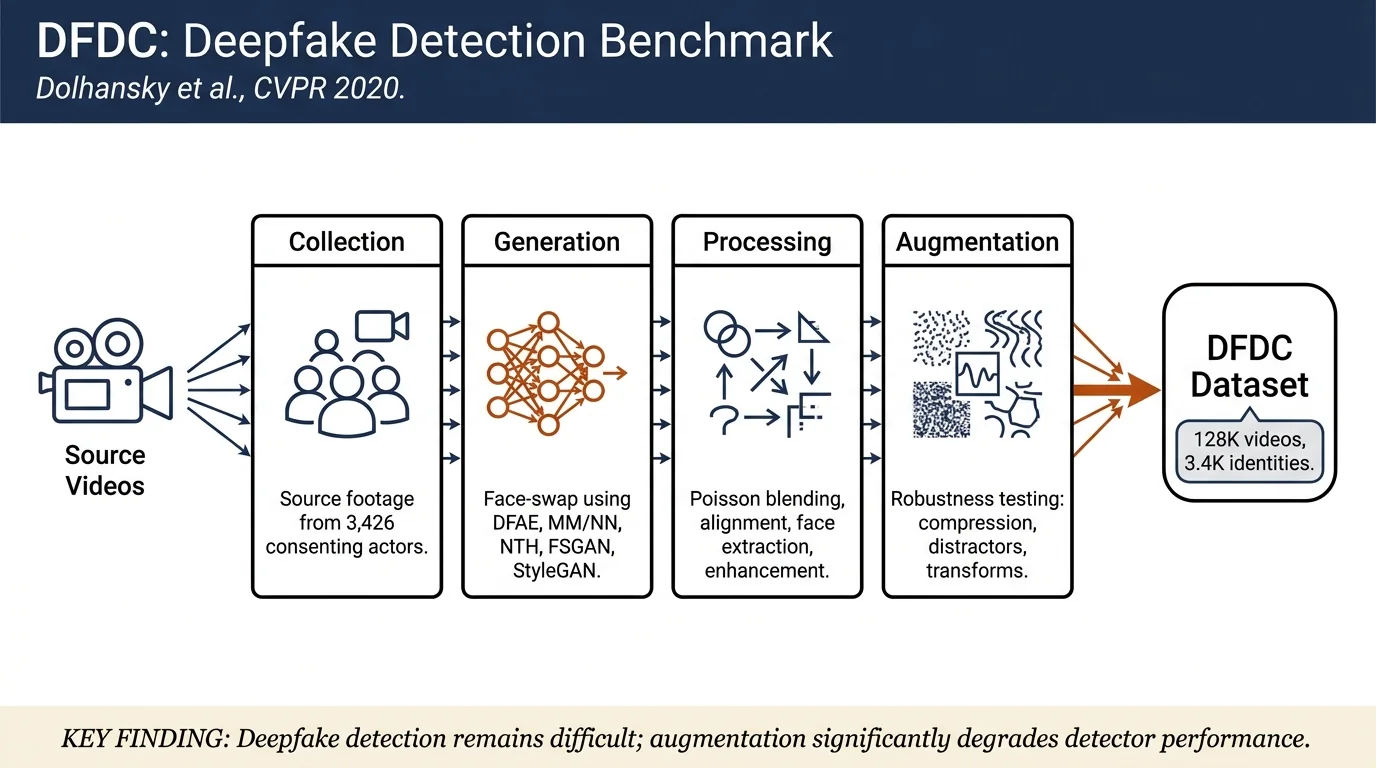
The DeepFake Detection Challenge (DFDC) DatasetThis paper introduces the DFDC Dataset, the largest publicly available deepfake detection benchmark at the time with 128,154 videos from 3,426 consented actors and 100,000 face-swapped clips. The dataset addresses ethical and methodological limitations of prior deepfake benchmarks by requiring explicit participant consent, including…
 Deepfakes & multimodalDatasets & evaluation
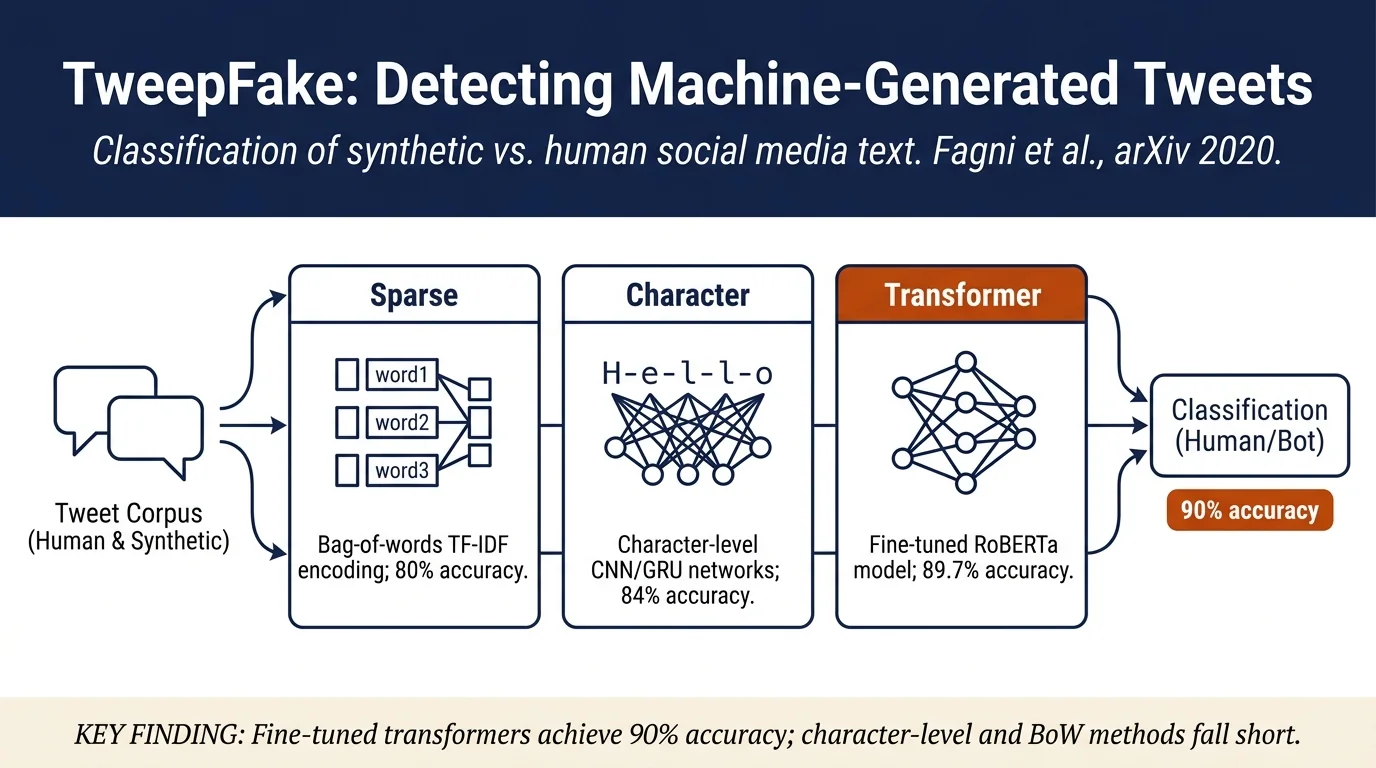
TweepFake: about detecting deepfake tweetsFirst publicly available dataset of real human-written and machine-generated tweets (TweepFake: 25,572 tweets, half human, half bot-generated from GPT-2, RNN, LSTM, Markov Chains, etc.). Benchmarks 13 detection methods and finds that transformer-based models fine-tuned on this task (RoBERTa) achieve ~90% accuracy, while BoW approaches…
 Datasets & evaluationDetection methods
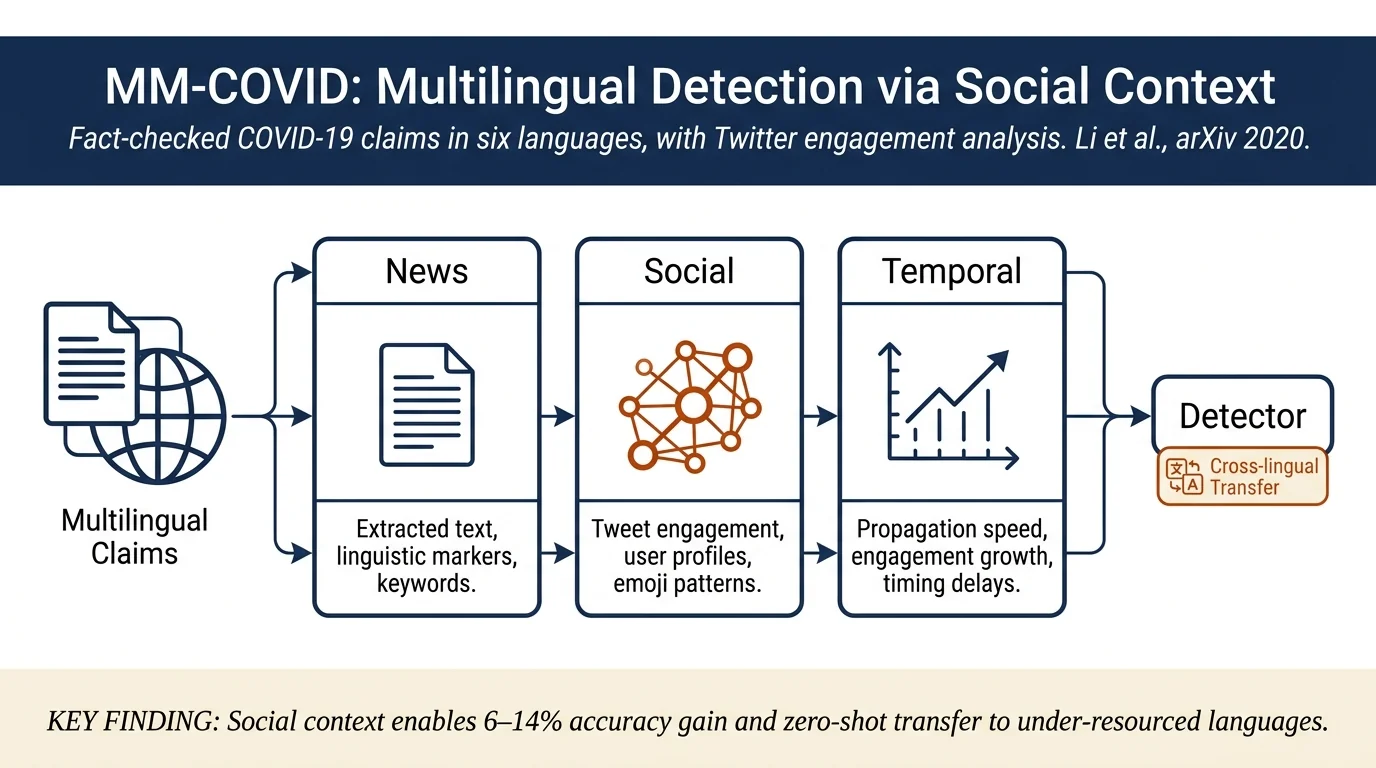
MM-COVID: A Multilingual and Multimodal Data Repository for Combating COVID-19 DisinformationThe paper introduces MM-COVID, a multilingual and multimodal dataset of COVID-19 fake news and social engagements in six languages (English, Spanish, Portuguese, Hindi, French, Italian). The dataset includes 3,981 fake news pieces with 7,192 tweets, fact-checking metadata, user profiles, and temporal propagation information.
 Deepfakes & multimodalDetection methods
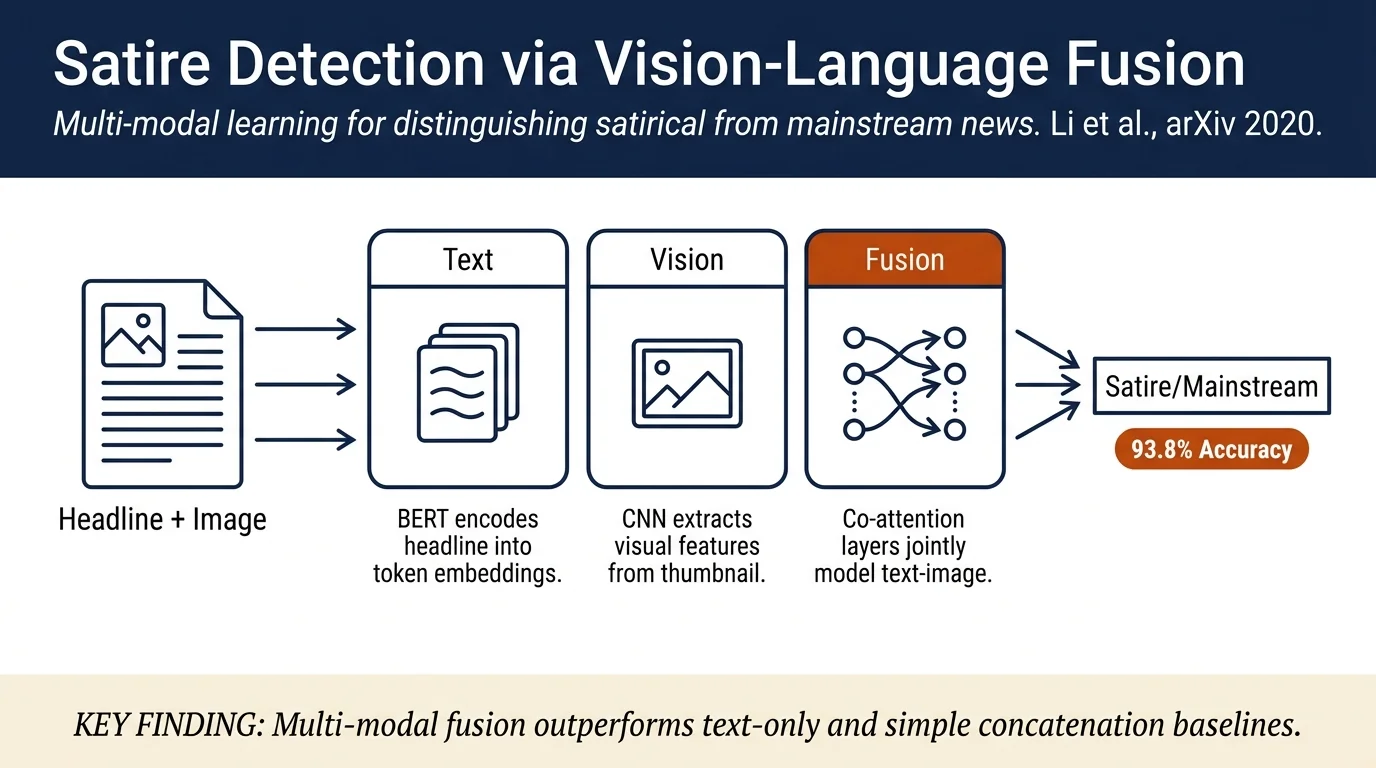
A Multi-Modal Method for Satire Detection using Textual and Visual CuesSatirical news articles are often misinterpreted as legitimate news. This work proposes a multi-modal approach using ViLBERT to detect satire by jointly analyzing headline text and thumbnail images, achieving 93.8% accuracy on a new dataset of 10,000 articles (4000 satirical, 6000 mainstream).
 Deepfakes & multimodalDetection methods
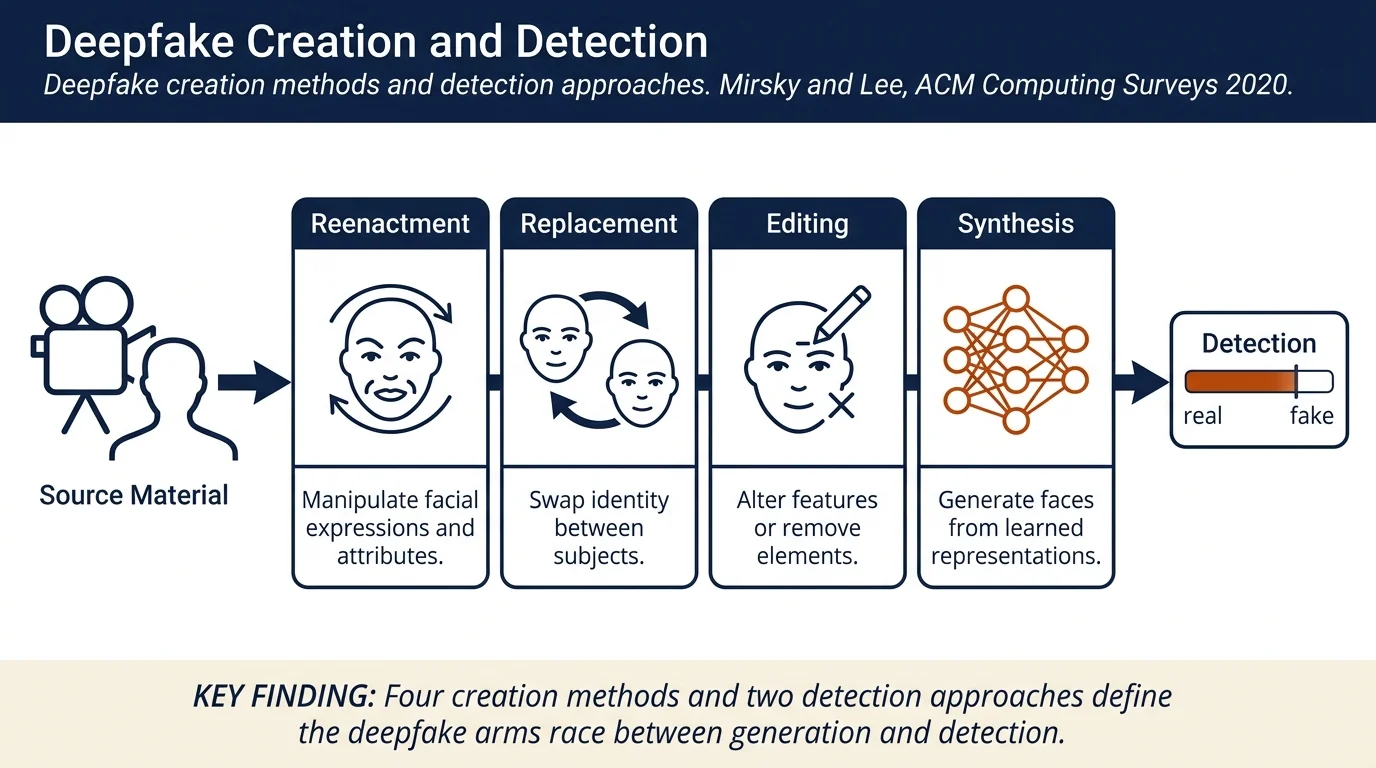
The Creation and Detection of Deepfakes: A SurveyComprehensive 38-page survey covering both creation and detection of deepfakes. Systematically reviews generative neural network architectures (GANs, autoencoders, CNNs, RNNs), technical approaches to reenactment, replacement, editing, and synthesis.
 Deepfakes & multimodalDetection methods
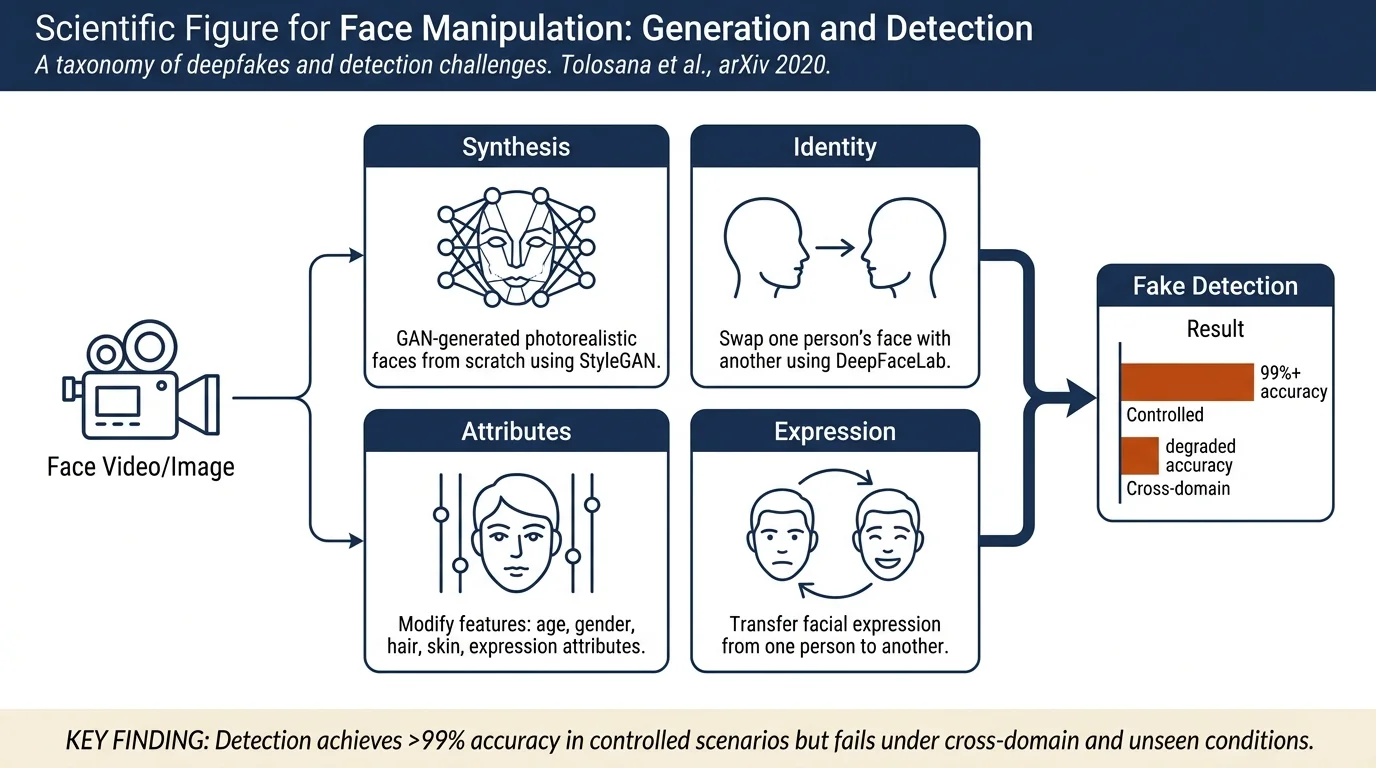
DeepFakes and Beyond: A Survey of Face Manipulation and Fake DetectionThis comprehensive survey reviews face manipulation techniques and detection methods in the era of deep learning. It categorizes facial manipulations into four types—entire face synthesis, identity swap, attribute manipulation, and expression swap—and surveys both generation and detection approaches across public datasets and benchmarks.
 Deepfakes & multimodalFact-checking & verification
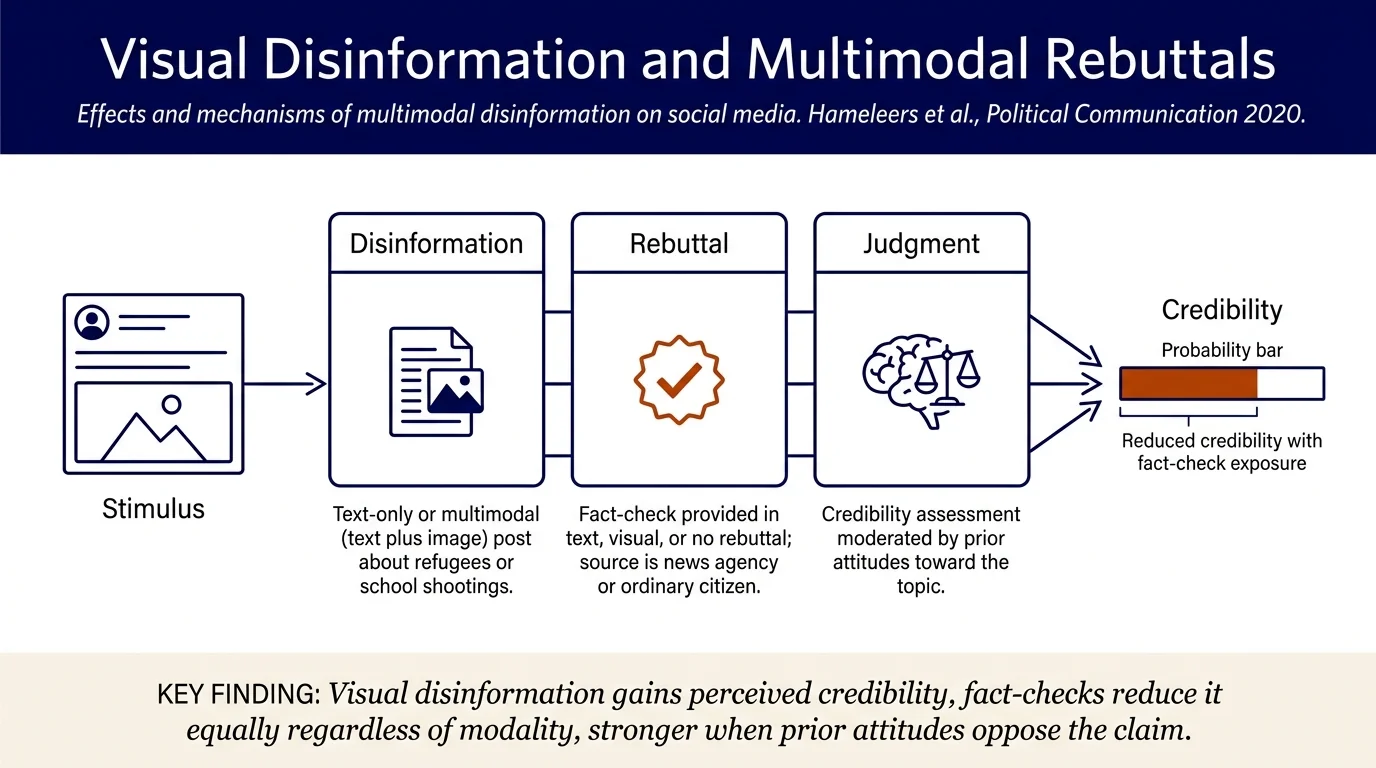
A Picture Paints a Thousand Lies? The Effects and Mechanisms of Multimodal Disinformation and Rebuttals Disseminated via Social MediaMultimodal disinformation (paired text and images) is perceived as more credible than text-only misinformation, but fact-checkers can overcome this effect. Importantly, the modality of fact-checks (visual or textual) matters less than their presence; fact-checks are more persuasive for people whose prior attitudes already oppose the…
 Deepfakes & multimodalPlatforms, policy & society
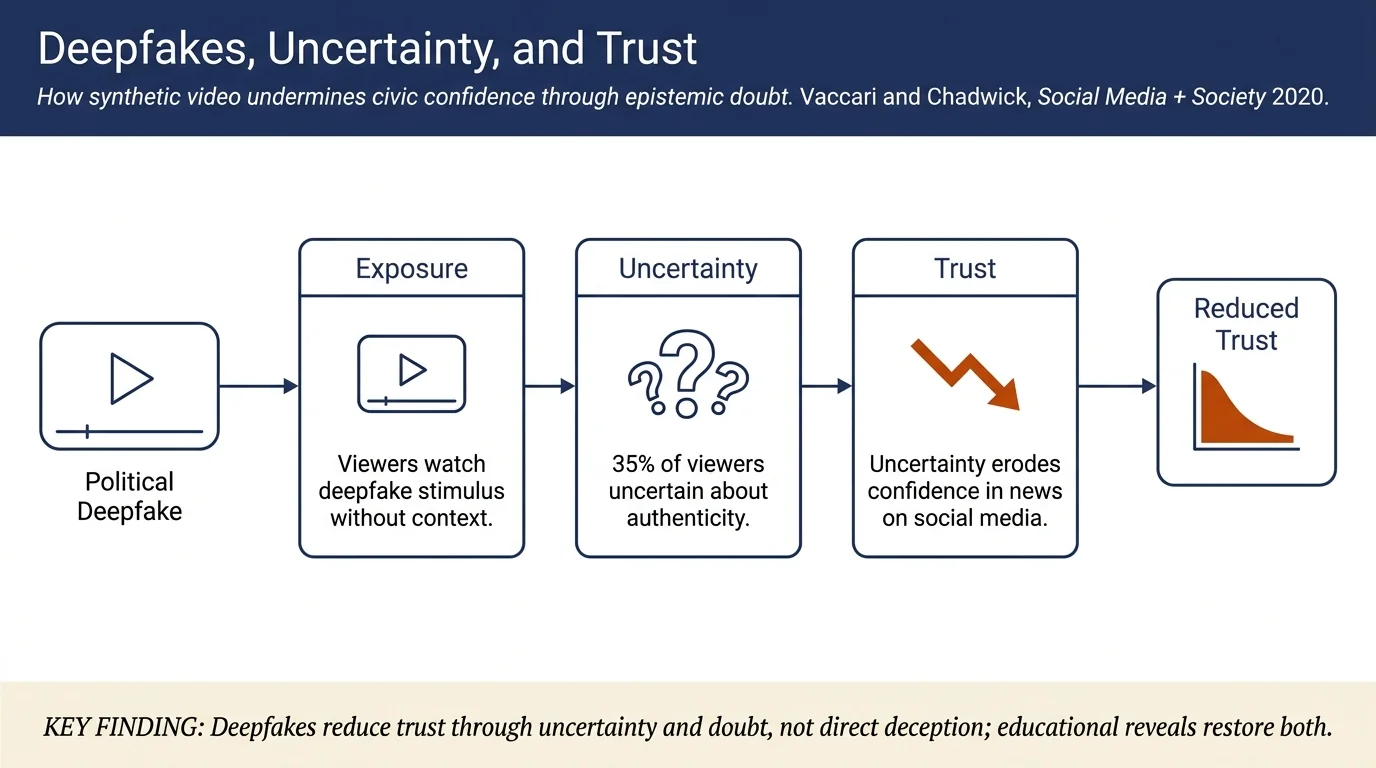
Deepfakes and Disinformation: Exploring the Impact of Synthetic Political Video on Deception, Uncertainty, and Trust in NewsExperimental study (N=2,005 UK respondents) testing how political deepfakes affect deception and trust in news. Deepfakes increased uncertainty about content, and that uncertainty mediated reduced trust in news on social media.
 Datasets & evaluationDeepfakes & multimodal
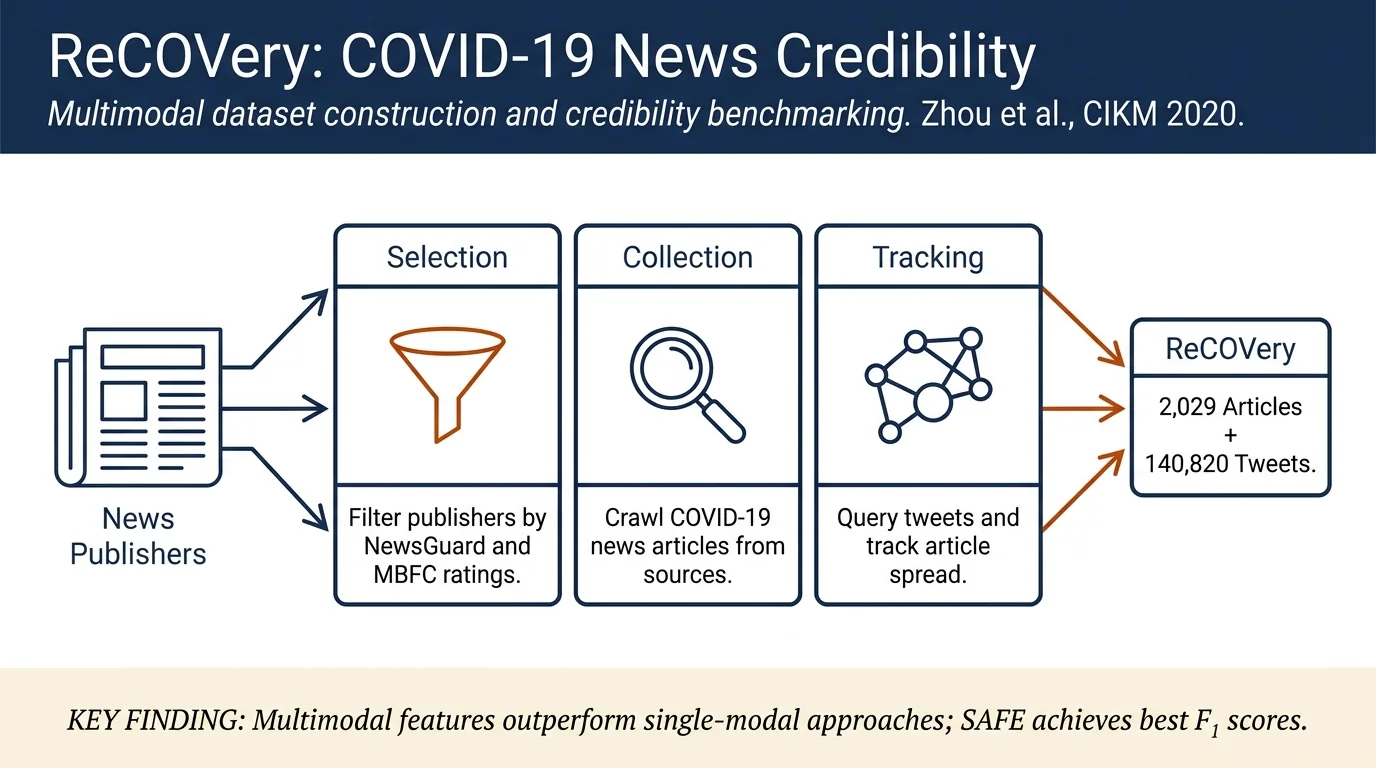
ReCOVery: A Multimodal Repository for COVID-19 News Credibility ResearchThe COVID-19 pandemic triggered a parallel "infodemic" of low-credibility news; this paper constructs ReCOVery, a multimodal repository of 2,029 COVID-19 news articles with binary credibility labels inherited from their publisher's NewsGuard/MBFC ratings, paired with 140,820 tweets tracking social spread. The key design trade-off is…
 Deepfakes & multimodalDetection methods
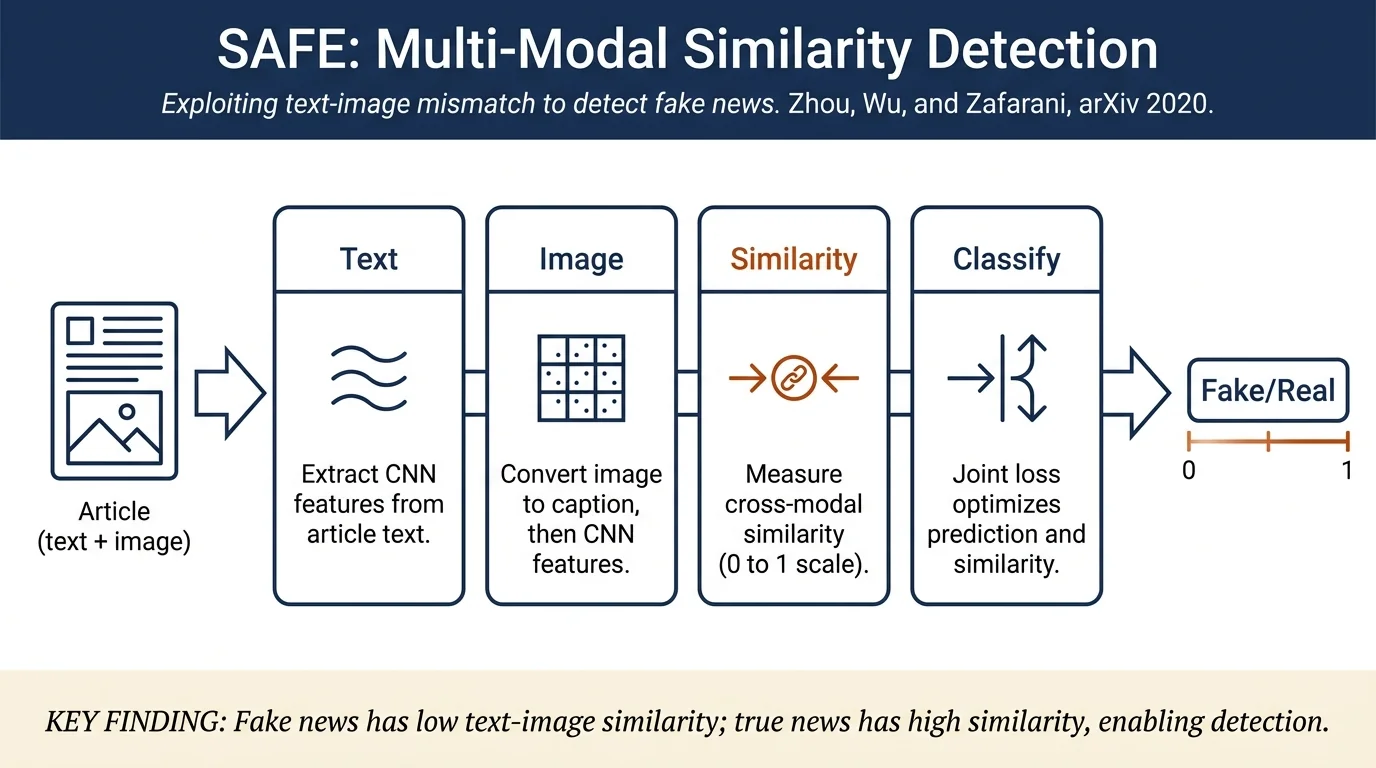
SAFE: Similarity-Aware Multi-Modal Fake News DetectionFake news articles frequently pair misleading textual claims with irrelevant or manipulative images, creating a detectable gap between the two modalities. SAFE addresses this by extracting separate neural representations of a news article's text and images — using the same Text-CNN architecture applied to an image2sentence embedding for…
 Deepfakes & multimodalDetection methods
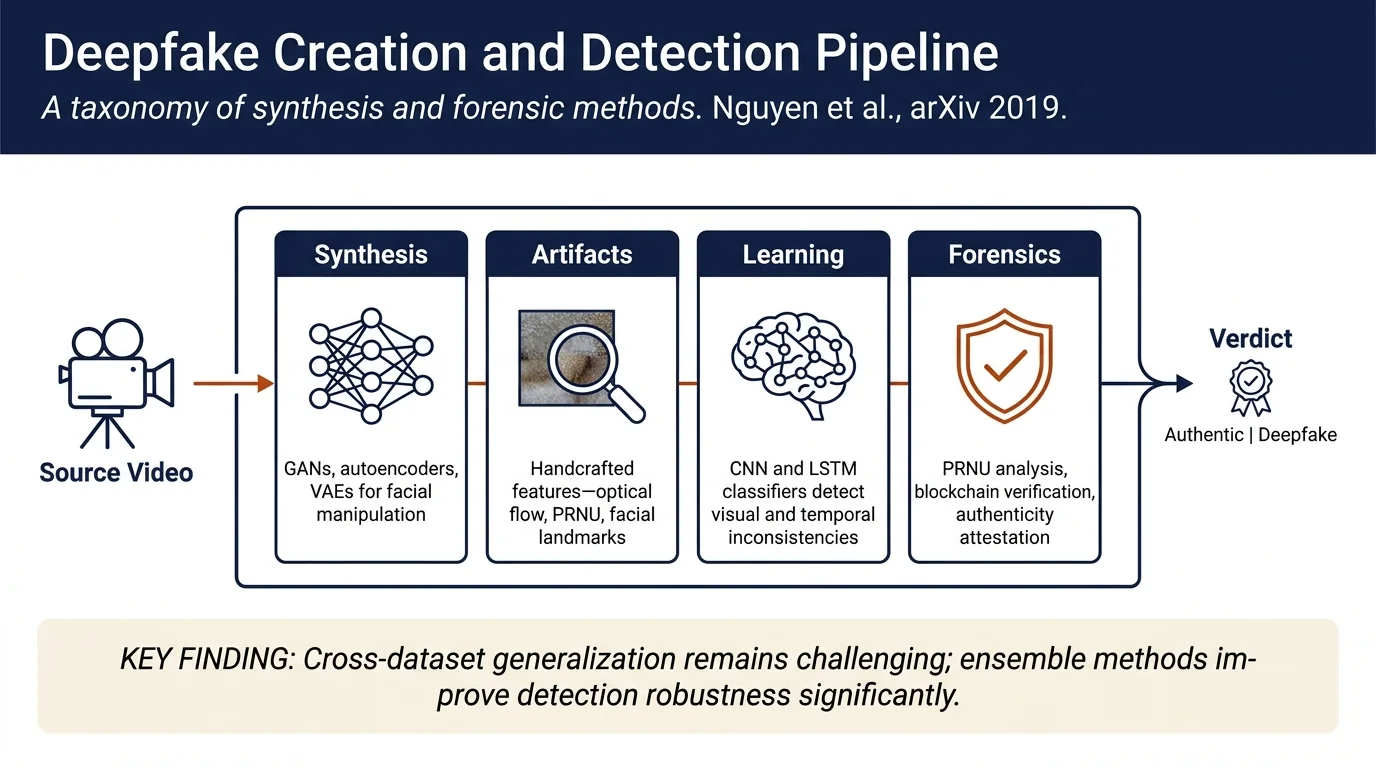
Deep Learning for Deepfakes Creation and Detection: A SurveyComprehensive survey of deep learning methods for creating and detecting deepfakes, covering face-swapping and lip-syncing generation techniques (GANs, autoencoders, encoder-decoder pairs), detection approaches (visual artifacts, temporal features, forensics), and challenges in cross-dataset generalization. The paper discusses…
 Deepfakes & multimodalDetection methods
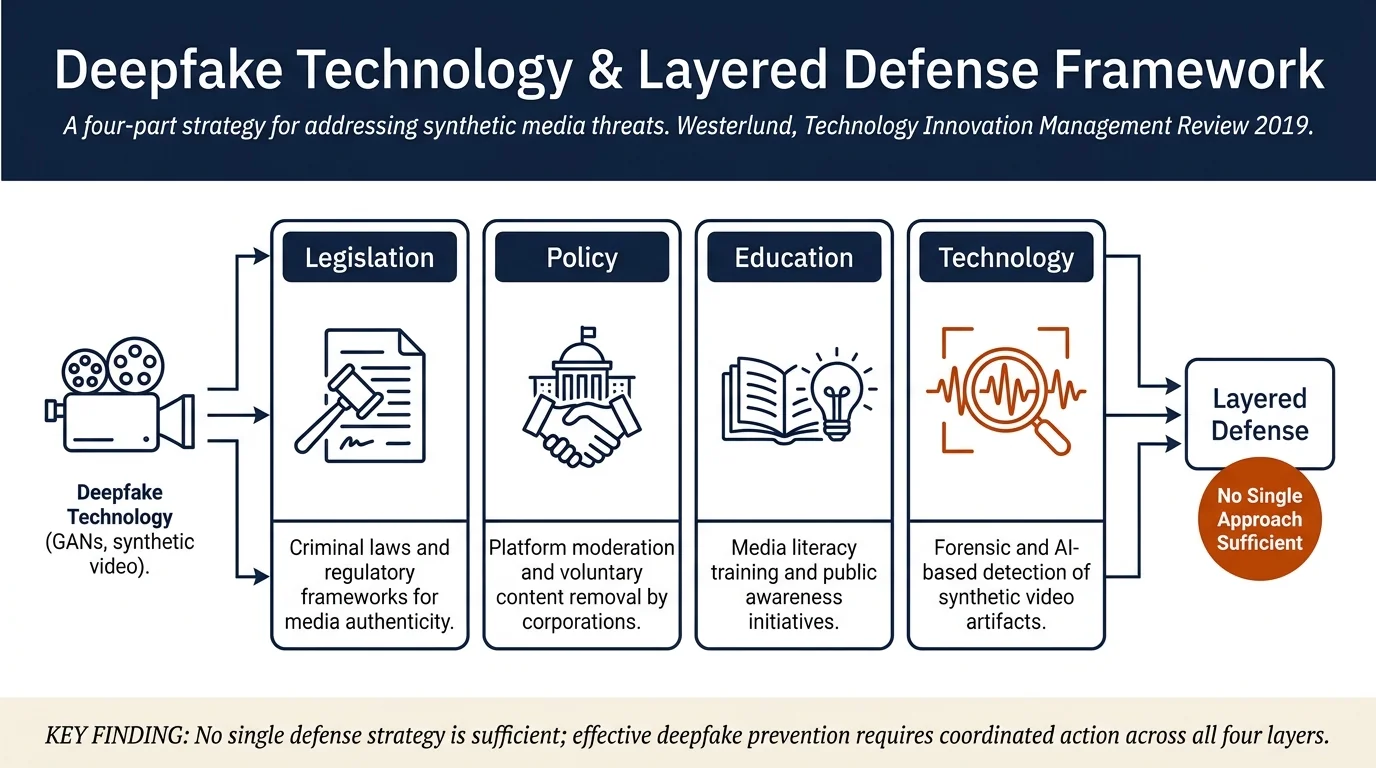
The Emergence of Deepfake Technology: A ReviewThis review analyzes 84 news articles about deepfakes to synthesize understanding of synthetic video technology, its applications, threats, and countermeasures. Deepfakes—hyper-realistic videos created using AI (primarily GANs)—lower the barrier to video forgery and represent a significant threat to trust, elections, and security.
 Deepfakes & multimodalPlatforms, policy & society
How deepfakes undermine truth and threaten democracyDeepfakes use machine-learning technology to create fabricated audio and video of people doing or saying things they never did. Law professor Danielle Citron explores the dual threats: individual harm (non-consensual sexual deepfakes targeting women, especially minorities and journalists) and societal damage (eroding trust in…
 Deepfakes & multimodalDetection methods
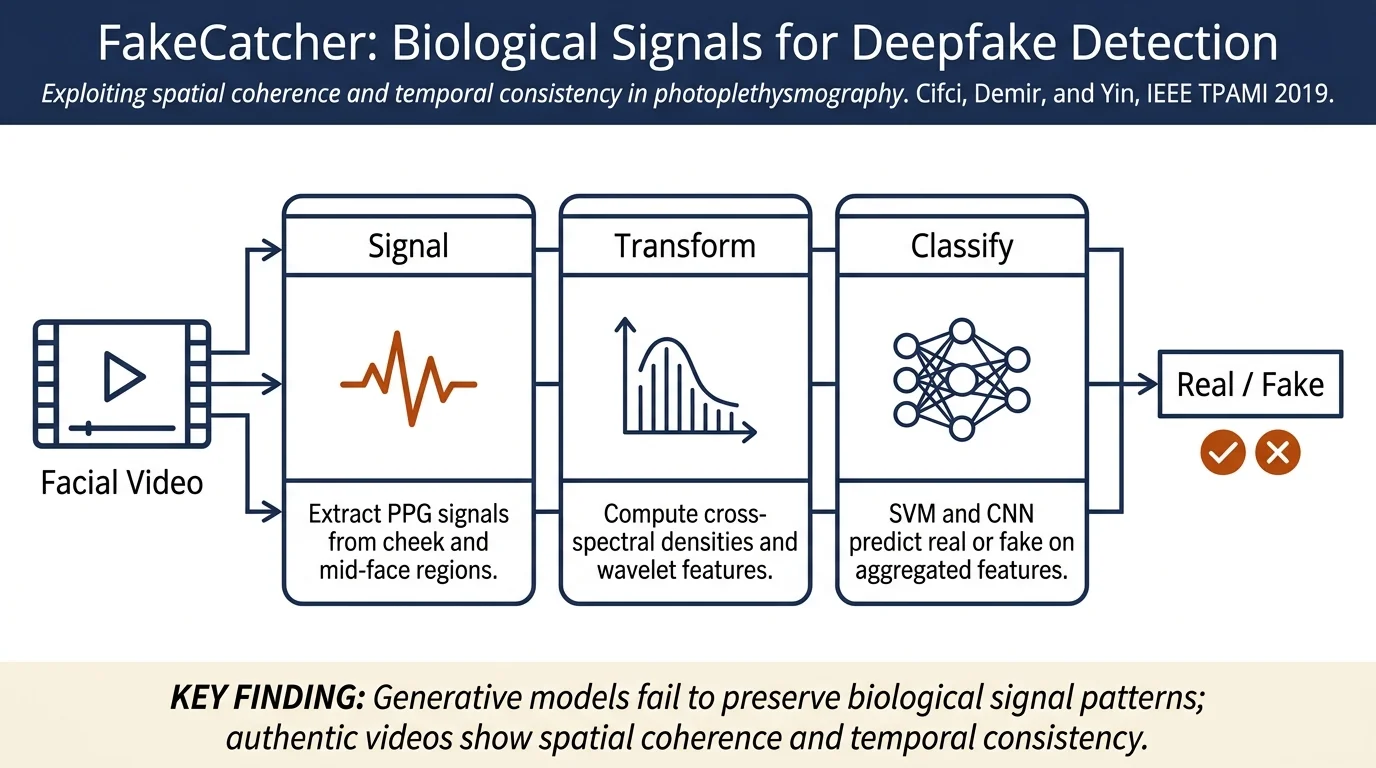
FakeCatcher: Detection of Synthetic Portrait Videos using Biological SignalsFakeCatcher detects deepfakes by analyzing biological signals (photoplethysmography—blood flow patterns) extracted from facial regions. The key insight is that generative models fail to preserve spatial coherence and temporal consistency of these signals in authentic videos, making biological signal analysis a powerful forensic tool…
 Datasets & evaluationDeepfakes & multimodal
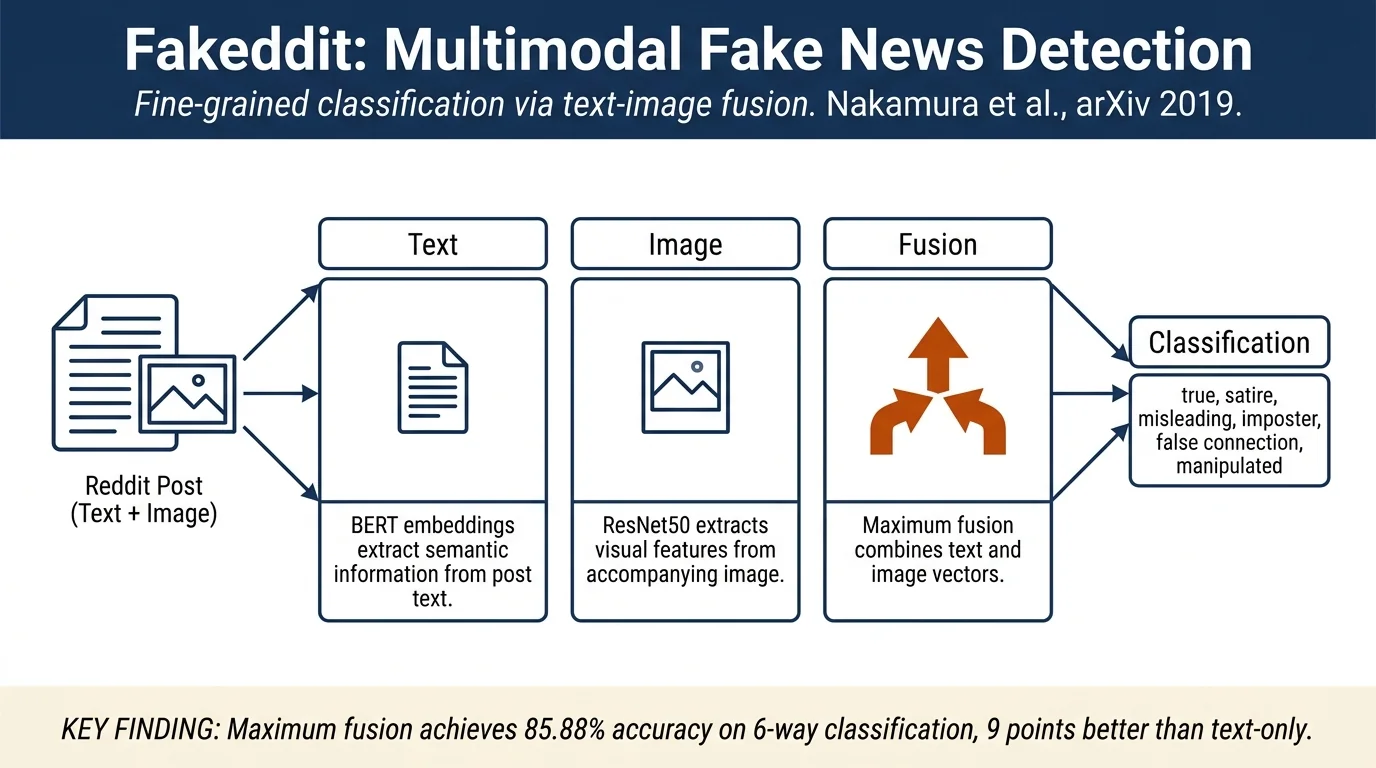
r/Fakeddit: A New Multimodal Benchmark Dataset for Fine-grained Fake News DetectionFakeddit is a large-scale multimodal fake news detection dataset with over 1 million Reddit samples labeled with 2-way, 3-way, and 6-way classification schemes. Multimodal models combining text (BERT) and image (ResNet50) features achieve 86.0% accuracy on 6-way classification, demonstrating the importance of jointly leveraging text and…
 Deepfakes & multimodalDetection methods
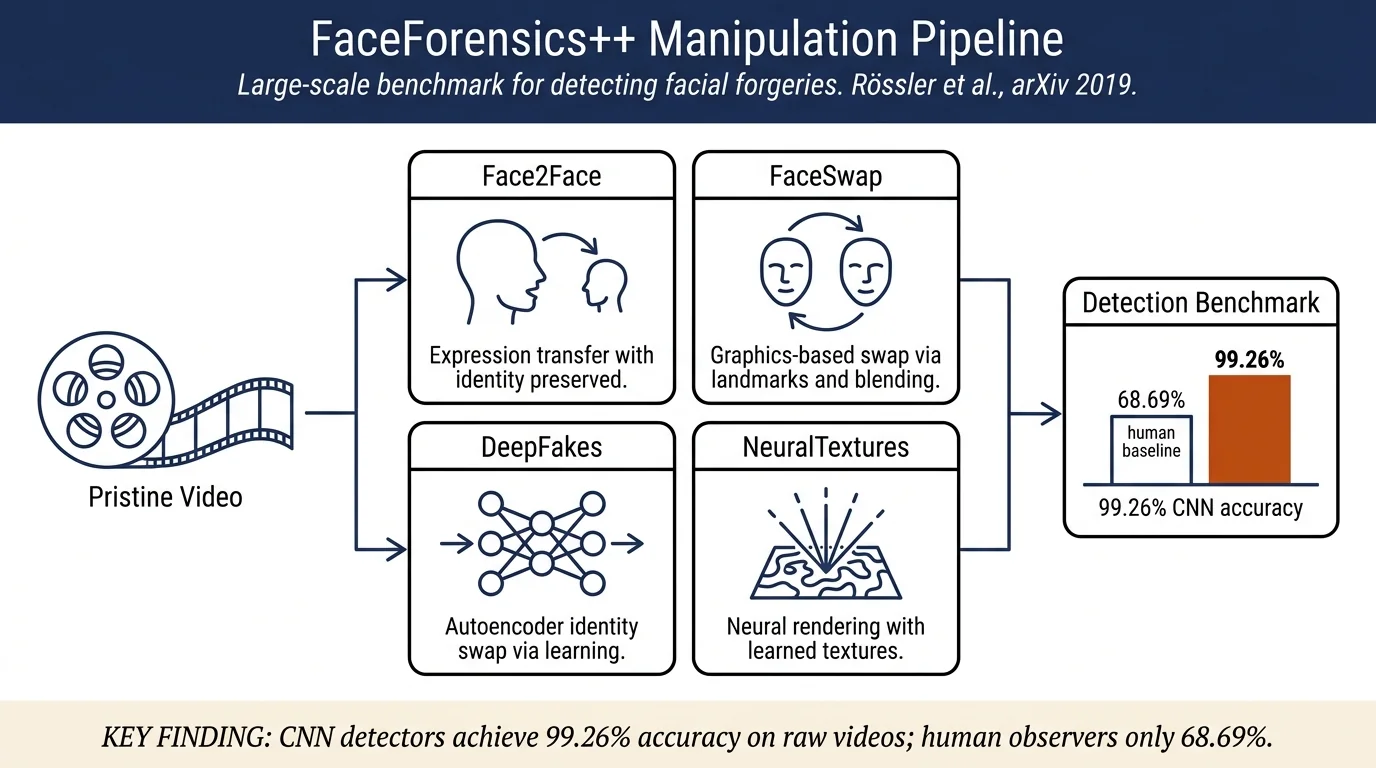
FaceForensics++: Learning to Detect Manipulated Facial ImagesFaceForensics++ introduces a large-scale benchmark (1.8+ million manipulated images from 1,000+ videos) for detecting facial manipulations created with four state-of-the-art methods: Face2Face, FaceSwap, DeepFakes, and NeuralTextures. The paper comprehensively evaluates detection methods from stegananalysis to deep learning,…
 Deepfakes & multimodalDetection methods
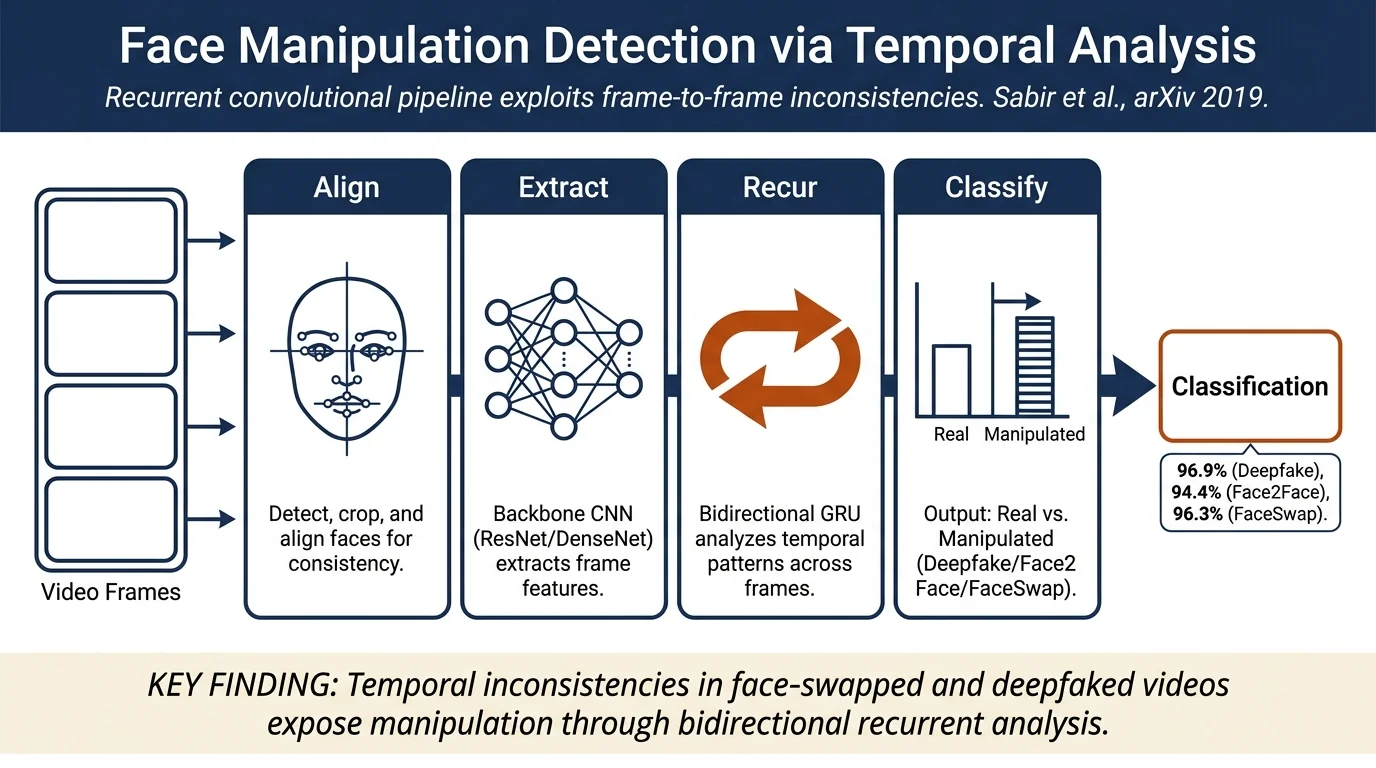
Recurrent Convolutional Strategies for Face Manipulation Detection in VideosThis paper proposes using recurrent convolutional networks to detect face manipulations (Deepfake, Face2Face, FaceSwap) in videos by exploiting temporal discrepancies across frames. Face preprocessing with alignment and bidirectional recurrent networks achieve state-of-the-art on FaceForensics++ with up to 4.55% improvement over prior…
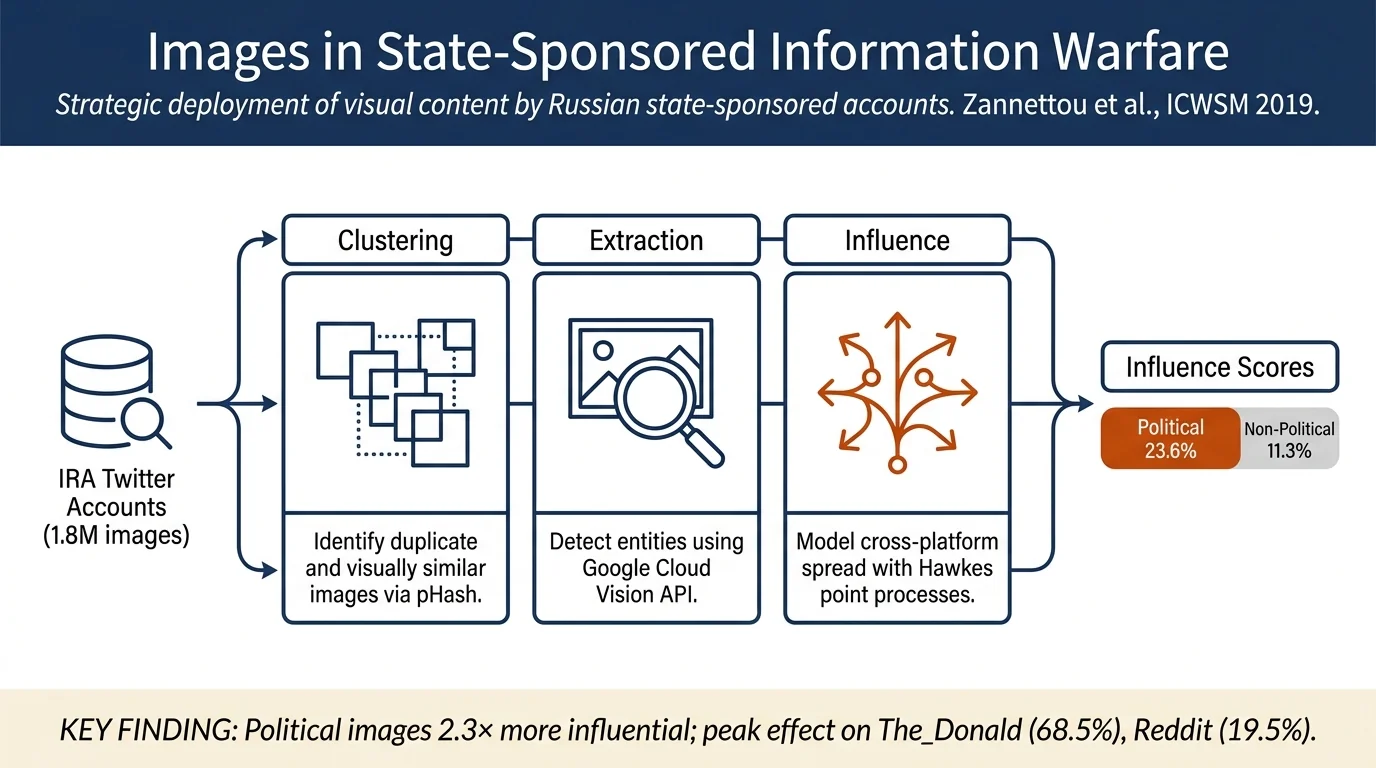 Bots & coordinated campaignsDeepfakes & multimodal
Characterizing the Use of Images in State-Sponsored Information Warfare Operations by Russian Trolls on TwitterLarge-scale analysis of 1.8M images posted by ~3.6K Russian state-sponsored Twitter accounts (IRA-controlled). Russian trolls strategically deployed images and memes to maximize political influence, with political imagery 2+ times more effective than general content.
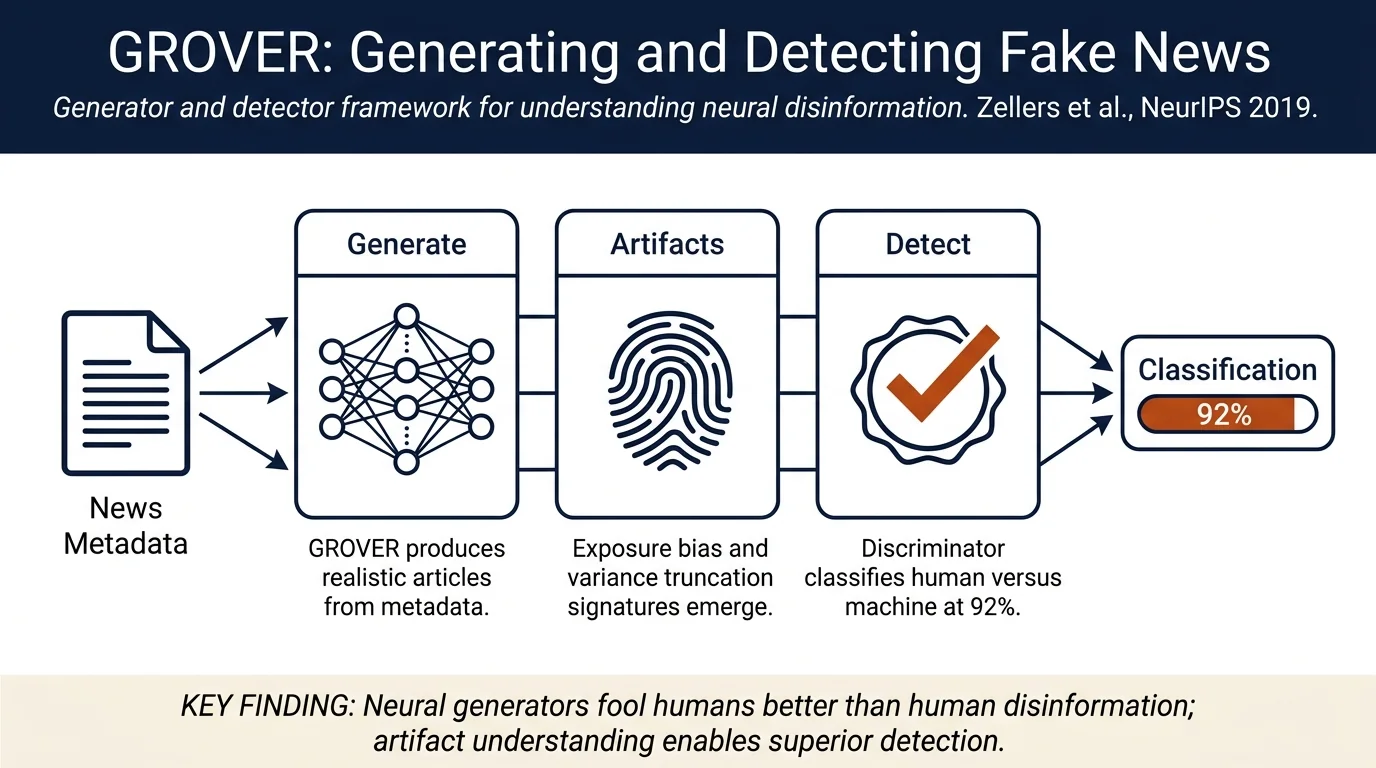 LLMs & generative AIDetection methods
Defending Against Neural Fake NewsZellers et al. introduce GROVER, a conditional neural text generation model that can both generate and detect neural fake news. The paper shows that humans cannot reliably distinguish GROVER-generated propaganda from real human-written disinformation, rating machine-generated propaganda as more trustworthy (2.42/3 vs 2.19/3 for human…
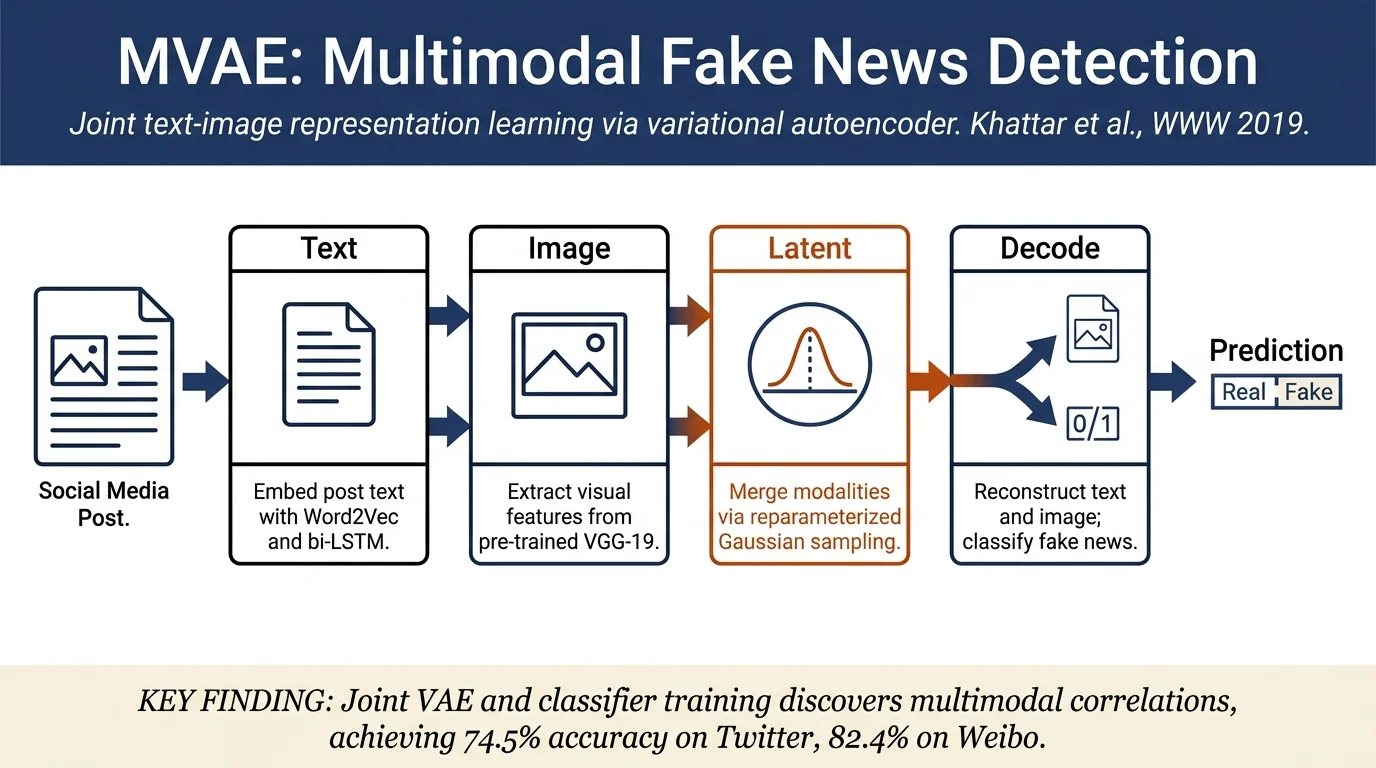 Deepfakes & multimodalDetection methods
MVAE: Multimodal Variational Autoencoder for Fake News DetectionThe paper proposes MVAE, a variational autoencoder that learns shared representations of text and images in social media posts to detect fake news. The model jointly trains an encoder-decoder (to discover correlations across modalities) with a binary classifier.
 Spread & networksDeepfakes & multimodal
Don't Blame Bots, Fake News Is Spread by HumansA comprehensive talk covering the scale of misinformation campaigns on social media (ranging from Syrian hackers compromising the AP's Twitter account to Russian interference in the 2016 US election), empirical findings on how false news spreads faster than truth, and emerging threats from synthetic media (deepfakes) created via…
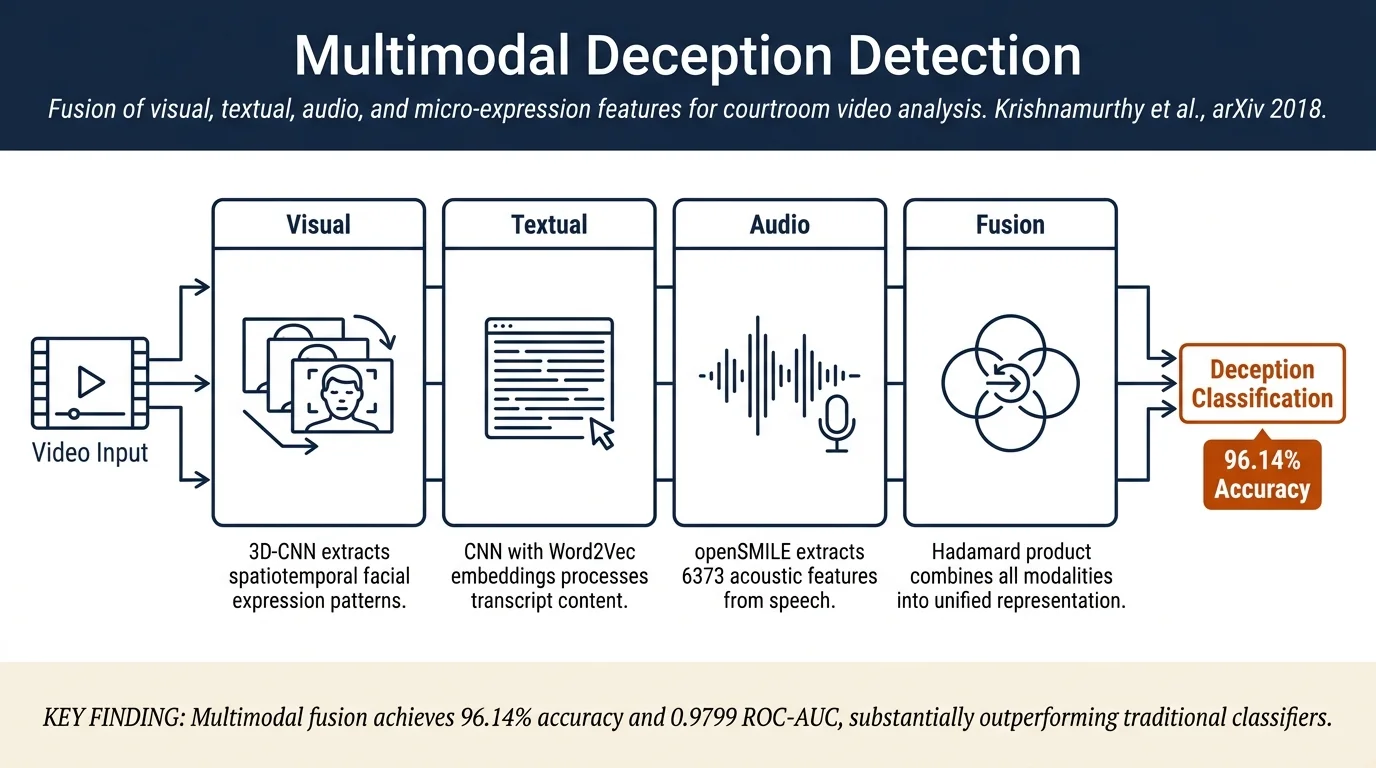 Deepfakes & multimodalDetection methods
A Deep Learning Approach for Multimodal Deception DetectionThis paper proposes a multimodal neural model for detecting deception in real-life courtroom trial videos by combining visual features from 3D-CNN, audio features from openSMILE, textual features from CNN on transcripts, and manual micro-expression annotations. The model achieves 96.14% accuracy and ROC-AUC of 0.9799, substantially…
 Platforms, policy & societyDeepfakes & multimodal
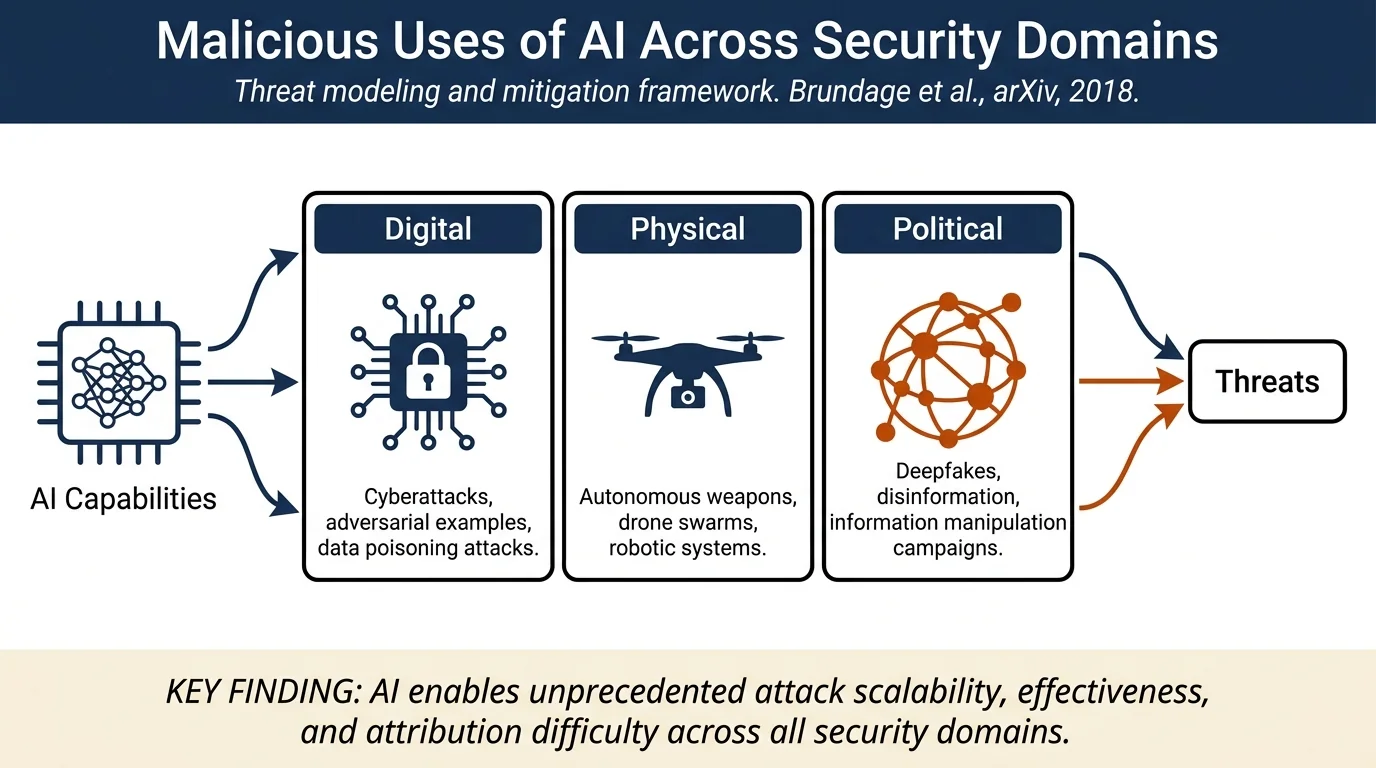
The Malicious Use of Artificial Intelligence: Forecasting, Prevention, and MitigationA landmark 2018 report surveying the landscape of potential security threats from malicious uses of AI across three domains—digital, physical, and political security. The work proposes frameworks for forecasting AI-enabled attacks, identifies specific threat scenarios including AI-generated disinformation and deepfakes, and recommends…
 Deepfakes & multimodalDatasets & evaluation
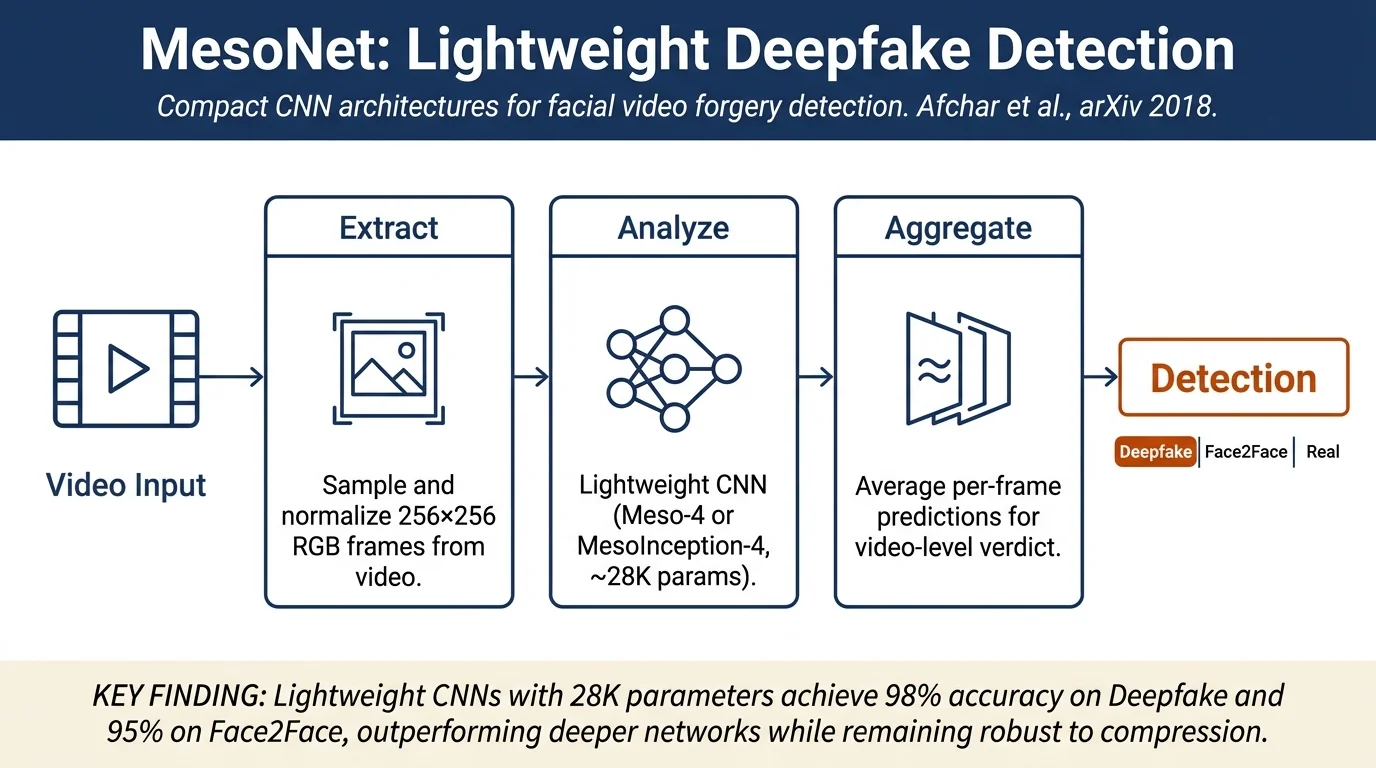
MesoNet: A Compact Facial Video Forgery Detection NetworkThis paper proposes two lightweight CNN architectures (Meso-4 and MesoInception-4) to detect facial video forgeries created by Deepfake and Face2Face techniques. Operating at the mesoscopic level of image analysis, the networks achieve 98% detection accuracy for Deepfake and 95% for Face2Face videos under realistic compression conditions.
 Deepfakes & multimodalDetection methods
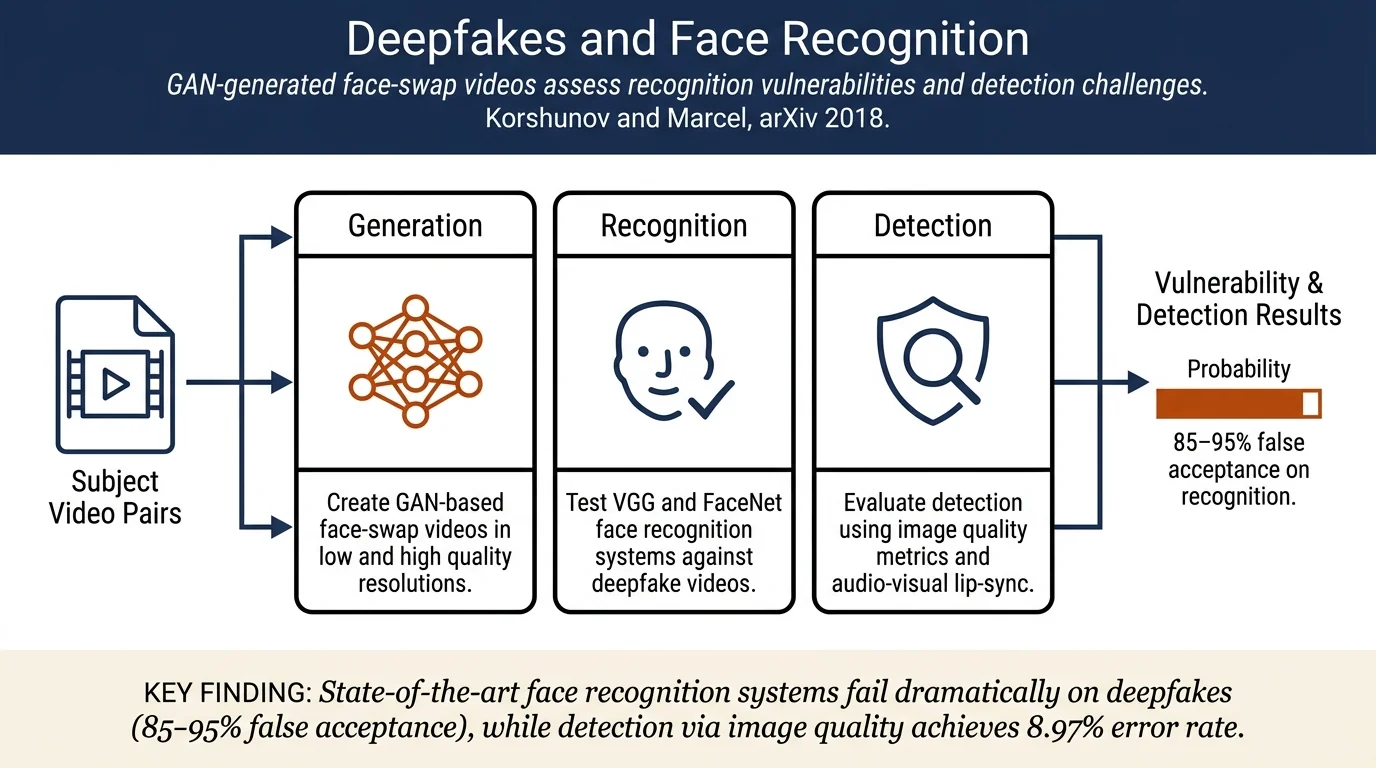
DeepFakes: a New Threat to Face Recognition? Assessment and DetectionGAN-based face-swapping (Deepfakes) pose a significant threat to face recognition systems: VGG and FaceNet achieve false acceptance rates of 85.62% and 95.00% on high-quality Deepfakes. The authors release the first public Deepfake video database (620 videos from 16 subject pairs) and show that image quality metrics with SVM achieve…
 Deepfakes & multimodalDetection methods
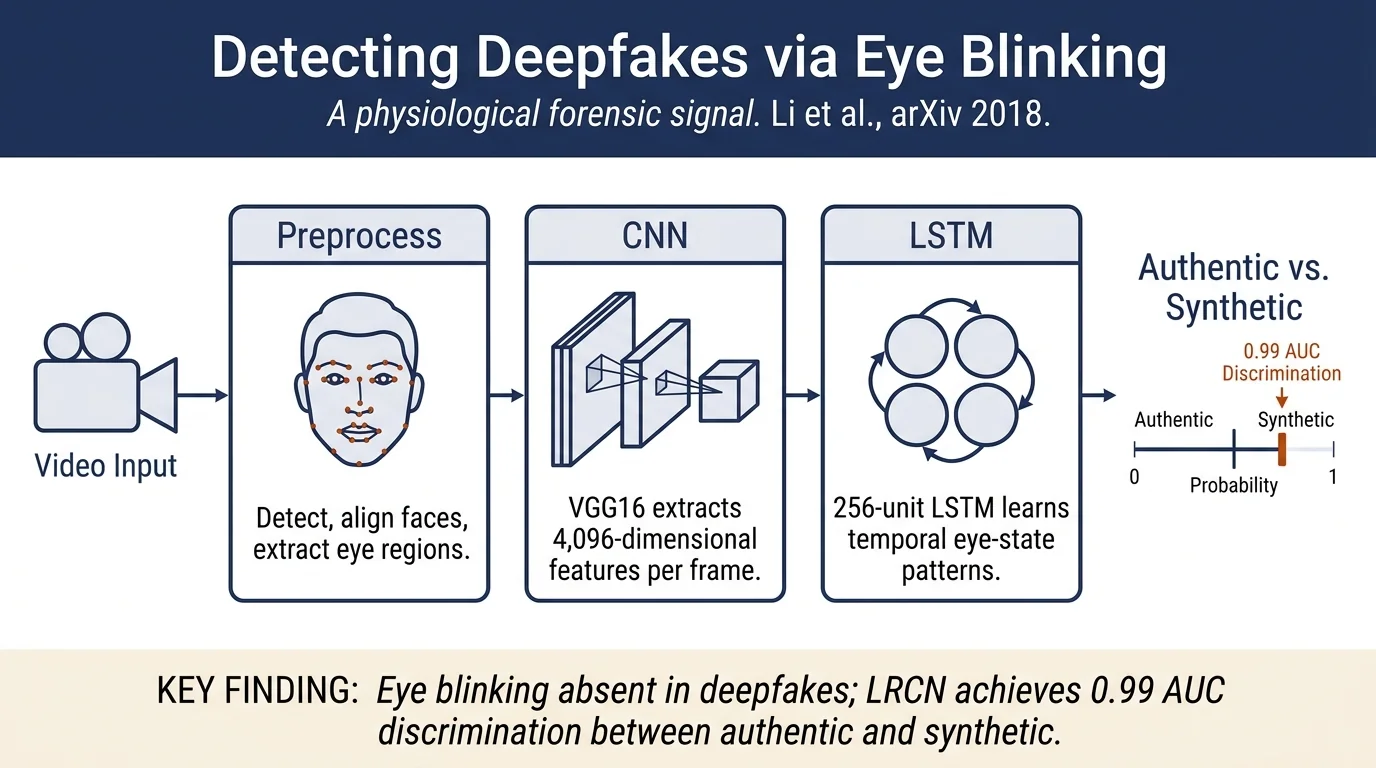
In Ictu Oculi: Exposing AI Generated Fake Face Videos by Detecting Eye BlinkingDetects DeepFake videos by exploiting the absence of natural eye blinking patterns in AI-generated faces. Uses a Long-term Recurrent Convolutional Network (LRCN) combining CNN for feature extraction with LSTM-RNN for temporal modeling of eye state, achieving 0.99 AUC on authentic vs. synthesized videos—a forensic signal invisible to the…