Shifting attention to accuracy can reduce misinformation online
Authors: Gordon Pennycook, Ziv Epstein, Mohsen Mosleh, Antonio A. Arechar, Dean Eckles, David G. Rand
Venue: Nature, Volume 592, pp. 590–595, April 22, 2021 — DOI
TL;DR
The paper shows through six online experiments and a Twitter field trial that simply drawing people's attention to accuracy can substantially reduce their sharing of misinformation. When asked to rate the accuracy of headlines before deciding whether to share them, participants share more accurate content; a Twitter field experiment confirms that sending users an accuracy-reminder message increases the quality of news they subsequently share, with the effect driven by a preference-based account rather than confusion-based remediation.
Contributions
- Disconnect between accuracy judgments and sharing: Demonstrates that while people generally believe it is important to share only accurate news, accuracy has surprisingly little effect on their actual sharing behavior—yet this disconnect is not due to lower accuracy judgments.
- Attention-based intervention mechanism: Shows that the primary mechanism driving reduced misinformation sharing is attention to accuracy, not belief correction or political ideology. When people's attention is primed toward accuracy, they voluntarily share higher-quality news.
- Scalable intervention design: Develops a simple, attention-based treatment that can be deployed at scale on social media platforms without requiring specialized fact-checking labels or overt correction messaging.
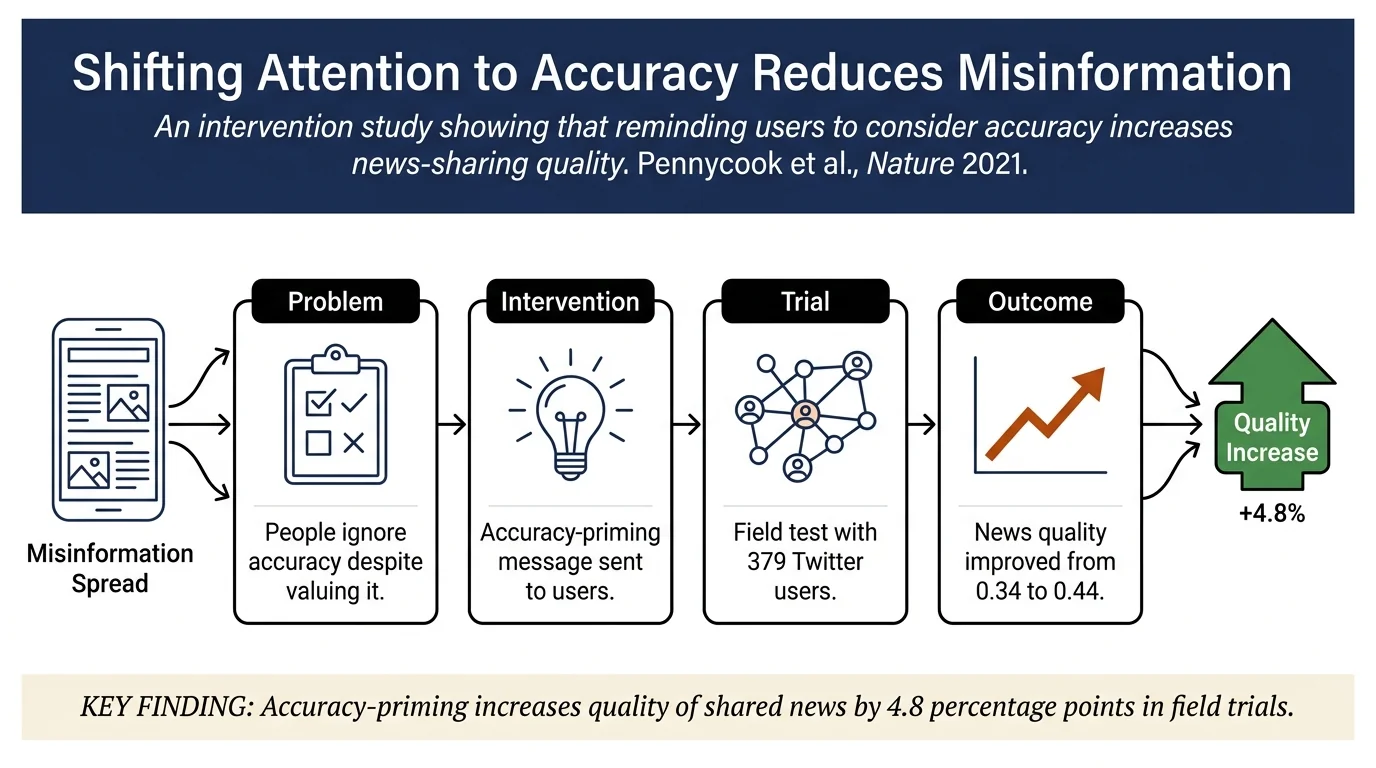
- Field validation on Twitter: Moves beyond laboratory experiments to conduct a field trial with 379 Twitter users, demonstrating that the accuracy-salience treatment increases the quality of real shared links in a 24-hour window.
- Quantitative evidence against preference-based accounts: Uses formal limited-attention modeling to show that treating accuracy as a weighted attribute in sharing decisions outperforms confusion-based accounts, providing theoretical support for attention-based interventions.
Method
The paper employs six primary studies on Amazon Mechanical Turk (MTurk) and a final field experiment on Twitter, with preregistered hypotheses.
Study 1 (n = 1,002): Baseline dissociation between accuracy and sharing. Participants saw 18 headlines (9 true, 9 false, balanced for political alignment) in a randomized order. In one condition, they judged whether each headline was accurate; in another, they directly saw the headline and indicated whether they would share it without an explicit accuracy judgment. Key finding: Participants shared more accurate news in the accuracy-judgment condition (75.8% true vs. 51.3% false in treatment vs. 55.9% true vs. 53.9% false in control sharing condition), but the effect of political concordance on sharing was significantly larger (10.1 percentage-point difference for politically discordant vs. 27.4 percentage-point difference for concordant headlines in control).
Studies 3, 4, 5 (varying conditions and samples): Tested whether survey-based accuracy priming generalizes across populations. Study 3 (n = 1,254 MTurk participants): Participants completed an importance-weighting task either rating headlines on importance to sharing only accurate news, or a control condition. Both led to reduced false-content sharing. Study 4 (n = 780 participants): Replicated findings with a different set of 24 headlines and a more nationally representative sample from Lucid. Study 5 (n = 1,200 participants): Added an "importance" treatment where participants indicated the importance of sharing only accurate content on social media. All three studies found treatment-driven increases in sharing accuracy.
Study 6 (field experiment design): A full-attention treatment where participants rated the accuracy of every headline before being asked whether they would share it. Effect size significantly larger than survey-based treatments, supporting the hypothesis that active engagement with accuracy salience (rather than passive exposure to a reminder) maximizes the intervention.
Study 7 (Twitter field trial, n = 379 users): Conducted a digital field experiment on Twitter with 379 users who had recently shared low-quality news. Researchers sent users an unsolicited private message asking for their opinion on the accuracy of a single non-partisan headline (or a control headline that asked about content importance). Results: Participants in the accuracy-priming condition subsequently shared higher-quality news in the 24 hours following the intervention (mean quality score 0.34 pre-treatment vs. 0.44 post-treatment; p < 0.001 for treatment effect), whereas the control condition showed no improvement.
Results
Study 1 Headline Accuracy and Sharing: In the control (no-accuracy-judgment) condition, participants shared false headlines at only slightly lower rates (53.9%) than true ones (55.9%), a difference of just 2 percentage points. In the accuracy-condition, the gap widened dramatically to 51.3% for false vs. 75.8% for true—a 24.5 percentage-point swing.
Partisan Effects: Interestingly, the headline's political alignment had a much larger effect on sharing intentions (27.4 percentage points for concordant vs. discordant in control) than accuracy status (2 percentage points). However, when accuracy was made salient, accuracy effects reversed course and became more than twice as powerful (r = 0.71 to 0.67 across studies 3–5), with a positive correlation between perceived accuracy and sharing intention.
Study 7 Twitter Results: Pre-treatment sharing behavior showed an average news quality score of 0.34 (on a scale where 0 is all false, 1 is all true). Among users assigned to the accuracy-message treatment, average quality increased to 0.44 post-treatment. This translates to a +4.8% absolute increase in average shared-content quality over a 24-hour window. The treatment effect was robust to clustering and multiple comparisons, and persisted across users with different follower counts.
Formal Model Fit: A preference-based limited-attention model (where accuracy is one of several weighted attributes in the sharing-decision utility function) fit the data better than a confusion-based account (where people mistakenly think false headlines are true). The preference-based account explained 51.2% of sharing intention variance in Study 6, vs. 33.1% for the confusion-based account, providing evidence that inattention to accuracy (rather than errors in accuracy judgment) is the primary driver.
Connections
- Related to Misinformation Interventions — core study on attention-based mechanisms for reducing misinformation spread.
- Related to Fact-checking and corrections — shows that accuracy-salience interventions can outperform or complement direct fact-checking approaches.
- Cited by recent work on behavioral interventions — several subsequent papers (2021–2022) build on the attention-based framework to test domain-specific and platform-specific variations.
- Related to Social media and misinformation — demonstrates real-world applicability of controlled experiments to production platform behavior.
- Related to Behavioral Intervention — exemplifies lightweight, scalable interventions based on psychological principles.
Notes
Strengths: - Six preregistered studies with transparent research protocols (https://osf.io/ppu8k). - Strong experimental design including active control conditions (e.g., importance treatments in Study 5) to isolate the role of accuracy salience. - Large sample sizes (ranging from n = 780 to n = 1,254 in studies 3–5) increase statistical power and generalizability. - Field trial on Twitter (Study 7) validates laboratory findings in a real-world setting with actual sharing behavior. - Formal quantitative modeling (preference-based vs. confusion-based accounts) provides mechanistic clarity. - Honest acknowledgment of limitations: small effect sizes in some analyses, potential participant selection bias in the Twitter sample, and uncertainty about longer-term persistence of effects.
Weaknesses: - The Twitter field trial, while valuable, is relatively small (n = 379) and targets users already identified as having shared low-credibility content—results may not generalize to the broader population or to first-time interventions. - Study designs focus on headlines in isolation rather than full articles or social-context cues (e.g., friend endorsements, network effects), which are known to drive sharing in practice. - Long-term persistence of effects is not tested—the Twitter experiment measures sharing behavior only in the 24 hours post-intervention; it is unknown whether the boost in accuracy persists beyond this window. - Measurement of "news quality" in the Twitter trial relies on professional fact-checkers' ratings and may not perfectly align with how users perceive credibility or relevance. - The intervention assumes users have the cognitive resources and motivation to attend to accuracy cues; effectiveness may be lower for users in high-distraction environments or with stronger partisan motivations.
Follow-ups: - Later work has explored boundary conditions: whether the intervention works equally well for all political ideologies, demographic groups, and content domains. - Studies on persistence and dose-response relationships would clarify whether repeated exposure to accuracy-salience interventions accumulates effects or shows habituation. - Investigation of platform-level implementations (e.g., algorithmic interventions that boost sharing of high-accuracy content) would test whether small individual interventions scale to reduce system-wide misinformation circulation.