Examining the consumption of radical content on YouTube
Authors: Homa Hosseinmardi, Amir Ghasemian, Aaron Clausett, Markus Mobius, David M. Rothschild, Duncan J. Watts
Venue: PNAS, 2021 — DOI
TL;DR
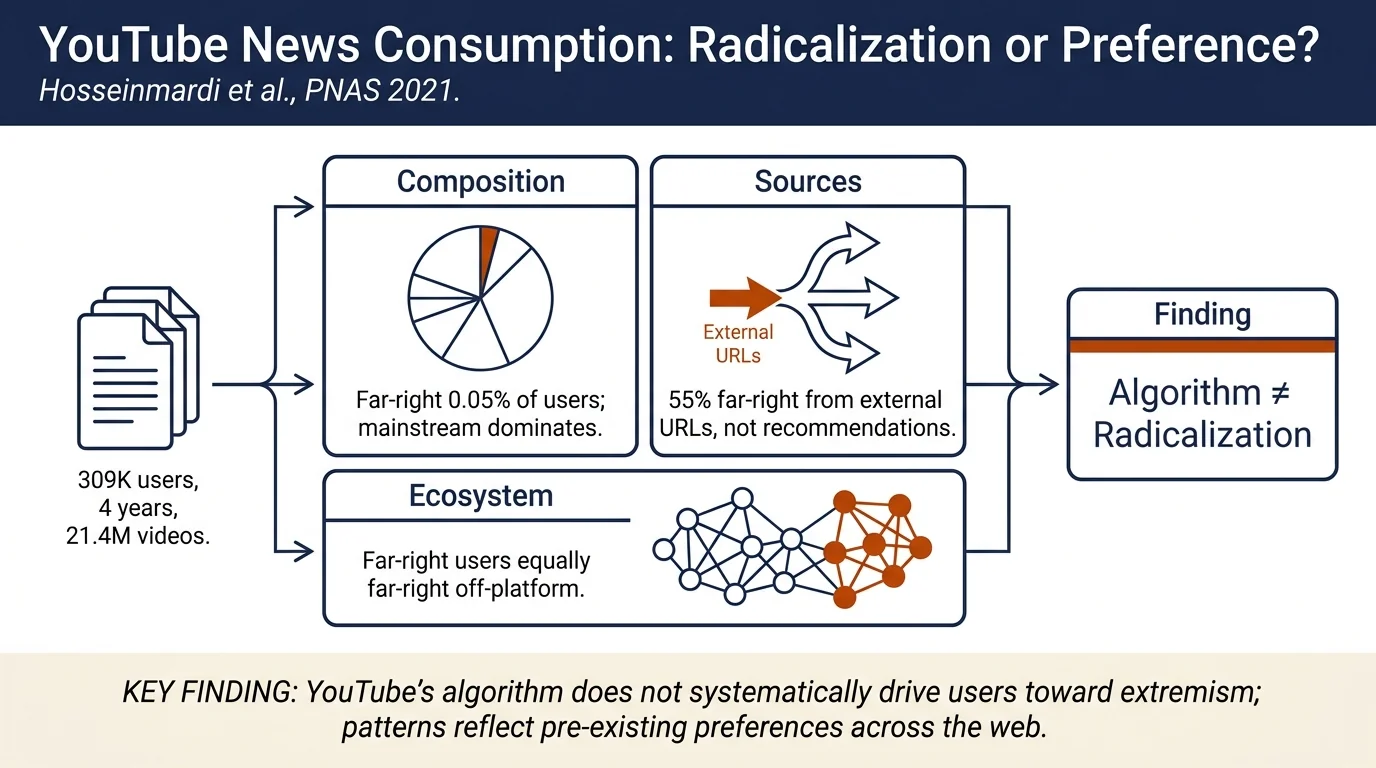
Large-scale study of 309,813 U.S. users' YouTube and web browsing from 2016–2019 finds that news consumption on YouTube is dominated by mainstream, centrist sources. While far-right content exists and engages users intensely, it remains a small and stable share. "Anti-woke" content grew steadily and correlates with far-right consumption off-platform, but YouTube's recommendation algorithm does not appear to systematically drive users toward extremism; instead, consumption patterns reflect individual preferences extending across the broader web.
Contributions
-
First large-scale empirical audit of YouTube political news consumption — 309,813 panelists tracked for 4 years (2016–2019), covering 21.4M watched videos and 974 labeled channels.
-
Quantifies consumption by political category — News accounts for only 11% of total YouTube watch time; within news, mainstream/left-leaning sources dominate (63–65% of viewers), while far-right comprises 0.05% of users (declining slightly) and far-left 0.002%.
-
Distinguishes far-right from anti-woke — Identifies anti-woke as a distinct category (roughly orthogonal to traditional left–right spectrum), showing it grew 3× in watch time (0.31% → 1.02%) while far-right remained small.
-
Tests three hypotheses against recommendation-driven radicalization:
- On- vs. off-platform consumption: Far-right, right, and anti-woke consumers show identical taste bias off YouTube (3× more likely to consume far-right content on the wider web).
- Referral pathways: 55% of far-right video starts come from external URLs, search, or homepage—not preceding videos.
-
Session dynamics: No evidence that far-right content appears more frequently toward session end or in longer sessions (where recommendations have more influence).
-
Concentrated exposure predicts future consumption — Bursts of anti-woke content correlate with 2× larger downstream engagement than other categories, but this is correlational, not proof of causal algorithmic promotion.
Method
The authors use Nielsen's nationally representative desktop web panel tracking individual-level pageview behavior. For each YouTube video viewed, they extract metadata via the YouTube API (channel ID, category, etc.) and label channels using prior research studies that classified 1,100+ channels along political spectra.
Video labeling: Six political categories (far-left, left, center, anti-woke, right, far-right) derived by reconciling two prior labeling studies (Ledwich & Zaitsev; Ribeiro et al.). The anti-woke category is defined negatively (opposition to progressive social-justice movements, critique of academia/mainstream media), not by positive ideological commitment.
Missing data: 20.1% of videos became unavailable via YouTube API. The authors impute labels using a supervised random forest trained on 69,611 recovered videos from prior datasets, achieving AUC 0.95–0.98 per category. Results presented use high-precision thresholds (conservative lower bounds on extremist content).
User clustering: News consumers identified as those spending ≥1 min/month on political channels. Hierarchical clustering yields 6 communities corresponding to the 6 political categories. ~70% of users receive 80%+ of content from a single category.
Session and referral analysis: YouTube sessions defined as consecutive video pageviews with <10 min gap between videos and <60 min gap between external/video URLs. Referral pages classified as: YouTube homepage, search, channel, preceding video, external URL, or other.
Results
Community size and engagement (aggregate level): - Far-right: 0.05% of users (declined slightly from 2016 peak), 0.17%→0.30% of watch time (almost 2× growth). - Anti-woke: Started ~same size as far-right, grew steadily to 0.2% of users, 0.31%→1.02% of watch time (3.3× growth, faster than overall news consumption growth). - Left/center communities remain dominant (largest: left, 0.63% users, 1.65% watch time).
Individual engagement: - Median per-video watch time: far-right increased 50% (2→3 min), anti-woke doubled and now exceeds centrist/left-leaning. - Monthly engagement for far-right and anti-woke users: up to 2× higher than center/left/right communities.
Community stickiness (month-to-month transitions): - Members stay within their communities (diagonal dominates). - Right/far-right move to anti-woke more than left/center do (6% and 5% vs. 3% and 2%), but most common destination for far-right exodus is still right or far-left (4% each).
On- vs. off-platform consumption: - Right/far-right YouTube users are 2× more likely to consume right-leaning content and 3× more likely to consume far-right content on the wider web. - Anti-woke YouTube users similarly biased off-platform: 1.5× right, 2.2× far-right—showing anti-woke audiences share taste with far-right even if channels don't self-identify as such. - Result: strongly consistent with user preference explanation; less consistent with algorithmic amplification.
Referral pathways: - Only 36% of far-right videos preceded by another video (implying recommendation). - 55% from external URLs (41%), YouTube homepage (8%), or search (6%). - When entering from a news domain, ~50% of far-right/right videos start after visiting right/far-right news sites (Breitbart, InfoWars, Fox News); ~70% of far-left/left/center videos start after center news domain visits.
Session analysis: - No trend toward more extreme content within sessions. - Fraction of far-right videos uniform across normalized session position (0 = start, 1 = end); entropy nearly uniform. - Longer sessions show decreased frequency of political content (dedicated to non-news), and no increase in far-right. - Result: inconsistent with algorithmic steering; consistent with user preference.
Connections
- Related to recommendation algorithm bias via direct audit of YouTube's recommendation effect claims.
- Complements work on political polarization and social media by quantifying YouTube's actual role relative to broader ecosystem.
- Cited by platform studies literature as major empirical counterweight to radicalization hypothesis.
- Methodologically informed by prior labeling studies on algorithmic extremism and YouTube radicalization.
- Differs from op-ed perspectives on YouTube's "rabbit hole" and anecdote-based analyses by providing population-level evidence.
Notes
Strengths: - Uniquely large and representative sample (300K+ users, 4 years, national panel). - Multiple convergent tests of radicalization hypothesis (referral mode, session dynamics, on/off-platform alignment) rather than relying on single metric. - Transparent about methodological limitations and imputation of missing labels. - Honest about what the data do and don't say: non-causal correlations, population-level only, no mechanism visibility.
Limitations acknowledged: - Desktop-only browsing (mobile is now 2× larger share of YouTube). May not capture mobile radicalization if it differs. - 20% label imputation via machine learning introduces model error, though high-precision threshold is conservative. - Panel-based data cannot see videos recommended but not chosen. - Channel-level label is imperfect proxy for individual video ideology. - Cannot see background tabs or multi-tab browsing, so "external entrance" is a lower bound.
Implications: - YouTube should not be understood as a primary radicalization vector when viewed in isolation; it is part of a larger ecosystem where far-right and anti-woke content are actively sought and widely available. - Consumption of radical content on YouTube, while small in aggregate, reflects pre-existing user preferences that span the web. - The growing anti-woke category is noteworthy as a platform-specific phenomenon (no equivalent off-platform) and sticky among right-leaning audiences, but does not function as a reliable gateway to far-right extremism. - Suggests future work should focus on the broader information ecosystem and address why users seek radical content, not just why platforms recommend it.