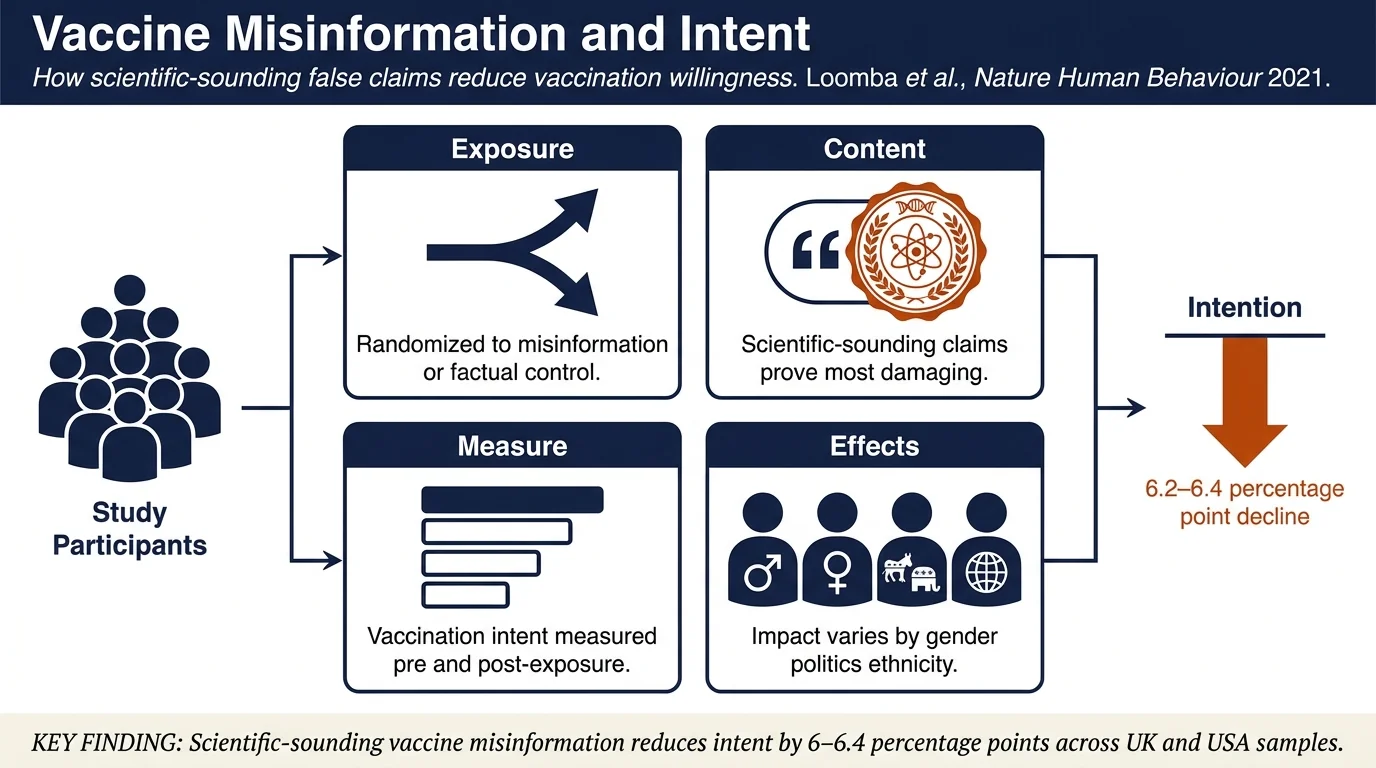
Measuring the impact of COVID-19 vaccine misinformation on vaccination intent in the UK and USA
Authors: Sahil Loomba, Alexandre de Figueiredo, Simon J. Piatek, Kristen de Graaf, Heidi J. Larson
Venue: Nature Human Behaviour, Vol. 5, March 2021, pp. 337–348 — DOI
TL;DR
Randomized controlled trial on 8,001 respondents (4,000 UK, 4,001 USA) measuring causal impact of exposure to COVID-19 vaccine misinformation. Exposure to misinformation reduced vaccination intent by 6.2 percentage points in the UK and 6.4 in the USA relative to exposure to factual information. Scientific-sounding misinformation was most effective; effects varied by sociodemographic group—females and certain political/ethnic minorities more resistant to misinformation's impact.
Contributions
- First large-scale randomized controlled trial quantifying causal impact of vaccine misinformation on vaccination intent in two countries
- Demonstrates asymmetry: scientific-sounding misinformation more damaging than non-scientific claims
- Reveals sociodemographic heterogeneity in susceptibility; maps patterns that inform targeted intervention design
- Documents persistence: treatment effects detected across multiple post-exposure measures; fact-checking shown to partially counteract misinformation
Method
Study design: Pre-exposure → exposure → post-exposure measurement. Nationally representative samples stratified by age, gender, education, employment, political affiliation, ethnicity, religion, and income.
Exposure: Treatment groups shown one of five COVID-19 vaccine-related images (varying in content and scientific-sounding rhetoric); control group shown factual vaccine information; second control measured passive exposure (no targeted messaging).
Outcome: Vaccination intent measured on ordinal 4-point scale (definitely yes → definitely not) for two contexts: (1) self-protection; (2) protecting family/others.
Analysis: Hierarchical Bayesian ordered logistic regression with treatment effects derived via posterior simulation; conditional treatment effects computed for each sociodemographic category; heterogeneous treatment effect (HTE) analysis.
Results
Primary findings: - UK treatment group: 6.2 percentage point decline in "definitely accept vaccine" intent vs. control (95% PI 5.5–11.4) - USA treatment group: 6.4 percentage point decline (95% PI 4.1–8.8) - Effect heterogeneity by sociodemographic group: females less affected in USA (2.8 pp decline vs. 6.4 for males); unemployed, students, and some ethnic minorities in UK more affected; political affiliation/trust in experts also predictive
Image-level analysis: - Image 1 (Oxford University claim of good immune response, scientific rhetoric) had 40% of UK respondents increase skepticism; largest effect on vaccination intent (39% disagree) - Images 2 and 3 (text with simplified claims) less effective - High perceived trustworthiness correlated with lower fact-checking and higher misinformation acceptance
Post-exposure measures: Respondents who encountered misinformation showed (1) lower intent to share corrected information; (2) higher willingness to tell others the vaccine is risky; (3) reduced fact-checking likelihood; (4) agreement that "misinformation raised their vaccination intent concerns."
Connections
- Related to Fighting COVID-19 Misinformation on Social Media: Experimental Evidence for via shared finding that messaging approach (accuracy vs. emotion framing) modulates misinformation impact
- Builds on Neutralizing misinformation through inoculation: Exposing misleading argumentation (inoculation theory) and Fake news game confers psychological resistance against online misinformation (psychological resistance to misinformation)
- Connected to broader vaccine hesitancy literature: Social media and vaccine hesitancy, Prevalence of Health Misinformation on Social Media: Systematic Review
- Provides causal evidence for mechanisms discussed in The psychological drivers of misinformation belief and its resistance to correction
Notes
Strengths: Large, nationally representative sample in two countries; randomized design enables causal inference; comprehensive outcome measurement (intent, trust, willingness to share/discuss); heterogeneous treatment effect analysis reveals which populations most vulnerable.
Limitations: Laboratory setting (not organic social media); short time horizon (effects measured immediately post-exposure); self-reported vaccination intent, not actual vaccination behavior; single-session exposure unlike cumulative real-world misinformation; cannot infer optimal intervention design from this study (factual messaging tested as control, not as an active intervention to counteract misinformation).
Implications: Underscores need for (1) platform-level amplification controls targeting scientific-sounding false vaccine claims; (2) targeted health communication for groups showing highest susceptibility; (3) pre-emptive inoculation (messaging on vaccine safety before exposure to misinformation).