Evaluating the fake news problem at the scale of the information ecosystem
Authors: Jennifer Allen, Baird Howland, Markus Mobius, David Rothschild, Duncan J. Watts
Venue: Science Advances, Volume 6, Issue 14 — DOI
TL;DR
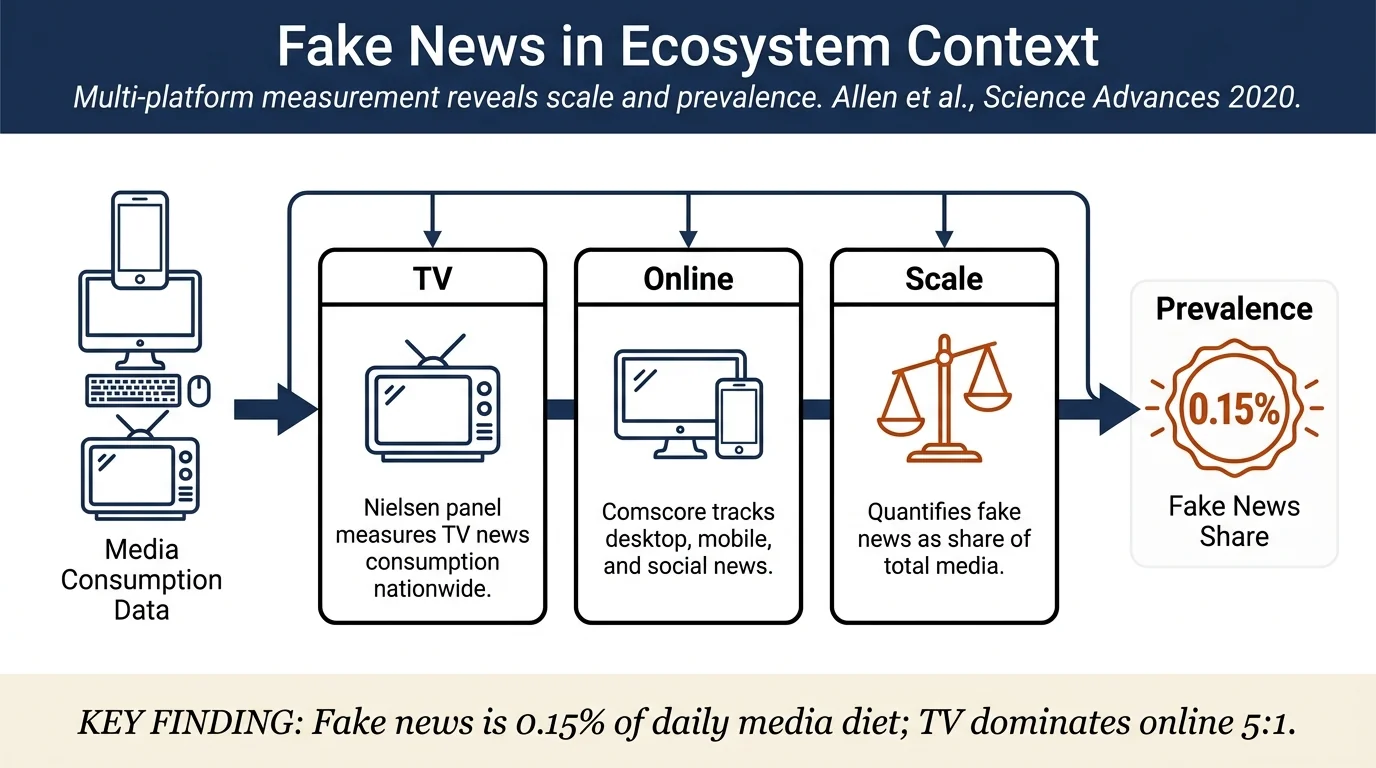
Using nationally representative data on mobile, desktop, and TV consumption spanning 2016–2018, the authors show that fake news comprises only 0.15% of Americans' daily media diet, while TV dominates news consumption by a 5:1 ratio over online. The paper challenges the widespread narrative of fake news as a pervasive crisis and suggests that public misinformation may stem more from ordinary news bias or news avoidance than from overt fabrication.
Contributions
- Multimode measurement framework: Integrated TV (Nielsen panel), desktop/mobile (Comscore), and web traffic data to measure consumption across all major platforms.
- Scale context: Quantified fake news as a fraction of total media consumption, not just as a share of news — revealing its negligible overall impact.
- Age-stratified analysis: Demonstrated that even older Americans (primary consumers of fake news) spend less than a minute per day on fake news.
- TV-online comparison: Documented the 5:1 ratio of TV to online news consumption, overturning assumptions centered on social media as the locus of misinformation.
Method
The study combined three nationally representative data sources:
- TV consumption: Nielsen's panel of ~100,000 households measured time spent on ~400 Nielsen-classified news programs, including hard news, magazine shows, morning shows, and late-night comedy.
- Online consumption: Comscore's desktop/mobile panel tracked time on >800 news websites and measured passive exposure via social media referrals (Facebook, Twitter, Reddit, YouTube) and search engines (Google, Bing, Yahoo).
- Fake news classification: 98 fake news domains identified by researchers, fact-checkers, and journalists; YouTube handled separately via internal classification of sampled videos.
- Coverage: 36 months of data (January 2016–December 2018), enabling tracking around key events (2016 election, 2017 inauguration).
Fake news was defined broadly to include hyperpartisan sites (e.g., Breitbart) alongside outright fraudulent domains; news was classified at the publisher/URL level (except YouTube, classified by video topic).
Results
Overall consumption patterns: - Americans spend ~7.5 hours (460 min) per day on media; ~86% is non-news. - Of news consumption, TV dominates: 54 min/day (TV) vs. 9.7 min/day (online) — a 5:1 ratio. - Ratio varies by age: 2:1 for 18–24-year-olds, 7:1 for 55+.
Fake news prevalence: - Fake news comprises 0.15% of total daily media diet. - No age group exceeds 1 minute/day average fake news consumption. - Fake news accounts for <1% of overall news consumption (TV + online combined). - Only 1.97% of desktop panelists consume more fake news than mainstream news; drops to 0.7% when restricted to ≥1 min/day consumers. - When excluding hyperpartisan sites, the proportion drops to 0.97% / 0.32%.
Online vs. TV breakdown: - Online news: 4.2% of total online consumption (including passive social media exposure). - TV news: 23% of total TV consumption, but TV dominates time allocation. - 44% of the population consumes zero online news on a given day; ~75% spend <30 seconds/day.
Connections
- Extends Guess et al. (2018) finding that online fake news exposure is rare, using ecosystem-wide measurement.
- Contextualized by Grinberg et al. (2019) on fake news on Twitter during 2016 election.
- Contrasts with media attention surge: ~2,210 publications with "fake news" in the title since 2017, vs. only 73 before 2016.
- Cited as evidence that misinformation concerns should broaden beyond fake news to include mainstream media bias and news avoidance, per Watts & Rothschild (2017).
Notes
Strengths: - Exceptional methodological rigor: integration of three independent, nationally representative datasets is rare and valuable. - Honest scope-setting: authors clearly define terms, discuss limitations (site-level classification, YouTube-only exception), and distinguish prevalence from impact. - Timing: 36-month window captures pre-, during, and post-2016 election behavior.
Limitations and caveats: - Impact unknown: The study measures prevalence, not impact per exposure. Fake news could still be disproportionately influential if it changes behavior more than mainstream news. - Offline content: Definitions of news and fake news are URL/publisher-based; misinformation spread as native social media posts or by mainstream outlets would be misclassified. - Subpopulation targeting: The analysis does not address whether fake news is concentrated on small, pivotal subpopulations in contested districts or demographics. - Broader misinformation: TV news bias, agenda-setting, and framing are acknowledged as potential sources of misinformation but are not quantified.
Impact and reception: This paper is frequently cited as empirical pushback against the "fake news crisis" narrative. Its main conclusion — that fake news is rare in absolute consumption — has shaped policy and research agendas to focus on mainstream media bias, news avoidance, and the conditional impact of misinformation rather than its raw prevalence. The work exemplifies the principle that scale matters: a numerator must be evaluated against its denominator.