Does Media Literacy Help Identification of Fake News? Information Literacy Helps, but Other Literacies Don't
Authors: S. Mo Jones-Jang, Tara Mortensen, Jingjing Liu
Venue: American Behavioral Scientist, Vol. 65(2):371–388, 2021 — DOI
TL;DR
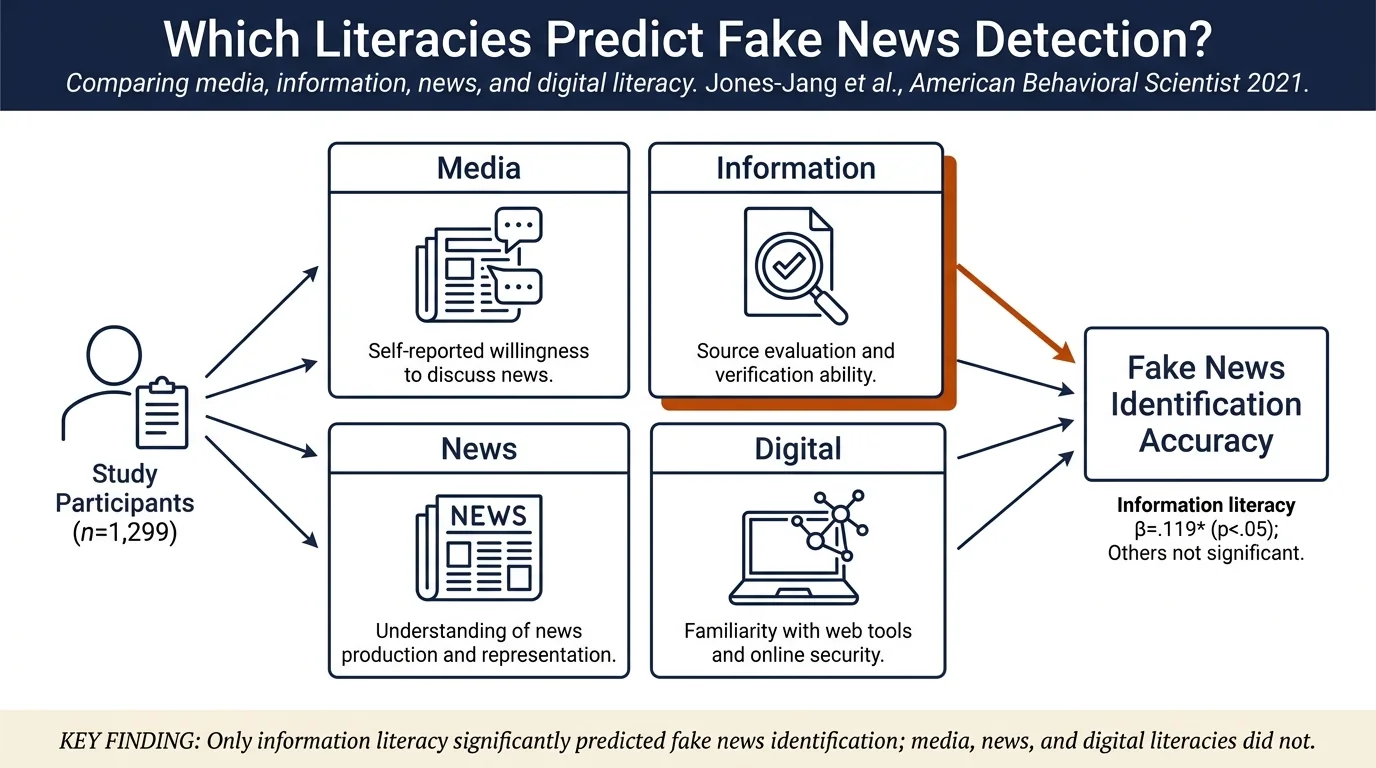
A survey of 1,299 U.S. citizens tests whether four types of media literacy—media, information, news, and digital—predict ability to identify fake news. Only information literacy (the ability to search and evaluate verified sources) significantly improves fake news identification; media, news, and digital literacies showed no significant relationship. This challenges the widespread assumption that general media literacy interventions will help citizens discern misinformation.
Contributions
- Provides empirical evidence on which literacy types correlate with fake news identification ability
- Distinguishes between four literacy constructs (media, information, news, digital) that are often conflated in policy discussion
- Shows that self-reported media literacy does not predict actual performance on fake news recognition tasks
- Raises methodological concerns about relying on self-reported literacy competencies rather than actual knowledge assessments
Method
Participants: 1,299 U.S. citizens surveyed online in March 2017 via Survey Sampling International (SSI), a demographically diverse panel. Sample: 83.3% White, 6.4% African American, 4.1% Asian, 3.8% Hispanic; median age 48.2; median income \(50,000–\)74,999; 51.2% female.
Literacy measures: - Media Literacy (4 items from Inan & Temur 2012): Self-reported willingness to exchange information about news with family/friends, contact organizations about media critiques. - Information Literacy (5 items from Boh Podgornik et al. 2016): Ability to identify verified sources, locate information in databases, and recognize opinion statements (multiple-choice questions with correct/incorrect answers). - News Literacy (6 items from Ashley et al. 2013): Understanding of news production, audience bias, representation, and reality; measured via Likert scale. - Digital Literacy (10 items from Hargittai & Hsieh 2011): Familiarity with web tools (PDF, phishing, Spyware, Wilds, Cache, Phishing, Tagging, PG, Weblog, Malware).
Fake news task: Respondents evaluated 10 news stories (5 fake, 5 real) related to the 2016 U.S. presidential election. Fake stories focused on topics that generated high Facebook engagement (e.g., "FBI Director Received Millions from Clinton Foundation"). Respondents indicated whether each story was fake or real. Overall accuracy: mean 6.35/10 (SD = 1.63).
Analysis: Hierarchical OLS regression predicting fake news identification. Models progressively added demographics (age, gender, education, income, political ideology), exposure to fake news, and literacy scales.
Results
In Model 3 (full model with all literacy measures):
- Information literacy was the only literacy significantly predicting fake news identification (β = .119, p < .05). Each additional point on the information literacy scale increased the predicted number of correctly identified fake news stories.
- Media literacy (β = −.057, not significant), News literacy (β = .023, not significant), and Digital literacy (β = −.037, not significant) did not significantly predict fake news identification.
- Demographics: Age (β = .244, p < .001) and political ideology (β = .190, p < .001; liberals more accurate) significantly predicted identification.
- Exposure to fake news was negatively associated with identification (β = −.060, p < .05), suggesting those who encounter more fake news online are less accurate at identifying it.
- Campaign interest was not a significant predictor.
- Model 3 R² = .139, indicating all variables combined explained ~14% of variance in fake news identification.
Connections
- Related to News literacy, social media behaviors, and skepticism toward information on via examination of news literacy's role in misinformation evaluation
- Extends Evaluating the fake news problem at the scale of the information ecosystem by focusing on individual competencies rather than ecosystem dynamics
- Complements Fact-Checking: A Meta-Analysis of What Works and for Whom in questioning intervention effectiveness; information literacy vs. fact-checking education
- Cited by work on Literacy interventions and media education policy
Notes
Strengths: - Clear distinction between literacy types, with actual knowledge assessment for information literacy (not just self-report) - Nationally representative sample from a diverse panel - Controlled for multiple confounders (demographics, political ideology, campaign interest, prior exposure) - Honest reporting of null findings for media, news, and digital literacy
Limitations: - Single temporal snapshot (March 2017); no longitudinal follow-up - Fake news context limited to 2016 U.S. election; unclear if findings generalize to other political contexts or domains - The study predates broad awareness of deepfakes and newer misinformation tactics - Information literacy measured via multiple-choice questions (actual knowledge), while media/news literacy measured via self-report; this methodological mismatch may partly explain the differential predictive power - Causality unclear: does information literacy help identify fake news, or are information-literate individuals more motivated to evaluate sources?
Policy implications: - Interventions targeting general "media literacy" may be insufficient; focusing on information-seeking and source evaluation skills is more promising - Self-reported media literacy competencies correlate poorly with actual fake news identification ability, suggesting the Dunning-Kruger effect may inflate perceived competence without improving actual performance - Fake news identification is a complex skill; improving it requires education specifically in information source evaluation, not just broader media understanding