Shared partisanship dramatically increases social tie formation in a Twitter field experiment
Authors: Mohsen Mosleh, Cameron Martel, Dean Eckles, David G. Rand Venue: Proceedings of the National Academy of Sciences, 2021 — DOI
TL;DR
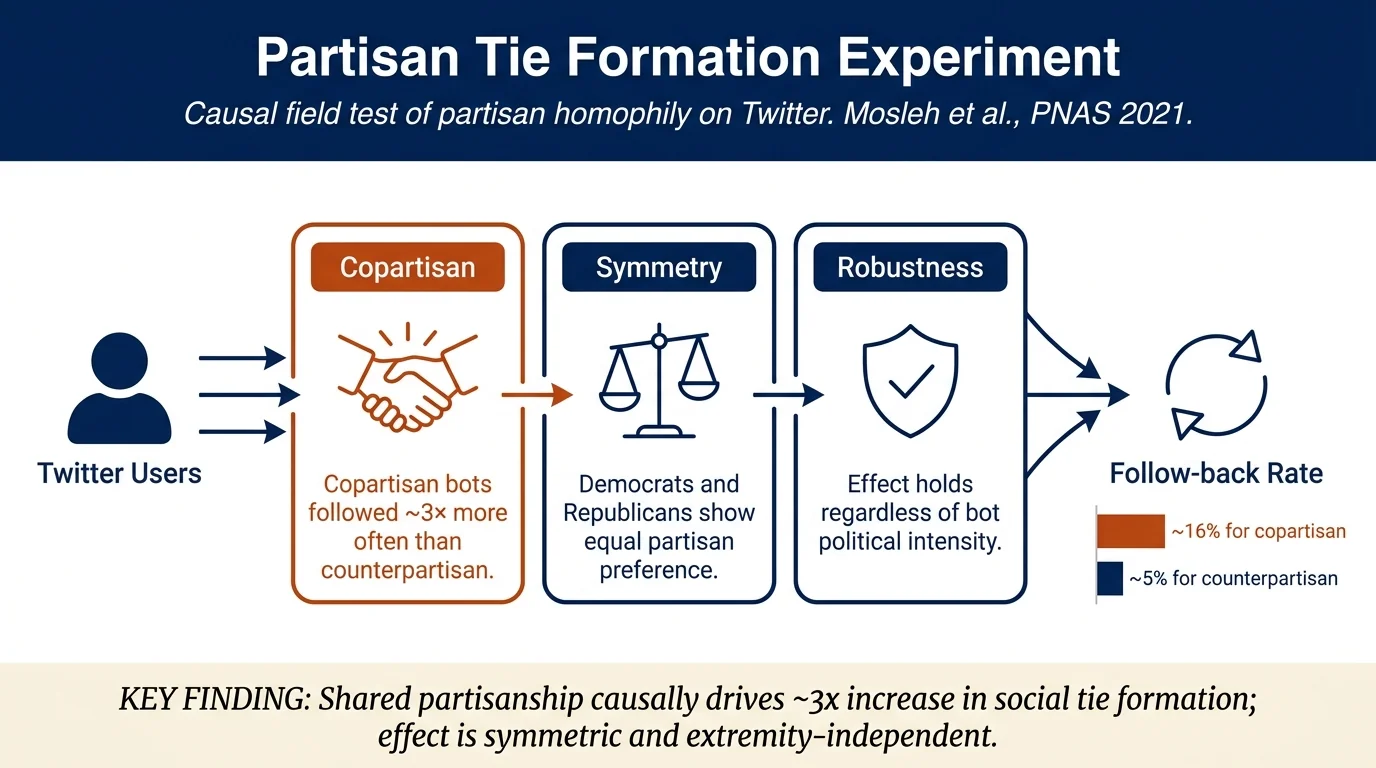
A Twitter field experiment with bot accounts reveals that shared partisanship causally drives social tie formation: users were nearly three times more likely to reciprocally follow accounts matching their political party, regardless of the account's partisan intensity. Critically, this preference was symmetric—Democrats and Republicans showed equal homophily, suggesting that partisan sorting on social media stems partly from intrinsic psychological biases rather than algorithmic curation or offline network structure alone.
Contributions
- Provides rare causal field evidence on partisanship's direct effect on social tie formation (vs. observational correlates confounded with demographics, geography, or algorithms)
- Demonstrates strong partisan preference: β = 0.093 [0.051, 0.135], t(840) = 4.381, p < 0.001; users ~3× more likely to follow copartisan bots
- Finds no significant partisan asymmetry: Democrats and Republicans equally prefer copartisans (interaction b = 0.012, p = 0.771), contradicting observational claims that conservatives are more homophilous
- Shows the effect holds regardless of bot's partisan intensity (no interaction between copartisanship and bot extremity, p = 0.465)
- Identifies partisan preference as an intrinsic driver of assortment, not merely a by-product of algorithms or preexisting offline network effects
Method
Experimental design: Created eight human-like bot accounts (two per condition) varying in: - Partisan identity: Republican vs. Democrat (signaled via presidential candidate preference and political hashtags) - Partisan extremity: Stronger (candidate name in profile, campaign background) vs. weaker (generic political stance, neutral city background)
Recruitment: Identified Twitter users who had retweeted MSNBC or Fox News, classified partisanship via media consumption patterns (absolute value of left- vs. right-leaning website sharing), and recruited n=842 politically balanced participants (46% Republican, 45% female, mean age 45.8 years, median 64.5 followers). Used stratified randomization (blocking on partisanship, extremity, followers, tweet frequency, reciprocity ratio) to assign users to bot conditions.
Bot credibility: Each bot account had ~1,000 politically neutral followers initially and retweeted 10 political tweets aligned with its ideology.
Outcome: Measured reciprocal follow-back within observation window. Study approved with waiver of informed consent (MIT Protocol 910465) and preregistered (aspredicted.org/ca3nm.pdf). Originally planned n=6,000 over 14 days but Twitter blocked accounts after 2 days (n=842).
Results
Primary finding: Linear probability model predicting user follow-back: - Copartisan effect: β = 0.093 [0.051, 0.135], t(840) = 4.381, p < 0.001 (Fisherian randomization inference PFRI < 0.001) - Interpretation: Copartisan bots followed by ~16% of users; counterpartisan by ~5%; 3× relative increase - No bot extremity effect: p = 0.754 - No copartisanship × bot extremity interaction: p = 0.465
Partisan symmetry: - No significant difference between Democrats and Republicans (interaction b = 0.012 [−0.071, 0.096], p = 0.771, PFRI = 0.784) - Contradicts prior observational work suggesting asymmetric homophily
Post hoc finding: Exploratory three-way interaction (copartisanship × bot extremity × user extremity, p = 0.051) suggests high-partisan users slightly more responsive to strong copartisan bots, though underpowered.
Connections
- Complements Cognitive reflection correlates with behavior on Twitter by examining a distinct mechanism for echo chamber formation (partisan vs. cognitive homophily)
- Builds on partisanship and social identity literature (Huddy et al. on expressive partisanship)
- Relates to observational work on Echo Chambers by mechanistically grounding assortment in intrinsic preference
- Extends homophily theory by showing preference operates even for complete strangers signaling only party membership
- Informs debates on Political polarization and ideological echo chambers by identifying individual-level drivers
Notes
Strengths: Rare causal field experiment in actual social media context (not lab simulation or dating site). Clear randomization and large effect size. Addresses major confounds plaguing observational work (age, geography, interests). Preregistered with transparent stopping rule. Symmetric finding across parties is policy-relevant and contradicts partisan-motivated theorizing.
Limitations: Sample restricted to politically active Twitter users (MSNBC/Fox retweeters)—not representative of Twitter generally or the US public. Bot accounts signaled partisanship via candidate preference; some copartisans may not support their nominee (possible underestimation of true effect). Twitter's account-blocking after 2 days (n=842 vs. planned n=6,000) reduced power. Cannot measure why users reciprocate (does partisan preference operate consciously or automatically?). Follow-back is low-cost; uncertain if effect translates to higher-stakes tie formation (conversation, endorsement, collaboration).
Follow-ups: Generalization to non-politically-active users and non-English contexts. Test higher-cost tie formation (replies, retweets, direct messages). Investigate psychological mechanism (explicit preference vs. automatic pattern matching). Examine whether algorithmic de-amplification of partisan homophily can counteract these intrinsic biases.