The psychological drivers of misinformation belief and its resistance to correction
Authors: Ullrich K. H. Ecker, Stephan Lewandowsky, John Cook, Philipp Schmid, Lisa M. Fazio, Nadia Brashier, Panayiota Kendeou, Emily K. Vraga, Michelle A. Amazeen
Venue: Nature Reviews Psychology, 2022 — DOI
TL;DR
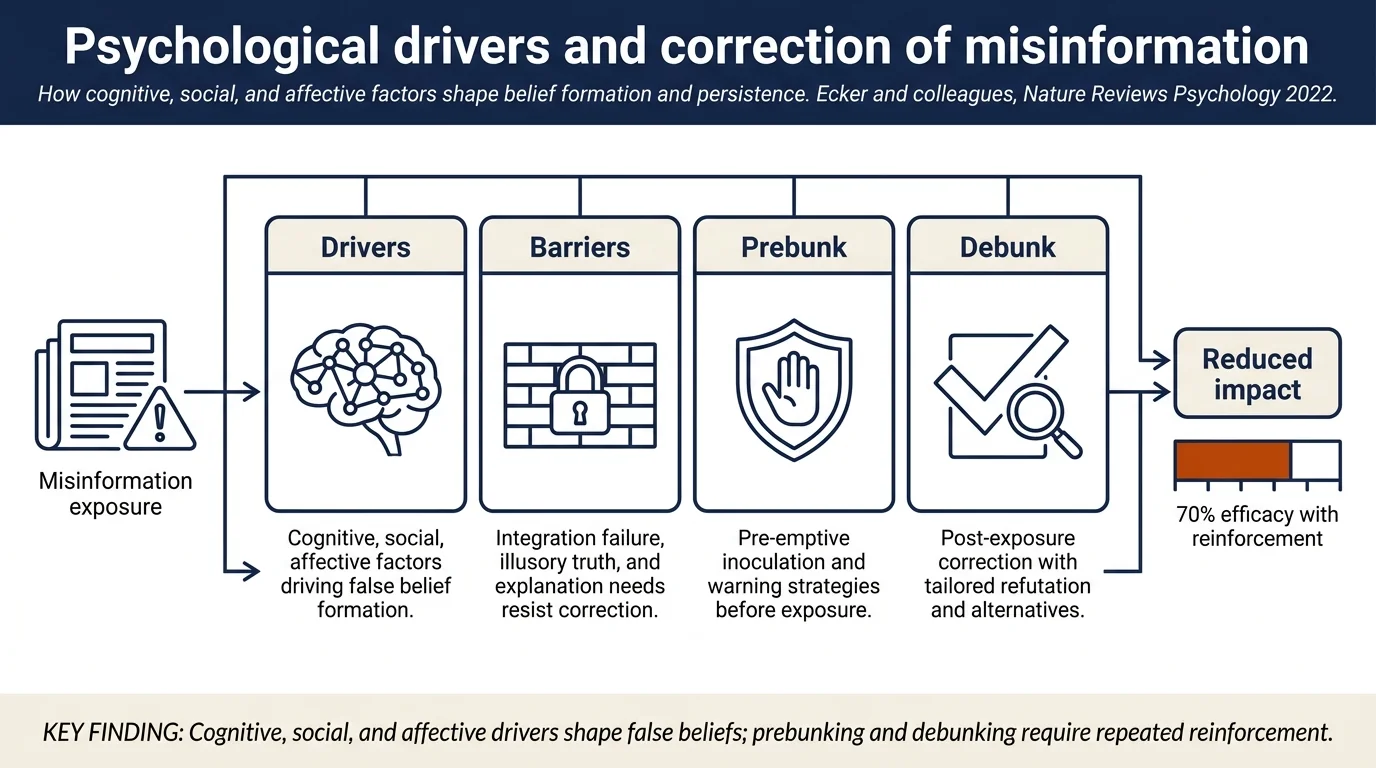
This comprehensive review establishes that misinformation's power lies not in exposure but in how cognitive, social, and affective factors shape belief formation and persist even after correction. False beliefs arise from intuitive thinking, memory failures, emotional content, in-group bias, and source credibility judgments; corrections often fail because integrated misinformation competes with the corrective fact in memory. Both prebunking (pre-emptive inoculation) and debunking (post-correction) interventions can reduce misinformation's impact, but effectiveness depends on tailoring strategies to specific barriers and maintaining repeated reinforcement.
Contributions
- Comprehensive framework of cognitive drivers (intuitive thinking, cognitive failures, illusory truth effect, fluency, source credibility) and socio-affective drivers (emotion, in-group identity, worldview-consistent reasoning) in false belief formation
- Analysis of the continued influence effect (CIE) — why misinformation influences reasoning even after correction — through dual-process mechanisms: integration account (correction fails to integrate with misinformation in memory) and selective-retrieval account (false information remains more accessible)
- Taxonomy of barriers to belief revision: need for causal explanation, failed integration or forgetting of corrections, and misinformation familiarity (illusory truth)
- Evidence-based intervention framework distinguishing pre-emptive corrections (prebunking via inoculation, warnings, generic refutation, specific counterarguments) from reactive corrections (debunking with fact, myth preface, plausible alternative explanations, fallacy identification, or multi-element approaches)
- Practical implications for information consumers, journalists, policymakers, and health communicators on designing correction strategies tailored to barrier type and misinformation domain
Method
The review synthesizes theoretical models and empirical evidence on how people form and maintain false beliefs. It structures psychological mechanisms into cognitive drivers (relying on heuristics and memory limitations), social drivers (source credibility, in-group trust, expert deference), and affective drivers (emotion, mood-dependent belief, identity threat perception).
The authors organize barriers to belief revision by identifying three core obstacles: individuals need causal explanations for events and resist corrections that leave them without one; corrections often fail to integrate with prior misinformation in memory or are quickly forgotten; and repeated exposure to misinformation increases its familiarity and perceived truth (illusory truth effect), making corrections less effective.
For interventions, the review distinguishes between pre-emptive strategies (prebunking) applied before misinformation exposure—including inoculation theory, warnings, generic refutation, and specific counterarguments—and reactive strategies (debunking) deployed after exposure, ranging from simple fact statements to multi-element approaches combining myth preface, alternative explanations, and logical fallacy identification.
Results
The review identifies multiple pathways to false belief formation: cognitive (intuitive thinking dominates over deliberation, memory failures, illusory truth from repetition, source confusion), social (in-group identity influences belief acceptance, expert and peer consensus shapes judgments, media outlet credibility affects information acceptance), and affective (emotional content spreads more readily, emotion drives belief in misinformation, mood-state influences belief revision receptiveness).
Regarding correction resistance, the continued influence effect is robust: misinformation shapes reasoning even after explicit correction. Two competing accounts explain this: corrections fail to become integrated with the misinformation already encoded in memory, or the original false information remains more cognitively accessible than the later correction. Empirical evidence supports both mechanisms operating in different contexts.
For interventions, prebunking (inoculation) has shown promise: pre-exposing people to weakened forms of misleading arguments and explaining their persuasion techniques can build resistance to later misinformation. Debunking effectiveness varies by design: simple corrections are less effective than detailed refutations paired with plausible alternative explanations; myth preface (warning that a statement is false) helps; multimodal approaches (combining fact, alternative causality, and fallacy explanation) outperform single-element corrections. However, no intervention eliminates false beliefs entirely, and effects often require repetition to sustain.
Connections
- Related to motivated reasoning and political bias in shaping belief resistance to correction
- Connected to COVID-19 misinformation as a major applied domain testing these frameworks
- Informs terminology and conceptual frameworks for distinguishing misinformation, disinformation, and propaganda by psychological mechanisms
- Theoretical foundation for misinformation spread and diffusion at the individual level (complements network-level and algorithmic studies)
- Bridging cognitive science with fake news detection — understanding why automated fact-checkers alone cannot eliminate misinformation's influence
- Related to media manipulation via understanding emotional and identity-based appeal mechanisms
- Connected to social media and misinformation via discussion of platform algorithms amplifying emotional content and source credibility cues
Notes
Strengths: Integrates decades of psychological research into a coherent, evidence-based framework. Avoids the temptation to treat misinformation as a unitary phenomenon; instead recognizes that different types (scientific consensus denial, health misinformation, geopolitical conspiracy) activate different belief drivers. The distinction between pre-emptive and reactive interventions is practically useful. Honest about the limits of current methods (small-scale lab studies, limited longitudinal evidence, participant pools often US-based and non-representative).
Weaknesses: Relies heavily on self-report and lab-based measures; real-world behavioral effects of interventions remain understudied. The paper notes that research on subtle misinformation types (deepfakes, coordinated inauthentic behavior, social media algorithmic amplification) is limited. Cross-cultural validation of psychological mechanisms is sparse. The review does not deeply engage with computational approaches to misinformation or the role of algorithmic systems in amplifying belief-driven sharing.
Follow-ups: The field needs longitudinal studies tracking correction effectiveness over weeks/months to establish durability. Research on network-level effects (how one person's belief correction spreads through social ties) is needed. Investigation of how AI-generated misinformation and synthetic media interact with these psychological mechanisms is urgent.