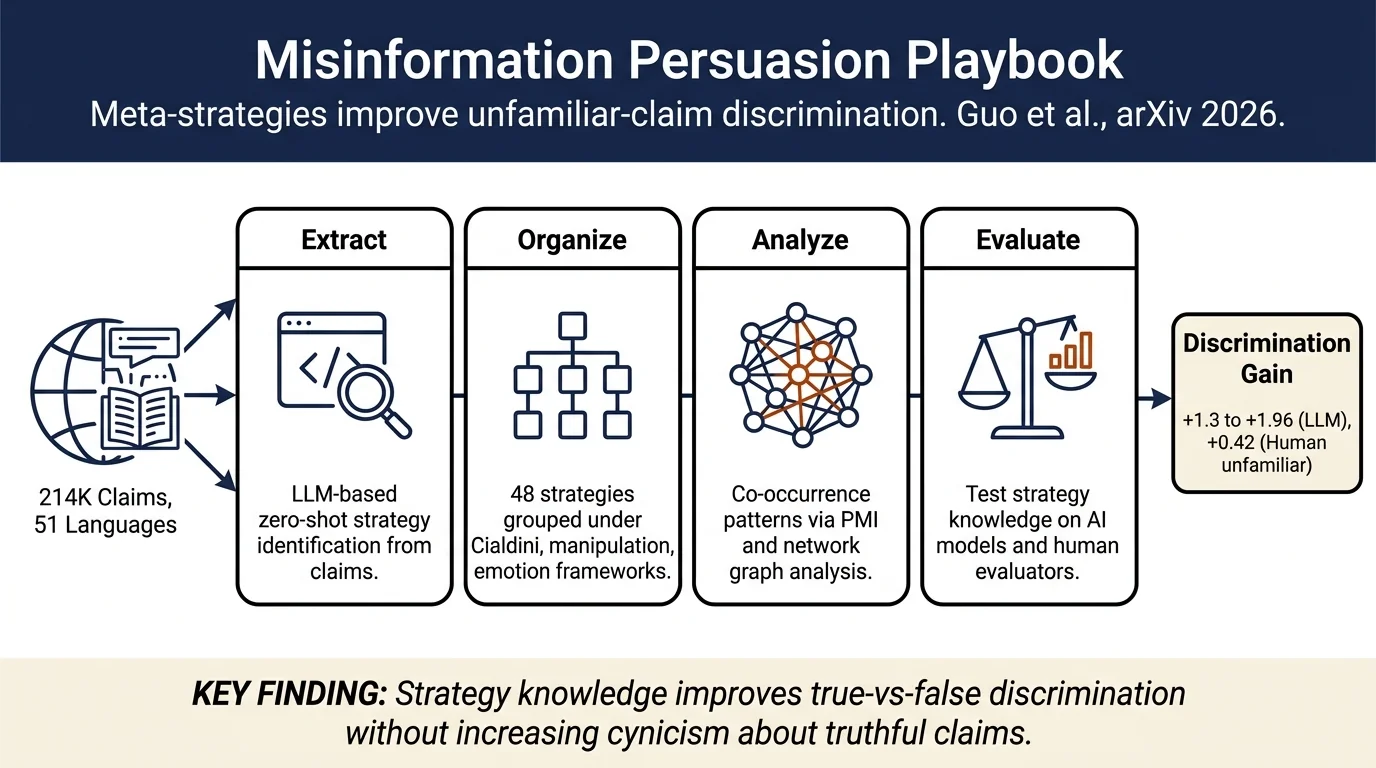
A misinformation playbook sharpens judgement without breeding cynicism
Authors: Tong Guo, Teng Ye, Yutong Xie, Qiaozhu Mei Venue: arXiv cs.SI, October 2026 — arXiv
TL;DR
This paper analyzes 214,646 fact-checked claims across 51 languages to map misinformation's persuasion playbook—48 recurring strategies organized under social influence, information manipulation, and emotional appeal. Rather than flagging specific false claims, teaching these meta-strategies improves how both AI models and humans judge unfamiliar claims without increasing cynicism about true ones. Strategy knowledge is most effective when evaluators lack factual basis for judgment.
Contributions
- Empirically derived taxonomy of 48 persuasion strategies from multilingual fact-checked claims (214,646 claims in 51 languages)
- Demonstrated that persuasion strategies recur consistently across topics, languages, and time
- Showed strategy knowledge improves AI and human discrimination between true and false claims on unfamiliar topics
- Tested the playbook's defensive and offensive properties: strategy-guided prompting makes AI-generated false claims more convincing
- Provided evidence that inoculation against persuasion techniques need not wait for claim-specific fact-checks
Method
The authors drew on the ClaimReview database (Duke Reporters' Lab), filtering to 214,646 claims with effective fact-check dates between January 2019 and April 2024 across 51 languages and 236 non-partisan fact-checking organizations.
Strategy identification: GPT-4o performed zero-shot inductive coding to extract persuasion tactics from each claim in its original language. Researchers then consolidated the resulting 28,000 distinct codes into 48 strategies through grounded-theory coding, organized under three theoretical frameworks: Cialdini's principles of social influence (Authority, Commitment & Consistency, Liking, Scarcity, Social Proof, Unity; 6 strategies), information-manipulation mechanisms (Hiding Information, Manipulating Information, Fabricating Information; 3 strategies), and affective/emotional strategies (Emotional Appeal, Appeal to Fear, Vivid Imagery, Conspiracy Theory; 4 strategies). The remaining strategies fall under "other rhetorical tactics."
Co-occurrence patterns: The authors computed pairwise pointwise mutual information (PMI) for each strategy pair, comparing observed co-occurrence against a maximum-entropy baseline that holds each claim's strategy count and each strategy's prevalence fixed. Network analysis revealed a tight core of Conspiracy Theory, Fabricating Information, Appeal to Fear, Manipulate Information, and Commitment & Consistency, plus auxiliary strategies that appear together more or less often than expected by chance.
Results
Language and topic generality: The core persuasion playbook persists across 15 languages with at least 3,000 claims; strategy co-occurrence networks remain similar (median r = 0.83). Within-language variation—e.g., Emotional Appeal at 62% of English claims vs. 60% of Spanish ones—shows language differences, but the overall architecture holds.
LLM evaluator experiments: Two language models (GPT-4o-mini and Gemini 2.5 Flash) were briefed under five conditions: no briefing (C0), decoupling only (C0b, instructing the model to treat persuasion strategy as non-proof of falsity), accuracy prompt (C1), strategy knowledge (C2), and full briefing (C3, C2 + decoupling instruction). Without briefing, the model rated true claims 0.77 points more believable than false ones on a 1–7 scale. Strategy knowledge widened this gap by 1.29 points (GPT-4o-mini) and 1.96 points (Gemini 2.5 Flash), with largest gains on claims where the model reported no factual basis or only general topical knowledge.
Human prebunking experiment: 749 US adults were randomly assigned to one of five briefing conditions matching the LLM experiment. Participants rated 20 claims (7 true, 13 false) on believability. Strategy briefing did not improve average human discernment significantly (discriminment gap +0.23 points, not statistically significant overall), but subgroup analysis showed gains for unfamiliar claims (+0.42 on claims participants rated as unfamiliar) and no evidence of increased cynicism about true claims. Importantly, the full briefing lowered belief in false claims (–0.23, p = .042) without affecting belief in true claims (no significant change).
Adversarial stress test: The authors generated 2,000 AI-created false claims about post-training-cutoff events under five generation conditions (A1–A5) ranging from zero-shot to guidance from corpus-wide strategy co-occurrence patterns. Strategy knowledge made these false claims more believable to AI evaluators, raising mean believability from 2.68 (zero-shot) to 2.94 (with strategy guidance), though they remained less believable than fact-checked false claims (~3.13).
Connections
- Related to Prebunking and inoculation against misinformation via empirically derived, generalizable persuasion techniques
- Related to Propaganda detection and Persuasion tactics: provides fine-grained taxonomy spanning multiple frameworks
- Extends inoculation theory research by testing meta-strategy knowledge rather than specific claim corrections
- Cited in context of Fact-checking interventions and LLM-Generated Misinformation
- Complements refutation approaches by targeting persuasion mechanics
Notes
Strengths: The empirical derivation of the playbook from 214,646 multilingual, professionally fact-checked claims grounds the taxonomy in real misinformation rather than researcher speculation. The combination of computational strategy recovery (LLM-assisted coding), network analysis of co-occurrence, and experimental validation (both LLM and human prebunking) is thorough. The paper avoids overstating the human effect: the average gain was small and non-significant, but the per-subgroup analysis (unfamiliar claims, low baseline discernment) is honest about where the intervention helps most.
Limitations: Human dropout was higher in the strategy-briefing conditions (15% vs. 8% in the decoupling-only condition), which may bias the human results toward more-motivated participants. All false claims in the human experiment were AI-generated, and while they match fact-checked claims in length, whether the effect generalizes to human-authored misinformation is open. The paper does not isolate causal effects of individual persuasion strategies on belief or sharing. Follow-up work should test longer-term retention, naturalistic social contexts, and cross-cultural boundaries of the playbook.
Impact for the field: This work bridges misinformation detection and psychological inoculation: the playbook is a concrete, empirically-grounded alternative to wait-and-check fact-checking for fast-moving claims. The finding that strategy knowledge helps most when factual knowledge is lacking suggests a complementary role for prebunking and fact-checking rather than replacement. The multilingual evidence (15 languages) strengthens claims about generality.