Right-Wing YouTube: A Supply and Demand Perspective
Authors: Kevin Munger, Joseph Phillips Venue: The International Journal of Press/Politics, 2022, Vol. 27(1), pp. 186–219 — DOI
TL;DR
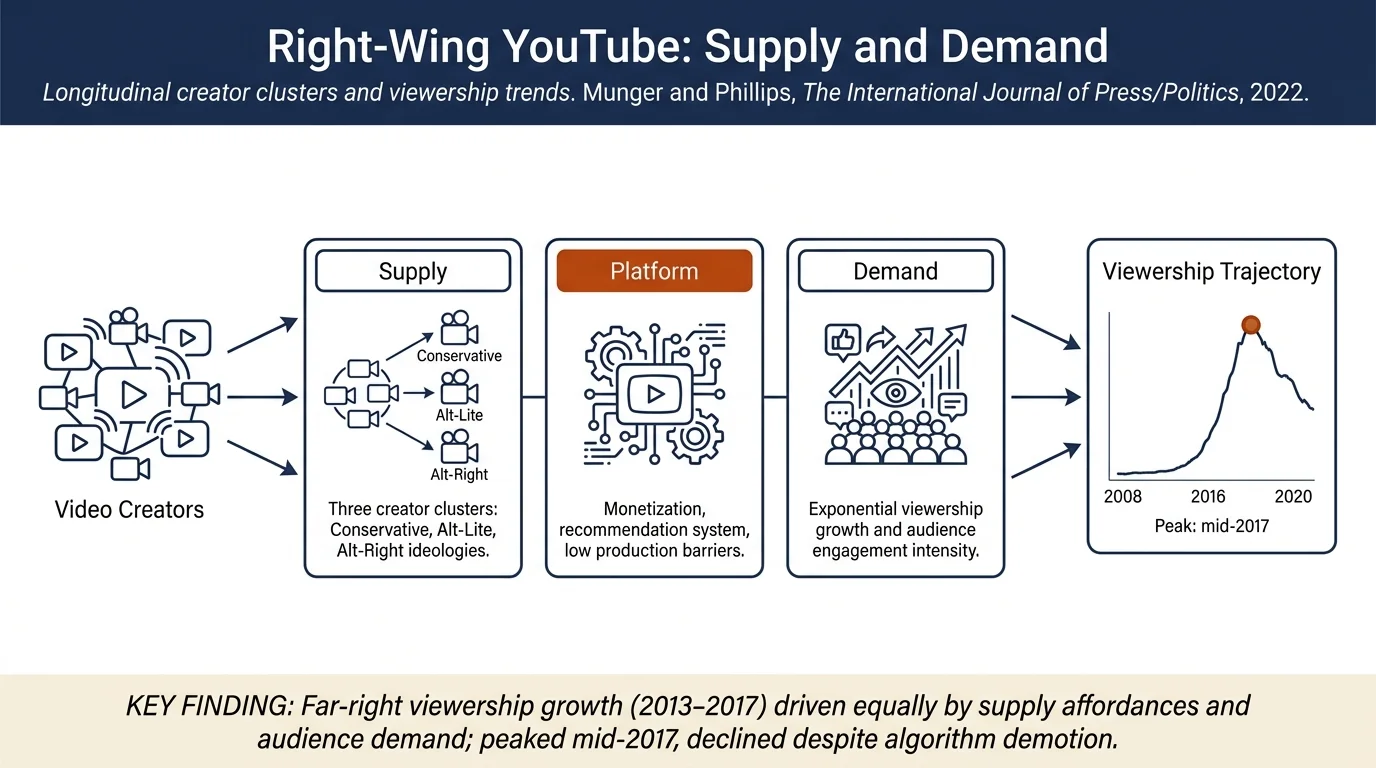
YouTube has become the dominant platform for right-wing political content in the US, driven by supply-side affordances (low creation barriers, monetization, algorithmic recommendation) and demand-side audience appetite for alternative media. Using longitudinal analysis of creator clusters (Conservative, Alt-Lite, Alt-Right), the authors show viewership of far-right content peaked in 2017 and has declined since. The paper reframes the "radicalization by algorithm" debate as a supply-and-demand problem: creators and audiences co-evolved with YouTube's features to fill a media ecosystem gap.
Contributions
- Supply-and-demand framework for analyzing political content proliferation on social platforms
- Longitudinal platform analysis from 2008–2018+ comparing far-right (35 channels, 26K+ videos) and mainstream media (219 channels, 821K videos)
- Creator clustering into three ideological groups (Conservative, Alt-Lite, Alt-Right) with distinct positioning, rhetoric, and mainstream connections
- Quantitative evidence that far-right viewership peaked in 2017 and declined despite claims of algorithmic amplification
- Methodological contribution: empirical measurement of "Alternative Influence Network" concept; demonstrates platform affordances create distinct creator and audience incentives
Method
The paper employs mixed methods:
Creator identification & clustering: The authors identified 35 far-right YouTube channels using prior work by Rebecca Lewis (2018) on the Alternative Influence Network (AIN). They snowball-sampled frequent guests and comment networks to expand the dataset. Manual coding of video content and creator statements yielded three clusters:
- Conservative: Free-market advocates (Ben Shapiro, Steven Crowder, Lauren Southern); strong legacy media connections (Fox News, Daily Wire); emphasis on "free speech" over explicit racial narratives.
- Alt-Lite: Transgressive progressivism (Andy Warski, Stefan Molyneux); reject mainstream legitimacy; distance themselves from explicit racism but share white-nationalist audiences; moderate on economics.
- Alt-Right: Explicitly white-nationalist, anti-Semitic, pro-ethnostate (Richard Spencer, identity-focused creators); reject conservatism as insufficiently radical; smallest audience reach.
Content & viewership timelines: Using the YouTube API, they collected metadata on all videos (title, upload date, view counts, engagement metrics) from 35 far-right channels and 219 mainstream media (MSM) channels (Jan 2008–Oct 2018, with May 2020 update). They plotted monthly upload volume and cumulative viewership by cluster and by search results.
Search visibility analysis: They queried the YouTube API for top-100 results on generic terms (economy, news, politics) and niche topics (feminism, white genocide, social justice) from Jan 2008–Oct 2018, measuring the monthly rank of far-right vs. MSM videos. This captures both algorithmic recommendation and user search behavior.
Engagement intensity: Using comments-to-views ratios, they measured whether audiences engaged more intensely with far-right creators, finding Alt-Lite and Alt-Right audiences showed higher comment rates in 2018 despite lower viewership.
Results
Supply side (creator activity):
- Far-right creators showed dramatic growth in video production: roughly flat 2008–2012, slow growth 2013–2016, explosive increase 2016–2017, plateau/decline after 2017 despite YouTube's algorithm change demotion efforts (Jan 2019).
- Conservative creators generated 60–70% of far-right viewership; Alt-Lite grew to 20–30% by 2018; Alt-Right remained <10%.
- Monetary incentives (partner program revenue, Patreon, alternative platforms) enabled full-time careers for far-right creators, reducing production costs relative to traditional broadcast media.
- Conservative creators sustained viewership into 2018–2019; Alt-Lite and Alt-Right declined.
Demand side (audience behavior):
- Cumulative viewership of far-right videos grew exponentially 2013–2017, with Conservative channels reaching 400M+ views/month by mid-2018, Alt-Lite 200M+. By May 2020, Conservative channels approached 1B views/month.
- Far-right videos ranked highly in niche-topic searches (feminism, white genocide, social justice) but rarely in mainstream topic searches (economy, news, politics), showing algorithmic clustering rather than broad mainstream penetration.
- Engagement intensity (comments/views) increased for Alt-Lite and Alt-Right after 2016, suggesting more invested, activist audiences despite smaller total viewership.
- Mainstream media continued to dominate absolute viewership; the far-right's growth was rapid but from a smaller base.
Structural findings:
- Monetization asymmetry: YouTube's algorithm and partner program incentivized content creation; the cost of producing one hour of political YouTube video is ~one hour of labor (compared to traditional broadcast requiring crews). This efficiency advantage benefited all creators but particularly empowered independent and fringe voices.
- Audience composition: Older (65+), more politically engaged, rural, and male audiences are overrepresented in far-right viewership, consistent with traditional conservative media consumption.
- Cross-platform coordination: Far-right creators used subreddits, Discord servers, Patreon, and alternative platforms (BitChute, Rumble) to build parallel media ecosystems, reducing dependence on YouTube alone.
Connections
- Related to Linvill & Warren (2020) — structured analysis of coordinated actor networks; here applied to creator ecosystems rather than bot networks.
- Related to Cinelli et al. (2021) — examines how platform architecture (YouTube's recommendation system, search rankings) creates segregated information ecosystems.
- Related to Bail et al. (2018) — inverse analysis: while exposure to opposing views can increase polarization, YouTube's clustering of far-right content creates spaces where opposing views are rare.
- Cited by subsequent work on algorithmic radicalization (e.g., reports on YouTube's role in January 6th disinformation); foundational for understanding creator-audience co-evolution rather than unidirectional algorithm causality.
- Contrasts with Grinberg et al. (2019) — Twitter shows different audience demographics (younger, more urban, more cross-ideological mixing); YouTube concentrates homogeneous, engaged audiences.
Notes
Strengths:
- First large-scale systematic analysis of far-right YouTube creators; moves beyond anecdotal "algorithm radicalization" narratives.
- Careful ideological classification (Conservative vs. Alt-Lite vs. Alt-Right) reveals granularity that blanket "far-right" framings obscure; the largest far-right viewership is Conservative (mainstream adjacent), not explicitly white-nationalist.
- Longitudinal view (2008–2018+) shows explosive growth (2016–2017) coinciding with political events (Trump election, rise of explicit white-nationalist rhetoric) rather than algorithm changes, suggesting demand-side drivers.
- Supply-and-demand framing rebalances discussions of "algorithm amplification"; YouTube's affordances (low creation costs, monetization, recommendation) matter, but audience appetite is equally causal.
- Empirical measurement of May 2020 update acknowledges YouTube's algorithm changes and shows mixed results: far-right viewership concentrated among remaining channels but did not disappear, and Conservative creators adapted quickly.
Limitations:
- Viewership estimates rely on API-retrieved view counts, which may lag or be subject to YouTube's post-hoc corrections; engagement (comments) may reflect bot activity or polarized superfans rather than typical audience experience.
- Creator clustering is manual and partly subjective; boundary between Alt-Lite and Alt-Right (explicit anti-Semitism and white nationalism) is blurry in practice.
- Does not measure individual exposure or radicalization; shows aggregate viewership trends but cannot causally link YouTube consumption to radicalization or political behavior.
- Alternative explanation underexplored: viewership decline post-2017 may reflect audience migration to other platforms (TikTok, Rumble, Facebook Groups, Telegram) rather than reduced demand for far-right content.
- No analysis of how mainstream media (Fox News, Daily Wire) are integrated into the far-right ecosystem; treats Conservative creators as quasi-mainstream when they are clearly part of ideologically captured media.
Follow-ups:
- Individual-level analysis: link viewer behavior (recommendations, watch history) to downstream political attitudes or actions.
- Cross-platform tracking: map creator and audience movement post-2018 to Discord, Telegram, Rumble, TikTok.
- Algorithmic mechanism: whitebox analysis of YouTube's recommendation algorithm or counterfactual testing of how algorithm changes affect visibility.
- Pre-2008 baseline: how did the emergence of YouTube itself create affordances for right-wing media relative to pre-social-media era?