A Multi-Branch Feature Fusion Approach for Health Misinformation Detection and Propagation
Authors: Mikululi Sikosana, Sean Maudsley-Barton, Oluwaseun Ajao Venue: IEEE Access, 2026 — arXiv:2609.00403
TL;DR
The paper presents a multi-branch fusion framework for detecting and characterizing health misinformation on social media, grounded in psychological theories (Elaboration Likelihood Model and Theory of Planned Behaviour). The model fuses transformer embeddings with rhetorical, stance, and theory-motivated linguistic features in a unified multi-task architecture, achieving ROC-AUC of 0.9999 on COVID-19 data and introducing the Cognitive Propagation Score—an interpretable, engagement-independent auxiliary metric for predicting misinformation spread.
Contributions
- Multi-branch neural architecture combining semantic embeddings (DistilBERT), rhetorical features, stance representations, and psychologically grounded linguistic proxies for ELM and TPB constructs
- Operationalization of ELM and TPB into explicit, text-derived features capturing central-route processing (argument complexity, emotional intensity), peripheral-route cues (heuristic punctuation, lexical markers), attitude-aligned tone, subjective norms, and perceived behavioural control
- Cognitive Propagation Score (CPS): An engagement-independent, interpretable post-hoc score designed to rank and prioritize misinformation when engagement metadata is incomplete or unavailable
- Comprehensive evaluation on three benchmark datasets (COVID-19-FNIR, Constraint, Monkeypox) demonstrating strong classification performance (ROC-AUC 0.9999 on COVID-19-FNIR) and near-perfect ranking agreement on propagation when engagement labels are available
Method
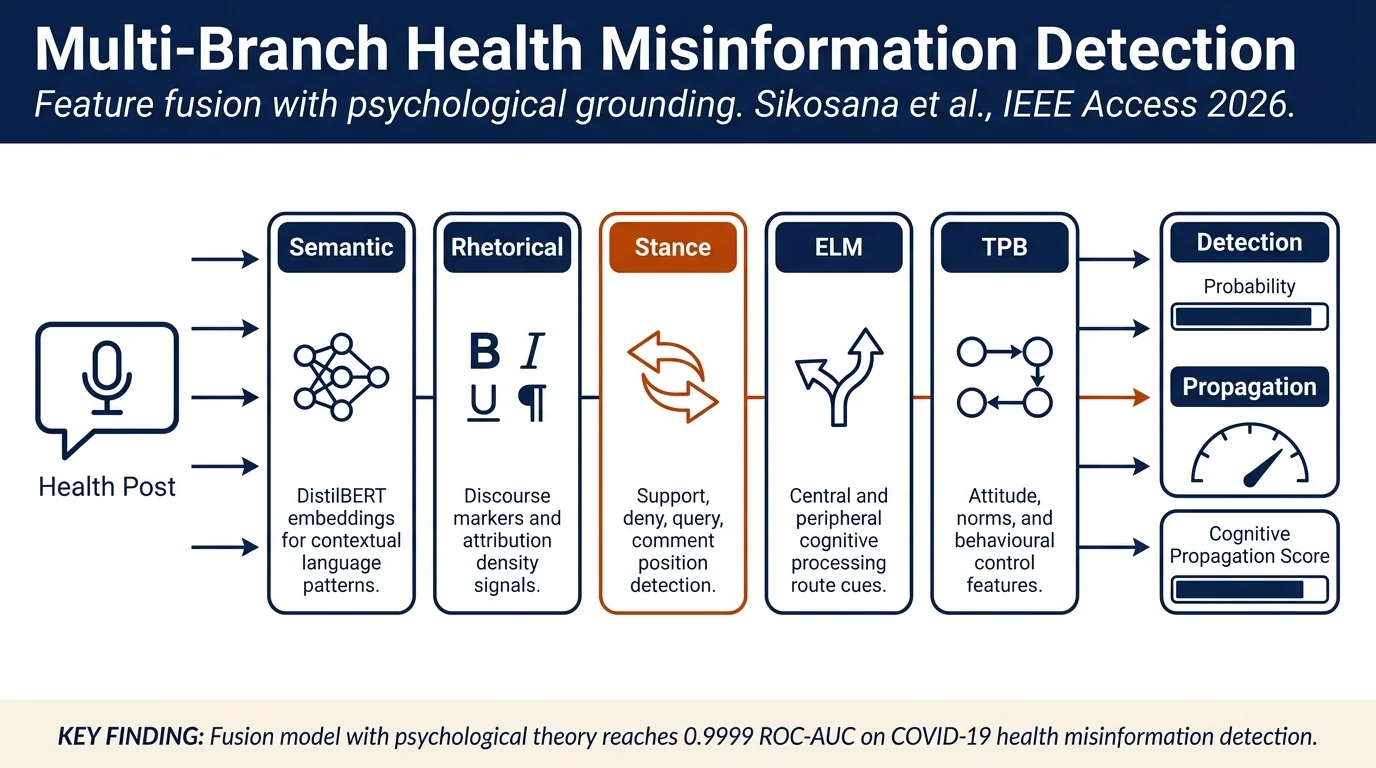
The framework integrates five feature branches into a unified multi-task architecture:
Semantic Branch — Posts encoded as 768-dimensional DistilBERT embeddings, capturing contextual language patterns. This serves as the foundational semantic understanding layer.
Rhetorical Features — Four discourse-level cues: discourse-marker density (normalized counts of connectives like "according to," "source," "because," "however"), attribution-marker density (citations and URLs), elaboration-marker density (causal and contrast connectives), and clickbait/sensational-cue index (proportion of sensational terms). These capture stylistic persuasion strategies.
Stance Branch — Four-way stance representation over {support, deny, query, comment}, encoding the author's attitudinal position towards health claims.
ELM Features — Ten features operationalizing central and peripheral processing routes. Central-route features include Flesch-Kincaid Grade Level (readability), Type-Token Ratio (lexical diversity), Mean Sentiment Polarity, and Token/Sentence counts. Peripheral-route features capture emotional intensity via adjective count, exclamation/question/uppercase ratios, and heuristic appeal through punctuation and character markers.
TPB Features — Nine features encoding three TPB constructs: Attitude (mean sentiment polarity, lexical valence, modal strength), Subjective Norms (group-pronoun ratio, retweet/mention counts, social-comparison cues), and Perceived Behavioural Control (certainty cues like "definitely"/"surely," instructional language like "click here"/"share this," directive hashtags like #WakeUp/#JoinUs).
All features are min-max scaled independently. The fused representation passes through a dense transformer layer with learned output heads for: (1) binary misinformation detection and (2) propagation estimation (regression). The Cognitive Propagation Score is computed post-hoc from selected raw features (Flesch-Kincaid Grade Level, adjective count, sentiment score, punctuation/character length) using fixed coefficients, independent of the shared hidden representation.
Results
- COVID-19-FNIR dataset: ROC-AUC = 0.9999, F1 and other metrics near-perfect; significantly outperforms transformer-only (DistilBERT) and SVM baselines
- Constraint dataset: Strong classification performance; linguistic-feature SVM baseline achieves ~96.7% F1, fusion model improves further
- Monkeypox dataset: Achieves consistent high accuracy; propagation regression target derived from observed engagement (retweets, likes, replies)
- Ablation analysis: Removal of psychological (ELM/TPB) branches reduces performance by measurable margins, confirming theoretical contributions are complementary to semantic embeddings
- Propagation-oriented ranking: When engagement metadata is available (Monkeypox), ranking by propagation labels achieves near-perfect Spearman's ρ correlation; CPS transfer to datasets without native engagement (Constraint, COVID-19-FNIR) provides ordinal proxies for diffusion propensity
- Cross-dataset generalization: Feature definitions, extraction order, and min-max scaling parameters are frozen after Monkeypox training; transferred scores remain rank-preserving across domains despite differing engagement characteristics
Connections
- Extends Psychological Theory by operationalizing ELM and TPB as learned feature proxies rather than self-report surveys
- Related to Stance Detection approaches; integrates stance as a feature branch within unified architecture
- Builds on Fake content detection work by combining transformer embeddings with interpretable linguistic signals
- Complements research on Health misinformation datasets and benchmarks; COVID-19-FNIR and Constraint are standard evaluation resources
- Related to Propagation Analysis by providing an engagement-independent scoring mechanism for ranked prioritization
Notes
Strengths: The paper makes a principled effort to ground detection in psychological theory, operationalizing ELM and TPB constructs as computable linguistic features. This theoretical grounding improves interpretability compared to end-to-end neural models. The introduction of CPS as an engagement-independent auxiliary score is pragmatically motivated (many platforms restrict access to engagement metadata) and elegantly designed. Experimental results are strong across three datasets, and the multi-branch design allows for clear ablation analysis.
Limitations: The paper relies on self-reported tone and rhetorical patterns as proxies for psychological constructs rather than direct behavioral measures. The CPS transfer experiment (applying Monkeypox-trained coefficients to Constraint and COVID-19-FNIR without retraining) is limited by domain differences in engagement distribution and user behavior. The lack of fine-grained error analysis makes it unclear whether the model struggles with specific categories of health claims (e.g., vaccine vs. treatment misinformation). Cross-lingual generalization is not explored; all experiments use English-language social media.
Future directions: The authors suggest validating CPS against human-centred diffusion judgements and exploring continual model updating as new health misinformation campaigns emerge. Integration with real-world platform moderation pipelines and deployment considerations (latency, resource constraints) are mentioned as future work but remain unexamined.