Fear Doesn't Go Viral, It Lingers: Spread, Affect, and Discourse of Food-Fear Content on TikTok
Authors: Hunjun Shin, Hongpeng Fu, Divya Chaudhary, Mohit Singhal
Venue: The Web Conference (WWW) 2027, May 10–14, 2027, Dublin, Ireland
TL;DR
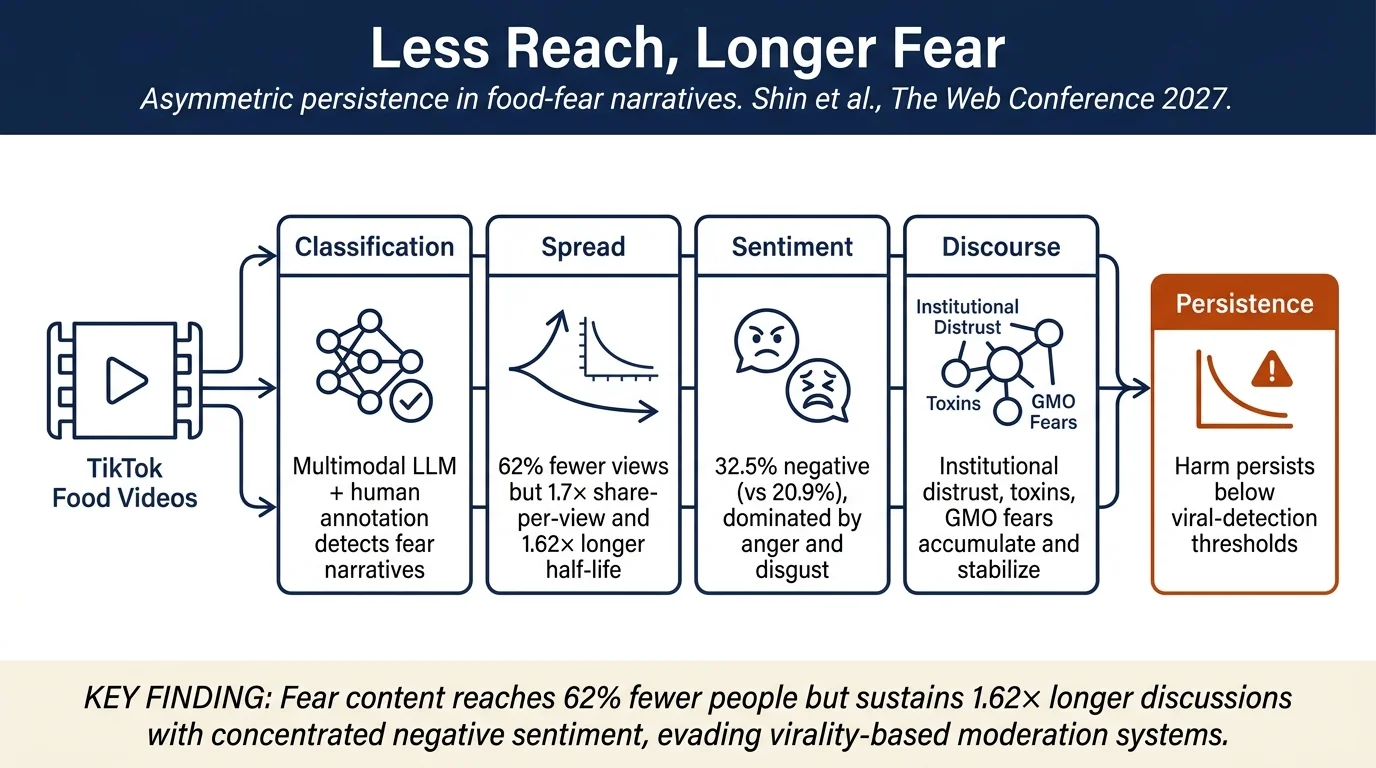
Fear-based content about food on TikTok reaches fewer people than non-fear nutrition videos but sustains engagement and discussion far longer. Fear videos trigger more negative, angry, and disgusted comments that persist for weeks; their discourse concentrates on distrust of food industry, contamination, and institutional skepticism. Detection and moderation systems tuned to "viralness" miss these longer-lingering fears, leaving persistent health misinformation unchecked.
Contributions
- Asymmetric spread dynamics. Fear videos get 62% fewer views than non-fear content but achieve 1.7–2.1× higher share-per-view, keeping discussions alive 1.62× longer (median half-life comparison).
- Emotional and conversational asymmetry. Fear threads are dominantly negative (32.5% vs 20.9% in non-fear); comments are angrier, more disgusted, and more self-reinforcing. Negative sentiment is not dampened by corrective replies in fear threads as it is in non-fear threads.
- Discourse repertoire mapping. Fear discourse spans food safety (toxins, contamination, recalls), institutional distrust (FDA, "Big Pharma"), and a widening set of health claims (from food-borne illness to cancer, GMO crops, chemicals). Fear frames stabilize over time and diversify by 2025, suggesting growing audience repertoires.
- Persistence beyond viral metrics. The standard "virality-based signals" (early reach, peak comments) fail to detect fear content before it has accumulated weeks of discussion and reinforced negative sentiment.
Method
Data collection. Researchers collected 97,234 TikTok food and nutrition videos via face-oriented and neutral keyword searches. They labeled 97,234 of them as Fear or Non-Fear using a fine-tuned multimodal LLM classifier (Gemini-1-Flash) and human annotation. Inter-annotator agreement was 90.5% (Cohen's κ = 0.94 on full-labeled videos; κ = 0.58 on fear-minority label agreement, showing lower confidence on subtle fear detection).
Comment analysis. They collected comments from April–August 2026, extracting 678K videos with engagement data and 1.1M comments. For ~500 randomly sampled videos (250 per group), they extracted full comment threads (up to 500 per video in TikTok's default order) and tracked: - Per-view engagement windows and reply-direction transitions - Sentiment and emotion labels (positive/negative/neutral, anger/fear/joy/disgust via RoBERTa fine-tuned on SemEval-2018 affect data) - Topic categories (via topic modeling using BERTopic) across comment threads over time
Analysis. They modeled comment arrival, sentiment drift, and reply-direction trends using: - Power-law decay models for discussion half-life - GEE logistic regression for parent-reply sentiment interaction - Topic modeling (BERTopic with automatic topic merging disabled) - Effect sizes (Cohen's h for proportional contrasts)
Results
Reach and persistence (RQ1). Fear videos have median 1,033 views vs. 2,741 for non-fear (0.38× reach). But they share 2.32× higher per-view share-rate (1.7–2.1× adjusted OLS estimate). Critically, comment arrival times show fear videos maintain 45% of comments within one day after upload vs. 51% for non-fear — a small raw difference, but the per-view gap is much larger: fear's comments linger (half-life 1.62× longer; decay exponent −0.049 vs. −0.063 for non-fear).
Affect and discourse (RQ2). Fear comments are 32.5% negative vs. 20.9% in non-fear threads (h = 0.27). Emotions of anger (21.9% vs. 14.0%) and disgust (4.6% vs. 3.4%) dominate fear threads; joy is rare (6.5% vs. 17.1%). Replies within fear threads show an asymmetry: negative-to-negative transitions are common (37.8%), and negative-to-positive replies fail to break the negativity pattern (18.9% vs. 21.8% in non-fear threads). Positive comments on fear videos do not sustain positivity, and threads stay contested rather than converging.
Discourse scope and evolution (RQ3). Fear discourse centers on: - GMO/bioengineered seeds/crops (38.4% of comments within category) - Seed oils & industrial fats (76.5%) - Chemicals & additives (58.2%) - Institutional distrust (56.9% — FDA, "Big Pharma," government skepticism) - Toxicity & food safety (51.9%)
Topic repertoires expand over 2026, with new frames emerging around "dangerous-food" framing (2020–21) and "ultra-processed" food (2025 surge). Creators' transcripts also diversify fear topics from year to year (Figure 4), suggesting creators are responding to audience concerns or introducing new ones, rather than focusing narrowly.
Robustness checks. Confidence labels, creator-overlap tests, restricted collections (e.g., videos ≥1 yr old), and sentiment-model validation confirm the findings. LLM-classifier half-life precision is 0.64 without noise (κ = 0.81 on human labels; model performance 0.88 on full-labeled subset).
Connections
- Health misinformation — directly studies fear-based misleading claims about food and nutrition, part of broader health misinfo ecosystem
- Social media engagement — examines engagement, sharing, and comment persistence patterns unique to fear content
- Content moderation — shows that virality-based detection misses persistent, under-the-radar harmful discourse
- Emotion analysis — applies sentiment and emotion labeling to understand affective drivers of persistence
- Conspiracy theories — reveals institutional distrust frames and belief reinforcement in food-fear discourse
- Platform harms — part of growing literature on how platforms amplify or suppress health misinformation through algorithmic ranking
Notes
Strengths. The paper's key insight—that fear content doesn't need to "go viral" to be influential—challenges platform metrics and moderation systems built on reach. The asymmetric persistence (lower reach, higher engagement per view, longer discussion half-life) is a real phenomenon and well-documented. Multimodal labeling with LLM + human annotation is appropriate for subtle fear detection. The discourse mapping is detailed and grounded in actual comment topics and their evolution.
Limitations. (1) The corpus is keyword-biased — captures only videos explicitly about food/nutrition, not organic discovery via algorithm. (2) Fear classification confidence is lower on minority-class examples (κ = 0.58 on fear labels), which could attenuate effect sizes. (3) Comment collection is incomplete (67% coverage in February 2026 due to TikTok API changes), and the sample is skewed to videos with engagement; low-engagement videos are underrepresented. (4) Causality claims (e.g., "fear drives persistence") are observational — replies to fear content could be driven by prior negativity, not caused by the fear label itself.
Open questions. (1) Do interventions (e.g., pinned corrections, debunking) actually reduce persistence, or are they drowned out by echo chambers? (2) How do creators' intent and audience expectations interact to shape fear discourse? (3) Are there platform-level countermeasures short of removal that reduce echo-chamber reinforcement without suppressing legitimate health concerns?
Relevance to fake news. Food-fear narratives are a subset of broader health misinformation that conflates genuine concerns (ingredient transparency, industrial farming impacts) with unfounded scares (GMO toxicity, FDA conspiracy). This paper does not distinguish truth from untruth — it is an empirical analysis of how fear persists regardless. The implications for moderation are direct: platforms that rely on "viral" as a proxy for harm will miss persistent, lower-reach misinformation.