Fact-checking as risk communication: the multi-layered risk of misinformation in times of COVID-19
Authors: Nicole M. Krause, Isabelle Freiling, Becca Beets, Dominique Brossard Venue: Journal of Risk Research, Vol. 23, Nos. 7–8, pp. 1052–1059 (April 2020) — DOI
TL;DR
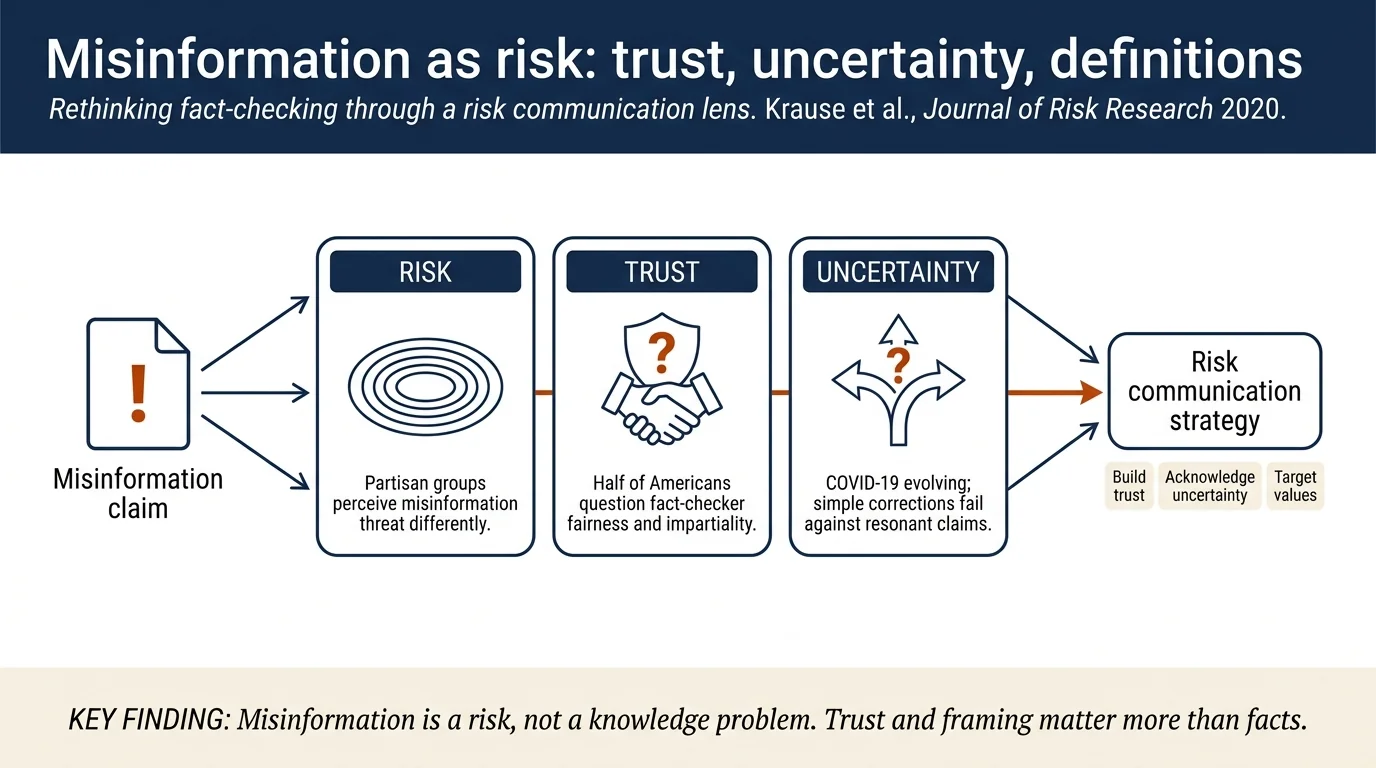
COVID-19 misinformation should be viewed as a risk in its own right, not just a communication failure. Fact-checking efforts face three key challenges: defining misinformation differently across political subgroups, earning trust in an environment of low press credibility, and communicating amid genuine uncertainty. Simple factual corrections are insufficient; risk communicators must build trust partnerships and acknowledge uncertainty.
Contributions
- Applies risk communication research to the COVID-19 "misinfodemic," viewing misinformation as a meta-risk that interacts with pandemic perceptions.
- Identifies multi-layered risk definition problems: publics disagree on the magnitude, source, and nature of misinformation risk, complicating fact-checking effectiveness.
- Documents that nearly half of Americans view fact-checkers as biased (Pew, 2019), particularly problematic when partisan groups blame different sources for misinformation.
- Argues that uncertainty is inherent to COVID-19 messaging (evolving virus knowledge, evolving model predictions) and that "stating the facts" fails when facts themselves are contested or incomplete.
- Provides evidence-based recommendations for risk communicators: build trust via trusted partners (CDC, WHO), acknowledge uncertainty without losing credibility, and connect corrections to audience values rather than relying on objective appeals.
Key arguments
The misinfodemic as risk. WHO characterized COVID-19 as spawning both a pandemic and an "infodemic." The paper argues misinformation should be treated as a risk in its own right—not merely false statements, but messages that conflict with best-available evidence and would not be corrected if challenged. This is distinct from knowledge deficits; it's about risk perception.
Multi-layered risk definition. When the subject of misinformation is itself a health risk (COVID-19), two risk perceptions layer: COVID-19 risk perception and misinformation risk perception. Empirical example: Two-thirds of Americans (66%) viewed COVID-19 as a major health threat (broad agreement), but partisan cleavage emerged on who is exaggerating it—77% of Republicans said media exaggerated COVID-19 risk, vs. only 49% of Democrats. If Republicans see journalists as the source of misinformation, they will expect fact-checkers to scrutinize traditional media; if Democrats do not share this expectation, fact-checkers' credibility suffers when they appear to disregard the "real" problem.
Trust barriers. Only half of Americans believe fact-checkers "deal fairly with all sides" (Pew, 2019b); 48% think fact-checkers "favor one side." This is especially problematic when fact-checking organizations are housed within traditional media outlets—Republicans, who distrust traditional media, are unlikely to trust media-affiliated fact-checkers. The paper cites low press trust in the U.S. (Hanitzsch et al., 2018) as a structural barrier to fact-checking credibility.
Uncertainty and the limits of knowledge. Fact-checking typically assumes disputants can resolve claims via "the facts." But COVID-19 is characterized by genuine uncertainty: evolving knowledge about SARS-CoV-2 biology, changing epidemiological models with different assumptions, and emergent evidence. The "knowledge deficit model" (the idea that misinformation stems from lack of exposure to facts) is debunked; people hold false beliefs due to psychological heuristics, motivated reasoning, and value alignment rather than simple ignorance. Emotionally resonant false claims compete against flat factual rebuttals. The paper cites vaccine misinformation literature showing that fact-checks alone do not shift behavior.
Recommendations
-
Build trust instead of asserting it: Partner with highly-trusted institutions (CDC, WHO) rather than housing fact-checking within media outlets. Trust is earned, not claimed.
-
Acknowledge uncertainty without losing credibility: When facts are genuinely unsettled (as with COVID-19), make this explicit. Research (Van Der Bles et al., 2020) shows that highlighting uncertainty does not undermine trust; hiding uncertainty or claiming certainty where none exists does.
-
Target values, not just facts: Connect corrections to what audiences deem important. Raw factual appeals fail; emotion-informed messaging that acknowledges audience concerns succeeds.
Connections
- Pennycook et al. (2020) — Accuracy nudges — experimental evidence that prompting people to consider accuracy works; complements this paper's psychological perspective with behavioral evidence.
- Roozenbeek et al. (2020) — Susceptibility to COVID-19 misinformation — international survey showing trust in scientists and numeracy predict resistance; aligns with this paper's trust-based framing.
- Ecker et al. (2022) — Psychological drivers of misinformation — comprehensive review of belief persistence mechanisms; provides the psychological foundation this paper invokes.
- Wardle & Derakhshan (2017) — Information disorder — defines misinformation, disinformation, malformation; this paper operationalizes that conceptual framework for risk communication.
- Roozenbeek & van der Linden (2019) — Inoculation game — demonstrates active inoculation works; aligns with this paper's argument that passive fact-checks fail and that pre-event preparation (building trust, framing) matters.
Notes
Strength. The paper makes a novel and important move: treating misinformation as a risk rather than as a knowledge problem. This reframe is powerful because risk communication research has a 40+ year body of work on why people define risks differently, why trust matters more than facts, and how to communicate uncertainty. Most fact-checking research implicitly assumes a "knowledge deficit model" (people lack facts); this paper correctly identifies that the problem is often trust, values, and psychological framing. The multi-layered risk insight—that COVID-19 risk perception and misinformation risk perception interact—is empirically grounded and actionable.
Limitations. The paper is a perspective/commentary, not an empirical study. It does not test fact-checking interventions or measure fact-checker credibility effects. The recommendations, while well-grounded in risk communication literature, are not validated on COVID-19 audiences. Additionally, by April 2020 (publication date), COVID-19 had not yet become deeply politicized in the U.S.; the partisan cleavages cited may not reflect late-2020/2021 trajectories when vaccine misinformation became highly partisan. The paper's emphasis on trust partnerships with WHO and CDC is sensible but does not address the case where those institutions themselves become targets of partisan distrust (as happened with CDC guidance on masks/vaccines).
Relevance. Critical for researchers designing COVID-19 misinformation interventions and for understanding why simple fact-checking fails in polarized environments. Essential reading for fact-checkers, risk communicators, and public health officials seeking to address misinformation without alienating target audiences.