Unifying Models of Intergroup Hostility in Online Discourse
Authors: Patrick Gerard, Julia Mendelsohn, Kristina Lerman
Venue: arXiv cs.CL, 2026 — arXiv:2609.20808
TL;DR
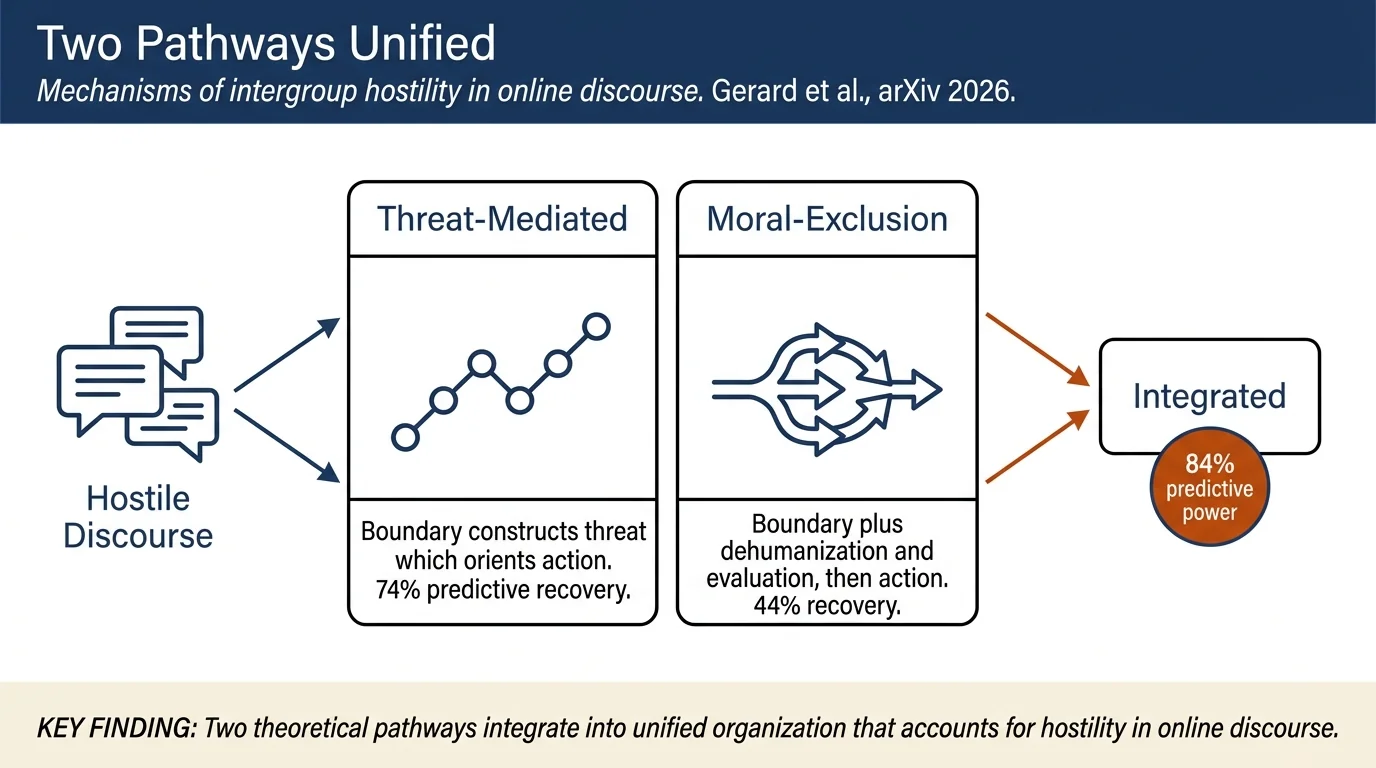
Hostile rhetoric toward outgroups in online discourse can be modeled through six mechanisms (boundary construction, threat construction, scapegoating, negative evaluation, dehumanization, action orientation) whose structural and temporal relationships were previously understood separately through competing theoretical frameworks. By analyzing 2.86 million posts from the 2024 U.S. election, Gerard et al. demonstrate that these mechanisms follow a unified organizational pattern: threat-mediated and moral-exclusion pathways capture complementary aspects of the same system, with a regular temporal sequence from boundary construction → threat construction → action orientation.
Contributions
- Unified framework: Demonstrates that six mechanisms of group-directed hostile rhetoric from distinct theoretical traditions (social identity theory, intergroup threat theory, moral psychology) are structurally interdependent and temporally organized within a single system.
- Empirical grounding: Analyzes 2,513 narrative clusters spanning 2.86M posts across TikTok (807.8K), Twitter/X (1.69M), and Truth Social (361.5K) collected during the 2024 U.S. presidential election.
- Structural organization: Shows that boundary construction and threat construction form the predictive backbone of the system (recovering 84% of predictive information when combined), while other mechanisms contribute complementary information.
- Temporal patterns: Documents that mechanisms unfold in a regular sequence: negative evaluation, boundary construction, and action orientation appear early in narratives, while dehumanization and threat construction form an intermediate tier, and scapegoating appears late.
Method
Mechanistic definitions: The paper operationalizes six mechanisms: - Boundary construction: Rhetoric that constructs or reinforces salient ingroup-outgroup distinctions, positioning a target as socially distinct - Threat construction: Rhetoric representing a target as a threat to the ingroup's security, identity, values, resources, status, or future - Scapegoating: Rhetoric assigning responsibility or blame to a target for social problems, crises, decline, or other harms - Dehumanization: Rhetoric denying or diminishing a target's humanity, individuality, agency, moral standing, or other uniquely human characteristics - Negative evaluation: Rhetoric expressing derogatory, contemptuous, and strongly negative judgments without necessarily portraying the target as threatening or subhuman - Action orientation: Rhetoric that advocates, legitimates, or normalizes harmful action or treatment of target
Data collection and annotation: - Narrative-level approach: grouped semantically normalized cross-platform posts into narratives representing coherent units of discourse around underlying issues, events, or claims - Manual annotation: 600 sampled post-mechanism pairs (262 positive, 338 negative) rated by trained annotators - Inter-annotator agreement: mean Cohen's κ = 0.643 across mechanisms - LLM evaluation: automated annotation using Gemma-3-1B, Llama-3-1-8b, Owen3-14B; best model (Owen3-14B) achieves κ = 0.588
Structural analysis: - Held-out predictive information: for each mechanism, measures how much additional predictive gain it provides beyond other mechanisms - Conditional association: estimates odds ratios for mechanism co-occurrence while conditioning on remaining mechanisms - Bayesian network learning: independently learns structure from data using hill-climbing - Theory-derived structures: compares empirically recovered relationships against structures predicted by existing theoretical accounts
Temporal analysis: - For each narrative, examines order of first appearance of mechanisms - Tests whether developmental sequences predicted by theory (e.g., boundary construction precedes action orientation) match observed narrative development - Controls for frequency and narrative length effects
Results
Structural organization: - Threat-mediated pathway alone recovers 74.0% of predictive information with only two edges (boundary construction → threat construction, boundary construction → threat construction → action orientation) - Moral-exclusion pathway (boundary construction + dehumanization + negative evaluation + action orientation) recovers 44.3% - Integrated model combining both pathways recovers 84.1% of available predictive information - Boundary construction and threat construction are the two strongest relationships in the system (47% of conditional mutual information) - The recovered structure is sparse (seven edges total) but highly organized and replicable across platform-specific subsets
Temporal organization: - All six mechanisms show distinct temporal tiers: negative evaluation, boundary construction, and action orientation enter early; dehumanization and threat construction form an intermediate tier; scapegoating consistently appears latest - 97.5% of bootstrap samples show this three-tier organization - Temporal patterns remain robust across narratives with different prior observation periods (0-30 days observation history) - The temporal organization is independent of mechanism frequency and narrative length
Robustness: - Platform heterogeneity in mechanism prevalence is small (Cramér's V < 0.026) - Structural relationships and temporal ordering are robust to 50% label perturbation (Spearman ρ ≥ 0.853) - The three-tier temporal organization holds at all observation window thresholds tested
Connections
Related to Propaganda through mechanisms of persuasion and influence — demonstrates how hostile rhetoric constructs group identity and threat perception as part of broader propaganda strategies.
Related to Computational Propaganda — these mechanisms are deployed at scale on social media platforms and automated systems; understanding their organization enables more targeted intervention.
Related to Political polarization and ideological echo chambers — boundary construction and threat perception are mechanisms through which groups become ideologically separated and mobilized.
Related to Hate speech detection and moderation — hostile rhetoric overlaps with hate speech detection but goes beyond detection to analyze underlying structural organization and temporal development; relevant for understanding how hateful speech emerges and escalates.
Extends Rhetoric by providing computational methods for analyzing rhetorical structures in online discourse.
Notes
Strength: The paper makes an important methodological contribution by demonstrating that seemingly competing theoretical accounts of hostility (threat-mediated vs. moral-exclusion) are not in fact contradictory but rather describe different aspects of a unified system. The temporal analysis is particularly novel — showing that the order in which mechanisms appear in narratives follows predictable patterns independent of their aggregate frequency. The scale of analysis (2.86M posts across three major platforms) grounds theoretical claims in large-scale empirical evidence.
Limitations: The analysis is limited to mechanisms as detectable in text; it does not directly measure underlying psychological processes, and automated annotation remains error-prone even at the best reported performance (κ = 0.588). The narrative construction method (semantic normalization across platforms) may conflate distinct events or claim instances, and the study is limited to the 2024 U.S. election context — generalization to other political contexts or languages is unclear. The temporal ordering analysis assumes narratives develop linearly, but some mechanisms may emerge non-sequentially or recursively.
Open questions: How do these mechanisms relate to actual persuasive effectiveness or radicalization outcomes? Does the temporal order reflect causal mechanisms of rhetorical escalation, or merely statistical correlation in how narratives are discursively organized? Whether the six-mechanism taxonomy is exhaustive or whether additional mechanisms should be added remains unexplored. How do these patterns compare across different ideological perspectives (left-right, ingroup-outgroup roles)?