Susceptibility to misinformation about COVID-19 around the world
Authors: Jon Roozenbeek, Claudia R. Schneider, Sarah Dryhurst, John Kerr, Alexandra L. J. Freeman, Gabriel Recchia, Anne Marthe van der Bles, Sander van der Linden Venue: Royal Society Open Science, 2020 — DOI
TL;DR
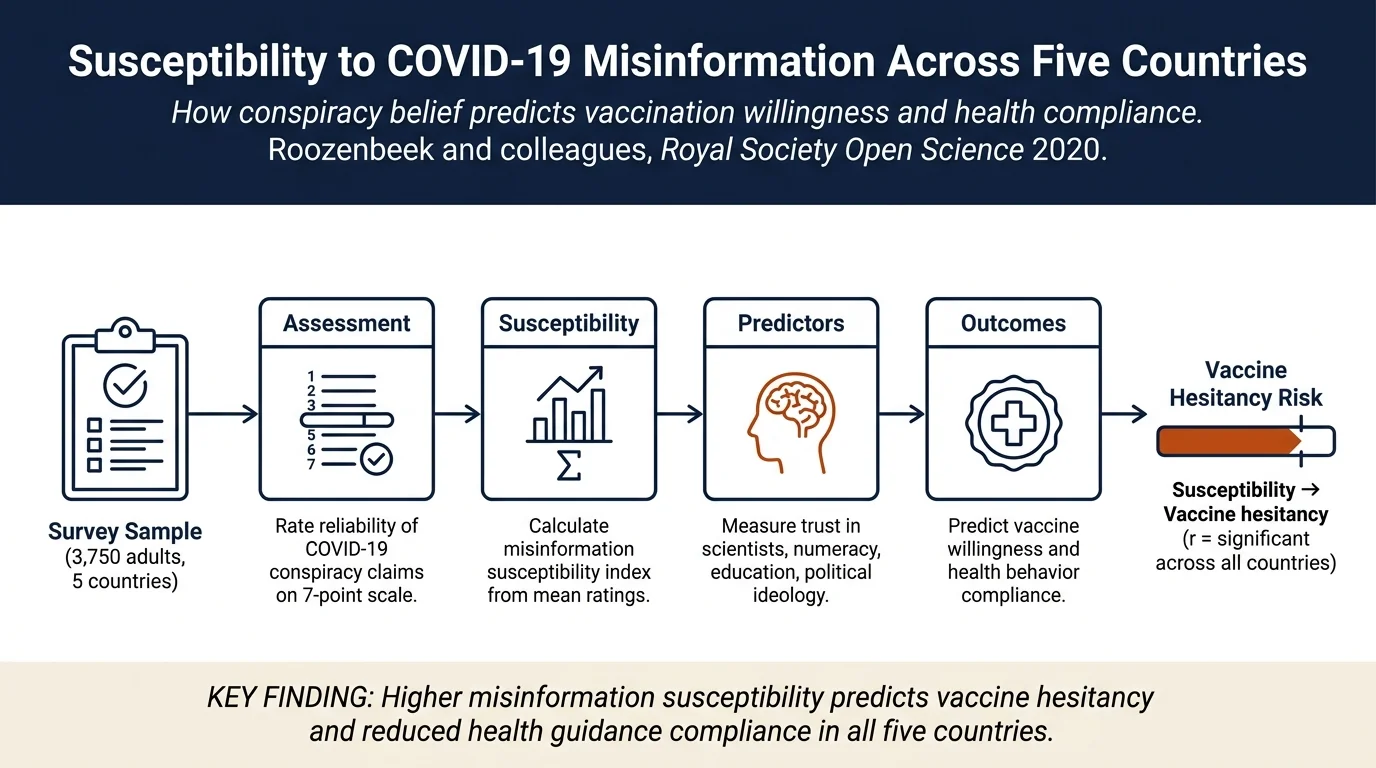
An international survey of 3,750 adults across five countries (UK, Ireland, USA, Spain, Mexico) measured susceptibility to COVID-19 misinformation and examined how it predicts public health behaviors. While majorities in each country did not find COVID-19 misinformation credible, higher susceptibility to misinformation was strongly linked to lower vaccine willingness and reduced compliance with health guidance. Key predictors of misinformation susceptibility included lower trust in scientists, lower numeracy, lower education, and in some countries, political conservatism.
Contributions
- First comprehensive cross-cultural assessment of susceptibility to COVID-19 misinformation using large national samples.
- Demonstrates a causal chain: susceptibility to misinformation → vaccine hesitancy and reduced health-compliance behavior.
- Identifies psychological and cognitive predictors of misinformation belief across diverse cultural contexts.
- Shows that higher trust in scientists and stronger numeracy skills are robust protective factors against COVID-19 misinformation across all countries.
- Provides evidence that misinformation susceptibility is a monological belief system, where belief in one conspiracy correlates with belief in others (e.g., 5G networks causing COVID-19, virus engineered in Wuhan lab).
Method
Sample. Five nationally representative or quota-balanced samples: UK (n = 1,050 and n = 1,150 in separate April and May 2020 surveys), Ireland (n = 700), USA (n = 700), Spain (n = 700), and Mexico (n = 700). Quotas were matched to national demographics for age and gender.
Misinformation statements. Participants rated the reliability of six COVID-19 misinformation statements on a 1–7 Likert scale (very unreliable to very reliable). The statements included: - Coronavirus was engineered in a Wuhan laboratory - 5G networks are causing COVID-19 symptoms - People with diabetes are at higher risk of complications from coronavirus - Ibuprofen makes COVID-19 worse - Hot water or saunas prevent/cure COVID-19 - Common claims about the virus and transmission
An overall misinformation susceptibility index was computed as the average reliability rating across all six items for each country.
Predictors. The study measured a broad array of potential predictors: - General predictors: age, gender, education, political ideology (left/right wing; liberal/conservative), performance on numeracy tasks, trust in scientists, trust in government, trust in journalists. - COVID-19-specific predictors: risk perception about COVID-19, trust in WHO, trust in politicians, perceived threat of misinformation, compliance with health guidance (wearing masks, washing hands, social distancing), willingness to get vaccinated (yes/no), willingness to recommend vaccination to vulnerable friends/family.
A one-way ANOVA tested whether misinformation susceptibility differed significantly across countries; Tukey's HSD post-hoc comparisons identified pairwise differences.
Regression model. An ordinary least squares (OLS) regression modeled the effects of general predictors (age, gender, education, numeracy, trust in scientists, political ideology) and COVID-19-specific predictors (risk perception, trust in politicians, information exposure) on susceptibility to misinformation for each country separately.
Health behavior outcomes. Two logistic regressions examined whether misinformation susceptibility predicted (i) willingness to get vaccinated and (ii) willingness to recommend vaccination to vulnerable contacts, controlling for age, gender, education, political ideology, self-perceived minority status, numeracy, and trust in scientists.
Results
Perceived reliability of misinformation statements. Across all countries, the claim that coronavirus was engineered in a Wuhan lab was rated as most reliable. In the UK and USA, approximately 22–23% of respondents rated this conspiracy as reliable (above the midpoint of the 1–7 scale); in Spain and Mexico, this rose to 33% and 37%, respectively. The 5G conspiracy was rated as reliable by around 16% of participants, with notable variation by country (highest in Spain and Mexico).
Cross-country differences. A one-way ANOVA revealed significant differences in the perceived reliability of misinformation between countries, F(4,3582) = 18.87, p < .0001. Mexico and Spain rated misinformation as most reliable on average, followed by Ireland, then the UK and USA. Post-hoc comparisons showed that the average perceived reliability ranged from about 2.27 in the USA to 2.67 in Spain (on a 1–7 scale).
Predictors of susceptibility to misinformation:
-
Trust in scientists was the strongest and most consistent protective factor across all countries. Higher trust in scientists predicted significantly lower misinformation susceptibility (standardized β ranging from −0.31 to −0.42 across countries).
-
Numeracy was significantly associated with lower misinformation susceptibility in all countries except Mexico, suggesting that individuals' ability to understand and process quantitative information protects against unreliable claims.
-
Education showed a protective effect in most countries, though the effect was not always statistically significant.
-
Political ideology showed mixed patterns. In Spain and Mexico, political conservatism was associated with higher misinformation susceptibility; this pattern was absent in the UK and USA. The authors note this may reflect temporal differences — the pandemic was at different stages of politicization across countries at the time of survey.
-
Age showed a significant association in Spain and Mexico (older individuals more susceptible), but not in other countries.
-
Trust in government and trust in journalists did not consistently predict misinformation susceptibility across countries.
Misinformation susceptibility and health behaviors. Higher susceptibility to misinformation was the only variable in the model that significantly predicted lower compliance with health guidance, particularly in Mexico and Spain (effect not significant in Ireland and UK). Critically, higher misinformation susceptibility was associated with reduced willingness to get vaccinated against COVID-19 and reduced willingness to recommend vaccination to vulnerable friends and family, consistent across all countries surveyed.
Connections
- Psychological drivers of misinformation belief (Ecker et al., 2022) — broader theoretical framework on susceptibility factors.
- Accuracy nudges and COVID-19 misinformation (Pennycook et al., 2020) — complementary intervention approach targeting the decision-making process rather than susceptibility factors.
- Inoculation against misinformation (Cook et al., 2017) — prebunking approach to building resilience, related to numeracy and critical thinking mechanisms.
- Trust in science and scientists — examined here as a key protective factor.
- Vaccine hesitancy — documented link between misinformation susceptibility and vaccination intentions.
- COVID-19 misinformation — specific context of pandemic-era false claims.
- Conspiracy theories — monological belief system evident in correlations between different COVID-19 conspiracy beliefs.
Notes
This paper is one of the first rigorous, large-scale international studies linking individual differences in misinformation susceptibility directly to public health behavior. The robustness of the trust-in-scientists finding across five distinct cultures is striking and suggests this is a fundamental mechanism rather than a culture-specific artifact.
The temporal context matters: the surveys were conducted in April–May 2020, early in the pandemic when COVID-19 politicization was still developing in most countries. Later studies show much stronger political polarization of COVID-19 beliefs, so the weaker political ideology effect here reflects the stage of the pandemic at the time.
The causal direction remains partially ambiguous: does misinformation susceptibility cause vaccine hesitancy, or does vaccine hesitancy cause increased receptivity to anti-vaccine misinformation? The authors note this is likely bidirectional and correlational in this cross-sectional design. However, the consistency across countries and the theoretical logic (susceptibility → reduced trust in guidance → lower health compliance) supports a causal pathway.
Limitations include reliance on self-reported compliance (not observed behavior), convenience sampling in some countries (not true probability samples), and the snapshot nature of the data — beliefs about misinformation and vaccines evolved substantially throughout 2020–2021. The finding that Spain and Mexico show higher susceptibility to misinformation aligns with subsequent literature on regional variation in health misinformation spread, though the mechanisms behind this variation deserve further investigation.
The connection between numeracy and resistance to misinformation is practical: it suggests that literacy interventions (e.g., teaching probabilistic reasoning, critical evaluation of claims, statistical literacy) may be effective public health tools. Combined with the trust-in-science finding, this paper suggests that institutional trust and cognitive skills are both leverage points for combating misinformation at scale.