News literacy, social media behaviors, and skepticism toward information on social media
Authors: Emily K. Vraga, Melissa Tully Venue: Information, Communication & Society, Vol. 24, No. 2, pp. 150–166 — DOI
TL;DR
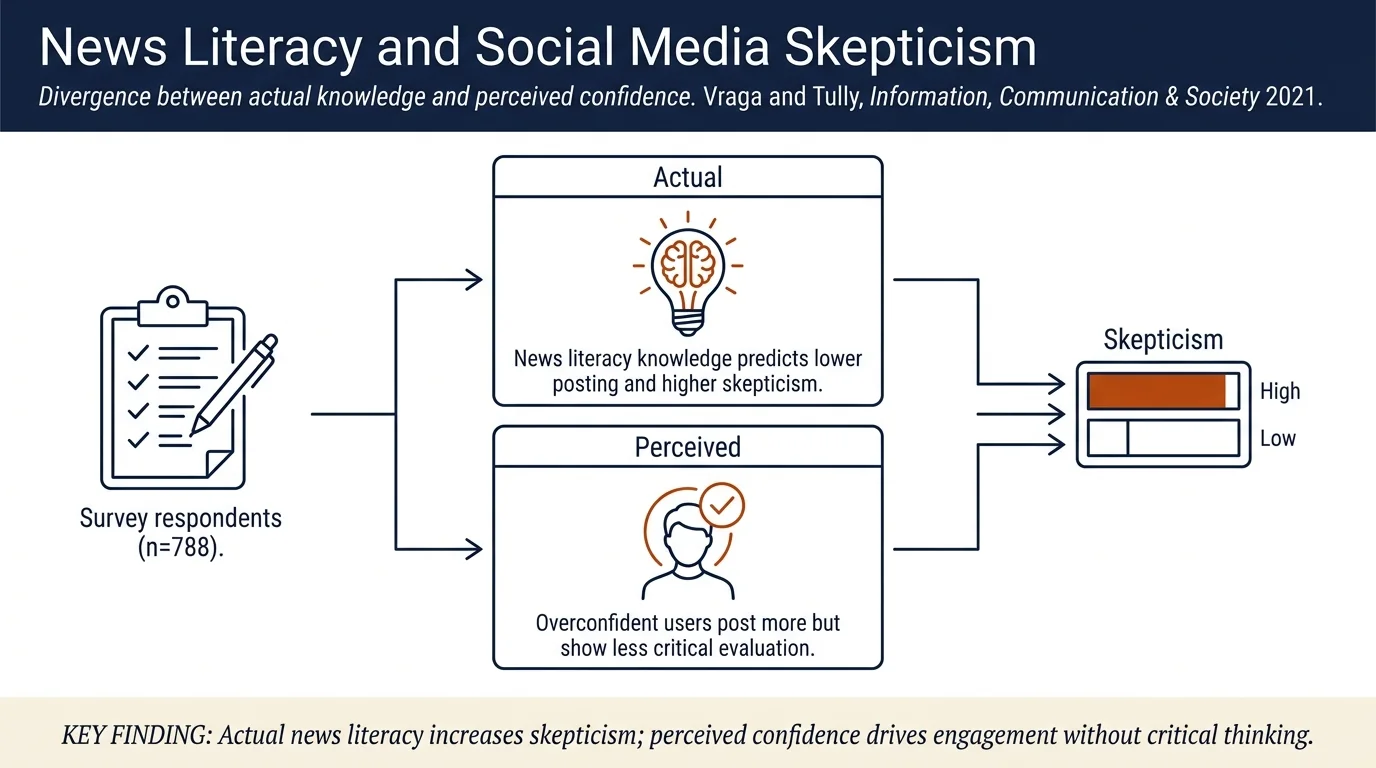
A national survey of 788 Americans examines how news literacy relates to what people see and share on social media, and whether it predicts skepticism toward information shared in these spaces. The key finding: people with higher news literacy see and post less political content on social media, but when they do engage, they're significantly more skeptical. Those who overestimate their own media literacy, by contrast, engage more but are less critical.
Contributions
- First empirical examination of whether news literacy and related psychological orientations predict both exposure and posting behaviors on social media, across three major platforms (Facebook, Twitter, YouTube)
- Demonstrates that the relationship between media literacy and social media engagement is platform-specific and depends on whether literacy is actual (knowledge) or perceived (confidence)
- Evidence that news literacy and value for media literacy promote skepticism toward information quality on social media, independent of engagement levels
- Identifies a problematic pattern: self-perceived media literacy correlates with more engagement but less skepticism, suggesting misalignment between confidence and actual knowledge
Method
National survey of 788 American adults (March 2017, Qualtrics Panels) with quota sampling on gender, age, race, and education to approximate U.S. demographics.
Measures: - News Literacy (NL): 10 multiple-choice items on knowledge of media systems and effects - Need for Cognition (NFC): 2 items measuring enjoyment of critical thinking - Self-Perceived Media Literacy (SPML): 4 items on perceived ability to evaluate media - Value for Media Literacy (VML): 8 items on perceived importance of media literacy to democracy - Social Media Behaviors: Frequency of seeing and posting news/political content on Facebook, Twitter, YouTube (5-point scales) - Social Media Skepticism: 2 items on credibility and trust of news encountered on social media (7-point scales)
Controls included age, gender, race, income, education, and political orientation measures.
Results
Seeing news and political content: - Models explained 14.6% variance (Facebook), 20.4% (Twitter), 26.0% (YouTube) - Higher NL predicted less exposure on Facebook and YouTube - Higher SPML predicted more exposure on Twitter (only platform where perceived literacy matters) - Higher VML consistently predicted less exposure across all platforms
Posting news and political content: - Models explained 53.6% (Facebook), 54.3% (Twitter), 63.2% (YouTube) - Higher NL predicted significantly less posting on all three platforms - Higher VML also predicted less posting across all platforms - SPML did not significantly predict posting
Skepticism toward social media information: - Model explained 14.4% variance - NL (β = .09), NFC (β = .09), and VML (β = .30) all independently predicted higher skepticism - SPML predicted lower skepticism (β = −.09) - Crucially: exposure to and posting of news/political content showed no significant relationship with skepticism; what matters is the quality of one's knowledge
Connections
- Related to Bode & Vraga's work on misinformation correction through shared focus on media literacy as predictor of behavior
- Extends Zhou & Zafarani's survey framework on detection methods by examining psychological precursors to engagement rather than technical detection
- Informs debate on prebunking and inoculation strategies by showing that existing literacy predicts selective engagement
- Complements definitional work on misinformation by measuring behavioral and attitudinal consequences of literacy differences
Notes
Strengths: - Large, nationally representative sample with careful demographic weighting - Simultaneous measurement of actual knowledge (NL) and perceived knowledge (SPML), revealing their divergent relationships to skepticism - Multi-platform analysis shows literacy effects are not uniform across media - Measures both exposure and active participation (posting), distinguishing between incidental and deliberate engagement
Limitations and follow-up questions: - Survey is correlational; cannot infer causality from NL to skepticism or behavior - Does not distinguish between types of content seen/posted (fact-checks, opinion, satire, misinformation) - Self-reported behaviors may not reflect actual engagement - SPML's inverse relationship with skepticism is worrying but underexplored; needs investigation of whether educational interventions inadvertently boost false confidence - Finding that higher literacy predicts less engagement raises democratic concerns: if news-literate citizens disengage from social media discussion, who is left to counter misinformation in those spaces?