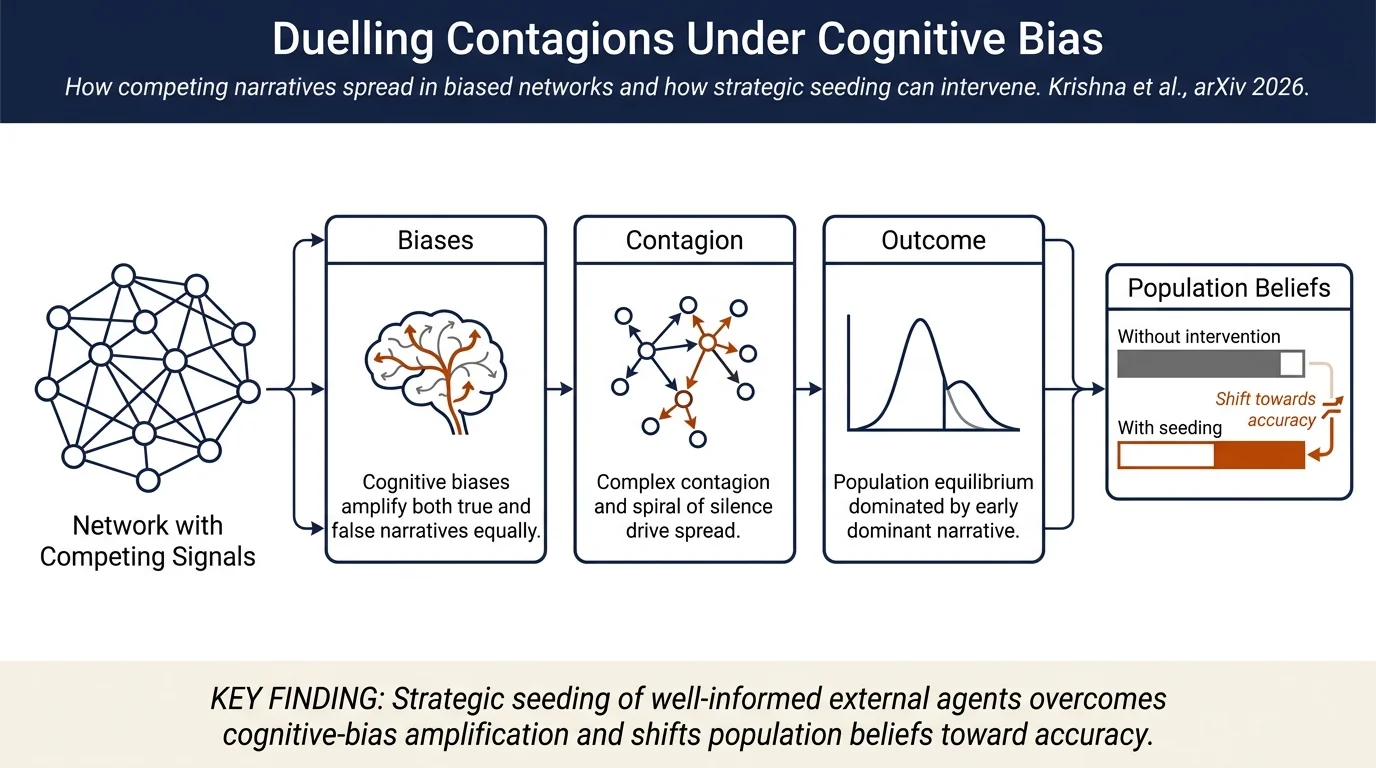
Modeling Duelling Contagions of True and False Information in the Face of Inherent Individual biases
Authors: Vaibhav Krishna, Hirokazu Shirado, Feng Fu, Nicholas A. Christakis
Venue: arXiv cs.SI — 2607.24360
TL;DR
This paper proposes CI-SRW, an agent-based co-diffusion model integrating cognitive biases with network dynamics to explain how competing true and false information spread in social media. Using behavioral experiments and simulations, the authors find that manipulative narratives dominate when early spreaders hold them, cognitive biases amplify both true and false information, and strategic seeding of well-informed agents can counter misinformation by shifting population beliefs toward accuracy.
Contributions
-
Psychologically grounded competing-information model: Extends traditional single-contagion epidemic models by embedding the Spiral of Silence theory and Complex Contagion mechanisms into an agent-based framework that captures how cognitive biases shape willingness to spread competing narratives.
-
Integration of cognitive mechanisms: Formally models unrealistic optimism, confirmation bias, false consensus effect, and naive realism as reinforcement loops that amplify information diffusion regardless of veracity.
-
Behavioral validation: Validates the model through two large-scale online behavioral experiments (single-round and multi-round) with human participants, showing that simulated and observed diffusion dynamics are statistically indistinguishable.
-
Counterfactual intervention analysis: Demonstrates two corrective strategies: (1) seeding agents with high self-censorship suppresses false information spread, and (2) deploying even small fractions of well-informed external agents can shift population equilibrium toward accurate beliefs, even in dense networks.
Method
The CI-SRW (Competing Information – Social Reinforcement and Willingness) model combines agent-based modeling with psychological theory. Each agent has two states: belief in either "true" or "false" information, and a state variable tracking self-censorship (willingness to express beliefs).
Contagion mechanisms:
- Complex contagion: Information spreads through repeated exposure from multiple sources; a single exposure insufficient for belief adoption.
- Spiral of silence: Agents monitor the perceived opinion climate and suppress opinions they believe are minority views; silence itself shifts the perceived climate.
- Optimism bias: Agents underestimate personal vulnerability and overweight favorable information.
- Confirmation bias: Agents preferentially incorporate information confirming prior beliefs.
Agent behavior: When an agent observes information from network neighbors, adoption probability depends on (1) message content, (2) exposure frequency, (3) perceived opinion climate, and (4) the agent's cognitive bias profile. The model also captures personal experience (favorable/unfavorable events) and its asymmetric effect on optimism: favorable events strongly reinforce optimism; unfavorable events only weakly attenuate it.
Experimental validation: The model was validated against two sets of online experiments:
- Single-round: 40-node networks; participants made decisions about "safe" vs. "danger" signals in a disaster scenario.
- Multi-round: The same participants played four rounds of an iterated evacuation game, allowing researchers to observe how beliefs evolve under repeated uncertain exposure and social feedback.
Results
Simulation findings:
- Networks initially dominated by manipulative information and characterized by stronger optimism bias converged to equilibrium states with substantially lower levels of accurate information (>90% susceptible to manipulation under highest-bias conditions).
- Time to peak diffusion and final belief proportions showed no statistical difference between "danger" (true warning) and "safe" (false reassurance) signals across conditions — cognitive biases amplify both equally.
- Temporal sequencing and valence of prior experiences crucially shaped collective belief trajectories: early negative experiences (e.g., a disaster in round 1) significantly suppressed subsequent optimism bias, but favorable experiences strongly reinforced it.
Intervention strategies:
-
Self-censorship seeding: Strategic seeding of "warning-informed" agents with high self-censorship reduced the proportion of the population believing correct information by up to 50% in biased environments, particularly in dense networks (from 38% with random seeding to 24% with high self-censorship seeds). Conversely, low-self-censorship informed seeds increased correct belief proportion from 43% to 51% in sparse networks and from 38% to 53% in dense networks.
-
External agent deployment: Deploying as few as 2% of well-informed external agents (each connected to 4 random nodes) significantly shifted equilibrium toward accurate information in sparse networks. In dense networks, approximately 5% external agent density was required to maintain >50% correct-information prevalence. Even peripheral placement of these agents was effective.
Connections
- Related to Rumor Cascade Models via shared network-dynamics framing, but extends them by integrating cognitive biases and willingness-to-speak rather than passive transmission.
- Builds on Spiral of Silence and Complex Contagion as core psychological mechanisms.
- Shares methodology with other agent-based modeling studies of Misinformation diffusion and spread, but uniquely grounds behavior in empirically validated psychological theories.
- Cited by and extends research on Cognitive Biases in Information diffusion in social networks (e.g., unrealistic optimism in crisis communication).
- Relevant to Intervention Strategies for Misinformation and Content moderation design — demonstrates the leverage of early strategic seeding.
Notes
Strengths:
- Novel integration of spiral-of-silence into diffusion modeling; prior cascade studies largely neglected willingness to speak as a behavioral state.
- Rigorous behavioral validation: two large-scale experiments designed specifically to test the model's predictions, with statistical measures of fit (Kolmogorov-Smirnov, Dynamic Time Warping).
- Counterfactual intervention analysis grounded in the validated model, enabling exploration of scenarios impractical to run experimentally.
- Clear policy relevance: demonstrates that strategic seeding and external expert deployment can overcome cognitive-bias amplification.
Limitations and open questions:
- Model assumes homogeneous processing of biases across agents; real-world contexts show identity, ideology, and institutional trust modulate susceptibility.
- Behavioral experiments use simplified "disaster" scenarios (safe/danger signals); external validity to real-world misinformation (health, political, conspiracy) requires further validation.
- Assumes agents process information uniformly given bias estimates; algorithmic amplification and selective exposure on platforms could interact with bias in unexpected ways.
- Does not model trust in institutions or experts; external agent efficacy may degrade in polarized or distrust-heavy contexts.
Follow-up work: Would benefit from (1) extending to ideologically charged real-world misinformation domains, (2) modeling agent heterogeneity in trust and institutional affinity, and (3) testing whether the intervention strategies transfer to platforms with algorithmic feed curation.