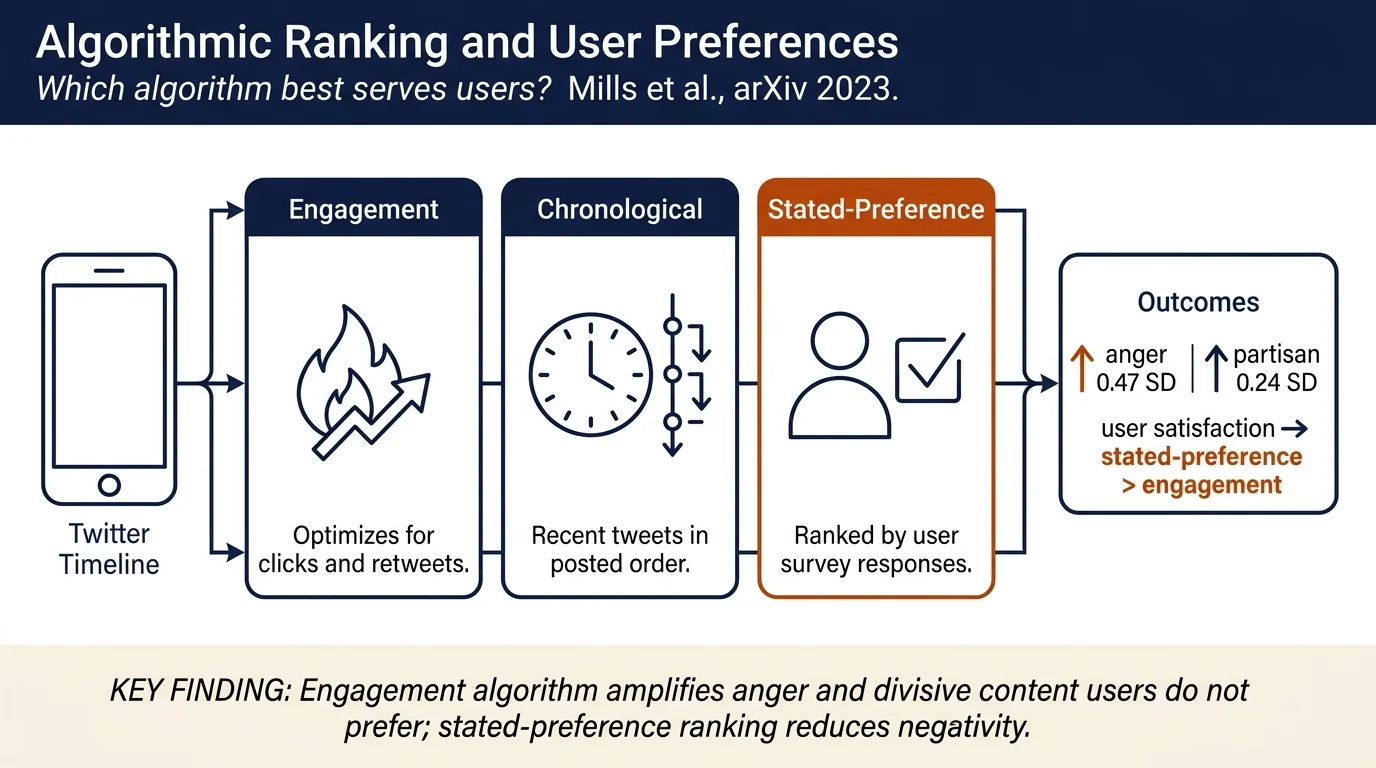
Engagement, User Satisfaction, and the Amplification of Divisive Content on Social Media
Authors: Smitha Mills, Micah Carroll, Yike Wang, Sashrika Pandey, Sebastian Zhao, Anca D. Dragan
Venue: arXiv:2305.16941, 2023
TL;DR
Twitter's engagement-based ranking algorithm amplifies emotionally charged and partisan divisive content beyond what users report wanting to see. Through a pre-registered experiment comparing the engagement-based timeline to a reverse-chronological baseline, the authors show the algorithm increases anger, sadness, and out-group animosity, while a timeline ranking by users' stated preferences reduces these negative effects and increases happiness.
Contributions
- Pre-registered field experiment on 150+ Twitter users comparing engagement-based ranking, reverse-chronological baseline, and stated-preference ranking
- Demonstrates that engagement optimization amplifies partisan tweets (0.24 SD), out-group animosity (0.24 SD), anger (0.47 SD), sadness (0.22 SD), and anxiety (0.23 SD)
- Shows users do not prefer the political tweets selected by the engagement algorithm, suggesting users' revealed preferences (engagement-driven) and stated preferences (survey) diverge
- Proposes and evaluates an alternative ranking algorithm based on users' explicit stated preferences, finding it reduces hostile content while maintaining engagement and user satisfaction
Method
The researchers conducted a two-week field experiment on CloudResearch Connect with 150+ US participants who actively use Twitter. The study collected three different timelines for each participant:
- Engagement-based timeline — The top ten personalized tweets from their engagement-based ranking algorithm
- Reverse-chronological baseline — The ten most recent tweets from their accounts they follow
- Stated preference timeline — Tweets ranked using their explicitly stated preferences from a survey
Participants rated each set of tweets on: (i) emotional content (anger, sadness, anxiety, happiness), (ii) ideological leaning and out-group animosity, (iii) whether the author was expressing in-group animosity, and (iv) whether they wanted to see similar tweets. Pre-registered hypotheses and exploratory analyses tested whether the engagement-based algorithm amplifies emotional, ideological, and partisan content.
Results
Engagement-based amplification of divisive content:
The engagement-based algorithm significantly amplified emotional and partisan content compared to the reverse-chronological baseline: - Political outcomes: Engagement timeline showed more partisan tweets (0.24 SD, p < 0.001) and more out-group animosity (0.24 SD, p < 0.001) - Emotional outcomes: Amplified anger (0.47 SD, p < 0.001), sadness (0.22 SD, p < 0.001), anxiety (0.23 SD, p < 0.001), but no significant effect on happiness - User preferences mismatch: Overall, tweets in the engagement-based timeline were rated as only slightly more valuable than reverse-chronological tweets (0.06 SD, p = 0.022), and political tweets in the engagement timeline were rated as less valuable (−0.18 SD, p = 0.005)
Stated preference ranking as a correction:
An exploratory analysis using a stated preference timeline (ranking tweets based on users' survey responses about what they value) showed: - Reduced negativity: lower anger, sadness, and anxiety - Increased happiness (0.12 SD, p < 0.001) - Decreased partisanship and out-group animosity compared to engagement-based ranking - No reduction in overall engagement compared to the engagement-based timeline
Connections
- Bail et al. 2018 — Documents backfire effects of cross-cutting political exposure on Twitter; this paper extends the mechanism through algorithmic amplification
- Brady et al. 2017 — Shows moral-emotional language spreads faster within in-groups; this paper demonstrates algorithms exploit this bias
- Political polarization — Algorithmic amplification as a driver of partisan sorting and affective polarization
- Platform amplification — Direct empirical evidence of engagement-based algorithms amplifying divisive content
- Algorithms and platform governance — Implications for algorithmic design and content ranking policies
Notes
The paper makes a crucial distinction between revealed and stated preferences: the algorithm optimizes for what users engage with (revealed preferences) but users explicitly report not wanting to see those tweets when asked directly. This disconnect challenges the assumption that engagement-based ranking aligns with user welfare and suggests room for algorithmic improvement. The stated preference timeline demonstrates that respecting explicit user preferences can reduce exposure to divisive, emotionally charged content without sacrificing engagement. The focus on political tweets in some analyses reveals that emotional amplification may be particularly pronounced in political speech, with implications for polarization at scale.
A methodological strength is the pre-registration and field experiment design, moving beyond observational studies that cannot disentangle algorithmic selection from homophily. However, the limited pool of 150+ participants and their self-selection to complete surveys may limit generalizability.