Deepfakes and Disinformation: Exploring the Impact of Synthetic Political Video on Deception, Uncertainty, and Trust in News
Authors: Christian Vaccari, Andrew Chadwick Venue: Social Media + Society, Vol. 6, No. 1, January–March 2020 DOI: 10.1177/2056305120903408
TL;DR
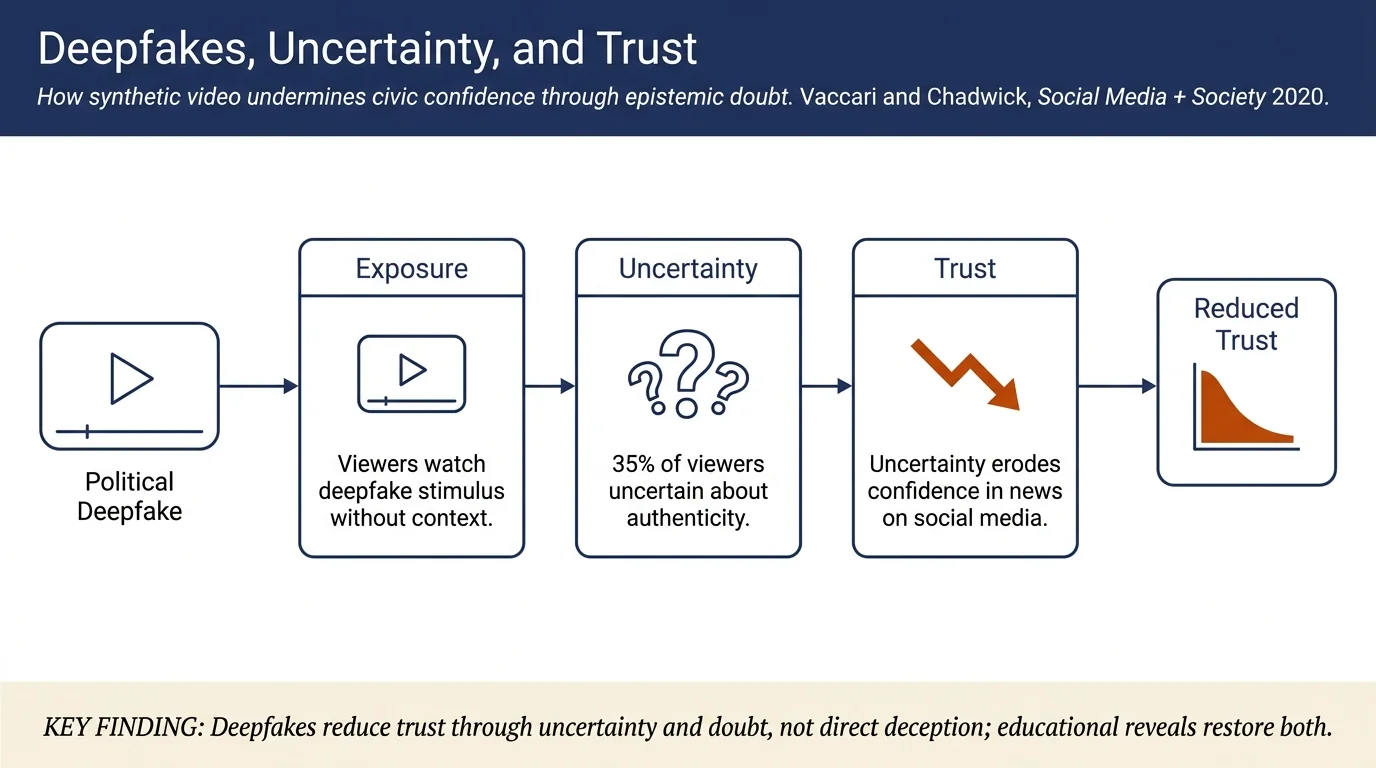
Experimental study (N=2,005 UK respondents) testing how political deepfakes affect deception and trust in news. Deepfakes increased uncertainty about content, and that uncertainty mediated reduced trust in news on social media. Crucially, deepfakes did not deceive a majority of participants; the threat lies in uncertainty and its corrosive effects on civic culture.
Contributions
- First empirical evidence on deepfakes' effect on deception and trust; tests three hypotheses on cognitive and attitudinal outcomes
- Experimental design using the widely-circulated BuzzFeed Obama/Peele deepfake across three conditions: 4-second deceptive clip, 26-second deceptive clip, and full-length educational reveal
- Mediation pathway: deepfake exposure → increased uncertainty → reduced trust in news on social media (indirect effect)
- Educational countermeasure: full-length video with reveal and explanation by Jordan Peele reduced uncertainty and increased trust relative to deceptive versions
Method
The study employed a between-subjects experiment with N=2,005 UK respondents recruited via Opinium Research on an online survey panel. Three randomized treatment conditions exposed participants to different versions of a BuzzFeed Obama/Peele deepfake:
- Deceptive 4-second clip: Obama saying "President Trump is a total and complete dipshit"—no context, no reveal.
- Deceptive 26-second clip: Same video with extended dialogue establishing apparent fluency.
- Full video with educational reveal: 1 minute 10 second version showing Obama speaking alone on camera, then revealing the synthetic nature of the deepfake; Jordan Peele explains how deepfakes work and warn about their threat.
Participants were randomly assigned to one of three conditions (653 saw the 4-sec clip, 683 saw the 26-sec clip, 669 saw the full video with reveal). All groups were measured on three dependent variables:
- Deception (H1 & H2): "Did Barack Obama ever call Donald Trump a dipshit?" (Yes/No/"Don't Know")
- Uncertainty (H2): "Don't Know" responses indicating uncertainty about the content's authenticity
- Trust in news on social media (H3): "How much do you trust the news and information about politics and public affairs that you see on social media?"
The study controlled for baseline levels of trust in news on social media and tested mediation effects via uncertainty using ordinary least squares regression.
Results
Overall deception rates (H1): - 50.1% of participants who watched the 4-second deceptive clip were not deceived (meaning 49.9% were deceived or uncertain) - 46.7% who watched the 26-second deceptive clip were not deceived - 55.6% who watched the full video with educational reveal were not deceived - Differences were not statistically significant between deceptive conditions (χ²=16.1, df=4, p=.003)
Uncertainty (H2): - The deceptive 4-second clip elicited 35.1% "Don't Know" responses - The deceptive 26-second clip elicited 36.9% "Don't Know" responses - The full video with educational reveal elicited only 27.5% "Don't Know" responses - Deepfakes did significantly increase uncertainty compared to the full video (p<.001)
Trust in news on social media (H3): - Exposure to either deceptive deepfake reduced trust in news on social media (indirect effect b=-0.175, SE=0.034, p<.001) - This effect was mediated through increased uncertainty - The 4-second deceptive video was the least likely to deceive (14.9% of participants answered "Yes") but was the most effective at reducing trust through uncertainty (35.1% of participants were uncertain) - The full video with educational reveal increased trust compared to deceptive versions by reducing uncertainty
Regression results (Table 1): - Exposure to deceptive deepfakes had a direct effect on uncertainty (a=0.085, p<.001) - Uncertainty had a strong effect on trust in news on social media (b=-0.175, p<.001) - The indirect effect of deepfake exposure on trust through uncertainty was significant (c'=-0.015, p<.005)
Connections
- Related to Disinformation — deepfakes as a form of synthetic disinformation designed to manipulate political discourse
- Extends work on trust in institutions and communicators — uncertainty about media content correlates with reduced institutional trust
- Shares experimental methodology with Roozenbeek & van der Linden (2019) on inoculation approaches; both test media literacy interventions
- Complements Ecker et al. (2022) on psychological mechanisms of misinformation belief via uncertainty and fluency heuristics
- Related to political communication and political video content analysis
Notes
Strengths: - First rigorous empirical test of deepfake effects on deception and trust; uses widely-known viral deepfake enhancing external validity - Clear experimental design with random assignment and tight control of treatments; enables causal inference - Focuses on an important but underappreciated outcome: deepfakes may threaten civic culture through uncertainty, not just deception - Mediation analysis clarifies the mechanism (exposure → uncertainty → reduced trust) rather than just estimating total effects - Large, representative sample (N=2,005) drawn from British population closely matching demographics of UK on gender, age, education
Weaknesses: - No control group baseline; comparison is only among deepfake variants, so it's unclear how participants would respond to non-deepfake political content - Single deepfake stimulus; generalizability to other deepfakes and political figures uncertain - Online panel recruitment may bias toward politically interested respondents - Uncertainty ("Don't Know") measured via survey response rather than behavioral indicators - Does not address cross-platform effects, interpersonal diffusion, or long-term attitude change - Limited to UK population; partisan trust dynamics and fact-checking credibility vary significantly across countries
Implications: - Deepfakes pose a unique threat not through widespread deception but through erosion of epistemic trust and creation of uncertainty that undermines democratic discourse - Educational interventions showing deepfakes' synthetic nature and explaining the technology can mitigate negative effects - Media literacy and platform countermeasures should emphasize not just detection but restoration of confidence in video as evidence