Online misinformation about climate change
Authors: Kathie M. d'I. Treen, Hywel T. P. Williams, Saffron J. O'Neill
Venue: WIREs Climate Change, 2020 — DOI
TL;DR
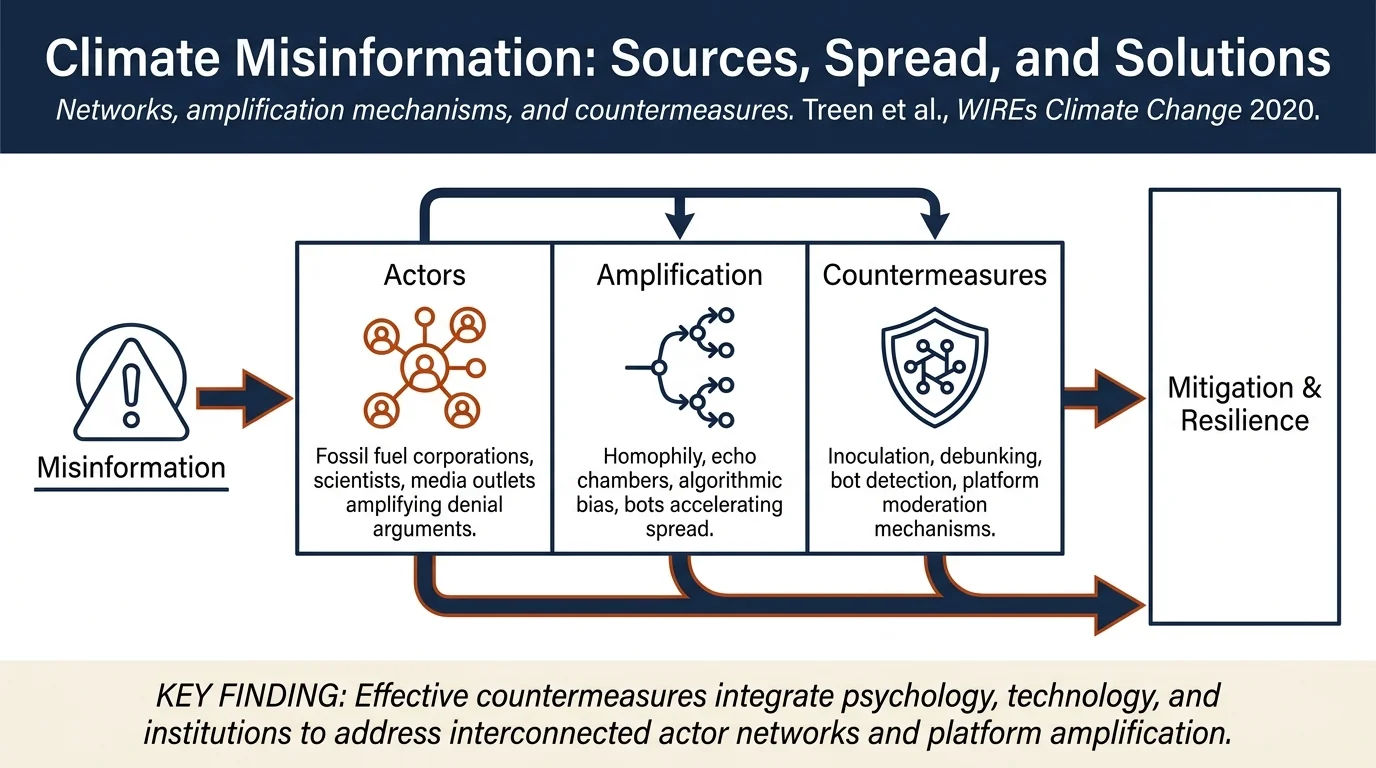
Comprehensive literature review examining climate change misinformation from multiple disciplinary angles. Defines misinformation vs. disinformation, identifies networks of actors (scientists, governments, industry, media) spreading false claims, examines how social media characteristics (homophily, echo chambers, algorithmic bias) amplify misinformation spread, analyzes why it matters for policy and public attitudes, and synthesizes evidence-based countermeasures including inoculation and correction strategies.
Contributions
- Unified terminology framework distinguishing information, misinformation, and disinformation based on falseness and intent-to-deceive, with specific definitions for climate change context.
- Network analysis of climate change denial actors identifying six categories: scientists, governments, political/religious organizations, industry (fossil fuels), media, and think tanks; documents funding flows and strategic communication tactics.
- Synthesis of diffusion mechanisms including epidemic/contagion models, homophily, echo chambers, and algorithmic bias as factors amplifying misinformation spread on social media.
- Evidence-based countermeasures review, covering inoculation theory (pre-emptive warnings), prebunking and debunking strategies, detection of malicious accounts, and platform-level ranking/removal mechanisms.
Definition and Conceptualization
The paper distinguishes three key concepts with a hierarchy (Figure 1):
- Information — claims that may be misleading but lack deceptive intent.
- Misinformation — false or misleading information spread without intent to deceive, characterized by potentially deceptive presentation.
- Disinformation — deliberately false information created and spread with intent to deceive, the most harmful subset of misinformation.
Climate change misinformation is contextualized as a subset of broader misinformation, and often manifests as climate skepticism, climate denial, climate alarmism, or attribution denial—terms frequently used inconsistently in academic discourse.
Who Spreads Climate Change Misinformation?
The paper identifies an interconnected network of actors (Figure 2: "the climate change misinformation network"):
- Corporate and philanthropic actors — Conservative foundations and fossil fuel interests funding climate denial messaging.
- Producers of climate change misinformation — Political/religious organizations, astroturf/grassroots campaigns, contrarian scientists producing denialist content.
- Influencers' echo chamber — Media outlets, skeptical bloggers, politicians, and pundits amplifying and distributing false narratives.
- The public echo chamber — End consumers who receive and share misinformation, with feedback loops back to all earlier stages.
Key mechanisms: corporate funding from ExxonMobil and Koch foundations documented as directly influencing thematic framing (scientific skepticism, economic development frames) of denial organizations. Media particularly identified as playing a crucial role in amplifying "false balance" narratives.
How Does Misinformation Spread?
The paper synthesizes both theoretical and empirical approaches:
Social media characteristics
- Homophily — Users' tendency to connect with similar others, creating ideologically consonant networks.
- Echo chambers — Homophilous groups reinforcing shared beliefs, exacerbating opinion polarization.
- Algorithmic bias — Platforms' content ranking algorithms designed to maximize engagement over trustworthiness, preferentially amplifying engaging (often emotionally charged, polarizing) content.
- Confirmation bias — Users' tendency to seek and believe information coherent with existing beliefs; discussed alongside "belief echoes" (persistent attitude shifts after corrections).
Diffusion mechanisms
- Contagion / epidemic models — Misinformation spreads via person-to-person transmission through social network connections, analogous to infectious disease diffusion.
- Malicious actors — Bots, spammers, and astroturfers amplify content, manipulate algorithms, and create artificial grassroots campaigns.
- Psychological factors — Ideologies and values, social norms, belief systems, confirmation bias all contribute to differential susceptibility to and spread of climate misinformation.
Why Climate Change Misinformation Matters
- Political inaction and policy resistance — Skepticism and doubt created by misinformation confuse publics, stall political will, and reduce public support for mitigation policies.
- Emotional and behavioral impacts — Misinformation triggers emotional responses (panic, suspicion, fear, anger) adversely affecting decision-making; doubt about scientific credentials undermines trust in institutions.
- Democratic implications — Widespread misinformation erodes informed democratic discourse and poses vulnerability to climate change (as a major global risk) being weaponized or dismissed.
Countermeasures and Interventions
The paper reviews four major intervention strategies:
-
Inoculation and prebunking — Pre-emptive exposure to weakened misinformation arguments and meta-knowledge of deceptive techniques (e.g., fake experts, false balance) that builds psychological resistance. Evidence shows pre-warnings preserve ~66% of the consensus-messaging effect against subsequent misinformation.
-
Correction and debunking — Post-hoc attempts to correct false beliefs. Mixed evidence: some studies show backfire/belief echoes (corrected individuals persisting in original beliefs), but recent meta-analyses find these effects rare; collaborative, politically cross-cutting corrections most effective.
-
Detection of malicious accounts — Technical approaches to identify and remove bots, spammers, and coordinated inauthentic behavior before misinformation spreads widely. Practical challenges include algorithmic accuracy and false positives.
-
Platform ranking, selection, and removal mechanisms — Algorithmic or crowdsourced curation changing content visibility or removing flagged content. Concerns about editorial control, potential to impede legitimate speech, and questions about algorithmic accuracy limit deployment.
The paper emphasizes no single intervention addresses all concerns; effective countermeasures require interdisciplinary approaches combining cognitive psychology, technological solutions, regulatory frameworks, and institutional trust-building.
Connections
- Related to Neutralizing misinformation through inoculation: Exposing misleading argumentation via shared focus on inoculation theory and experimental evidence of neutralizing misleading arguments.
- Related to Inoculating the Public against Misinformation about Climate Change on pre-emptive warnings against climate change misinformation with consensus messaging.
- Related to Corporate funding and ideological polarization about climate change documenting the funding networks and strategic messaging of climate denial actors.
- Related to Information Disorder: Toward an Interdisciplinary Framework for Research and on the broader conceptual framework distinguishing mis-, dis-, and mal-information.
- Related to The psychological drivers of misinformation belief and its resistance to correction on psychological mechanisms (confirmation bias, belief echoes) in misinformation persistence.
- Related to Emotion shapes the diffusion of moralized content in social networks on emotional content as a driver of information spread in polarized social networks (climate change context included).
Notes
Strengths: - Exceptionally thorough synthesis across multiple disciplines (communication, psychology, computer science, political science, environmental studies) with 150+ citations. - Clear visual frameworks (Figures 1–3) effectively communicate hierarchy of information types, network structure of actors, and interconnected human and platform factors. - Honest discussion of intervention limitations and trade-offs (e.g., platform moderation risks balancing misinformation reduction with free expression concerns). - Grounded in concrete case studies (tobacco industry "doubt" strategies, vaccine misinformation parallels, 2016 election interference).
Limitations: - Little quantitative original analysis; heavily literature-review based, so inherits limitations of cited work (small sample sizes, geographic/temporal specificity, methodological debates). - Limited discussion of non-English contexts despite climate misinformation being global. - Countermeasures section largely reports on efficacy of individual interventions in isolation; less on synergistic or system-level combinations tested in the field. - Does not address whether misinformation correction effects persist over long timescales or against sustained exposure to new false claims.
Significance: Serves as a canonical reference for researchers entering climate misinformation studies, establishing shared terminology, identifying key actors and mechanisms, and providing evidence-informed synthesis of what works to counter it. The interdisciplinary framing grounds climate misinformation within broader research on information disorder, positioning it as a critical instance of a wider societal challenge.