On the Opportunities and Risks of Foundation Models
Authors: Rishi Bommasani, Drew Hudson, Ehsan Adeli, and 50+ co-authors
Organization: Center for Research on Foundation Models (CRFM), Stanford Institute for Human-Centered Artificial Intelligence (HAI), Stanford University
Venue: arXiv, August 2021 — arXiv:2108.07258
TL;DR
A comprehensive 214-page report analyzing foundation models—large neural networks trained on broad data that can be adapted to diverse downstream tasks (BERT, GPT-3, DALL-E). The report maps capabilities across language, vision, and reasoning; applications in healthcare, law, and education; and societal risks including misuse (generating fake news, deepfakes, harassing content), fairness harms, environmental costs, and security vulnerabilities. It argues that understanding foundation models requires interdisciplinary collaboration across computer science, social science, ethics, and policy.
Contributions
- Defines and names foundation models as a distinct paradigm shift in AI, capturing the emergence of homogenized, large-scale pretrained models adapted to many tasks.
- Catalogs capabilities and limitations across modalities (language, vision, robotics) and reasoning tasks (question answering, semantic understanding).
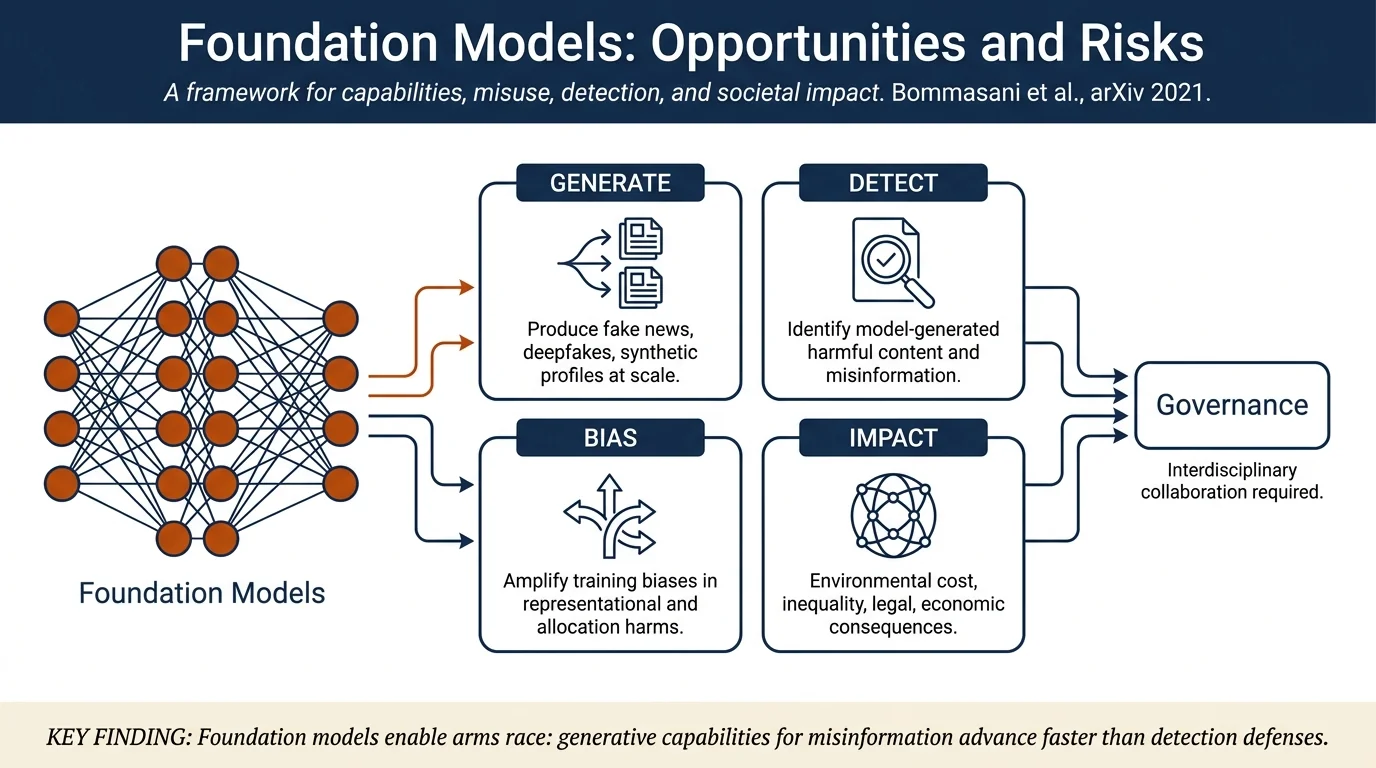
- Documents misuse risks including generation of synthetic misinformation, deepfakes, and profiles; cost reduction for malicious content creation; and interactive manipulation.
- Analyzes fairness and bias including representational bias (underrepresentation), misrepresentation (negative stereotypes), and allocation harms across downstream applications.
- Examines societal impact on inequality, environmental costs (carbon emissions from training and deployment), legal compliance, economic disruption, and ethics.
- Proposes frameworks for detecting model-generated harmful content and mitigating risks through proactive design, intervention, and accountability.
Method
The report synthesizes perspectives from 50+ researchers across academia and industry, covering technical capabilities, applications, risks, and societal considerations. It is structured as a policy-oriented analysis rather than a traditional empirical study.
Key Sections
Opportunities
Foundation models demonstrate remarkable emergent capabilities: they excel at downstream task adaptation through few-shot prompting or fine-tuning, enable zero-shot transfer across domains, and unlock multimodal reasoning. Applications span healthcare (medical question answering, drug discovery), law (contract analysis, legal reasoning), education (tutoring, explanation generation), and content understanding.
Misuse Risks
Foundation models enable high-quality generation of manipulative content at scale. Key concerns include:
- Fake news generation: Models like GPT-3 can generate synthetic news articles indistinguishable from human-written content, reducing the cost and effort for disinformation campaigns.
- Deepfakes and synthetic media: Vision-language models enable generation of synthetic images and video, used to harass individuals or spread false narratives.
- Fake profiles: Models can generate credible synthetic personas, social media profiles, and biographical data for coordinated inauthentic behavior.
- Personalized manipulation: Models can generate customized toxic content targeting specific audiences at scale.
Detection Capabilities
Foundation models also offer powerful detection mechanisms: their multimodal representations and reasoning capabilities enable them to detect both human- and model-generated harmful content. However, an arms race emerges—generative capabilities advance faster than detection, and adaptive attackers can prompt models to evade detection systems.
Fairness and Bias
Foundation models inherit and amplify training biases:
- Representational bias: Underrepresentation of certain demographics and languages (e.g., African American English speakers are underrepresented in training data, leading to poor model performance).
- Misrepresentation: Models encode negative stereotypes about marginalized groups, amplifying downstream harms across applications.
- Allocation harms: Biased models deny opportunities or resources to underrepresented groups; performance disparities spiral into systemic disadvantage.
Societal and Environmental Impacts
- Environmental cost: Training large models requires massive compute, incurring high carbon emissions. A BERT-base model trained from scratch generates ~1.5 metric tons of CO₂ equivalent.
- Inequality and access: Foundation models are developed primarily by industry, not academia, concentrating power and limiting diverse perspectives in their design.
- Legal and ethical concerns: Generative models raise questions about copyright, consent, accountability when models cause harm, and the concentration of AI capabilities.
- Economics: Foundation models may displace workers; they also create economic value through efficiency gains, raising distributional questions.
Connections
- Related to A Comprehensive Survey of AI-Generated Content (AIGC): A History of Generative — survey on generative AI safety and misuse.
- Related to Deepfake Detection: A Systematic Literature Review — covers deepfake generation and detection, a specific misuse risk discussed here.
- Relevant to Generative Models and Large Language Models topic pages.
- Foundational reference for Misuse and Fake news detection methods in the context of modern AI systems.
Notes
Strengths: - Exceptionally comprehensive scope, integrating technical, social, ethical, and policy perspectives. - Grounded in concrete examples (GPT-3, BERT, DALL-E) and their real-world deployment. - Honest about uncertainties and gaps in understanding foundation models. - Proposes actionable frameworks for proactive design, intervention, and accountability. - Directly addresses the societal and environmental stakes of scaling.
Limitations: - 214 pages of synthesis inevitably surface-skims some topics; deeper dives on specific risks (e.g., specific detection techniques, fairness metrics) exist elsewhere. - The report is assessment-focused; it diagnoses problems but defers to domain experts for implementation details. - Published in August 2021; foundation models have advanced rapidly (GPT-4, multimodal models), and the misuse landscape evolves quickly.
Relevance to fake news research: This is a foundational reference for understanding how modern large language models and vision models enable the generation and detection of misinformation at scale. It articulates both the promise (foundation models as detectors) and the peril (foundation models as generators of high-quality synthetic misinformation). The framework for assessing misuse, fairness, and societal impact is broadly applicable to misinformation research.
Impact: This report has been widely cited and shaped policy discussions at the EU, US, and international level regarding AI regulation and responsible development. It is a key reference for researchers, policymakers, and practitioners concerned with AI safety and misuse.