GraphSeal: Graph-Augmented Speech Deepfake Detection via Temporal-Spectral Artifact Propagation
Authors: Seung-woo Lee¹, Bowen Qi², Min-jun Kim³, Won-young Jang³
Affiliations:
1. Pusan National University
2. Shanghai Jiao Tong University
3. Hanyang University
Venue: arXiv cs.CY, November 2026 — arxiv
TL;DR
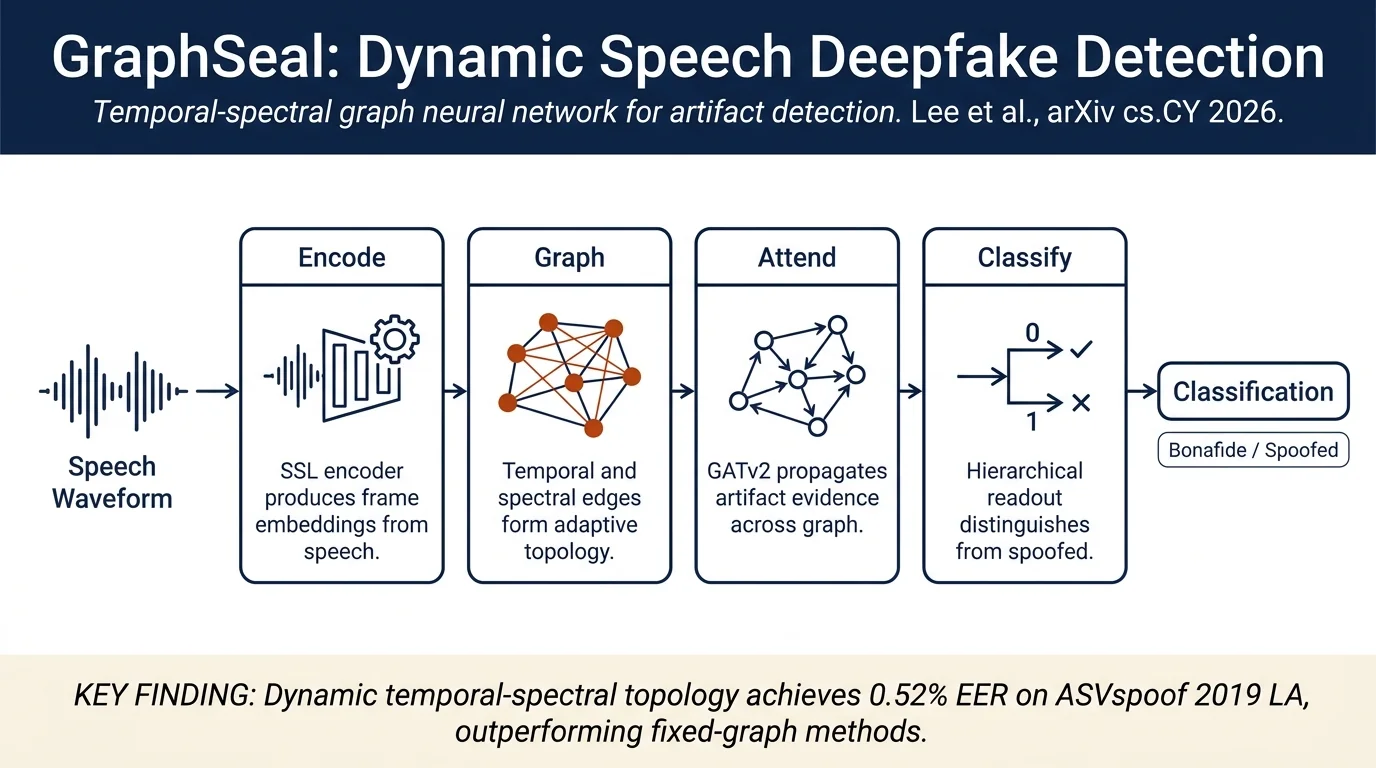
GraphSeal proposes a dynamic temporal-spectral graph neural network for speech deepfake detection that outperforms fixed-topology baselines on generalization tasks. Unlike prior graph-based anti-spoofing methods that use feature-extraction-determined topologies, GraphSeal constructs utterance-specific edges from both temporal adjacency and learned spectral similarity, allowing distant spectrally-related frames to share artifact evidence. With only 2.1M parameters on top of a frozen self-supervised encoder, GraphSeal achieves state-of-the-art or competitive equal error rates (EER) on four benchmarks: 0.52% (ASVspoof 2019 LA), 2.41% (ASVspoof 2021 LA), 8.17% (ASVspoof 5), and 5.24% (In-the-Wild).
Contributions
- Dynamic temporal-spectral graph construction that creates data-dependent edges based on temporal adjacency (±k_t neighbors) and spectral similarity (k_s nearest in embedding space), enabling adaptive topology per utterance.
- Graph attention propagation with edge attributes encoding temporal distance and spectral similarity; GATv2 formulation allows attention weights to change dynamically based on both source and target node content, critical for deepfake detection.
- Hierarchical readout combining mean pooling and learned attention weighting to aggregate variable-size node embeddings into fixed-size utterance representations.
- Comprehensive evaluation and ablations confirming that spectral edges, temporal edges, edge attributes, paralinguistic features (F0, energy, spectral centroid), and multi-layer propagation each contribute meaningfully to performance.
Method
GraphSeal operates in four stages:
-
Frame encoding: A frozen self-supervised speech encoder (WavLM, wav2vec 2.0, or Whisper) produces d-dimensional frame embeddings from the waveform.
-
Segmentation and initial embeddings: Frames are partitioned into overlapping segments of w frames (default w=32) with stride s=16. Each segment is mean-pooled and augmented with three paralinguistic features: fundamental frequency F0, RMS energy, and spectral centroid. These are linearly projected and concatenated to form initial node embeddings.
-
Graph construction: Two edge types:
- Temporal edges: Each node connects to its k_t nearest temporal neighbors on each side (default k_t=3), preserving sequential structure.
- Spectral edges: Each node connects to its k_s most spectrally-similar non-adjacent nodes (default k_s=5), computed via cosine similarity in the SSL embedding space. These long-range edges enable the model to compare regions with shared synthesis artifacts despite temporal separation.
Edge attributes combine temporal distance and spectral similarity: e_ij = λ_t · exp(-|i-j|/τ) + λ_s · sim(v_i, v_j), where λ_t, λ_s are learned parameters initialized to 0.5.
- Graph attention propagation: L=3 graph attention layers (M=4 heads) propagate artifact cues. Each layer updates nodes via GATv2 attention:
- Attention scores depend on both source and target node representations plus edge attributes.
- Outputs are concatenated across heads, then normalized with residual connections and layer normalization.
-
Dropout (0.1) is applied to attention coefficients during training.
-
Hierarchical readout: After L layers, two complementary aggregations:
- Mean pooling: u_mean = (1/N) ∑ h_i^(L)
- Attention-weighted: u_att = ∑ β_i h_i^(L), where β_i = softmax(w_r^T h_i^(L))
- Utterance embedding: u = [u_mean ∥ u_att]
- Binary classification via 2-layer MLP with GELU activation, trained with weighted cross-entropy to handle class imbalance.
Results
Main benchmarks (Table 1): - ASVspoof 2019 LA: 0.52% EER (vs. 0.59% WavLM-AASIST, 0.68% SAMO) - ASVspoof 2021 LA: 2.41% EER (vs. 2.85% WavLM-AASIST) - ASVspoof 5: 8.17% EER (vs. 9.62% WavLM-AASIST) — strongest gain on unseen attack types - In-the-Wild: 5.24% EER (vs. 6.31% WavLM-AASIST) — real-world recording conditions
Front-end agnostic: GraphSeal maintains effectiveness across three SSL encoders (Table 2): - WavLM-Large: 2.41% (2021 LA), 5.24% (In-the-Wild) — best - wav2vec 2.0-Large: 2.93% (2021 LA), 6.12% (In-the-Wild) - Whisper-Medium: 3.18% (2021 LA), 6.79% (In-the-Wild)
Per-attack breakdown (Figure 2): GraphSeal improves EER on 12 of 13 attack types in ASVspoof 2019 LA. Largest gains on: - A17 (waveform concatenation): −0.46% - A10 (neural vocoder with Griffin-Lim): −0.29% - A16 (neural TTS): −0.23%
Spectral edges particularly effective at linking discontinuities at concatenation boundaries.
Ablations (Table 3): - Removing spectral edges (k_s=0): +0.71% EER (regression to 3.12%) - Removing temporal edges (k_t=0): +1.56% EER (regression to 3.97%) - Removing edge attributes (e_ij=1): +0.37% EER - Removing paralinguistic features: +0.22% EER - Mean-pool-only readout (no attention): +0.30% EER - Single GAT layer (L=1): +0.94% EER; L=5 improves marginally to 2.52% but with diminishing returns - GCN instead of GAT: +0.48% EER; GraphSAGE: +0.31% EER — dynamic attention crucial
Attention analysis: For bonafide utterances, attention distributes uniformly across neighbors (entropy H=2.31 nats). For spoofed utterances, attention concentrates on spectral edges connecting to similar-distortion regions (entropy H=1.47 nats), validating that the graph learns to route information along artifact-bearing paths.
Generalization: ASVspoof 5 and In-the-Wild improvements confirm GraphSeal captures attack-agnostic artifacts rather than memorizing specific synthesis algorithms. Per-attack variance substantially lower than WavLM-AASIST (σ²=0.18 vs. 0.34), indicating more uniform detection across spoofing methods.
Computational efficiency
The graph back end adds only 2.1M parameters (0.7% of the frozen 316M-parameter WavLM-Large encoder) and 12 ms wall-clock latency per utterance on a single NVIDIA A100 GPU. Graph construction (segment pooling, cosine similarity, top-k selection) accounts for 3 ms; GAT propagation adds 9 ms. This efficiency supports real-time deployment in full-duplex voice agents (<50 ms per-turn budget).
Connections
- Deepfakes — speech deepfakes as misinformation vector
- Audio Deepfakes — audio synthesis detection methods
- Graph Neural Networks — GNN architectures for sequential/relational data
- Deepfake Detection — detection methods across modalities (video is the primary focus; audio is the complementary domain)
- VietPrism: A Large-Scale Vietnamese Speech and Deepfake Corpus with Diverse — multilingual audio deepfake detection; highlights generalization challenges across languages
- DeepFakes and Beyond: A Survey of Face Manipulation and Fake Detection — comprehensive survey covering both audio and video deepfakes; GraphSeal represents third-generation audio detection (SSL-based back ends)
- Deepfake Detection: A Systematic Literature Review — systematic review of detection approaches; highlights deep learning dominance (77%) and CNN architectural prevalence (GraphSeal adds GNN perspective)
Notes
Strengths: - Novel dynamic graph construction meaningfully outperforms fixed-topology predecessors (AASIST, RawGAT-ST). - Strong generalization to unseen attack types and unconstrained recording conditions; rare in audio deepfake detection. - Truly front-end agnostic; works with multiple SSL encoders without retraining the graph module. - Comprehensive ablations and per-attack analysis validate design choices. - Efficient: 2.1M parameters and 12 ms latency compatible with real-time deployment.
Weaknesses: - Error analysis reveals failure modes on irregular prosody (hesitations, non-verbal vocalizations) and spectrally homogeneous neural codec attacks, where spectral edges become less informative. - Inherent limitation: as synthesis quality improves and approaches genuine speech, no detection method can maintain arbitrarily low EER—this is a fundamental problem, not unique to GraphSeal. - Limited to lab-controlled and semi-wild datasets; true in-the-wild performance on actively adversarial synthesis (voice cloning for fraud) remains understudied.
Future directions: - Combine with recurrent refinement (iterative evidence accumulation over multiple graph passes) to improve codec-attack detection. - Extend to multimodal deepfakes (audio-visual consistency checking via unified graph framework). - Privacy-preserving deployment: graph-level embeddings abstract away speaker identity while retaining artifact signatures.