From Manipulation to Mistrust: Explaining Diverse Micro-Video Misinformation for Robust Debunking in the Wild
Authors: Zhi Zeng, Yifei Yang, Jiaying Wu, Xulang Zhang, Xiangzheng Kong, Herun Wan, Zihan Ma, Minnan Luo Venue: ACM International Conference, 2026 — arXiv:2603.25423
TL;DR
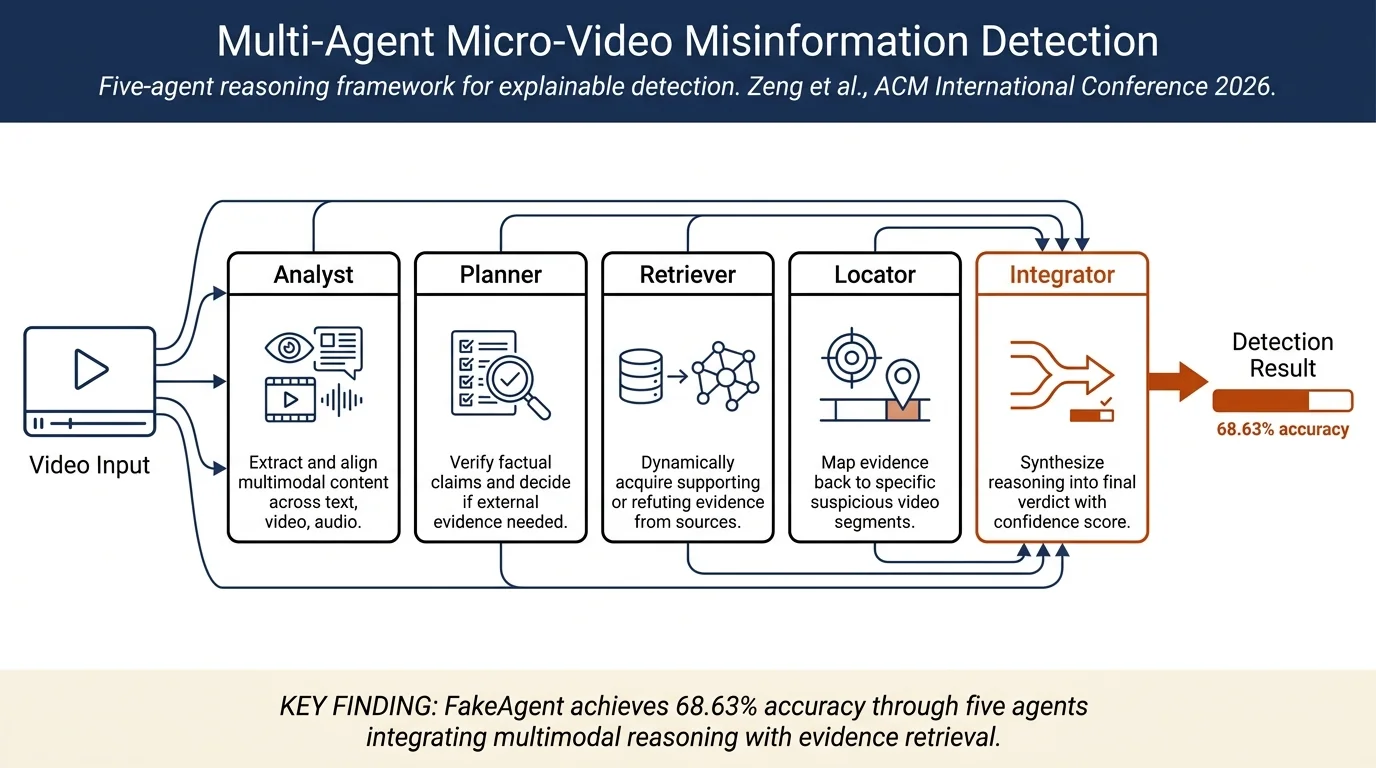
The paper introduces WildFakeBench, a benchmark of 10,000+ real-world micro-videos spanning diverse misinformation types (manipulation, bias, AI-generated content, out-of-context) from six social platforms. The authors propose FakeAgent, a multi-agent reasoning framework combining neural networks and large language models, which achieves 68.63% accuracy while producing interpretable, evidence-grounded explanations for misinformation detection.
Contributions
- WildFakeBench: A large-scale, diverse micro-video misinformation benchmark with:
- 10,107 real-world micro-videos collected from 2017-2025
- Coverage across six platforms (YouTube, Twitter, Facebook, TikTok, Instagram, Kuaishou)
- Fine-grained annotation with four deception categories: Manipulation (text/video/audio tampering), Biases (faulty logic, exaggerated narrative, offensive content), AI-Generated Content (AI edition, deepfake), and Out-of-Context (knowledge error, event fabrication, event splicing)
-
Expert-verified annotations with consistency checks against fact-checked sources
-
FakeAgent: A multi-agent reasoning framework for detection and explanation:
- Content Analyst: Analyzes multimodal content consistency via Chain-of-Thought reasoning
- Planner: Verifies factual accuracy of explicit claims and decides when external evidence is needed
- Retriever: Dynamically acquires supporting evidence from authoritative sources (Wikipedia, fact-checking databases)
- Locator: Pinpoints suspicious content segments across modalities
-
Integrator: Synthesizes multi-source reasoning into final verdicts with confidence scores and grounded explanations
-
Delphi-inspired multi-agent design enabling transparent, evidence-based reasoning chains
- Comprehensive evaluation showing FakeAgent outperforms closed-source baselines (GPT-4o) and larger LLMs
Method
FakeAgent orchestrates five specialized agents to integrate multimodal understanding with external validation:
Multimodal Content Understanding — The Content Analyst agent applies Chain-of-Thought reasoning to extract and align information across text, video frames, and audio. Multi-turn interactions evaluate consistency between visual and textual narratives, flagging potential multimodal manipulations (e.g., mismatched dubbed audio, doctored captions).
External Evidence Reasoning — The Planner agent identifies factual claims and determines whether external evidence is required. Using a dynamic threshold on internal confidence, it activates the Retriever agent, which queries fact-checking platforms, Wikipedia, and academic sources for supporting or refuting evidence. The Locator agent maps retrieved evidence back to specific video segments for pinpoint attribution.
Multi-view Evidence Integration — The Integrator synthesizes internal multimodal reasoning (from the Content Analyst) with external evidence (from the Retriever and Locator) through structured templates. This produces a unified evidence set \(\mathcal{E}_{\text{agg}}\) that combines perception-grounded assessments with authoritative external sources. The final prediction incorporates both verdicts and confidence measures.
Results
- Detection Performance: FakeAgent achieves 68.63% micro-accuracy across all misinformation types, outperforming GPT-4o (65.14%), Qwen2.5-VL-32B (65.87%), and multiple specialized baselines (InterVL-2.5-38B, VideoLLaMA2-7B)
- Ablation Studies: Removing cross-modal knowledge refinement (w/o CKR) and external evidence retrieval (w/o EER) each causes 3-4% performance drops, confirming both modules are essential
- Explanation Quality: Human evaluation shows FakeAgent consistently surpasses larger LLMs (Qwen2.5-VL-32B) in Informativeness and Soundness across perceptual, reasoning, and conclusion dimensions
- Category-Specific Performance: Strongest on content manipulation (81.05% accuracy) and weakest on out-of-context scenarios (61.57%), indicating domain-specific knowledge gaps for emerging manipulation tactics
- Generalization: Framework generalizes across platform-specific linguistic and visual characteristics (Figure 5 shows platform-specific word clouds and misinformation distribution)
Connections
- Related to Deepfake Detection via handling of AI-generated content in video
- Extends Multimodal Misinformation Detection by integrating evidence retrieval with reasoning
- Builds on Explainable fake news detection work to produce grounded, interpretable verdicts
- Shares evaluation methodology with misinformation benchmarks such as FVC and FakeRecipe
- Complements Fact-checking and corrections systems by providing attribution to specific video segments
Notes
Strengths: WildFakeBench addresses a real gap in micro-video misinformation coverage (most prior benchmarks focus on single deception types). The multi-agent reasoning design elegantly decomposes detection into modular, interpretable steps. Evaluation is thorough, including both automatic metrics (accuracy, F1) and human assessment of explanation quality.
Limitations: FakeAgent's performance on out-of-context scenarios (61.57%) suggests domain-specific knowledge remains a bottleneck. The paper acknowledges this and notes future work should explore adaptive retrieval and continual knowledge updating. Error analysis (Figure 9) illustrates the challenge of handling low-resource, rapidly evolving misinformation categories. Scalability to real-time platforms and integration with existing fact-checking APIs are not addressed.
Future directions: The authors suggest exploring mechanisms for real-time evidence alignment, continual knowledge updating to handle emerging misinformation tactics, and development of more adaptive retrieval strategies for dynamic domains. The dataset release and framework design provide a foundation for follow-up work on evidence-grounded explanation and cross-domain transfer.