Drowning in AI Slop: How Social Media Platforms (Do Not) Label AI and Deepfake Content under EU law
Authors: Bram Rijsbosch, Luka Bekavac, Henry Tari, Gijs van Dijck, Konrad Kollnig
Venue: arXiv cs.CY — 2609.38571
TL;DR
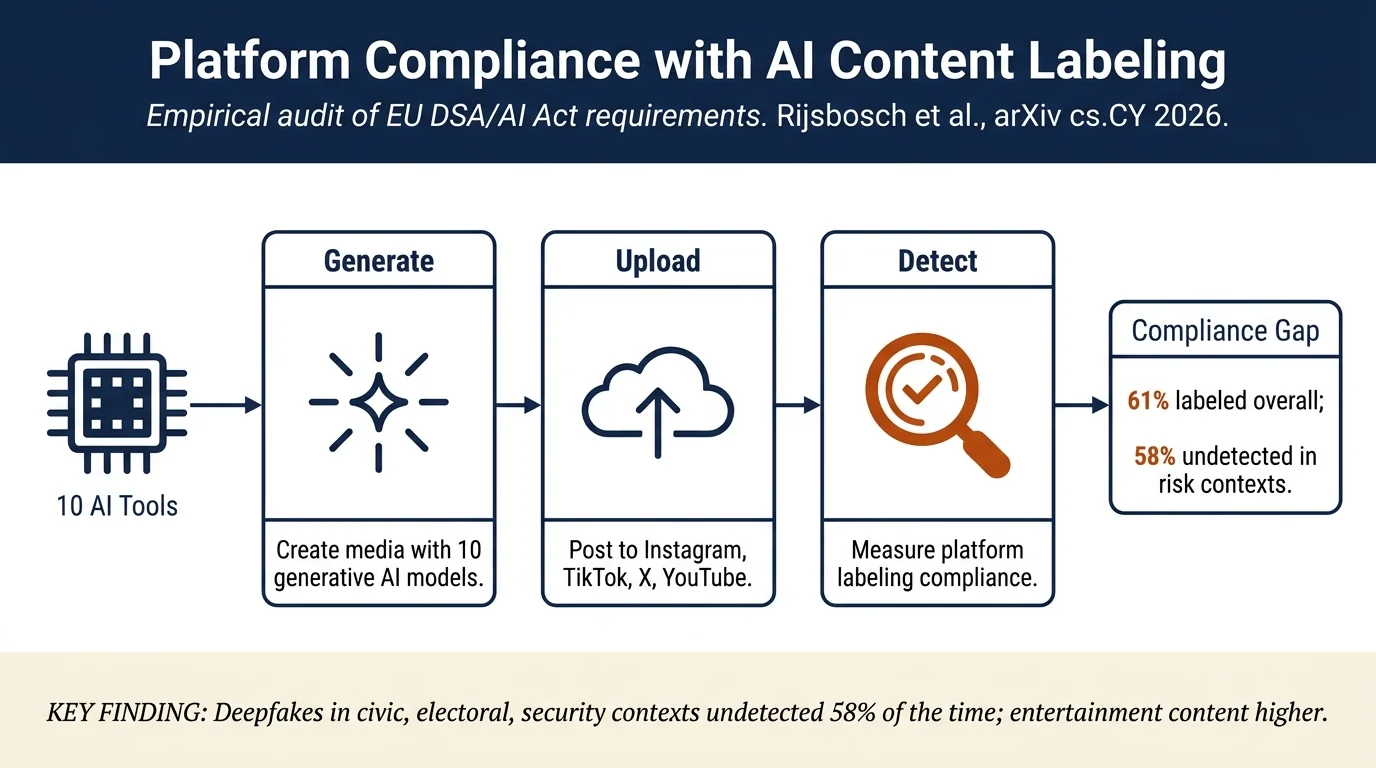
This paper conducts a legally grounded empirical audit of AI-labeling practices across Instagram, TikTok, X, and YouTube, testing how well platforms comply with EU legal obligations to label AI-generated and deepfake content. Using uploads of content generated by 10 generative AI tools, the authors find that platforms labeled only 36 of 59 uploads (61%), with highly variable rates across platforms, and substantial gaps where AI-generated content—especially in systematic risk contexts—went unlabeled.
Contributions
- Legal analysis: Derives operational interpretation of the EU Digital Services Act (DSA) and AI Act requirements for AIGC and deepfake transparency, examining what constitutes an AIGC label and deepfake definition.
- Empirical platform audit: Tests 10 generative AI tools across Instagram, TikTok, X, and YouTube; finds only 61% auto-detection rate, with Instagram at 82% for creator-labeled content but only 34% for all posts.
- Systematic risk assessment: Documents labeling gaps in posts containing civic discourse, electoral content, and public security keywords—precisely the high-risk contexts the DSA targets.
- Platform-specific findings: Documents divergence in labeling approach (label design, visibility, creator vs. automated), showing Instagram and TikTok label 50%+ of AI-keyword posts while X reaches only 18% and YouTube 33%.
- Dataset and annotation: Provides dataset of 10,722 publicly collected posts with expert annotation of 500-post subsample, codebook for deepfake detection criteria.
Method
Legal framework: The authors ground their empirical work in the EU's DSA Article 35(1)(k) and AI Act Article 5(2)(c), extracting two-step operative reading: (1) what counts as AIGC/deepfake, (2) what labeling, removal, and reporting entails.
Detection testing: Uploaded content from 10 generative AI models (Meta AI, CapCut, Grok, Gemini, Adobe, HappyHorse, Kling AI, Lumma, OpenAI, Runway) with metadata tracked. Recorded platform responses 24 hours post-upload; assessed whether automatic labeling was applied.
Large-scale data collection: Sampled 10,722 recent public posts (January–September 2026) via keyword search using DSA-relevant risk keywords (systematic risk: civic discourse, elections, security; AI-explicit keywords: "ai", "genai", "madewithiai", "generated", "ai_deepfakes") across four platforms. Each post coded for AIGC status (fully generated, partially generated, manipulated, no signs), deepfake status (creator/caption-indicated, visual indicators), and label visibility.
Expert annotation: Three-coder annotation of 500-post subsample with detailed codebook (Appendix E) operationalizing the legal deepfake definition. Inter-rater agreement measured via Krippendorff's alpha (~0.65 for primary label, 0.73+ for deepfake criteria).
Results
Upload experiment findings: - Overall detection rate: 36 of 59 uploads labeled within 24h (61%) - By platform: Instagram 82% (creator-labeled reels), TikTok 59%, X 41%, YouTube 63% - Variability by AI tool: Grok, Gemini, OpenAI detected >70% across platforms; Lumma 40%; CapCut 40%
Full dataset labeling rates (10,722 posts): - Instagram: 34% of all posts labeled, 74% of AI-keyword posts, 19% of risk-keyword posts - TikTok: 21% of all posts, 50% of AI-keyword posts, 11% of risk keywords - X: 5% of all posts, 18% of AI-keyword posts, 1% of risk keywords - YouTube: 12% of all posts, 33% of AI-keyword posts, 5% of risk keywords - Label visibility: 60% visible on Instagram, 100% on TikTok, 100% on X (where shown), 82% on YouTube
Label design diversity: - Instagram: "AI info" label (post description), account-level "AI creator" badge (optional) - TikTok: Creator-labeled "made with AI", platform "contains AI-generated media", internal template - X: "Made with AI" (creator/platform), "Made with Grok Imagine" (tool-specific) - YouTube: "[i] AI" label with source signal (OpenAI, tool-specific)
Key finding on systematic risk: Deepfakes in systematic-risk contexts (civic discourse, elections, security) went undetected in ~58% of annotated cases (AI-generated or 3D-rendered, partially generated, or manipulated). In contrast, labeling for aesthetic/entertainment deepfakes (gaming, music, artistry) was higher.
Connections
- Deepfake Detection — core technical challenge: how to reliably detect synthetic content
- Synthetic media encompasses the broader landscape
- Content moderation — platforms' operational obligation to implement labeling
- Platform policy literature on disclosure and transparency measures
Notes
Strengths: Legal grounding is rigorous, operationalizing vague DSA language into concrete audit criteria. The three-step deepfake definition (resemblance, existingness, falsity) is clear and reproducible. Large-scale data collection with expert annotation provides evidentiary foundation. Platform-specific findings are concrete and policy-relevant.
Weaknesses: Upload experiments are limited to 10 tools and may miss edge cases in newer systems. Annotation codebook, while detailed, required substantial human effort; fully automated detection remains elusive. The paper does not audit removal/reporting obligations (W6 focus on labeling only). Cross-platform comparison is complicated by different label types and visibility rules; aggregating "labeling rate" risks obscuring platform design differences.
Future work: Extend audit to additional platforms (Reddit, WhatsApp, YouTube Shorts) and additional AI tools. Test whether label placement and design affect user perception and downstream spread. Audit removal and reporting workflows (DSA Article 35(1)(k) and AI Act enforcement). Examine whether provenance signals (machine-readable metadata, C2PA watermarks) would improve labeling feasibility.
Implications: The findings highlight that self-regulation through platform-applied labels is insufficient to meet EU legal expectations, especially for systematic-risk content. Gap between policy and practice suggests either platform underinvestment in detection, inherent difficulty of the task, or deliberate permissiveness. Policy interventions might include regulatory audits, mandatory technical standards, or third-party certification.