What's Left Unsaid? Detecting and Correcting Misleading Omissions in Multimodal News Previews
Authors: Fanxiao Li, Jiaying Wu, Tingchao Fu, Dayang Li, Herun Wan, Wei Zhou, Min-Yen Kan Venue: arXiv preprint — 2601.05563
TL;DR
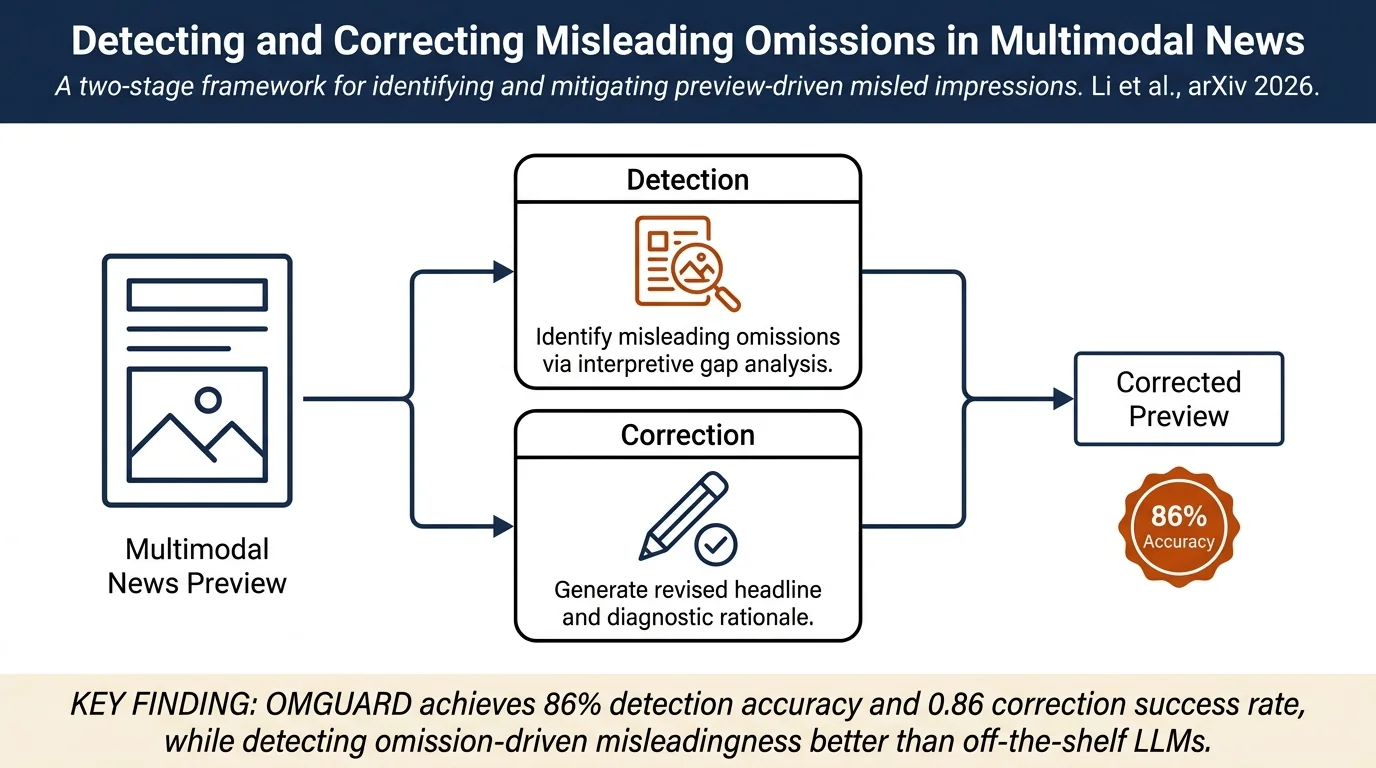
News previews (headline + image) on social media can mislead readers through selective omission of critical context present in the full article. This paper introduces MM-MISLEADING, a benchmark of 6,000 multimodal news previews annotated for misleading omissions, and proposes OMGUARD, a framework combining interpretation-aware fine-tuning for detection and rationale-guided correction that achieves 86% accuracy in identifying misled readers and substantially improves headline corrections.
Contributions
- MM-MISLEADING Benchmark: A dataset of 6,000 multimodal news previews (headline + image) with annotations capturing preview-based versus context-based understanding, enabling evaluation of omission-induced misleadingness.
- Problem Formulation: Formalizes misleading omissions as a semantic mismatch between preview interpretation and full-context interpretation, distinct from explicit fabrications.
- OMGUARD Framework: A two-stage approach combining (1) Interpretation-Aware Fine-Tuning using auxiliary reasoning context to detect omission-based misleadingness, and (2) Rationale-Guided Mitigation generating corrected headlines with explicit rationales explaining why they fix the misled impression.
- Comprehensive Analysis: Demonstrates that off-the-shelf LLMs systematically underdetect omission-based misleadingness; shows most cases stem from missing background/context rather than global reframing; identifies visual semantics as a limiting factor in text-only correction.
Method
The OMGUARD framework operates in two main stages:
Stage 1: Interpretation-Aware Fine-Tuning (Detection). Given a news preview (headline T, image I) and full article C, the model simulates a reader's preview-only understanding U_p and context-aware understanding U_c. These intermediate representations serve as auxiliary reasoning signals. The model is trained to detect misleading omissions by comparing U_p and U_c—if they diverge significantly in the perceived event nature, implications, or emotional valence, the preview is labeled misleading. Crucially, the loss is computed only on the final label prediction y (not on U_p or U_c directly), allowing the model to learn what interpretive gaps constitute misleadingness.
Stage 2: Rationale-Guided Correction. For detected misleading instances, the model generates a corrected headline T' under one of two protocols: (1) Minimal-Edit Revision (style preservation), prioritizing minor edits that preserve original tone while eliminating misled impressions; or (2) Free-Form Revision (factual restoration), rewriting headlines to maximize fidelity to the full context. A strict length constraint limits additions to ~3 words, ensuring practical usability. Rationales r explain why the preview misled and how the correction resolves it, providing diagnostic accountability.
The approach differs from standard label-only supervision by explicitly modeling the interpretive gap. Error analysis shows that omission-based misleadingness typically arises from local narrative shifts (missing background, omitted context) rather than global reframing, and that image-text coherence matters for correction—visual prototyping on 20 uncorrectable cases confirms that image replacement can mitigate 90% of image-driven misleadingness.
Results
Detection Performance: On the MM-MISLEADING benchmark, standard open-source LLMs (Qwen3-VL-8B, Llama3, InternVL3.5-8B) exhibit high overall accuracy (>80%) but poor recall on misleading instances, revealing a systematic blind spot in recognizing omission-based mismatch. In contrast, OMGUARD achieves 86% accuracy with balanced precision-recall (0.84 F1). The interpretation-aware auxiliary supervision significantly improves class balance and generalization, reducing error propagation from imperfect intermediate interpretations.
Mitigation (Correction Success Rate): OMGUARD's corrected headlines achieve >0.86 CSR (Correction Success Rate) under Minimal-Edit constraints and 0.72 under Free-Form constraints, substantially outperforming oracle baselines. High-quality rationales (generated by GPT-5 in the oracle setting) are essential—with oracle rationales, even smaller models achieve CSR ≥0.72; with self-generated rationales, CSR drops to 0.41. This perception-correction gap underscores the importance of accurate diagnosis for effective mitigation.
Frame Shift Analysis: Most misleading headlines undergo local narrative shifts rather than global reframing. Minimal-Edit revisions preserve stylistic continuity while shifting frames less effectively; Free-Form revisions achieve stronger frame alignment at the cost of original stylistic voice. Both settings fail to fully close the truthfulness gap, indicating that textual interventions alone cannot resolve image-driven misleadingness (CSR on text-fixable cases reaches 0.88 vs. 0.46 on image-driven cases).
Connections
- Related to Zhou and Zafarani's foundational A Survey of Fake News: Fundamental Theories, Detection Methods, and Opportunities via shared focus on detection methodology and multimodal signals.
- Extends work on Multimodal Misinformation Detection (e.g., DECEPTIONDECODED) by formalizing omission as a distinct class of misled understanding.
- Complements Visual misinformation research by showing visual semantics limit the effectiveness of text-only correction; proposes image replacement as necessary complement to headline revision.
- Related to interpretation-aware detection approaches in Fact-checking and corrections and Misinformation and fake news detection; contributions to Content moderation by enabling proactive headline correction before viral spread.
Notes
A rigorous treatment of a subtle but consequential failure mode in news consumption: omission-driven misled impressions. The paper's strength lies in problem formulation and benchmark construction—the clear distinction between explicit falsehoods and selective presentation fills a real gap. The two-stage pipeline (detect-then-correct) is sensible, though the perception-correction gap reveals that headline rewriting has hard limits; multimodal interventions (image selection) are flagged as necessary for image-driven cases. The interpretation-aware auxiliary supervision is clever but modest in impact compared to oracle rationale quality, suggesting that effective correction ultimately depends on high-fidelity diagnosis—a practical constraint in deployment. Worth noting: missing background and context account for ~67% of all misleadingness cases, indicating that the dominant mitigation strategy should be adding missing context rather than reframing.