Prompt-Induced Linguistic Fingerprints for LLM-Generated Fake News Detection
Authors: Chi Wang, Min Gao, Zongwei Wang, Junwei Yin, Kai Shu, Chenghua Lin
Venue: World Wide Web Conference (WWW), April 13–17, 2026, Dubai
TL;DR
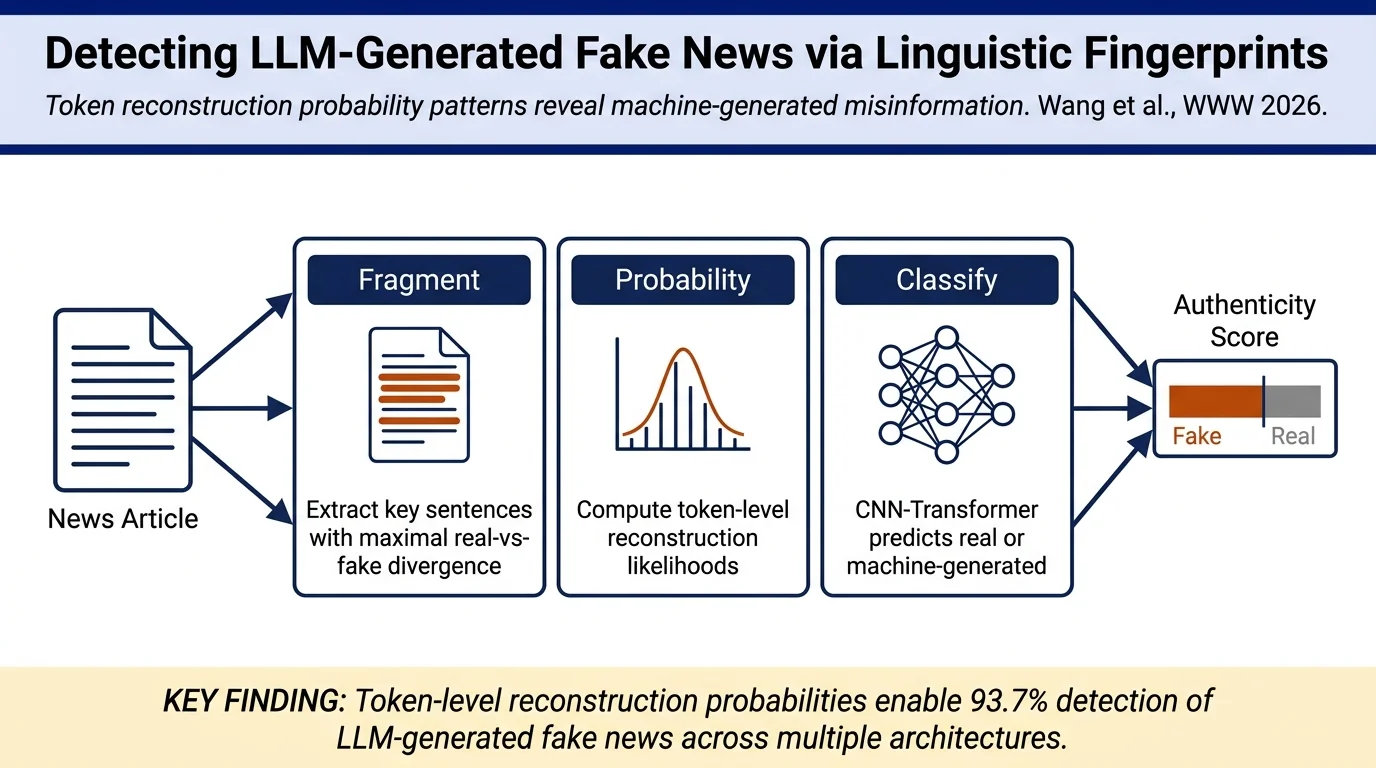
LLMs can generate convincing fake news, but malicious prompts induce consistent statistical divergences in token-level reconstruction probabilities. The authors propose LIFE (Linguistic Fingerprints Extraction), which identifies key fragments where real and fake news differ most in their probability signature, achieving 93.7% accuracy on standard benchmarks while generalizing across different LLM architectures and prompt styles.
Contributions
- First work to detect LLM-generated fake news by analyzing token-level reconstruction probabilities within LLMs, shifting focus from content features to the underlying generation process.
- Introduce Linguistic Fingerprints: empirically demonstrable probability shifts in how LLMs reconstruct tokens when processing real versus fake content under malicious prompting.
- Propose LIFE, a three-stage detection framework: key fragment extraction (identifying sentences where real/fake divergence is largest), probabilistic reconstruction module (computing token-likelihood probability vectors), and a CNN-Transformer classifier.
- Demonstrate state-of-the-art performance across five LLM-generated datasets (GossipCpp++, CoasiCpp++, VLFPN, GenFake variants) with strong generalization to unseen LLM architectures and human–LLM mixed datasets.
Method
The core insight is that malicious prompts subtly manipulate model outputs, creating detectable patterns in token reconstruction probability. LIFE operates in three stages:
Key Fragment Extraction: Rather than using full articles, the authors identify critical sentences where the model's decision boundary shifts when key words are masked. Using Kullback–Leibler divergence and information-theoretic masking, they select fragments where removal causes the largest posterior probability shift. This is more efficient than full-text analysis and isolates semantically important regions.
Reconstruction Probability Acquisition: For each key fragment, LIFE uses guided decoding to acquire the original token-level probabilities during reconstruction. For each token w_i, the model computes p(w_i | preceding context), capturing how the LLM's vocabulary distribution reflects the underlying generation patterns. These probabilities are aggregated into a vector P representing the linguistic fingerprint.
Sequence-Based Classification: The probability vectors P are fed into a CNN-Transformer architecture (combining local feature extraction via CNN with global dependencies via Transformer) to classify whether the news is fake or real. The classifier is trained with binary cross-entropy loss.
The method is grounded in cognitive science: humans engage distinct cognitive processes when evaluating true versus false information. LLMs that inherently mimic human-written fake news may exhibit cognitive pattern differences in their generative mechanisms.
Results
Tested on five LLM-generated datasets (GossipCpp++, CoasiCpp++, VLFPN, GenFake-GptNeo, GenFake-LLaMA2) plus a human–LLM mixed dataset:
- GossipCpp++: 0.937 accuracy, 0.924 F1
- CoasiCpp++: 0.937 accuracy, 0.924 F1
- VLFPN: 0.926 accuracy, 0.926 F1
- GenFake-GptNeo: Achieves superior performance to classical baselines (TextCNN, HAN, dEFEND/c, BERT, RoBERTa, L-Defense, SheepDog, BREAK, ChatGLM2-6B, LLaMA2-7B)
Ablation studies show that all three components (key fragment extraction, probabilistic reconstruction, Transformer classification) are essential. The method shows consistent gains of 1.07–2.9% accuracy on human-written datasets compared to sub-optimal variants, and maintains effectiveness across six different malicious prompt templates (factual distortion, emotional amplification, contextual fabrication variants).
Key fragment selection significantly improves performance: using fragments rather than full text increases accuracy from 55.17% to 71.82% on GossipCpp++, and from 50.40% to 63.20% on human–LLM mixed data.
Connections
- Deepfakes — overlaps on the problem of detecting machine-generated content
- LLM-generated content — focuses specifically on the challenge of LLM-based misinformation
- Linguistic Analysis of Fake News — applies stylometric and probability-based linguistic analysis to detection
- Prompt injection — exploits how adversarial prompts manipulate LLM behavior
- FakeNewsNet: A Data Repository with News Content, Social Context and Spatiotemporal — earlier work on fake news detection using graph and content features
Notes
Strengths: The insight to shift from content features to reconstruction-probability patterns is novel and well-motivated. The framework is theoretically grounded in information theory and cognitive science. Extensive experiments across multiple LLM architectures, datasets, and prompt styles demonstrate robustness and generalization. The case study (Figure 5) effectively visualizes how key fragments capture discriminative probability shifts.
Limitations: The method requires access to LLM logits during inference (reconstruction probabilities), limiting applicability to closed-source APIs. The evaluation is limited to English news; cross-lingual generalization is untested. While the paper evaluates on GossipCpp++ and synthetic datasets, real-world fake news often has richer contextual cues that may diminish the relative importance of linguistic fingerprints.
Follow-ups: Extending to multilingual settings, evaluating on naturally-occurring LLM-generated misinformation in the wild, and developing defenses that help LLMs generate less detectable fake news are natural next steps.