The Paradigm Shift: A Comprehensive Survey on Large Vision Language Models for Multimodal Fake News Detection¶
Authors: Wei Ai, Yilong Tan, Yuntao Shou, Tao Meng, Haowen Chen, Zhixiong He, Keqin Li
Venue: arXiv preprint, 2026 — arxiv:2601.15316
TL;DR¶
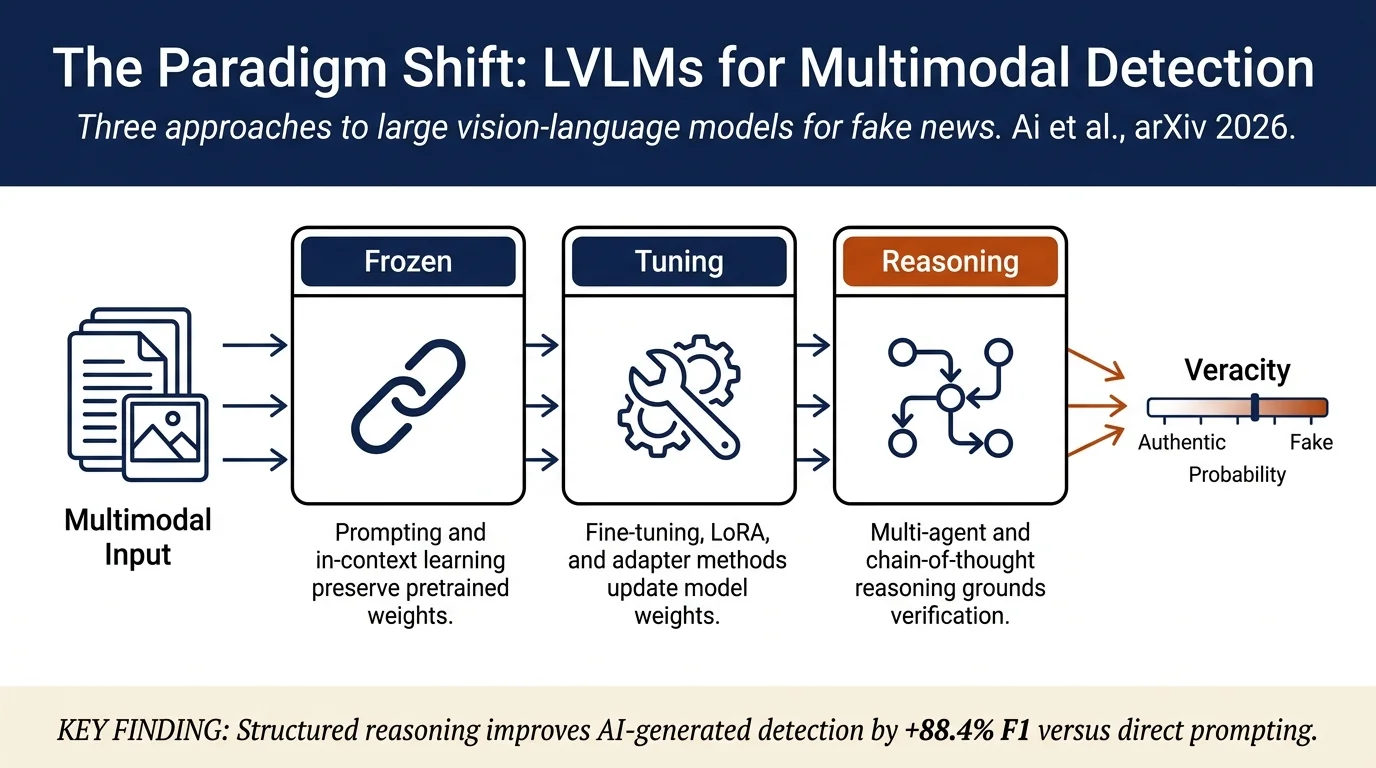
This comprehensive survey systematically reviews the application of Large Vision-Language Models (LVLMs) to multimodal fake news detection (MFND). It proposes a novel three-branch taxonomy categorizing current approaches into parameter-frozen, parameter-tuning, and reasoning paradigms, each addressing different resource constraints and adaptation trade-offs. The paper establishes a structured analytical framework encompassing model architectures, task formulations, training strategies, and evaluation metrics, then benchmarks representative methods across eight major datasets while identifying critical research gaps including causal reasoning, adversarial robustness, and knowledge-enhanced reasoning for improved generalization.
Contributions¶
-
Three-Branch Taxonomy: Proposes a principled taxonomy organizing LVLM-based MFND into three distinct paradigms: (1) Parameter-Frozen—preserving pretrained parameters via prompting and in-context learning; (2) Parameter-Tuning—adapting model weights through full fine-tuning, parameter-efficient methods (LoRA, prefix-tuning), and adapter-based approaches; (3) Reasoning—using multi-agent reasoning, chain-of-thought prompting, and evidence-grounded verification to enhance semantic reasoning and interpretability.
-
Comprehensive Review: Systematically documents the evolution from single-modal (text-only or image-only) fake news detection through early cross-modal fusion approaches to unified end-to-end multimodal reasoning frameworks leveraging joint vision-language representation learning.
-
Structured Analytical Framework: Establishes a unified conceptual framework encompassing: (i) model design principles and architectural variants; (ii) task formulation including problem definitions across unimodal and multimodal settings; (iii) training paradigms (supervised, few-shot, zero-shot, reinforcement learning from examples); (iv) evaluation metrics addressing classification performance, cross-modal consistency, and interpretability.
-
Multimodal Veracity Assessment Dimensions: Introduces a principled decomposition of multimodal deception into five interacting dimensions—(1) Media Authenticity (whether content is synthetic or altered), (2) Cross-Modal Consistency (semantic alignment between text and visual modalities), (3) Authenticity (credibility of sources and claims), (4) Intent (manipulative framing or persuasive devices), (5) Consistency in temporal and spatial context—providing unified evaluation lens across diverse misinformation types.
-
Comprehensive Benchmarking: Compares performance of representative LVLMs (GPT-4V, LLaVA, BLIP-2, InstructBLIP, Qwen-VL, VILLA, Flamingo, Kosmos-1) across eight diverse datasets (MM-FakeBench, Twitter, Fakeddit, MDAM-DB, Pheme, Twitter16, DriftBench, FakeSV) with ablation studies isolating the contributions of visual retrieval, structured reasoning, and evidence integration.
-
Future Research Roadmap: Identifies eight critical open challenges: (i) causal and counterfactual reasoning for explainable detection; (ii) adversarial robustness under out-of-distribution content variations; (iii) efficient, modular architectures for real-time deployment; (iv) inference-time mitigation of hallucinated visual content; (v) knowledge-enhanced LVLM adaptation leveraging external knowledge bases; (vi) improved benchmarks capturing semantic and visual distortions; (vii) domain and cross-lingual generalization; (viii) user perception and deployment considerations.
Method¶
Problem Formulation: Multimodal Fake News Detection (MFND) aims to assess veracity of multimodal claims—a set of text, images, video, and audio content—by reasoning over semantic inconsistencies, visual artifacts, and external knowledge. Formally, given claim \(c\), external context \(\kappa\), and multimodal evidence \(\mathcal{E}\), the task is to infer veracity label \(y \in \{0, 1\}\) (0 = fake, 1 = authentic) together with interpretable grounded rationale \(R\) supporting the decision.
Large Vision-Language Models: Modern LVLMs such as CLIP, BLIP-2, LLaVA, and GPT-4V integrate pretrained visual encoders (e.g., Vision Transformers, ResNets) with frozen or adapting LLM backbones to enable joint cross-modal representation learning and reasoning. Key architectural innovations enabling this paradigm include:
-
Unified Parameterization: LVLMs instantiate the factorization in Eq. 11 via explicit plugging of visual tokens alongside textual inputs, allowing the LLM to attend jointly over modalities. Claim-aware token streams encode claim text and visual content (via region embeddings or visual spans) into a shared semantic space.
-
Three-Paradigm Mechanistic Views:
- Parameter-Frozen (§3.1): Backbone LLM remains unchanged; task adaptation is realized purely through prompting and in-context specification. Prompts encode claim-conditioning instructions, evidence constraints, and structured exemplars. This paradigm offers fast deployment and high generalization at the cost of limited semantic fine-graining for implicit cross-modal inconsistencies.
- Parameter-Tuning (§3.2): Full fine-tuning or parameter-efficient methods (LoRA, prefix-tuning, adapters) update model weights to enhance multimodal alignment. Cross-modal aggregators (Eq. 16) learn task-aligned joint representations. Supervision is naturally multi-task, penalizing veracity, authenticity, consistency, and intent estimates jointly (Eq. 25). This paradigm trades computational cost for improved discriminative power and interpretability.
- Reasoning (§3.3): Methods employ explicit multi-step reasoning pipelines—evidence retrieval (Eq. 20), grounded rationale generation (Eq. 21), and claim-conditional verification (Eq. 18)—to decompose the detection task into interpretable sub-goals. Agent-based systems coordinate reasoning across modalities via reinforcement signals or chain-of-thought prompting, enabling causal and counterfactual reasoning pathways.
Evidence-Grounded Reasoning: A representative architecture (Figure 3, Framework 4) integrates direct prediction and reasoning mechanisms. Initial inference outputs veracity scores directly from input tokens. If external knowledge is needed, a multi-query generation module formulates news-related questions from claim title and keywords. Retrieved evidence from external sources (e.g., Wikipedia, fact-check databases) is filtered topically, then evidence snippets are extracted via HTML parsing. Evidence is refined through an additional reasoning pass, allowing refinement based on consistency between initial predictions and retrieved facts (Eq. 12), producing final output.
Evaluation Metrics: The paper systematizes evaluation across five key dimensions: - Classification Performance: Accuracy, Precision, Recall, F1-score, and per-class macro-F1 (§5) to capture fine-grained performance across minority misinformation types. - Cross-Modal Consistency: Distance \(D\) between modality-aligned embeddings (Eq. 8-9) quantifies semantic misalignment. - Authenticity and Intent: Score functions \(S_F\) and probabilistic models (Eq. 10) distinguish synthetic media and manipulative framing. - Interpretability: Grounded rationales \(R\) and visual evidence pointers (\(\mathcal{E}_v\), \(\mathcal{E}_t\)) enable auditing of model decisions. - Adversarial Robustness: Performance under controlled stylistic and semantic shifts (DriftBench, Table 7) demonstrates generalization.
Results¶
MM-FakeBench Benchmark (Table 3): Among models with 13B parameters, LLaVA-13B with MMD-Agent framework achieves 56.0 F1 (validation), substantially outperforming standard prompting baselines and single-modality methods. GPT-4V with MMD-Agent reaches 75.5 F1, reflecting the paradigm shift enabled by larger, more capable multimodal models. Models below 13B (7B parameters) exhibit macro-F1 scores under 50, highlighting the importance of scale in addressing cross-modal inconsistencies.
Twitter and Fakeddit Datasets (Table 4): LEMMA framework—combining initial-stage inference, multimodal evidence integration, and visual retrieval—achieves 0.824 accuracy and 0.816 F1 on Twitter, and 0.828 accuracy with 0.857 F1 on Fakeddit. Ablation studies show that removing visual retrieval reduces Twitter accuracy from 0.824 to 0.809 (−1.5%), demonstrating the value of external multimodal evidence. Baseline methods like FacTool and InstructBLIP struggle with conflicting content (precision 0.273, recall 0.082 on non-rumor factual conflicts), revealing limitations in distinguishing authentic from misleading visual cues.
MDAM-DB Benchmark (Table 5): Evaluating across four misinformation categories (fact-conflicting, AI-generated, offensive, out-of-context), MMVD framework demonstrates strongest generalization. GPT-4V with direct prompting achieves 0.853 accuracy (fact-conflicting), but this drops to 0.491 on AI-generated content, indicating challenges in detecting synthetic media. The MMD-Agent framework improves AI-generated detection from 0.491 to 0.924 via structured reasoning, a +88.4% relative gain, underscoring the value of decomposed reasoning for semantic grounding.
DriftBench Results (Table 7): Under controlled stylistic and semantic shifts, models exhibit considerable fragility. GPT-4V-mini accuracy drops from 83.3% (realistic distribution) to 64.4% (−18.9%) under diversified content, while CMIE (cross-modal inconsistency aware) maintains 88.8%, demonstrating the importance of explicit consistency objectives. SNIFFER and LEMMA show better stability (76.2–83.3% vs. 50.1–67% for generic LVLMs), highlighting that specialized multimodal fusion mechanisms significantly improve robustness.
Cross-Domain Generalization (Table 9): TRUST-VL framework achieves state-of-the-art out-of-domain performance, with 82.75 F1 on MMFakeBench and 73.75 F1 on VERITE, substantially outperforming general LVLMs (GPT-4V 50.75 F1 on VERITE). Results underscore that domain-aware adaptation and multimodal alignment constraints are essential for generalization across diverse misinformation distributions.
Connections¶
-
Cao et al. (2023) — A Comprehensive Survey of AI-Generated Content (AIGC) — covers generative AI foundations (GANs to transformers, foundation models) necessary for understanding AI-generated misinformation that LVLMs must detect.
-
Chang et al. (2023) — A Survey on Evaluation of Large Language Models — provides evaluation methodologies and trustworthiness criteria relevant to assessing LLM-based fake news detection systems.
-
Chen et al. (2024) — Can LLM-Generated Misinformation Be Detected? — directly addresses detection of LLM-generated false claims, a key application of multimodal LVLMs.
-
Su et al. (2023) — Adapting Fake News Detection to the Era of Large Language Models — contemporary work on aligning traditional fake news detection methods with LLM capabilities.
-
Zhou & Zafarani (2020) — A Survey of Fake News — foundational survey of pre-LVLM fake news detection methods that this work builds upon and supersedes for multimodal scenarios.
-
Shu et al. (2020) — Mining Disinformation and Fake News — comprehensive coverage of user engagement, weak supervision, and broader detection landscape.
-
Multimodal Fake News Detection — cross-referenced topic covering diverse methodological approaches beyond LVLMs.
-
Multimodal Learning — foundational techniques for joint vision-language representation learning underlying LVLM architectures.
-
Cross-modal reasoning — key capability that LVLMs bring to misinformation detection via aligned multimodal inference.
Notes¶
Strengths: This is the first comprehensive survey to systematically document and categorize the role of LVLMs in multimodal fake news detection. The three-branch taxonomy (parameter-frozen, parameter-tuning, reasoning) provides a practical organizing principle reflecting real resource constraints and adaptation trade-offs. The five-dimensional framework for multimodal deception (media authenticity, consistency, source credibility, intent, temporal context) offers novel structure beyond binary veracity assessment. Extensive benchmarking across eight datasets with ablation studies isolates the value of individual components (visual retrieval, reasoning, evidence integration) and demonstrates significant improvements (e.g., +88.4% F1 on AI-generated detection via structured reasoning). The identification of eight future research directions provides actionable roadmap for the community.
Weaknesses: While comprehensive, the survey is heavily focused on closed-source proprietary LVLMs (GPT-4V) and well-resourced open models (13B+ parameters), with limited discussion of resource-efficient alternatives or deployment considerations for real-world platforms with computational constraints. The evaluation is largely empirical and dataset-centric; stronger treatment of causal and counterfactual reasoning for explainability (Section 7.1) is promised but underdeveloped. The paper does not deeply engage with the broader sociotechnical context—platform-specific moderation rules, legal/regulatory requirements, or user-in-the-loop workflows—that constrain practical deployment. Finally, multimodal hallucination (Section 7.4) remains an open challenge with only preliminary mitigation strategies proposed; more concrete methods for inference-time hallucination detection would strengthen practical utility.
Impact & Relevance: This survey arrives at a critical inflection point where LVLMs have become mainstream in NLP and vision systems, and multimodal misinformation is accelerating (deepfakes, AI-generated media, synthetic imagery). By providing a principled taxonomy and comprehensive benchmarking, the work enables researchers and practitioners to position their contributions, identify gaps, and prioritize resource allocation. The reasoning paradigm (Section 3.3) is particularly novel, pushing beyond traditional fine-tuning toward interpretable, grounded detection—a necessary evolution as misinformation becomes more sophisticated.