Debunk and Infer: Multimodal Fake News Detection via Diffusion-Generated Evidence and LLM Reasoning
Authors: Kaiying Yan, Moyang Liu, Yukun Liu, Ruibo Fu, Zhengqi Wen, Jianhua Tao, Xuefei Liu Venue: arXiv preprint, June 2025 — arXiv:2506.21557
TL;DR
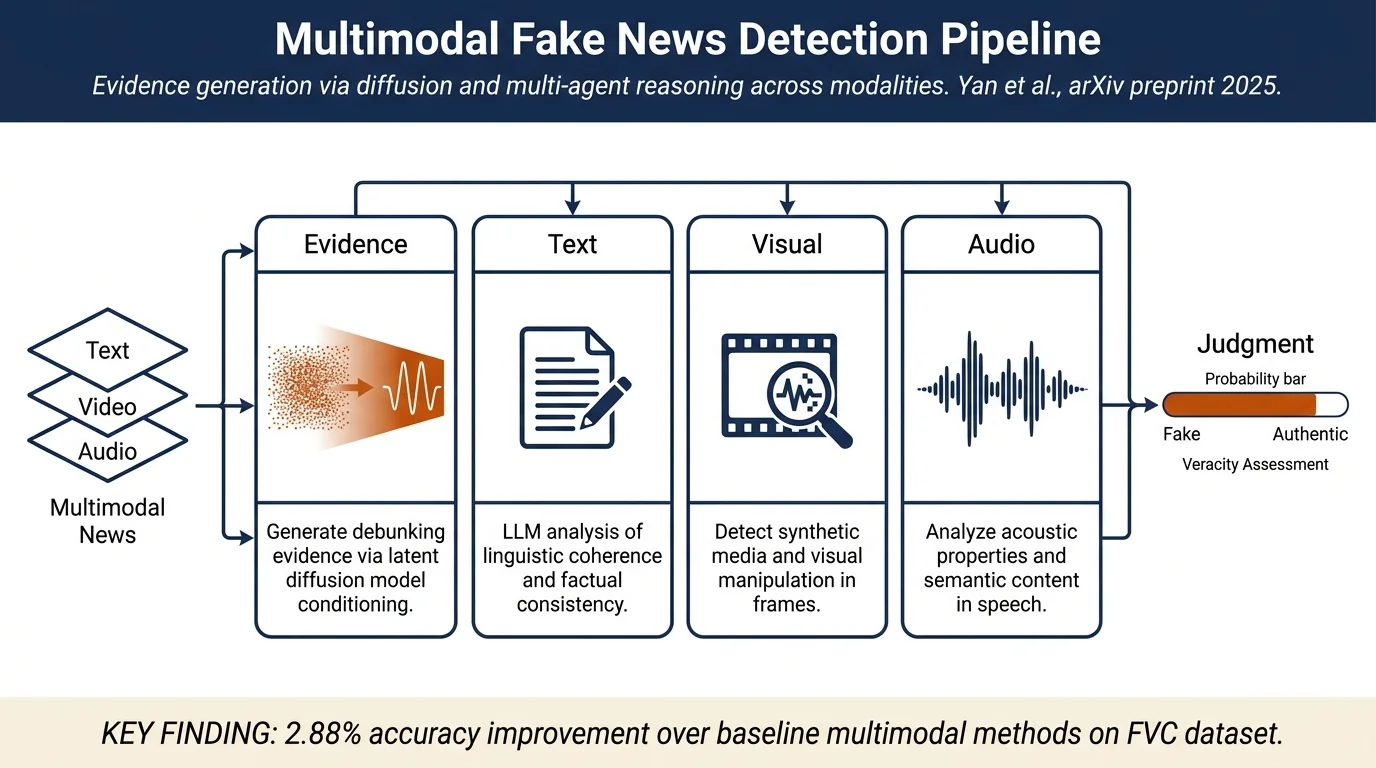
This paper introduces DIFND, a framework for multimodal fake news detection that generates refuting/authenticating evidence via diffusion models and performs reasoning over multimodal content using large language models (LLMs). The approach uses a chain-of-debunk strategy where multiple MLLMs act as collaborative agents to assess news authenticity across text, audio, and visual modalities, achieving notable improvements on FakeSV and FVC datasets.
Contributions
- DIFND framework — A debunk-and-infer approach integrating diffusion-based evidence generation with multimodal LLM reasoning for fake news detection.
- Debunk Diffusion mechanism — A conditional latent diffusion model that generates textual debunking evidence from multimedia content, trained to produce both refuting and authenticating statements.
- Chain of Debunk (CoD) — A multi-agent reasoning strategy where multiple MLLMs independently analyze different modalities (text, video keyframes, audio), then synthesize their conclusions for robust veracity judgment.
- Empirical validation — Demonstrates 2.33% and 2.88% accuracy improvements over existing multimodal methods on FakeSV and FVC datasets respectively, with ablations showing the contribution of each component.
Method
The framework consists of two main stages:
Debunk Diffusion
Rather than merely refuting false claims, the paper proposes a broader concept of debunking that encompasses both refutation and authentication of true information. A conditional latent diffusion model generates textual evidence from learned debunking feature distributions:
- Compression Network — Transforms high-dimensional text features into compact latent space optimized for diffusion
- Conditional Latent Diffusion — Forward process adds noise to debunk features guided by multimodal conditioning (text embeddings, vision features, audio features). Reverse process denoises iteratively to reconstruct debunking evidence.
- Multimodal Conditioning — Uses Sinusoidal positional encoding to embed multimodal conditions so they guide the denoising process
- Self-Refinement Network — Filters noise and refines generated debunking features
Chain of Debunk (CoD)
Multiple MLLMs are deployed as collaborative agents analyzing the news item from different perspectives:
- Text Analysis Agent — Examines on-screen text, linguistic coherence, and factual consistency using a specialized LLM (Deepseek-R1)
- Video Understanding Agent — Processes video keyframes and conducts visual analysis for synthetic media or manipulation detection
- Audio Analysis Agent — Analyzes audio properties using GLM-4-Voice to capture semantic meaning and emotional tone
- Comprehensive Reasoning — Synthesizes outputs from all agents via multi-layer fusion and attention mechanisms; integrates cross-modal consistency checks
The outputs from debunk diffusion and chain-of-debunk are fused via an attention-based mechanism to produce the final veracity judgment.
Results
Extensive experiments on two datasets show:
FakeSV dataset (Chinese fake news videos): - DIFND: 87.68% accuracy, 87.34% F1, 87.02% recall, 87.87% precision - Improvement over best baseline (Fakinrecipe): +2.33% accuracy
FVC dataset (multilingual videos with diverse content): - DIFND: 92.16% accuracy, 92.01% F1, 92.21% recall, 91.88% precision - Improvement over best baseline (MMSD): +2.88% accuracy
Ablation studies (Table II): - Diffusion Diffusion alone: 75.70% accuracy on FakeSV - Adding Chain of Debunk: 86.21% (10.51% improvement) - Full model with all components: 87.68% - Debunk data augmentation contributes 1.89% improvement, evidencing the utility of LLM-generated evidence
All components contribute meaningfully; visual and audio modalities provide complementary signals to text-based reasoning, with visual cues most influential.
Connections
- Related to Multimodal fake news detection via fusion of text, visual, and audio modalities for veracity assessment
- Builds on Large Language Models by deploying MLLMs as collaborative reasoning agents
- Extends Evidence-based fake news detection by generating debunking evidence synthetically via diffusion models rather than relying solely on external sources
- Related to Debunking and correction interventions through its focus on generating refuting and authenticating evidence
- Focuses on video-based fake news detection through explicit video frame and audio analysis
Notes
Strengths: - Novel application of diffusion models to generate debunking evidence in a controlled, multimodal setting - Thoughtful decomposition of reasoning tasks across multiple agents with specialized prompts for each modality - Comprehensive ablation studies quantifying the contribution of diffusion, each modality, and data augmentation - Consistent improvements on two diverse datasets (Chinese and multilingual) suggest generalizability
Considerations: - Relies on access to multiple specialized LLMs (Deepseek-R1, GLM-4-Voice) which may limit reproducibility and deployment scalability - Computational cost not discussed; inference time across multiple agent executions likely substantial compared to single-model baselines - Evaluation limited to two datasets; cross-dataset generalization (especially to Western platforms like Twitter/X) not demonstrated - Chain-of-debunk generates interpretable reasoning chains, but the paper does not analyze failure modes or compare explanation quality against simpler baselines