Prevalence of Health Misinformation on Social Media: Systematic Review
Authors: Victor Suarez-Lledo, Javier Alvarez-Galvez Venue: Journal of Medical Internet Research, 2021 — DOI
TL;DR
Systematic review of 69 studies examining health misinformation prevalence across social media platforms. Vaccines, drugs, and smoking are the most-studied topics; Twitter is the primary platform for misinformation about smoking and substances, while vaccines are discussed broadly across platforms. The review provides a taxonomy of dominant misinformation topics and methodologies used for their detection.
Contributions
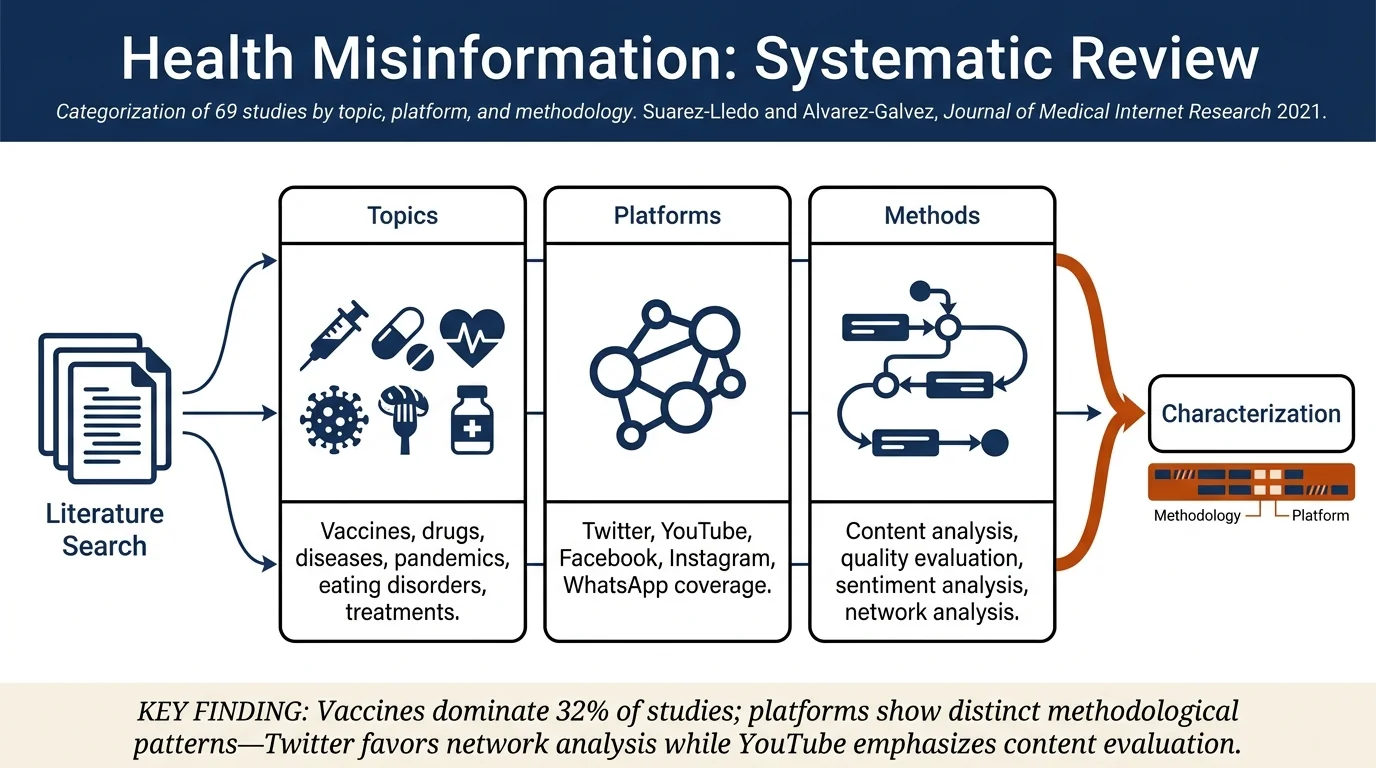
- Comprehensive survey of health misinformation topics on social media (vaccines, drugs, noncommunicable diseases, pandemics, eating disorders, medical treatments)
- Comparative analysis of misinformation prevalence across major platforms (Twitter, YouTube, Facebook, Instagram, WhatsApp)
- Systematic characterization of research methodologies (content analysis, sentiment analysis, social network analysis, quality evaluation)
- Identification of gaps and recommendations for future research in health misinformation
Method
The study conducted a systematic review following PRISMA guidelines, searching PubMed, MEDLINE, Scopus, and Web of Science for articles published before March 2019. Inclusion criteria focused on studies of health misinformation on social media. Data extraction covered descriptive information (27 items), search strategy evaluation (8 items), information quality (6 items), and research methodology quality (15 items). Studies were classified into five methodological categories: content/textual analysis, quality evaluation, sentiment analysis, social network analysis, and sentiment analysis techniques. The review assessed quality using composite scoring (S score, E score, Q score) and analyzed prevalence by topic and platform.
Results
69 studies met inclusion criteria, covering a range of health topics and social media platforms:
Topic prevalence: Vaccines dominated 32% (22/69) of studies; drugs or smoking 22% (15/69); noncommunicable diseases 19% (13/69); pandemics 10% (7/69); eating disorders 9% (6/69); medical treatments 7% (5/69).
Platform prevalence: Twitter 29% (20/69), YouTube 23% (16/69), Facebook 9% (6/69); others (Instagram, WhatsApp, Pinterest, Tumblr, etc.) represented 29%.
Methodological patterns: Content/textual analysis 22% (15/69); quality evaluation 24% (16/69); sentiment analysis 6% (4/69); social network analysis 3% (2/69); multi-method approaches common. Among microblogging platforms (Twitter, Tumblr), social network analysis was the most common method (19% of studies). YouTube and Instagram emphasized content evaluation (22% and 16% respectively).
Topic-specific findings: - Vaccines: 32% of studies; often frame anti-vaccine narratives using pseudo-scientific language and appeal to anecdotal evidence; false claims about HPV vaccines and general vaccination hesitancy widespread - Drugs and smoking: 22% of studies; misinformation promotes consumption of opioids, marijuana, e-cigarettes; promotion of alternative forms (hookah, water pipes); posts praising drugs reach 87% misinformation rates in some studies - Noncommunicable diseases: 13% of studies; focus on cancer, diabetes, epilepsy; YouTube is primary platform; discuss usefulness and accuracy of information - Pandemics: 10% of studies; COVID-19 pandemic elevated awareness of pandemic-related misinformation; social media used as forum for sharing false health information - Eating disorders: 9% of studies; pro-eating disorder communities on social media; pro-anorexia and bulimia discussions; support for unhealthy weight loss practices - Medical treatments: 7% of studies; lowest misinformation prevalence; most content from official sources, making false information less prevalent
Connections
- Related to Misinformation and fake news detection via methodological approaches (content analysis, sentiment analysis, network analysis)
- Complements Vaccine hesitancy and vaccine safety concerns literature on anti-vaccine narratives in online spaces
- Related to Content moderation via discussion of platform responses and interventions
- Connected to Social Media Analysis methodologies for studying information spread
- Related to Substance Abuse and Drug Misinformation discourse and misinformation about drugs and controlled substances
Notes
Strengths: First systematic effort to quantify health misinformation prevalence with comparable metrics across diverse topics and platforms. Comprehensive methodology characterization reveals that different platforms attract different analytical approaches — Twitter studies emphasize network analysis while YouTube studies focus on content evaluation, suggesting platform-specific affordances shape research design.
Gaps: Definition of health misinformation is broad and contextual; heterogeneity in methodologies makes cross-study comparison difficult. Study limited to English-language journals and articles published before March 2019. Missing perspectives on mechanisms that make certain health topics more susceptible to misinformation (emotional framing, uncertainty, lack of expert consensus). Limited discussion of interventions or platform-level moderation strategies.
Implications: The dominance of vaccine-related misinformation across platforms suggests urgent need for coordinated fact-checking and counter-messaging. The relative scarcity of studies on medical treatments contrasts with high prevalence on other health topics, indicating potential blind spot. Eating disorder communities represent a distinct phenomenon where misinformation is intertwined with identity and community support — standard detection methods may be insufficient.