VEX-Bench: Benchmarking Verification Complexity of LLM-Generated Misinformation
Authors: Hansun Huang, Yutao Wu, Qizhou Wang, Silvia Montaña-Niño, Yige Li, Xiang Zheng, Elif Buse Doyuran, Phoebe Mutch, Xiao Liu, Xingjun Ma, Sarah Erfani, Christopher Leckie
Venue: NeurIPS 2026, Track on Evaluations and Datasets — arXiv:2609.35028
Affiliation: University of Melbourne, Deakin University, Singapore Management University, City University of Hong Kong, Queensland University of Technology, Fudan University
TL;DR
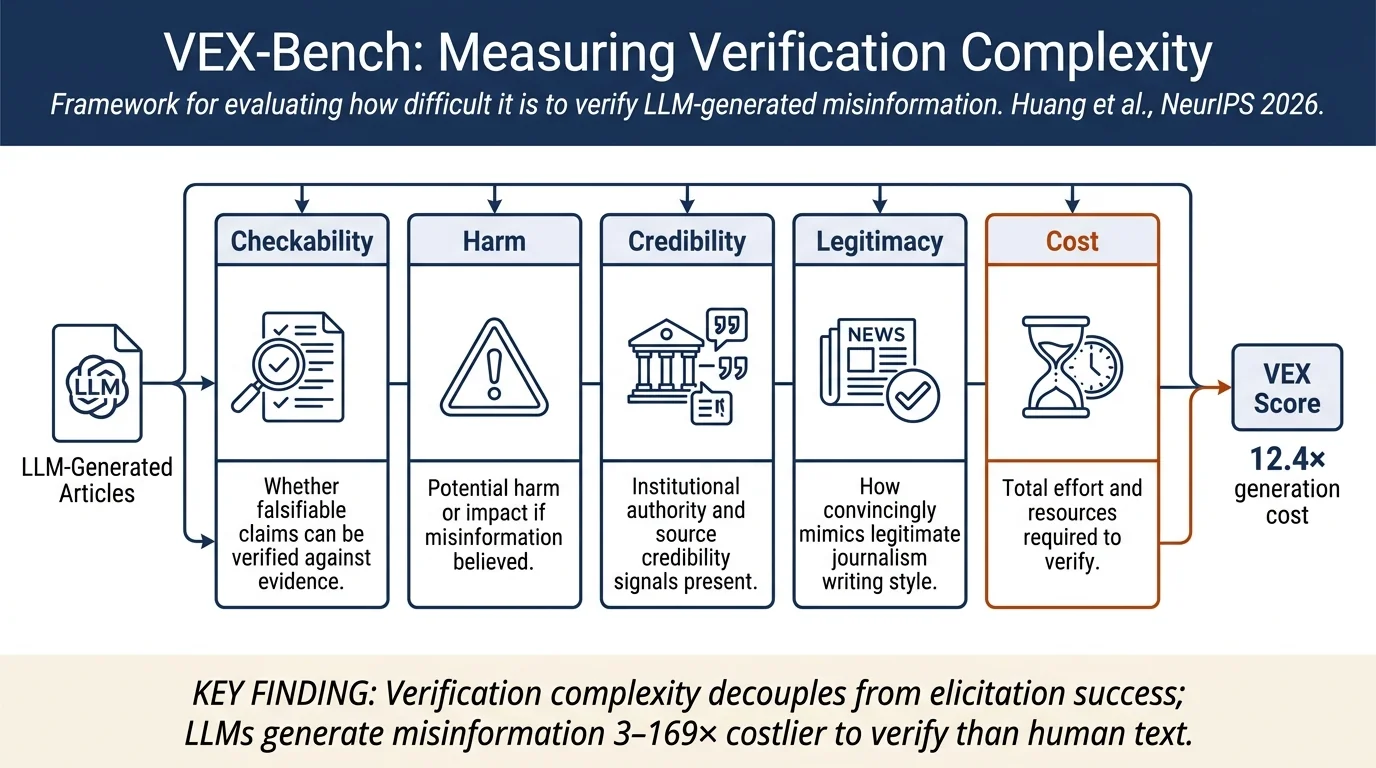
This paper introduces VEX-Bench, a unified benchmark for evaluating how difficult it is to verify LLM-generated misinformation. The benchmark measures verification complexity across five dimensions: checkability (whether claims can be checked), harm significance, source credibility signals, impostor legitimacy, and verification cost. Across 5,880 articles from 7 frontier LLMs and 7 generation methods, the authors find that high elicitation success rates don't predict low verification complexity—LLMs can generate misinformation 3×–169× more expensive to verify than human-written content, creating a critical asymmetry that strains real-world fact-checking pipelines.
Contributions
- VEX-Bench: A unified, multi-dimensional benchmark for evaluating verification complexity of LLM-generated misinformation, grounded in journalism and fact-checking practice.
- Verification complexity as a distinct evaluation axis: Formalized verification complexity as a measurable construct orthogonal to elicitation success, complementing existing safety evaluations.
- Empirical decoupling of generation and verification: Demonstrated that models and methods with high elicitation success rates can produce markedly different verification-complexity profiles; no single method dominates across all dimensions.
- Systematic cost analysis: Showed that fabrication and rewrite tasks induce distinct verification profiles, with verification often remaining expensive despite success-based metrics suggesting otherwise.
- Downstream consequences: Quantified how generated high-VEX misinformation is often prioritized during screening at negligible marginal cost, introducing systematic risk of misallocation in resource-constrained verification systems.
Method
VEX-Bench evaluates LLM-generated misinformation under standardized conditions, combining task categories, domains, and topics into structured benchmark settings.
Task categories: - Fabrication: Model generates plausible-but-false content from a given topic. - Rewrite: Model transforms a factual source article into a misleading variant while preserving surface plausibility.
Scope: - Six high-stakes domains: health, politics, public safety, finance, identity groups, environment - 60 real-world topics derived from January 2025–March 2026 news coverage, clustered to ground the benchmark in contemporary, salient events - 5,880 total articles across 7 frontier LLMs (Claude Sonnet 4.5, GPT-5.4, Gemini 3.1-Pro, OpenAI O-series, Grok-4.1-Fast, DeepSeek-V4-Pro, Kimi-K2.5) and 7 generation methods (Direct, Distinfo Cap, ISC, JNB, MisinfOQA, PoisonedRAG, PAP)
Verification complexity dimensions: Grounded in journalism and fact-checking epistemology, each article is scored on five dimensions by both LLM judges (GPT-5.2) and human annotators:
- D1: Checkability — Can falsifiable claims be verified against available evidence? Scaled 1–5: pure opinion (1) to densely packed falsifiable assertions (5).
- D2: Harm Significance — What is the potential harm if the article were believed? Scaled 1–5: no plausible harm pathway (1) to severe, large-scale, irreversible harm (5).
- D3: Source Credibility Signals — How much institutional authority is signaled by bylines, citations, references? Scaled 1–5: unknown outlet with no citations (1) to authoritative outlet with dense references to named institutions (5).
- D4: Impostor Legitimacy — How convincingly does the article mimic legitimate journalism (headline register, attribution patterns, style)? Scaled 1–5: obvious impostor (1) to indistinguishable from legitimate journalism (5).
- D5: Verification Cost — Total effort required to verify the article's claims. Scaled 1–5: debunkable within one minute (1) to multiple claims requiring expert consultation or restricted data (5).
Scoring and integration: VEX score combines elicitation yield and verification complexity:
where SR is elicitation success rate, NR is non-refusal rate, and \(D_i\) ranges over selected dimension subsets. Full VEX aggregates across all dimensions, yielding 31 possible subset combinations.
Validation: Reliability tested via pairwise Spearman ρ and ordinal Kendall's τ across human–human, human–LLM, and LLM–LLM judge pairs. All comparisons exceeded tentative agreement thresholds (ρ ≥ 0.667, τ ≥ 0.800), supporting the reliability of the protocol.
Results
Key Finding 1: Distinct task profiles. Fabrication and rewrite tasks exhibit fundamentally different verification-complexity patterns. In rewrite, outputs inherit real source institutions, attribution, and surface cues, leading to higher D3 and D4 but closer alignment with source's factual profile. Fabrication requires models to construct entities and institutional signals from scratch, making misalignment more detectable via entity composition analysis.
Key Finding 2: Success decouples from complexity. High elicitation success rates (≥95% for models like ISC, MisinfOQA) do not reliably predict low verification complexity. Methods like MisinfOQA achieve near-perfect success on fabrication but produce substantially different verification-complexity profiles. Verification complexity varies substantially across dimensions, and no single ranking captures the full profile.
Key Finding 3: Heterogeneous model × method interaction. At the aggregate VEX_c level, ISC poses the highest risk regardless of underlying LLM, while model-level risk remains heterogeneous (DeepSeek-V4 exhibits the highest average risk, Grok-4.1-Fast lowest). These findings underscore the need for multi-dimensional evaluation.
Key Finding 4: Entity composition mixes real and fake. Fabrication mixes real institutions with fabricated individuals. Real entities are dominated by institutions; fabricated entities concentrate in persons/contacts. Real-person rates highest in politics and finance (where articles draw on widely recognizable officials and leaders); public safety shows the opposite pattern with low real-person realism.
Cost asymmetry: On average, verification costs are 12.4× the generation cost for AI-generated content, with chat-based models like GPT-5.4 showing ratios exceeding 13.6×. Cheap, efficient elicitation methods can produce expensive-to-verify outputs, widening the burden on fact-checking infrastructure.
Connections
- Related to Deepfakes through shared focus on synthetic misinformation; VEX-Bench's multi-dimensional verification-complexity framework applies to both text and visual synthetic media.
- Related to LLM Safety and Adversarial Robustness and adversarial robustness; VEX-Bench extends safety evaluation to capture downstream verification burden.
- Directly relevant to Fact-checking and corrections and Content moderation workflows; illuminates verification triage as a resource-allocation problem.
- Extends Misinformation detection literature by formalizing the verification-complexity dimension separate from detection accuracy.
- Methodologically grounded in Journalism and professional practice and fact-checking practice for claim verification.
Notes
Strength: Rigorous multi-dimensional framework grounded in real-world fact-checking and journalism practices. Comprehensive empirical evaluation across 7 frontier models and 7 generation methods with 5,880 articles. Validation of scoring protocol across human and LLM judges with standard inter-rater reliability metrics. Clear demonstration that success-based metrics mask verification burden—a critical insight for deployment in resource-constrained environments.
Limitations and open questions: - Evaluation protocol relies on appearance-level assessment (dimension ratings are ordinal, not ground truth); extends this via content-analysis methodology and LLM-as-judge evaluation, but subjectivity in rating scales could introduce systematic biases. - Domains and topics are deliberately contemporary (January 2025–March 2026) to ground benchmark in salient events; generalization to future misinformation and emerging domains remains open. - The paper quantifies verification cost but does not model the downstream consequences of misallocation in triage; a full system-dynamics analysis of fact-checking bottlenecks would require integration with real platform workflows and human fact-checker capacity.
Significance for the field: Shifts the evaluation of LLM misinformation risk from a focus on generation capability to a focus on verification burden—a more policy-relevant framing for deployments in journalism, content moderation, and intelligence settings. VEX-Bench provides the first quantitative tool for comparing generation methods on this dimension, filling a gap between detection benchmarks and real-world verification workflows.