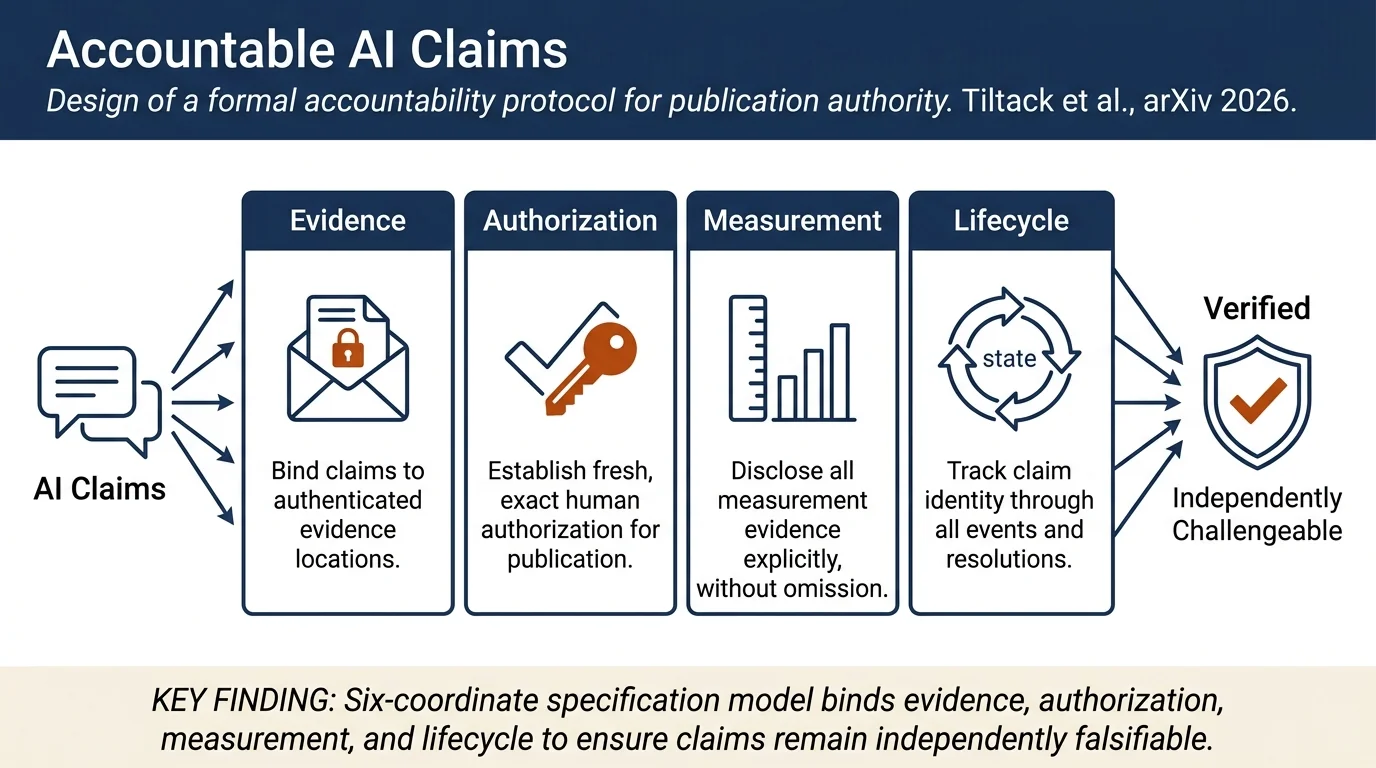
Making AI-Assisted Claims Independently Challengeable
Authors: Torsten Olivi Tiltack, Yifei Dong, Kun Yu, Xu Wang, Wei Liu, Jianlong Zhou, Ren Ping Liu, Fang Chen
Venue: arXiv, 2026 — arxiv:2609.17631
TL;DR
AI-assisted claims can appear authoritative even when evidence, analysis, and authorization refer to different states—creating a coordination problem. This work introduces Publication Authority (PA) as a non-transferable, single-use capability governing publication transitions, and proposes PAC-2026 SF-4, an executable specification artifact that binds evidence, authorization, measurement, and lifecycle events to ensure claims remain independently challengeable and falsifiable.
Contributions
- Publication Authority: Defines PA as a derived capability that grants permission to publish an explicit, checkable consequence of the fixed recorded state. PA is non-transferable and exists only when every mandatory publication obligation has a fresh, exact-target passing result.
- PAC-2026 SF-4 as executible specification: An executable specification defining how PA operates through six coordinates (evidence closure, run/artifact closure, measurement disclosure, exact authorization, surface correspondence, lifecycle continuity), with formally defined transition rules and failure classes.
- Five laws for accountable publication: Accountability Closure, Authorization Freshness, Epistemic Non-Amplification, Semantic Surface Preservation, and Continuing Challengeability—design constraints ensuring PA's derivation and preservation.
Method
The authors use a Design Science Research (DSR) methodology to develop and evaluate PA. The core artifact is the fixed-profile PAC-2026 SF-4 specification, which instantiates PA through six orthogonal coordinates:
- Evidence closure (E): Claim-evidence loci must resolve to authenticated locations under the candidate policy.
- Run/artifact closure (R): Profile-required run IDs, states, targets, and artifact digests must be exact and typed.
- Measurement disclosure (M): Measurement evidence is explicit, with required supporting records and no ambiguous omissions.
- Exact authorization (A): Human authorization is authenticated, binding exact candidate, actor, authority, scope, disposition, and time.
- Surface correspondence (S): Registered reader surface must reconstruct the candidate's exact Core projection.
- Lifecycle continuity (L): Publication and subsequent events (challenge, resolution, correction) remain bound to exact candidate identity through authenticated lifecycle state machine.
The evaluation tests semantic coherence (schema and registry validation), bounded safety (invariant preservation across 110,764 reachable states and 76 unsafe configurations), targeted fault sensitivity (localized mutation coverage), and constructibility (historical implementation lineage and backward compatibility).
Results
- Semantic coherence: 36 schemas, 53 typed reason codes, all 21 SF-4 tuples matched declared tuples; all 17 SF-3 cases retained as passing regressions.
- Bounded safety: 110,764 distinct reachable safe states without invariant violation; 76 unsafe configurations produced expected violations or blind spot outcomes.
- Targeted fault sensitivity: Declared mutations were localized; non-pass paths did not produce Publication Authority.
- Constructibility: All 17 SF-3 successor cases matched; same 373 tests passed in source; exact-source distribution matched; selected prior cases reproduced historical behavior.
The historical rival comparison (comparing PAC-2026 SF-4 against 40 exact sources, 6 aggregate records, 45 search events, and author mappings) confirmed that pre-cut-off sources lacked novelty evidence but were retained as method history.
Connections
- Related to Content moderation via publication accountability and verification workflows.
- Related to Fact-checking and corrections through formalization of evidence-claim binding and falsifiability.
- Methodologically aligned with Verification protocols and registered reports practices.
- Connects to Misinformation by ensuring AI-assisted content can be independently challenged.
- Related to evidence-based fact verification through formalization of provenance and authorization workflows.
Notes
Strengths: The paper makes an important conceptual contribution—formalizing what it means for an AI-assisted claim to be "independently challengeable." The design science methodology is rigorous, with clear failure-class definitions and bounded evaluation. The PAC-2026 SF-4 specification is machine-readable and testable, moving beyond purely theoretical accountability frameworks. The six-coordinate model separates concerns (evidence, authorization, measurement, lifecycle) without artificial coupling.
Limitations and open questions: The evaluation is artificial (executable schemas and controlled finite models) rather than on deployed systems with real stakeholders. The paper defers to external standards (CIPA, SCITT, RATS) for some components, leaving open questions about how PA integrates with existing publication workflows. The correspondence between the frozen specification and implementations of it in practice remains uncertain. Field utility and adoption barriers are not addressed.
Significance: This work is timely. As AI systems generate more claims embedded in publications, provenance and challenge-ability mechanisms become critical to preventing false claims from acquiring false authority. The paper advances the state of the art by moving from informal transparency principles (e.g., "disclose your methods") to formal, executable verification semantics.