When Platforms Pay Users to Correct Misinformation: Revenue Incentives and Governance Capacity in Weibo Annotations
Authors: Chichen Lin, Huajin Xie, Wenhan Xie, Weijian Fan, Xiao Han, Xiaojie Hao, Yijie Jin, Jiaying Wu
Venue: arXiv cs.SI, 2026 — arXiv:2610.18668
TL;DR
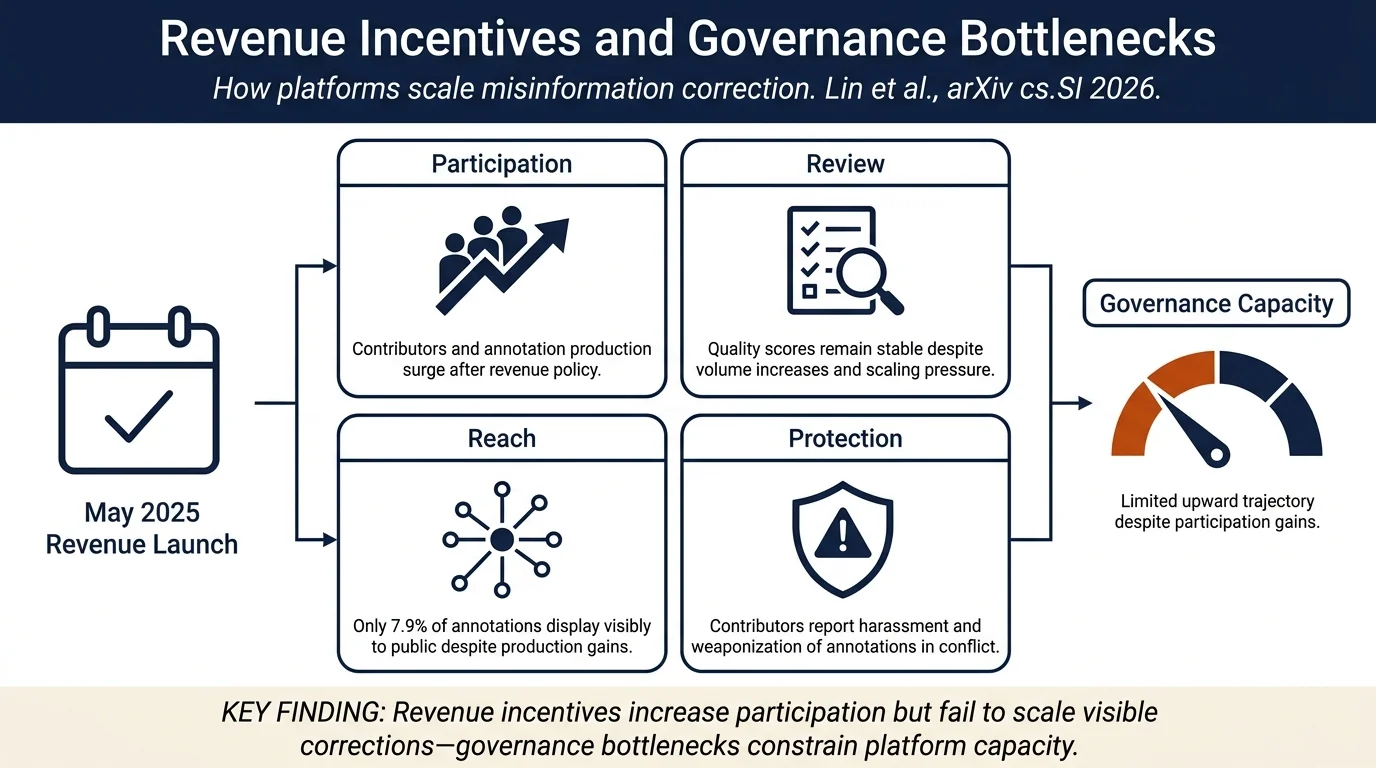
Weibo Annotations is a crowdsourced governance system that lets users add corrections and contextual information to disputed claims. In May 2025, Weibo introduced monetary rewards for approved annotations. This mixed-methods study of 102,994 posts and 431,407 comments (Aug 2023–Jul 2026) shows that revenue incentives substantially increased contributor participation and annotation production, but gains in visible corrections and engagement fell short of growth in submission volume. Four governance bottlenecks—participation, review, reach, and protection—constrain the system's ability to scale corrective labor.
Contributions
- Mixed-methods examination of how monetary incentives reshape participation in crowdsourced misinformation governance, using corpus analysis, policy counterfactual modeling, public discourse analysis, and interviews with 15 contributors.
- Empirical quantification of the four governance bottlenecks that emerge when platforms attempt to expand corrective labor capacity: uneven verification effort, constrained review feedback, limited public visibility, and users' vulnerability to harassment and manipulation.
- Characterization of "governance orchestration"—the coordination of participation, review, public reach, and contributor protection—as a constraint on scaling crowdsourced corrections.
Method
The authors analyzed Weibo Annotations between August 2023 and July 2026, spanning the introduction of the Revenue Incentive Model in May 2025. The corpus comprises 102,994 retrieved posts and 431,407 comments. They combined four complementary analytical approaches:
Step 1: Corpus and measures. Human-labeled alignment and held-out test sets for post type, annotation quality, comment stance, and engagement; model-assisted annotation for scale.
Step 2: Four analytical lenses. (A) Structural analysis: contributor concentration, collection-time display, annotation quality versus engagement correlation. (B) Policy counterfactual analysis via Bayesian time-series: daily outcomes against the May 7, 2025 policy launch. (C) Public discourse analysis: semantic clustering of 1,100 mechanism-discussion candidates and 291 confirmed discussions. (D) Interview analysis: 15 semi-structured interviews (42–100 minutes each) with contributors, stratified by activity level and verification status.
Step 3: Cross-method evidence integration to identify recurring frictions in governance orchestration.
Results
Participation bottleneck: Monetary incentives strongly increased contributor entry (new contributors up 34.9–118.2%) and annotation production (substantive annotations up 139.5% above counterfactual). However, production remained highly concentrated among a small core of active contributors, mirroring the inequality in Community Notes.
Review bottleneck: Annotation quality remained close to pre-policy levels on the five-point scale. Display growth over the full 90-day window was inconclusive and did not follow policy introduction's trajectory clearly. Engagement per annotation fell below expectations.
Reach bottleneck: Only 7.9% of substantive annotations were visibly displayed at collection time. Among annotations with an accessible source post, 12.6% were displayed. Visible corrections thus remained limited even as production ramped.
Protection bottleneck: Public discussion and contributor interviews identified substantial verification demands, difficult-to-interpret review processes, unstable recognition, unequal public display, and weak protection. Contributors experienced harassment and pressure after annotations gained visibility, and several described annotations becoming "weapons" in political conflict.
Policy dissociation: Public discussion and interviews reveal that despite policy launch, engagement per annotation was weakly associated with quality, and engagement mainly occurred among high-activity contributors. Fairness concerns, transparency gaps, and opaque review outcomes limited trust in the system.
Connections
- Related to Two Fault Lines: Latent Polarity Geometry in X Community Notes on participant disagreement and publication bottlenecks in crowdsourced fact-checking systems (X's Community Notes).
- Related to What Was Written vs. Who Read It: News Media Profiling Using Text Analysis on profiling media sources and establishing trustworthiness as foundational to misinformation governance.
- Related to The platform governance triangle: conceptualising the informal regulation on multi-stakeholder governance models and informal platform governance arrangements.
Notes
This paper makes a valuable empirical contribution to understanding how monetary incentives interact with governance capacity constraints. The four-bottleneck framework (participation, review, reach, protection) is concrete and actionable for platform designers. The finding that revenue expansion in participation is decoupled from gains in visibility and engagement is sobering—it challenges the assumption that scalable incentive design alone solves misinformation governance.
The mixed-methods approach is thorough, but several design elements merit scrutiny: (1) Annotation quality measured on a five-point scale shows only weak correlation with engagement, raising questions about whether quality itself is incentivized or merely quantity; (2) The counterfactual analysis is careful, but the 90-day window may be too short to detect longer-term behavioral patterns; (3) Interview sampling by activity level is strategic but limits generalizability to lurkers or one-time contributors.
The protection bottleneck—contributors experiencing harassment, surveillance, and political weaponization—is underexplored relative to the technical design discussion and deserves more longitudinal study. This aligns with growing evidence in moderation research that visible corrections can trigger conflict escalation.