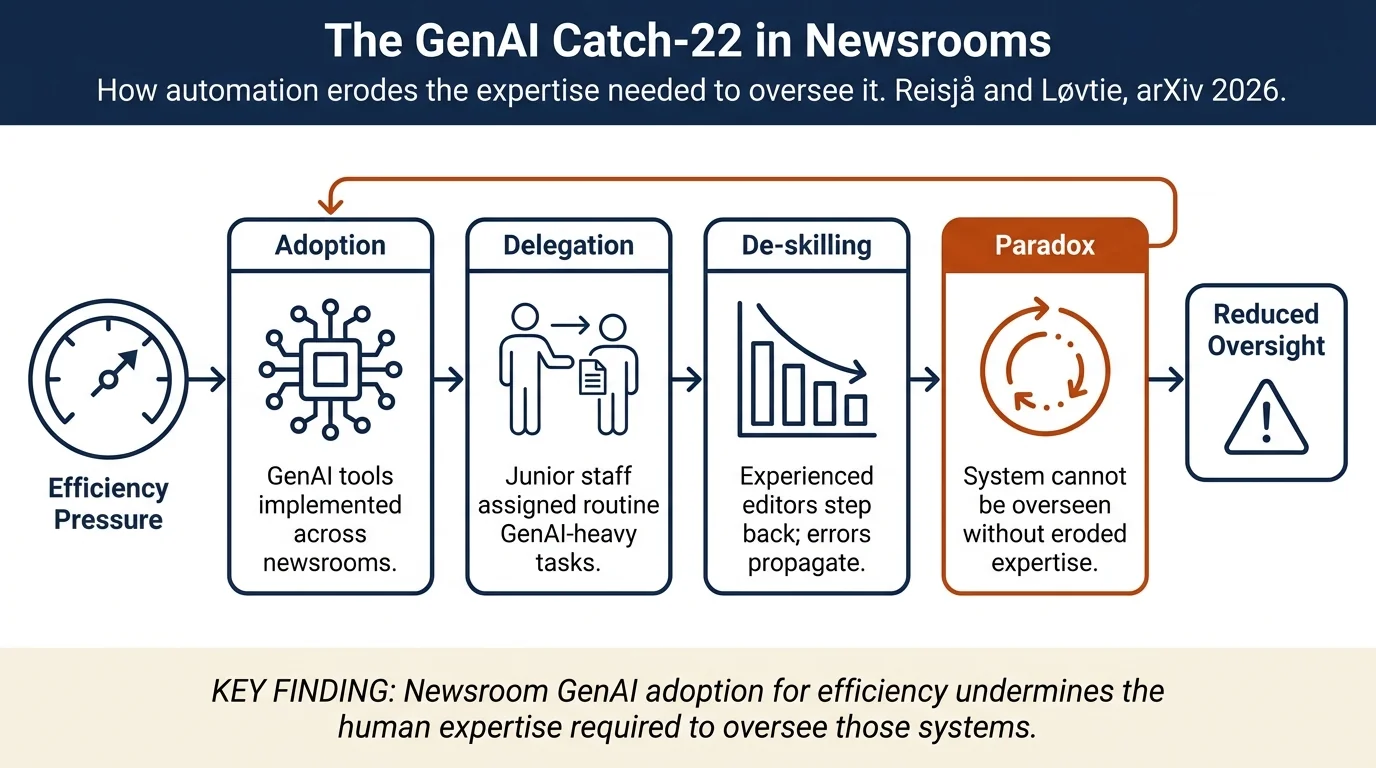
The GenAI Catch-22: Use of Generative Artificial Intelligence in Norwegian Newsrooms During the 2025 Parliamentary Election
Authors: Mari Reisjå, Anders Sundnes Løvtie Affiliation: IT University of Copenhagen Venue: arXiv cs.CY, 2026 — arXiv:2608.10773
TL;DR
A longitudinal qualitative study of four major Norwegian newsrooms (NRK, TV2, VG, Dagbladet) during the 2025 parliamentary election reveals a "GenAI Catch-22": newsrooms need human expertise to oversee generative AI systems and prevent errors, but extensive use of GenAI leads to de-skilling that erodes that very expertise, rendering oversight inadequate. Ambitious initial plans for public-facing GenAI tools (chatbots, fact-checking) collapsed due to accuracy failures, shifting adoption toward internal tools for routine tasks, often delegated to inexperienced staff. Transparency about GenAI use declined over the campaign, and managers dismissed risks to election coverage while overlooking the structural vulnerability created by their reliance on the technology.
Contributions
- Identifies the "GenAI Catch-22" structural vulnerability in journalistic use of AI: maintaining human oversight of GenAI systems requires expertise and time, but the efficiency gains from GenAI adoption reduce journalist availability and erode organizational expertise.
- Longitudinal qualitative case study spanning 10 months (January–November 2025) with 13 semi-structured interviews across four major Norwegian news organizations during a national election—a crucial case where democratic role of journalism is heightened.
- Documents collapse of ambitious GenAI visions in practice: chatbot replacements for party selection quizzes, automated fact-checking of live political debates, and AI-driven investigative analysis all abandoned due to technical limitations (hallucination, accuracy, irrelevance ranking).
- Empirical evidence of de-skilling and competence loss: Delegation of GenAI-heavy tasks (quiz generation) to inexperienced staff (student interns, non-specialist journalists) resulted in errors that went undetected by colleagues, illustrating how GenAI automation undermines the human expertise needed to catch its mistakes.
- Documents reduced transparency about GenAI use in election coverage: newsrooms shifted from labeling AI-generated content clearly to vague or absent disclosure; managers justified this by claiming GenAI had no influence on editorial choices, a claim contradicted by their own descriptions of GenAI's role in content generation.
- Distinguishes between external and internal threats to journalism: while managers focused on external threats (disinformation, adversarial use of GenAI by bad actors), the paper highlights internal structural threats stemming from newsrooms' own GenAI adoption.
Method
Longitudinal qualitative case study using semi-structured interviews and thematic analysis.
Sample: 13 interviews with 9 informants across four organizations: - Four AI managers (one per organization), interviewed twice: in January/February 2025 (planning phase) and October 2025 (post-election reflection). - Five journalists responsible for election coverage tasks (party selection quizzes, live fact-checking, social media analysis), interviewed once. - Organizations: NRK and TV2 (public broadcasters); VG and Dagbladet (tabloid newspapers, largest by digital readership).
Data collection period: January–November 2025, covering planning, campaign, and post-election phases.
Analytical approach: Thematic analysis using a codebook structured around three themes: 1. Imaginaries and justifications for GenAI use — societal narratives about inevitability of AI adoption and its necessity for competitive survival. 2. Practical use, control, and ethics — how GenAI systems were actually deployed, quality assurance practices, and ethical guardrails. 3. Organization, power, and vulnerabilities — how technological infrastructure and staffing decisions affected newsroom resilience and editorial autonomy.
Results
Before the elections: Optimistic ambitions and risk appetite
In January and February 2025, all four organizations reported ambitious plans for GenAI in election coverage:
- TV2, VG, Dagbladet planned GenAI-powered chatbots to replace traditional party selection quizzes, inspired by chatbot popularity in the 2024 U.S. election.
- NRK and TV2 contracted external vendors to develop live fact-checking tools that could automatically verify claims made by politicians in broadcast debates.
- Managers shared societal narratives framing GenAI adoption as inevitable and necessary ("as the internet killed the paper newspaper, so will AI kill the internet"). Risk appetite was high despite acknowledged concerns about hallucination, bias, and trust erosion.
Managers believed GenAI could add "nuance, depth, customization, and engagement" to election coverage while freeing journalists for investigative work.
Ambitions shelved: Technical reality vs. expectations
Over spring and summer 2025, all four organizations scaled back or abandoned their initial GenAI plans:
- Chatbot projects failed: The quizzes required high accuracy on political facts and party platform nuances. The systems could not differentiate between the ~22 parties running (vs. 2 in the U.S. election). User testing showed readers preferred multiple-choice quizzes over chatbot interaction. All four shelved election-specific chatbots by March–June 2025.
- Live fact-checking failed: NRK and TV2's systems could not determine which claims were journalistically salient amid hundreds per debate. The NRK AI manager noted the gap: "There are perhaps 300 claims that appear in one debate, and then there are three of them that we think are journalistically relevant, interesting and important to check." Technical limitations made the tool useless.
- Internal frustration: Managers expressed surprise and relief that competitors had also failed to deploy these systems. One stated: "I had thought there would be more of that, but I haven't missed it."
Shift to internal GenAI tools and routine tasks
As public-facing ambitions collapsed, all organizations increased reliance on internal GenAI tools (NRK-GPT, Valgvenn, NotebookLM, Claude, ChatGPT) for routine tasks: navigating party programs, rephrasing text, generating quiz questions, summarizing content.
Party selection quizzes: Despite the chatbot failures, all organizations used GenAI extensively to create traditional multi-choice quizzes. Approximately 2.2–2.9 million users completed these quizzes across the organizations.
Quality control failures: - One inexperienced TV2 journalist (student intern, non-specialist) used GenAI to draft quiz questions and was unsupervised in vetting factual accuracy. She later discovered errors stemming from GenAI: one question used a politically charged phrase ("working capital") associated with right-wing rhetoric, which she failed to catch initially until an economics journalist reviewed it. - At NRK, the most experienced quiz maker abandoned GenAI because correcting the system's suggestions was more time-consuming than doing the work manually. - At Dagbladet, journalists using multiple GenAI systems (Claude, ChatGPT) for cross-checking acknowledged they did not know whether colleagues who reviewed their work also used GenAI—potentially allowing errors to propagate through GenAI-assisted quality assurance.
Reduced labeling and transparency
Initially (January 2025), all newsrooms had strict policies labeling content created with GenAI. By the election campaign (August–September 2025):
- VG and Dagbladet removed explicit AI labels, arguing that GenAI use had become too pervasive across the newswork process to label every instance (from interviewing to text processing). They posted links to general AI use policies instead.
- NRK and TV2 had public guidelines accessible via search, but did not label individual pieces.
- Justification: Managers worried that labeling would erode reader trust; they noted readers might distrust AI-assisted content without recognizing that they distrust all content equally if they cannot identify which stories involved AI.
However, party selection quizzes—heavily GenAI-assisted—were not labeled as such, despite millions of completions.
Journalists minimize risk to coverage
When asked whether GenAI influenced editorial choices or coverage direction, journalists and managers typically responded with skepticism:
- One TV2 journalist: "No, because I used the tools as a kind of complicated search engine that helped me streamline my work. It didn't really have any influence on the result, or how I chose to weight the parties."
- Dagbladet journalist: "I don't think we need to say specifically that we have used AI in some project or other. We do that in the same way that we use Google and call people."
Only the Dagbladet journalist acknowledged ambiguity: "I don't know, that's the honest answer."
Yet these same interviews also revealed GenAI had shaped task delegation and coverage choices: quiz-making was delegated to less experienced staff precisely because GenAI was expected to "simplify" the task, and internal tools were central to navigating party programs and generating summaries.
Connections
- Controlled Change — Documents how Dutch journalists' GenAI integration reflects "controlled change" where professional authority is preserved through critical assessment and ethical guidelines; contrasts with this study's finding that such safeguards may be insufficient when GenAI automation reduces journalist expertise over time.
- Journalism and AI — Broader topic covering GenAI adoption, ethical challenges, and impacts on newsroom labor.
- Election coverage — Topic covering how technology, misinformation, and journalistic practices shape election reporting.
- De-skilling and automation — Related concept from automation literature (Bainbridge's "Ironies of Automation") on how automation of routine tasks leads to loss of human expertise and reduced ability to handle exceptions.
- Transparency in Journalism — Addresses shifting labeling practices and disclosure of editorial methods.
- Content moderation — Related infrastructure challenge: both moderation platforms and newsrooms face the problem that offloading decisions to AI systems requires human expertise to oversee them, yet that expertise is eroded by routine automation.
Notes
Strengths: The 10-month longitudinal design captures the gap between ambitious planning and practical constraints—a methodologically strong choice not visible in cross-sectional snapshots. The study triangulates manager and journalist perspectives, revealing discrepancies between stated editorial principles and de facto practices. The focus on a "crucial case" (national election) where democratic stakes are high makes findings especially salient. Explicit attention to the internal threat of de-skilling distinguishes this work from the dominant discourse on external misinformation threats.
Limitations and questions: The sample size is small (13 interviews, 9 informants, four organizations) and geographically limited to Norway, where trust in news media is exceptionally high relative to global patterns—generalization to lower-trust or more fragmented media systems is uncertain. The study documents disclosed plans and post-hoc reflections but does not have detailed access to the actual GenAI-assisted content production process; more granular analysis of newsroom workflows would deepen understanding. The paper focuses on large organizations with resources for ethical reflection; implications for smaller news outlets or resource-constrained newsrooms remain unclear. The analysis does not quantitatively measure whether GenAI-assisted quizzes contained systematically higher error rates than manually produced ones.
Relevance to the wiki: This paper directly addresses the intersection of generative AI, journalism, democracy, and information integrity. It reveals a structural vulnerability not commonly addressed in the misinformation literature: that newsrooms themselves may inadvertently create conditions for errors (de-skilling) by adopting the very tools meant to enhance efficiency. The finding that transparency about GenAI use decreased during a high-stakes election contradicts recommendations from media ethics literature and illustrates how efficiency pressures can override disclosure commitments.