A Survey on Automated Fact-Checking
Authors: Zhijiang Guo, Michael Schlichtkrull, Andreas Vlachos
Venue: arXiv, 2021 — arxiv:2108.11896
TL;DR
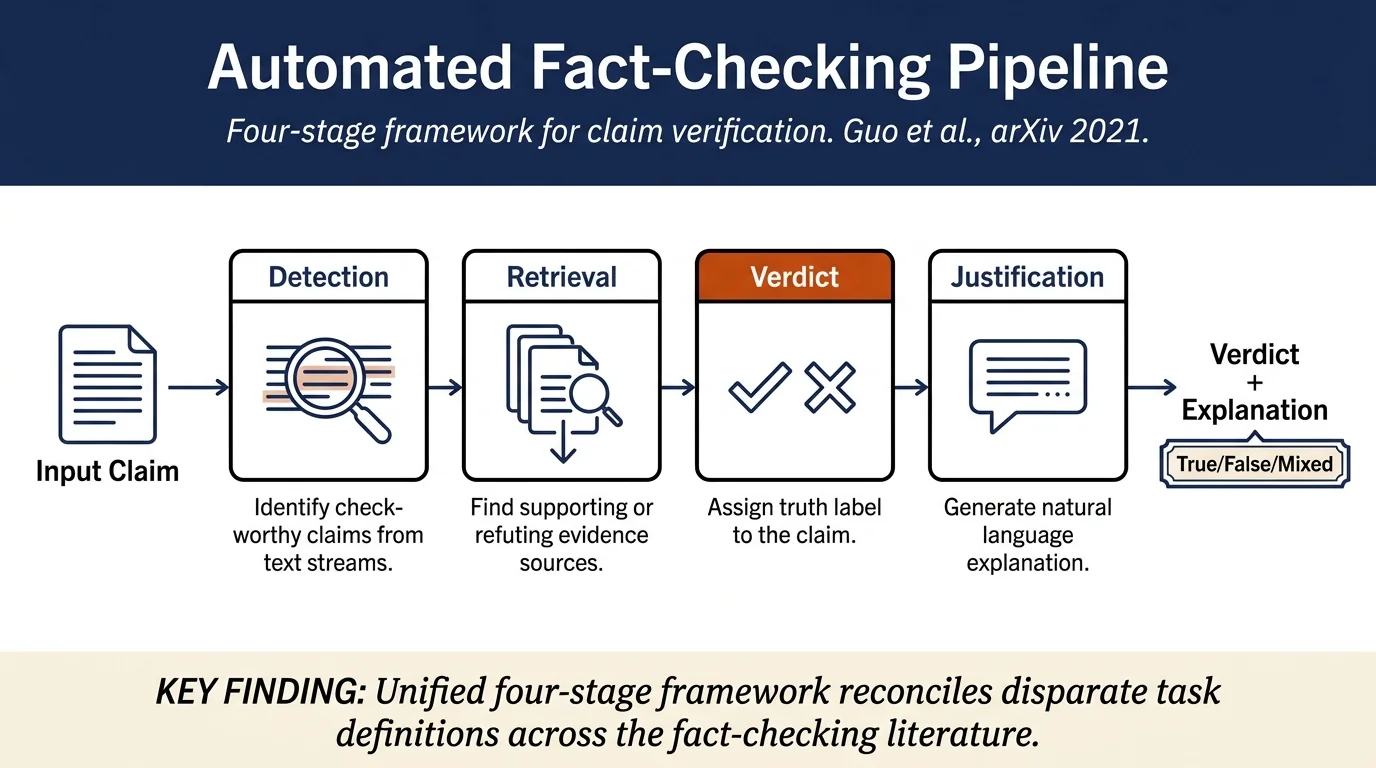
This comprehensive survey unifies automated fact-checking research under a four-stage NLP framework: claim detection (identifying check-worthy claims), evidence retrieval (finding supporting/refuting information), verdict prediction (assigning truth labels), and justification production (explaining decisions). The authors review 25+ datasets, contrast modelling strategies, and identify six major research challenges including label ambiguity, dataset artifacts, source subjectivity, multimodality, multilinguality, and faithfulness of explanations.
Contributions
- Proposes a unified four-stage framework for automated fact-checking that reconciles disparate task definitions across the literature
- Surveys and summarizes 25+ fact-checking datasets (both natural language inputs and synthetic inputs)
- Categorizes modelling strategies for each stage (supervised classifiers, neural networks, graph-based approaches, attention mechanisms, rule-based systems, generative explanations)
- Documents emerging research challenges: coarse/ambiguous labels across sources, dataset artifacts and biases, source credibility heterogeneity, multimodal misinformation, multilingual claim verification, and faithfulness of generated justifications
- Identifies promising research directions including pre-bunking, adversarial robustness, and cross-lingual transfer
Method
The paper organizes automated fact-checking into four sequential stages:
-
Claim Detection: Identifying check-worthy claims from large information streams (social media posts, news articles, statements). Framed as a classification task with challenges of distinguishing checkability (e.g., "COVID-19 exists" is not checkable; "COVID-19 was engineered" is checkable). Systems use feature engineering (metadata, named entities, temporal signals) or neural approaches (LSTM, attention networks).
-
Evidence Retrieval: Finding information sources (Wikipedia, news articles, knowledge bases, tables) that support or refute the claim. Approaches include information retrieval (TF-IDF, dense retrievers), knowledge graph traversal (treating graphs as flow networks), and semantic similarity using learned representations. Early systems use commercial APIs; recent work employs dense embeddings and BERT.
-
Verdict Prediction: Assigning a truth label (true, false, mostly true, mixed, not enough information). Early datasets used binary labels; recent work uses more nuanced multi-class schemes. Systems employ textual entailment, stance detection on evidence, and joint modeling of evidence ranking with veracity prediction. The paper discusses how different datasets harmonize conflicting labels across fact-checking organizations.
-
Justification Production: Generating natural language explanations for verdicts. Three design considerations: readability (can non-experts understand?), plausibility (how convincing is it?), faithfulness (does the explanation accurately reflect model reasoning?). Approaches range from attention-weight visualization to abstractive summarization to rule-based logical reasoning.
Results
-
Dataset scope: The survey catalogs 25+ datasets spanning different input types (aggregate social-media posts, individual statements from fact-checking websites, transcripts, scientific claims), evidence sources (text, knowledge graphs, tables, images), and verdict schema (2–27 classes). Largest single dataset: FEVER with 185,445 claims.
-
Modelling trends: Supervised methods initially dominated; neural approaches (LSTMs, transformers) now prevalent. Recent systems jointly optimize multiple stages. Joint training of evidence retrieval and verdict prediction outperforms pipeline approaches. Attention mechanisms highlight salient evidence; rule-based systems offer interpretability; generative models struggle with faithfulness.
-
Performance on benchmarks: Best systems on FEVER achieve ~64% (shared task 2018); on LIAR ~75% on binary classification. Performance varies widely with dataset size and annotation quality.
-
Multimodal extensions: Emerging work on multimodal claims (text+image) shows that misinformation often pairs text with misleading visuals; detection requires joint reasoning across modalities.
Connections
- Related to NLP via shared NLP foundations (textual entailment, semantic similarity, information extraction)
- Foundational to Claim Verification and Evidence Retrieval as methodological frameworks
- Builds on Knowledge graphs for structured evidence matching and Information Extraction for identifying relevant facts
- Applied in Content moderation for at-scale misinformation detection
- Extends Propaganda detection to automated assessment of truth rather than persuasion techniques
- Complements Stance Detection as a related NLP subtask often used as a component in claim verification pipelines
Notes
Strengths:
- Comprehensive unification of disparate terminology and task definitions across the fact-checking literature
- Detailed dataset inventory with clear taxonomy (input type, evidence source, label schema)
- Honest discussion of why current systems struggle: label subjectivity, source heterogeneity, the tension between fully-automated systems and human-in-the-loop fact-checking
- Forward-looking identification of challenges (multimodality, multilinguality, faithfulness) that remain open as of 2021
Limitations:
- The faithfulness problem is acknowledged but not deeply addressed; many "explainable" systems generate plausible-sounding but unfaithful justifications
- Limited discussion of cross-lingual transfer or zero-shot approaches (though multilingual section covers multilingual datasets)
- The survey was written before the recent surge in LLM-based fact-checking; some sections on "generative models" refer to pre-2021 work (e.g., BART) before instruction-tuned LLMs
- Does not cover the "previously fact-checked" detection task (identifying whether a claim has already been checked), though notes it in related work
- Evidence aggregation from multiple conflicting sources is mentioned but not thoroughly systematized
Follow-ups:
- How do LLMs (GPT-3, ChatGPT, Llama) change the landscape? Do they solve faithfulness, or amplify it? (Addressed by subsequent work post-2021, e.g., Nakov et al. 2023)
- Cross-lingual fact-checking: can evidence in one language verify claims in another?
- Temporal dynamics: how to re-verify claims as evidence evolves over time?
- Adversarial robustness: can claim generation systems defeat fact-checkers at scale?