Causes and consequences of mainstream media dissemination of fake news
Authors: Yariv Tsfati, H. G. Boomgaarden, J. Strömback, R. Vliegenthart, A. Damstra, E. Lindgren
Venue: Annals of the International Communication Association, Vol. 44, No. 2, pp. 157-173, May 2020 — DOI
TL;DR
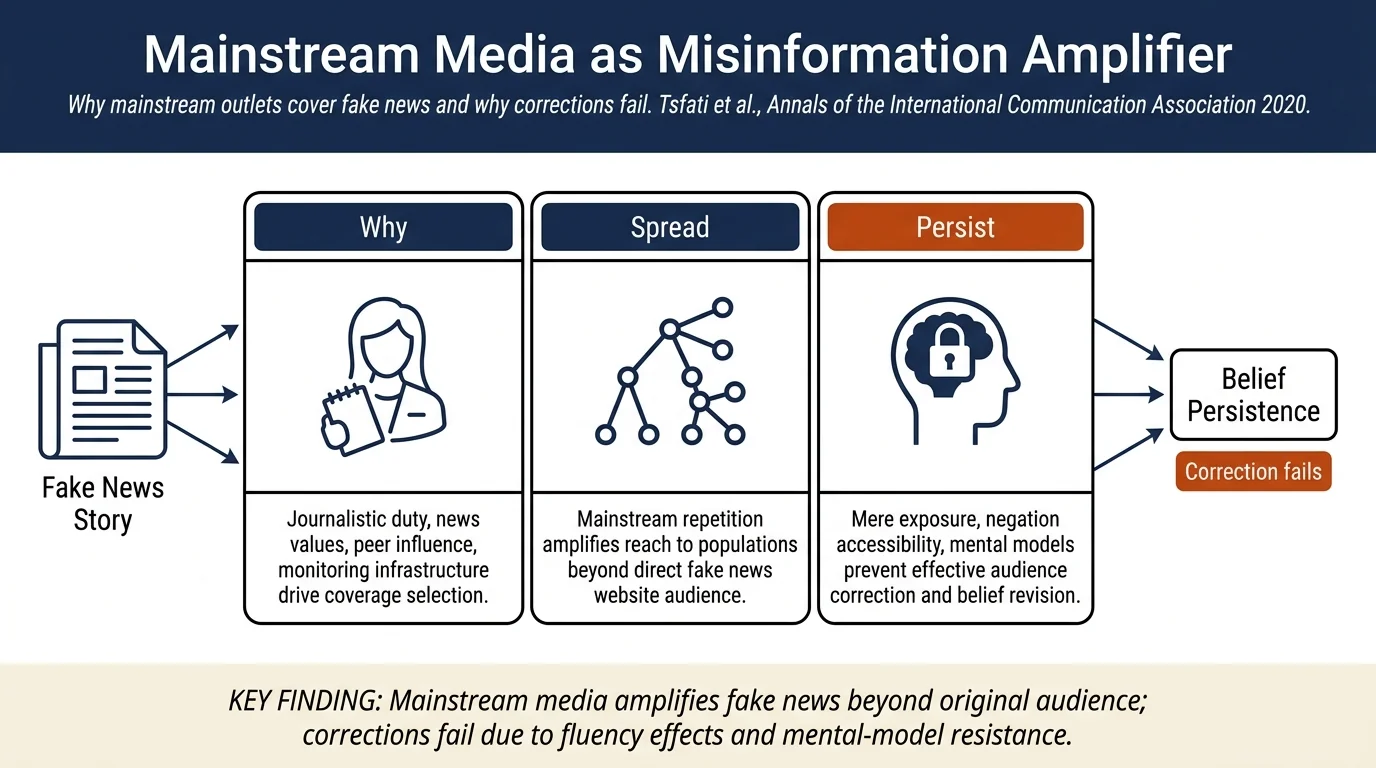
While fake news websites have limited direct reach, mainstream media coverage is probably how most people encounter fake news stories. This synthesis identifies why mainstream outlets cover falsehoods (journalists' professional duties, news values, peer psychology, technical infrastructure) and explores how mainstream coverage amplifies misinformation despite correction attempts through familiarity, repetition, and audience predispositions.
Contributions
- Synthesizes fragmented literature on the understudied role of mainstream media in disseminating fake news, not as passive reporters but as active amplifiers
- Identifies four structural reasons why mainstream media covers fake news: journalistic role perceptions, news values, psychological decision-making, and technical monitoring infrastructure
- Examines audience-level mechanisms explaining why mainstream coverage of debunked claims often backfires: fluency effects, negation accessibility, mental model persistence, and motivated reasoning
- Highlights the paradox that large populations hear about fake news from mainstream sources despite limited direct exposure to fake news websites themselves
Method
This is a literature review synthesizing existing scholarship across three core questions:
-
What role do mainstream news media play in disseminating fake news? — Evidence from traffic analysis, survey data, and content studies showing mainstream outlets as primary disseminators despite limited reach of native fake news sites.
-
Why do mainstream news media cover fake news? — Four mechanisms identified:
- Journalists' role perceptions: The professional duty to expose falsehoods and verify information (Donsbachian theory of journalistic mission)
- News values: Fake news stories often meet traditional criteria (negativity, elite involvement, human interest, novelty, political impact) and function as narrative content
- Psychology of news decisions: Social validation (peer influence through newsroom networks), attitude confirmation (matching reporter ideology), and newsroom norms drive coverage selection
-
Technical infrastructure: Monitoring services, social-media-as-assignment-desk, dedicated fact-checking beats, and systems to detect online virality all increase visibility of false claims
-
What are the potential influences of mainstream media coverage on audiences? — Examined through psychological mechanisms of misinformation persistence and resistance to correction
Key findings
Reach and exposure: - Fake news websites receive limited direct traffic (1-10% of population in most studies); most people hear about fake news stories through mainstream media reporting on them - Study of 12 American mainstream outlets found 2,787 hits for "fake news" in 2016 alone; Pizzagate was covered 34+ times before the December 2016 shooting - Mainstream media attention can amplify fake stories to populations that would never visit the original fake news sites - Social media is NOT the primary disseminator; mainstream media coverage in mainstream outlets is responsible for much of the public attention fake news stories garner
Why coverage happens despite intentions to debunk: - Stories about fake news meet journalistic news values: they are novel, negative, often involve political figures or public controversy, and have elements of human interest - Journalists perceive an ethical obligation to expose what is false and correct public misperceptions—a core professional identity - Peer influence and newsroom dynamics mean individual journalists' coverage triggers follow-on coverage (citing each other's investigations) - Partisan media are more heavily influenced by fake news agendas than mainstream outlets, but mainstream outlets still amplify controversial stories
Audience effects of mainstream coverage: - Mere exposure effect: Repetition increases familiarity; people tend to perceive familiar information as more true, even when labeled false - Negation accessibility: Correcting false claims requires audiences to encode the original false assertion before processing the negation—both "activate" the false idea - Mental model persistence: Coherent but incorrect mental models are difficult to revise; people may dismiss corrections as conflicting with the model they've already constructed - Motivated reasoning: Audiences with strong preexisting beliefs (especially partisan ones) are less likely to update beliefs in response to corrections, particularly when correction is ideologically incongruent - Fluency-driven persistence: Even when audiences consciously reject the false claim as a result of media correction, fluency (ease of processing) increases perception of truth, creating dissociation between stated disbelief and implicit acceptance - Correction complexity: Detailed corrections are less effective than simple ones; when audiences are cognitively loaded, corrections fail
Practical implications: - Media organizations are paradoxically important disseminators and important correctors of false information - Heavy consumers of mainstream news can still retain false beliefs because coverage without explicit negation may increase false-belief accessibility - The gap between awareness of debunking and actual belief change is larger than researchers previously appreciated - Audience distrust of mainstream media means refutations from those outlets may backfire among skeptical segments
Connections
- Related to Correction effectiveness via shared focus on how corrections can backfire or fail to reduce misinformation
- Cited by work on Media consumption patterns showing how audiences access fake news through mainstream-media reporting
- Extends news values research by demonstrating how traditional journalistic criteria inadvertently increase misinformation visibility
- Complements propagation-based approaches by emphasizing mainstream-media role as distribution amplifier
- Informs Fact-checking and corrections design by showing why mere debunking statements often fail in mainstream media context
Notes
Strengths: - Fills critical gap in literature by focusing on understudied mainstream-media role rather than platforms or fake websites themselves - Strong theoretical grounding in journalism studies, psychology, and communication theory - Identifies institutional and behavioral mechanisms, not just technological ones - Practical insights for journalists and fact-checkers on why coverage inadvertently amplifies false claims
Weaknesses: - Largely synthetic; empirical evidence on how much of fake news exposure comes through mainstream vs. direct is still limited - Limited systematic content analysis of how mainstream outlets frame fake news stories (simple debunking vs. narrative investigation) - Few studies on the differential effectiveness of various correction strategies (timing, placement, tone, visual elements) - Audience research mostly on partisan audiences; less on non-political misinformation (health, science) in mainstream coverage
Open questions: - What stylistic or narrative choices in mainstream media reporting most reduce correction effectiveness? - Do different demographic groups respond differently to mainstream-media debunking? - How do media organizations balance ethical obligation to expose falsehoods with risk of amplification? - What role does outlet reputation and trust play in whether corrections are effective for different audiences?