Types, Sources, and Claims of COVID-19 Misinformation
Authors: J. Scott Brennen, Felix M. Simon, Phillip N. Howard, Rasmus Kleis Nielsen
Venue: Reuters Institute for the Study of Journalism, Oxford Martin Programme on Misinformation, Science and Media, University of Oxford — April 2020 (DOI)
TL;DR
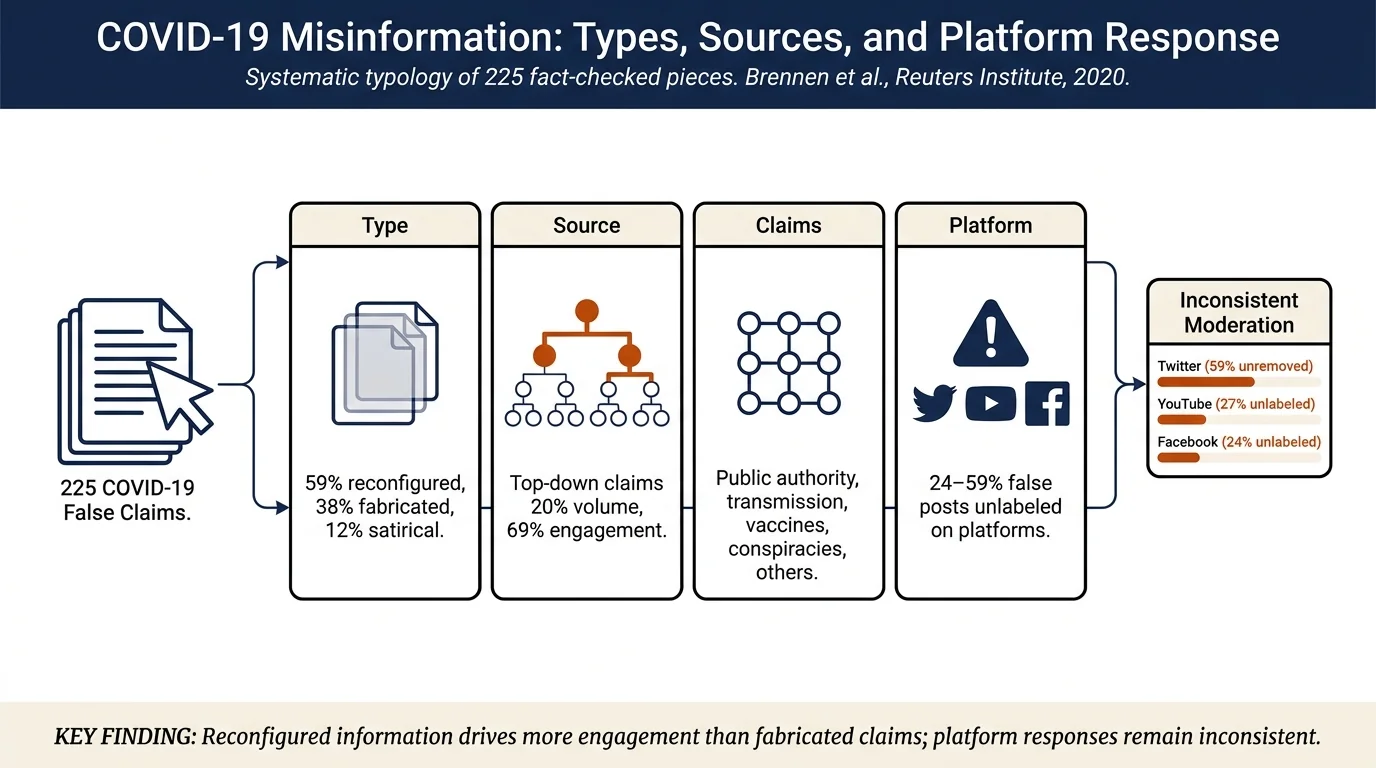
Systematic analysis of 225 fact-checked COVID-19 misinformation pieces reveals that most false content reconfigures existing information (59%) rather than fabricating entirely new claims. Public authorities are cited in 39% of misinformation, yet top-down claims from politicians and celebrities account for only 20% of volume but drive 69% of social media engagement. Most false posts remain unremoved or unlabeled on platforms despite fact-checker debunking.
Contributions
- Comprehensive typology of COVID-19 misinformation distinguishing reconfigured, fabricated, and satirical content
- Empirical characterization of misinformation sources (top-down vs. bottom-up) and their relative reach and engagement
- Analysis of nine claim types (public authority action, community spread, medical advice, prominent actors, conspiracies, virus transmission, virus origins, public preparedness, vaccine development)
- Platform-level analysis of removal and labeling rates on Facebook, Twitter, and YouTube
- Evidence that fact-checkers successfully identify misinformation but platform responses are inconsistent and often delayed
Method
Analysis of 225 pieces of English-language COVID-19 misinformation rated false or misleading by fact-checkers. Data drawn from three sources: First Draft News database, International Fact-Checking Network (IFCN) portal, and Google Fact Check Explorer, covering January–March 2020.
Systematic coding scheme: each piece coded by two independent coders for misinformation type (reconfigured, fabricated, satire), source (top-down from public figures vs. bottom-up from ordinary people), claim type (nine categories), and platform appearance with engagement metrics (likes, shares, comments). Intercoder reliability (Cohen's kappa for misinformation types: 0.82; apparent motivation: 0.68). Social media engagement data limited to platform-provided metrics and archived posts.
Results
Scale and growth: 90% growth in English-language fact-checks about COVID-19 from January to March 2020. Fact-checking volume increased faster than misinformation could be addressed, straining resources.
Formats: 59% of misinformation reconfigured existing, often true information (twisted, recontextualized, or misapplied), vs. 38% completely fabricated. Reconfigured content received higher engagement than fabricated (independent samples t-test, p < 0.05), suggesting manipulated but plausible claims spread more effectively than obvious fakes. Only 12% of social media interactions involved fabricated content; 87% involved reconfigured or satirical content.
Sources: Public authority action/policy is the most common claim type (39% of sample). However, top-down claims from politicians, celebrities, and prominent public figures account for only 20% of total content volume but 69% of all social media engagement. Bottom-up misinformation from ordinary users dominates in volume but engages smaller audiences.
Claims: Nine inductive claim types emerge: public authority action (39%), community spread (24%), general medical advice (24%), prominent actors (23%), conspiracies (17%), virus transmission (16%), virus origins (12%), public preparedness (6%), vaccine development (5%).
Platform response: Social media platforms removed or labeled majority of debunked posts in sample, yet inconsistently: - Twitter: 59% of false posts remain active without warning labels at end of March - YouTube: 27% remain unlabeled - Facebook: 24% remain unlabeled
Significant variation across platforms suggests different moderation policies and resource allocation.
Connections
- Related to Misinformation and fake news detection via empirical typology of false COVID content
- Related to COVID-19 misinformation and the infodemic as foundational taxonomy for pandemic-related information disorders
- Related to Social media manipulation via analysis of top-down vs. bottom-up misinformation dynamics
- Cited by Roozenbeek et al. 2020 on vaccination misinformation susceptibility
- Cited by Pennycook et al. 2020 on accuracy-nudge interventions during pandemic
- Related to Fact-checking and corrections infrastructure and limitations during crisis periods
Notes
Strengths: Comprehensive inductive typology developed from actual fact-checked content, not theoretical categories; clear operationalization of "top-down" vs. "bottom-up" framing; platform-level engagement and removal data add empirical grounding. Early pandemic snapshot captures critical moment when information systems were stressed.
Limitations: English-language only; limited to posts linked by fact-checkers, introducing selection bias toward high-engagement misinformation; no follow-up after March 2020 documenting longer-term removal patterns; engagement data incomplete for private channels (Facebook groups, WhatsApp) and messaging apps. Sample size (225 pieces) is modest for drawing population-level conclusions.
Implications: The finding that reconfigured content drives engagement more than fabricated content suggests that prevention strategies must address not just source credibility but also the recontextualization and manipulation of genuine information. The gaps in platform response (59% of Twitter false posts still active in late March) highlight scalability challenges for moderation and the continued critical role of independent fact-checking during crises.