Explore papers
Filter by research area, year and venue. Every filter is in the address bar, so you can share a view as a link.
 Bots & coordinated campaignsPlatforms, policy & society
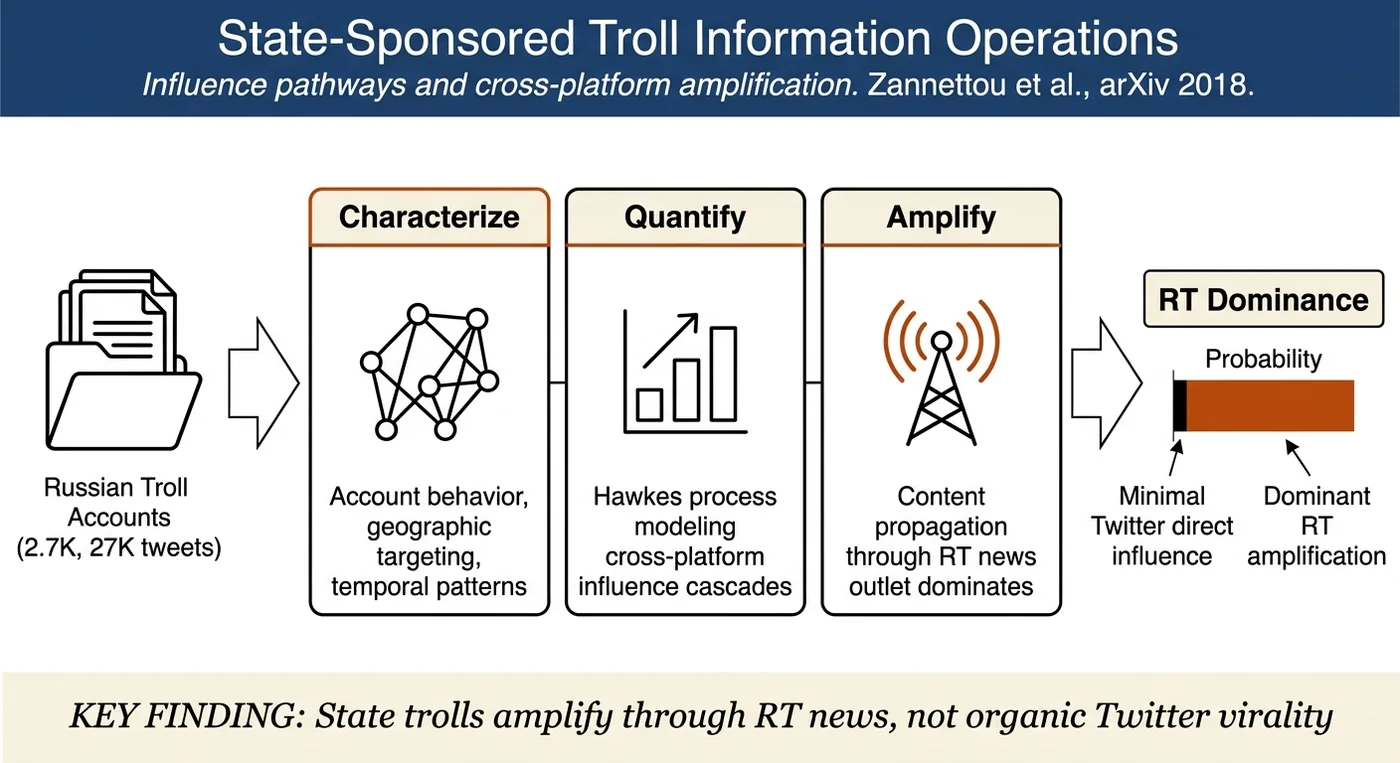
Disinformation Warfare: Understanding State-Sponsored Trolls on Twitter and Their Influence on the WebLarge-scale empirical study of 2.7K Russian state-sponsored troll accounts and 27K tweets (Jan 2016–Sep 2017) reveals minimal direct Twitter influence but significant content amplification through RT news outlet. Trolls actively target political events, adopt multiple identities, concentrate geographically in USA/Germany/Eastern Europe,…
 Detection methodsDeepfakes & multimodal
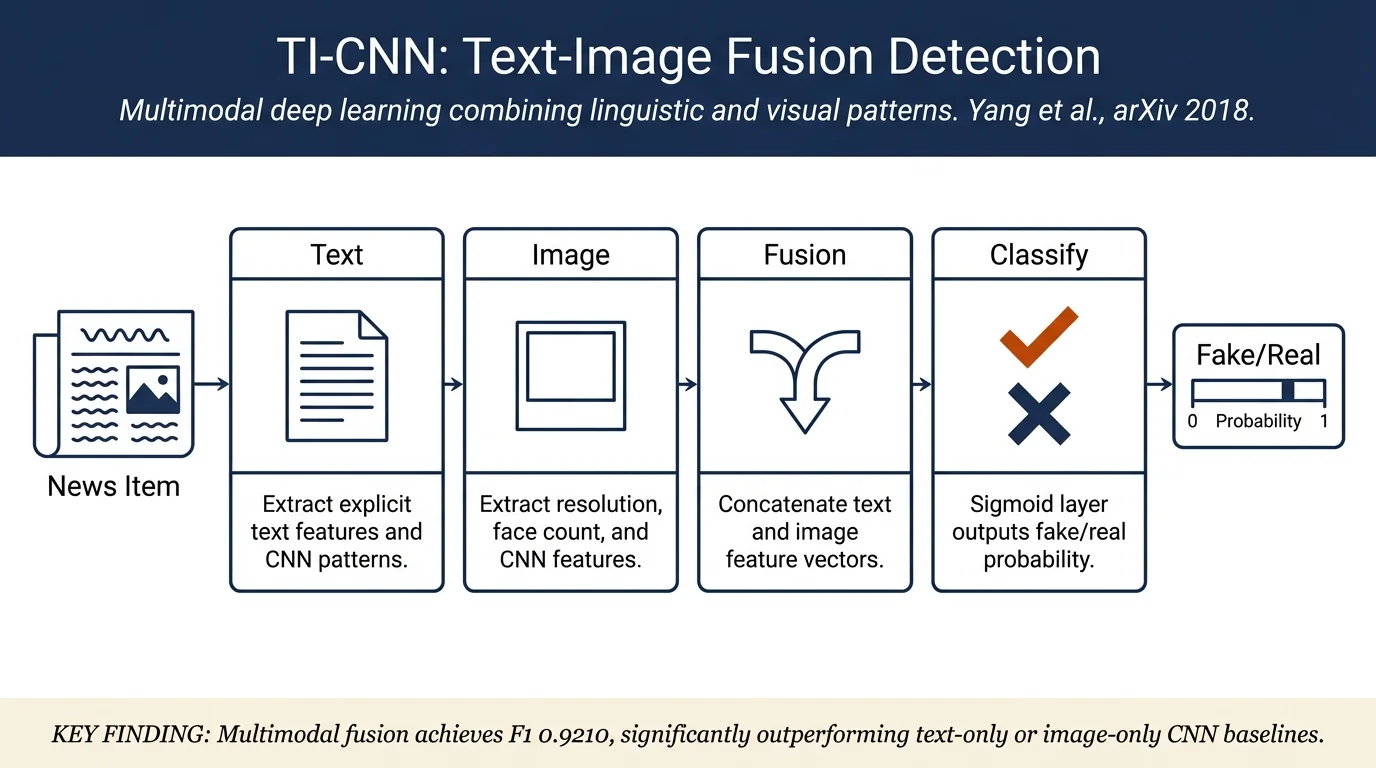
TI-CNN: Convolutional Neural Networks for Fake News DetectionThis paper proposes TI-CNN, a multimodal deep learning model that combines explicit and latent features from both text and images to detect fake news. Through analysis of 20,015 news items, the authors identify distinctive linguistic and visual patterns in fake versus real news, and demonstrate that their unified CNN-based approach…
 Deepfakes & multimodalDetection methods
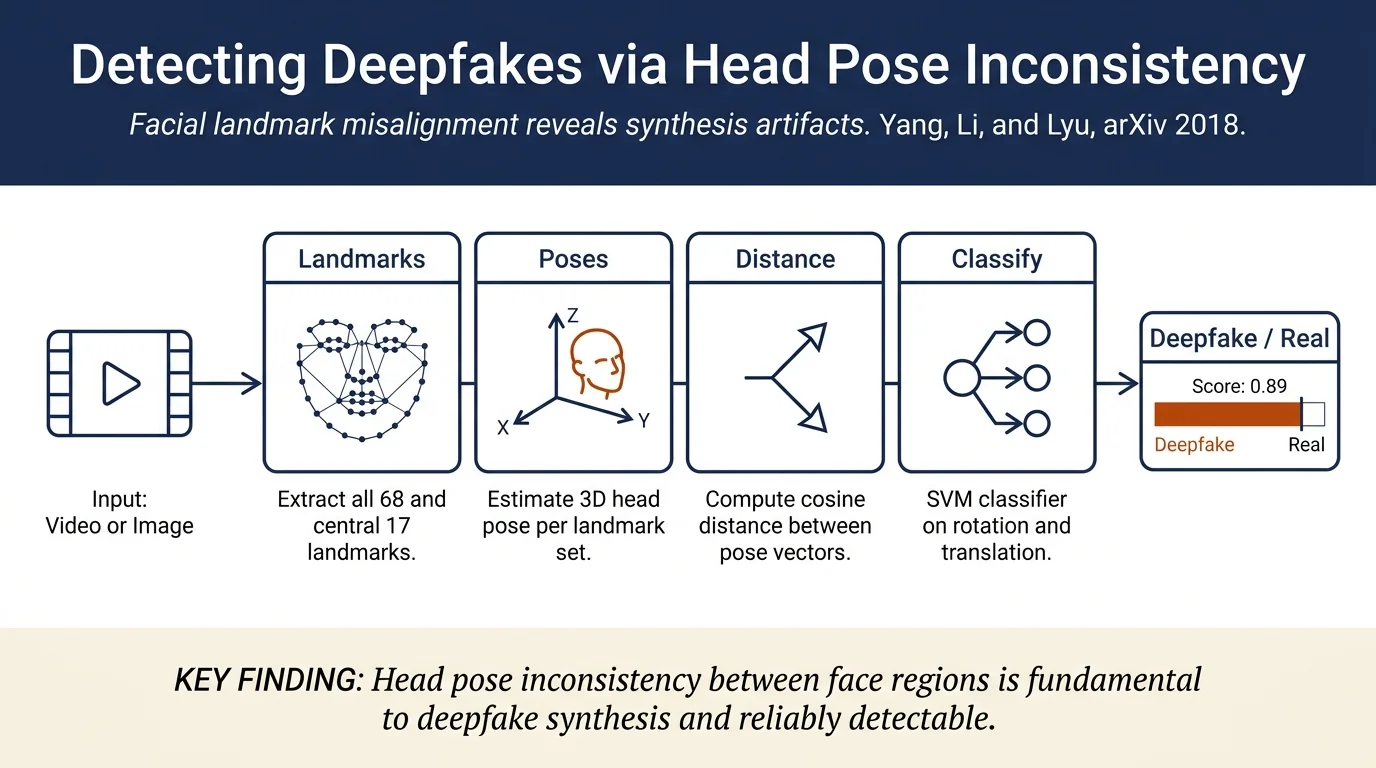
Exposing Deep Fakes Using Inconsistent Head PosesDeepfakes splice a synthesized face into an original image, introducing landmark misalignment errors invisible to the eye but detectable through 3D head pose estimation. The method compares head poses estimated from all facial landmarks versus only the central region; real faces show consistent poses while deepfakes exhibit large…
 Fact-checking & verificationDatasets & evaluation
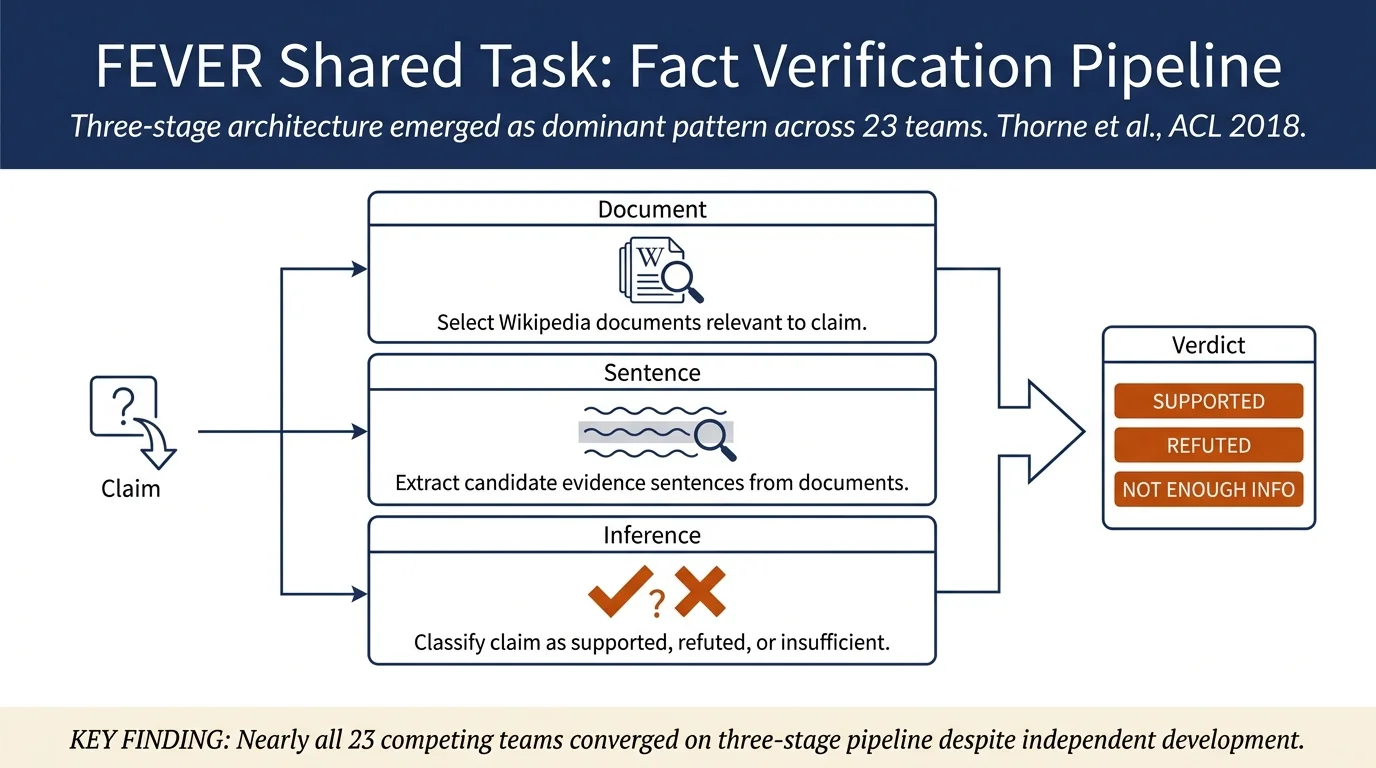
The Fact Extraction and VERification (FEVER) Shared TaskThis paper presents results of the first FEVER shared task competition, which challenged 23 teams to classify whether human-written factoid claims could be SUPPORTED or REFUTED using evidence retrieved from Wikipedia. The best system achieved 64.21% FEVER score, demonstrating the difficulty of joint evidence retrieval and natural…
 Fact-checking & verificationDatasets & evaluation
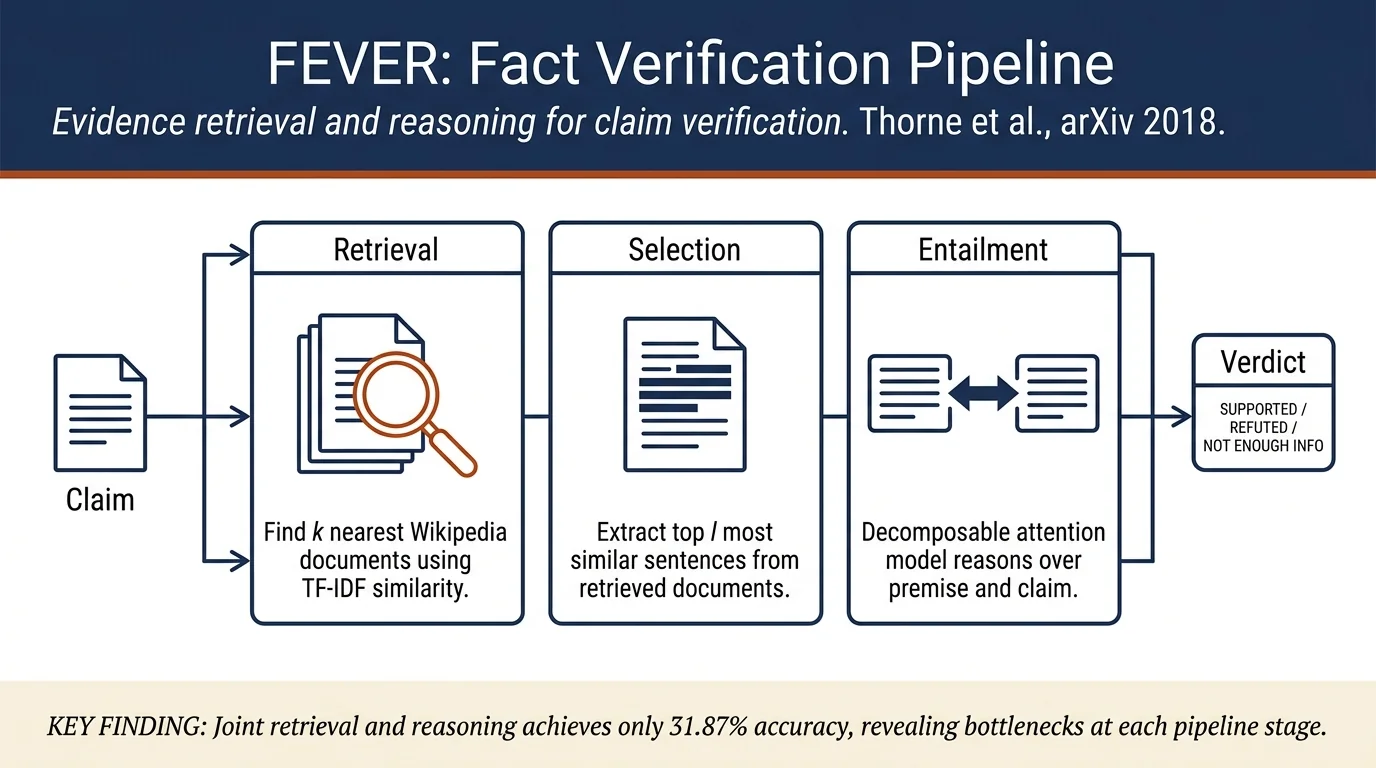
FEVER: A Large-Scale Dataset for Fact Extraction and VERificationThis paper introduces FEVER, a large-scale dataset of 185,445 human-verified claims with Wikipedia evidence for training fact verification systems. Claims are generated from Wikipedia and labeled as SUPPORTED, REFUTED, or NOT ENOUGH INFO; the paper presents a three-stage baseline pipeline (document retrieval, sentence selection, textual…
 Spread & networksDetection methods
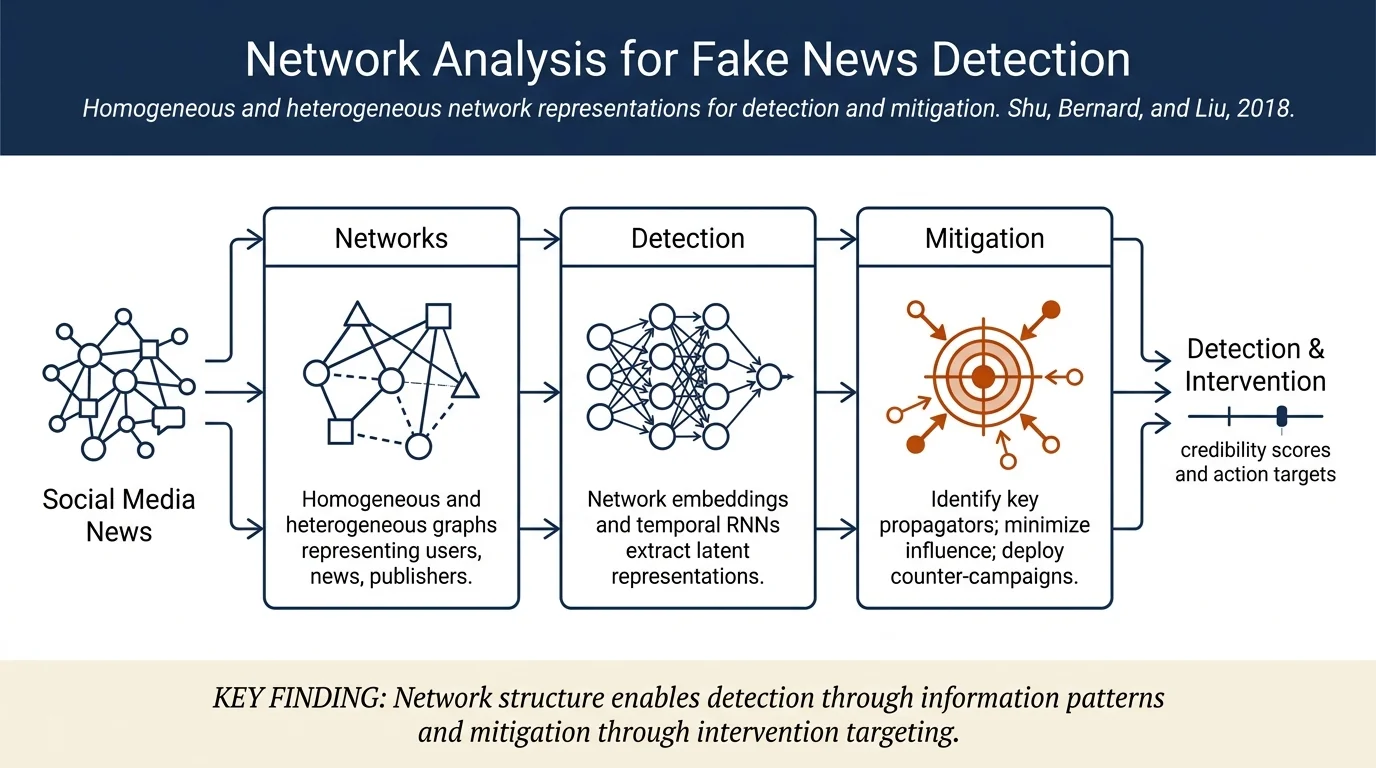
Studying Fake News via Network Analysis: Detection and MitigationThis chapter surveys network-based approaches to fake news detection and mitigation on social media, organizing fake news dissemination along three dimensions (content, social, temporal) and introduces methods exploiting network structure: homogeneous networks (friendship, diffusion, credibility) and heterogeneous networks (knowledge,…
 Fact-checking & verificationDetection methods
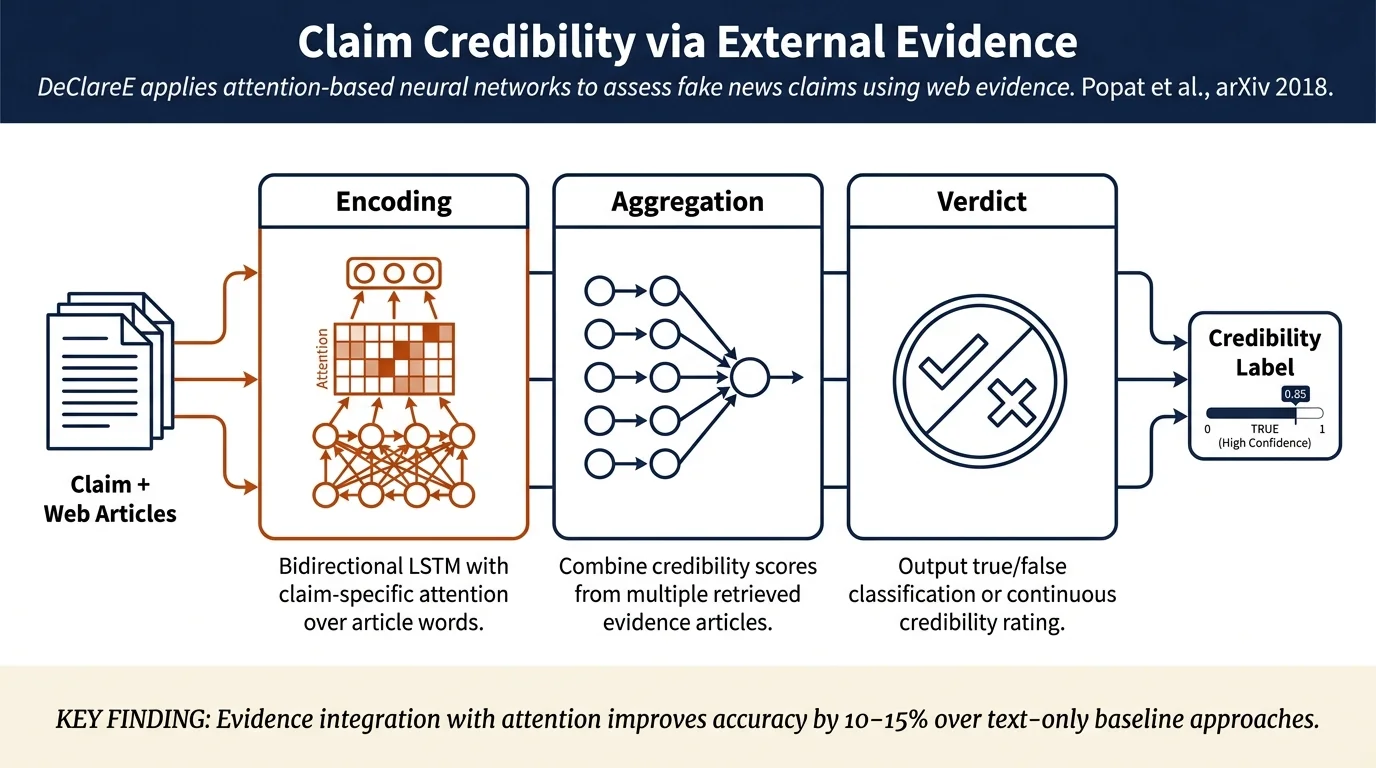
DeClareE: Debunking Fake News and False Claims using Evidence-Aware Deep LearningDeClareE is an end-to-end neural network for evidence-aware credibility assessment of arbitrary natural-language claims. The model combines claim and evidence article representations using bidirectional LSTMs with claim-specific attention, automatically discovering which web articles support or refute a claim without hand-crafted…
 Spread & networksPlatforms, policy & society
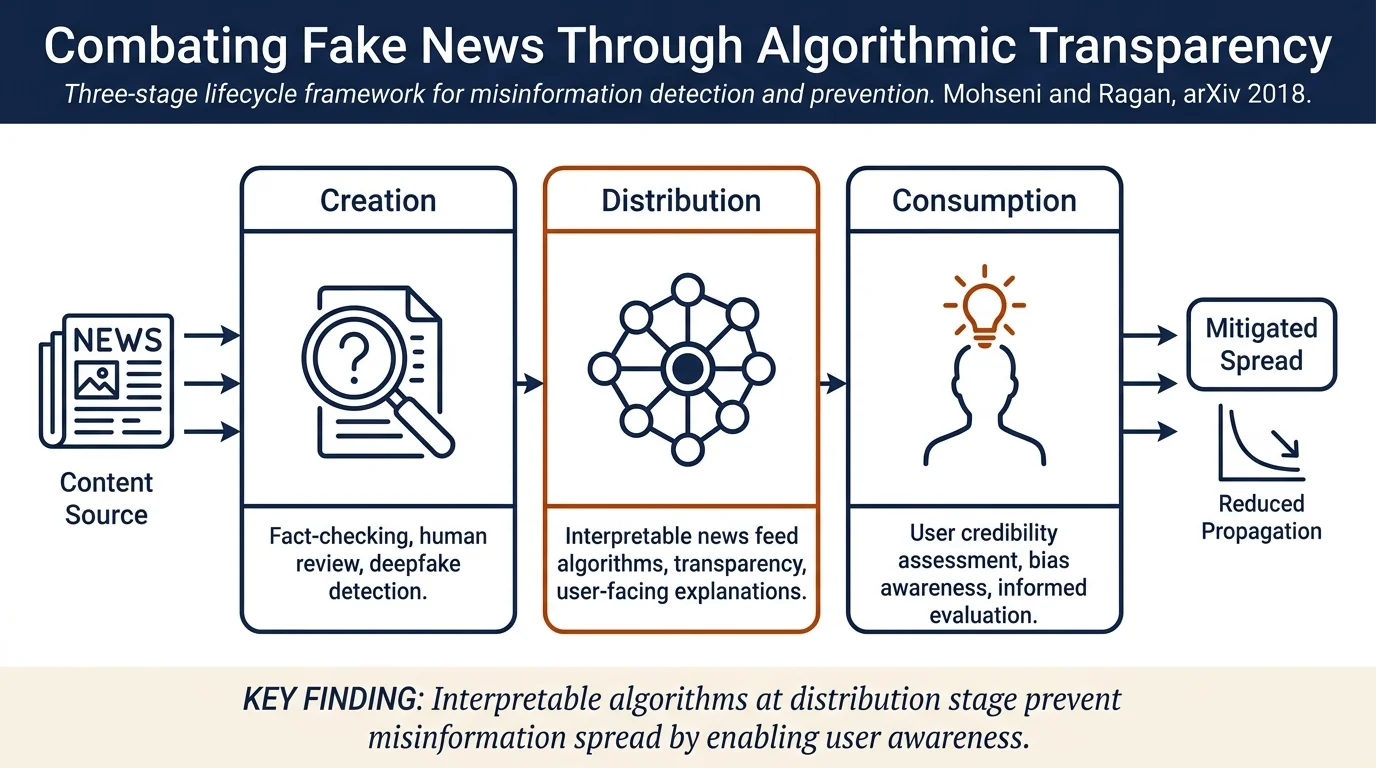
Combating Fake News with Interpretable News Feed AlgorithmsThis position paper reviews fake news detection methods and argues that news feed algorithms are insufficiently transparent, enabling echo chambers and filter bubbles that amplify misinformation. The authors propose interpretable and explainable news feed algorithms as a solution, positioning transparency and user awareness as critical…
 Deepfakes & multimodalDetection methods
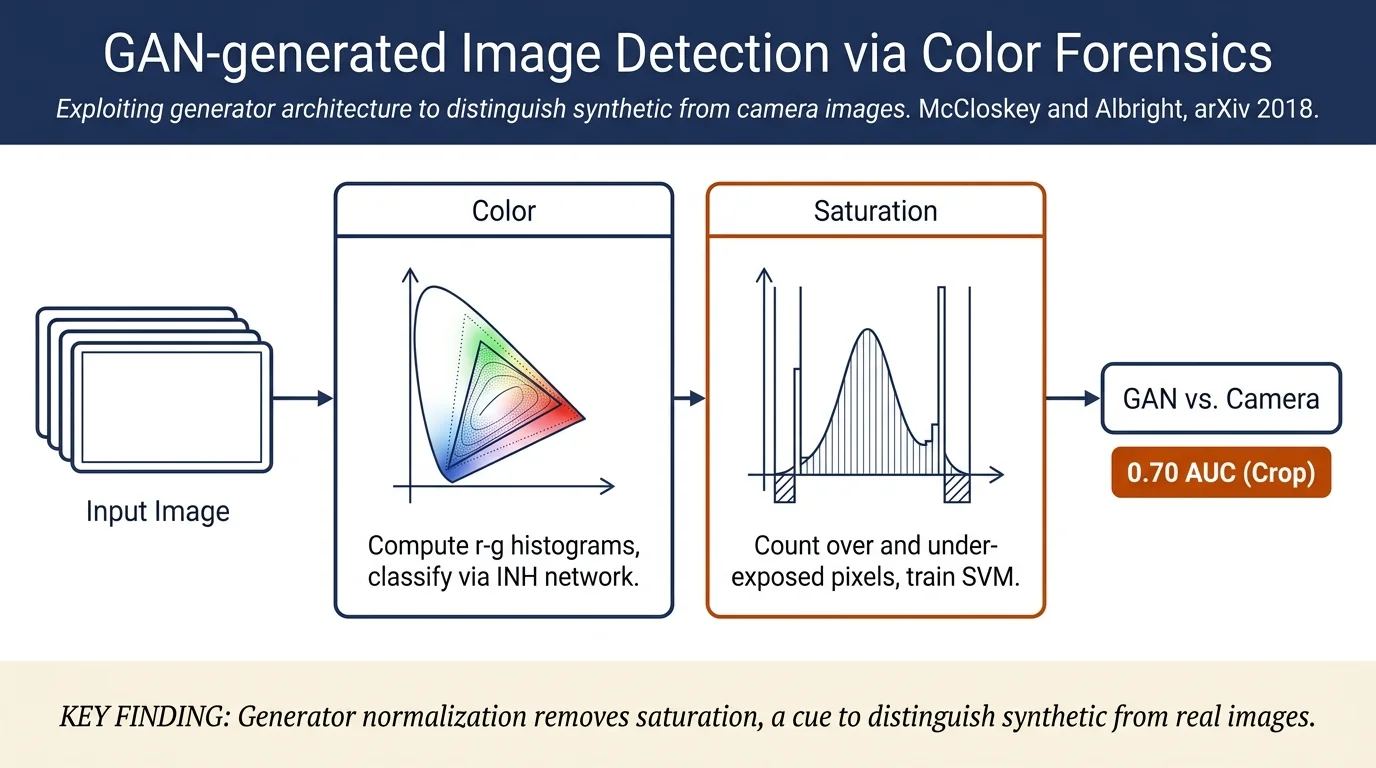
Detecting GAN-generated Imagery using Color CuesThis paper identifies two forensic cues to distinguish GAN-generated images from real camera imagery by analyzing how generator networks process color. The first cue exploits overlapping color channel weights in the generator (unlike camera spectral sensitivities); the second leverages the fact that generator normalization suppresses…
 Deepfakes & multimodalDetection methods
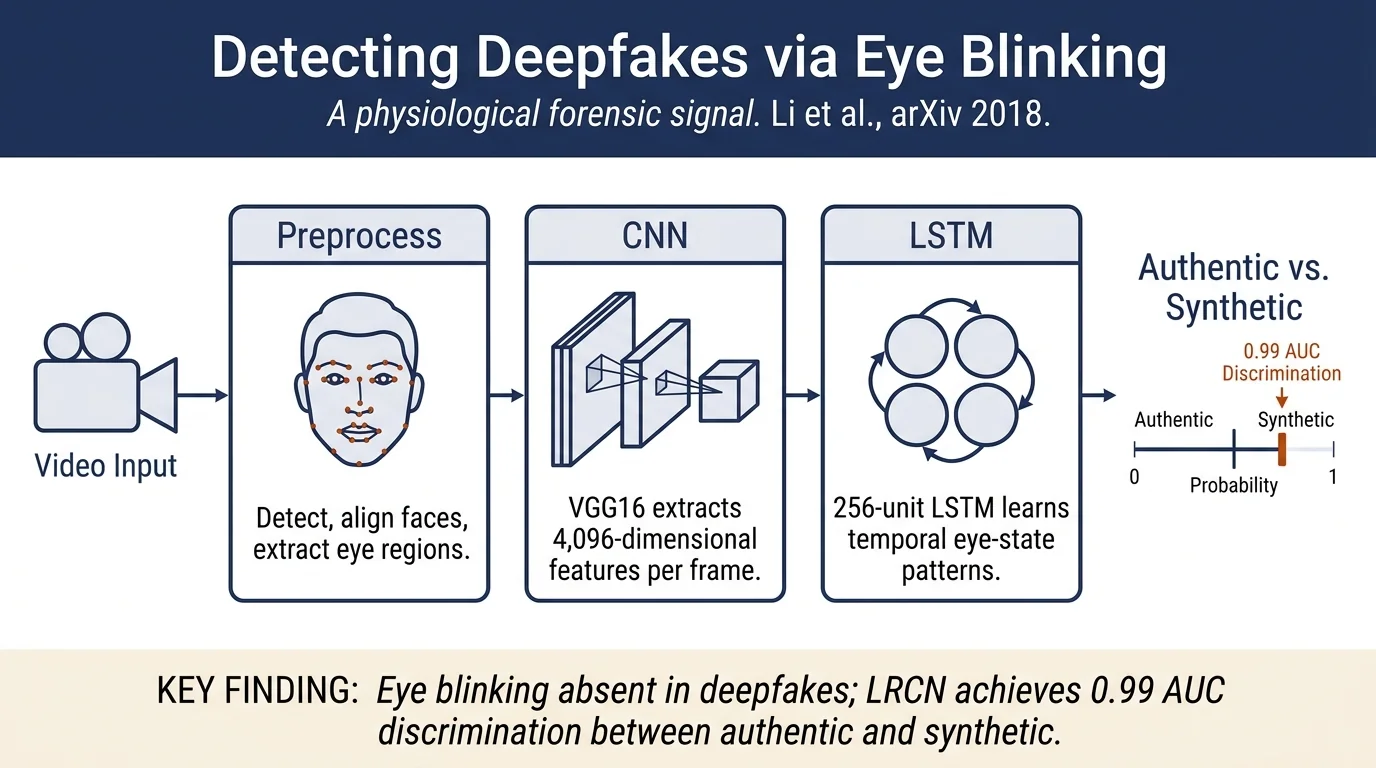
In Ictu Oculi: Exposing AI Generated Fake Face Videos by Detecting Eye BlinkingDetects DeepFake videos by exploiting the absence of natural eye blinking patterns in AI-generated faces. Uses a Long-term Recurrent Convolutional Network (LRCN) combining CNN for feature extraction with LSTM-RNN for temporal modeling of eye state, achieving 0.99 AUC on authentic vs. synthesized videos—a forensic signal invisible to the…
 Deepfakes & multimodalDetection methods
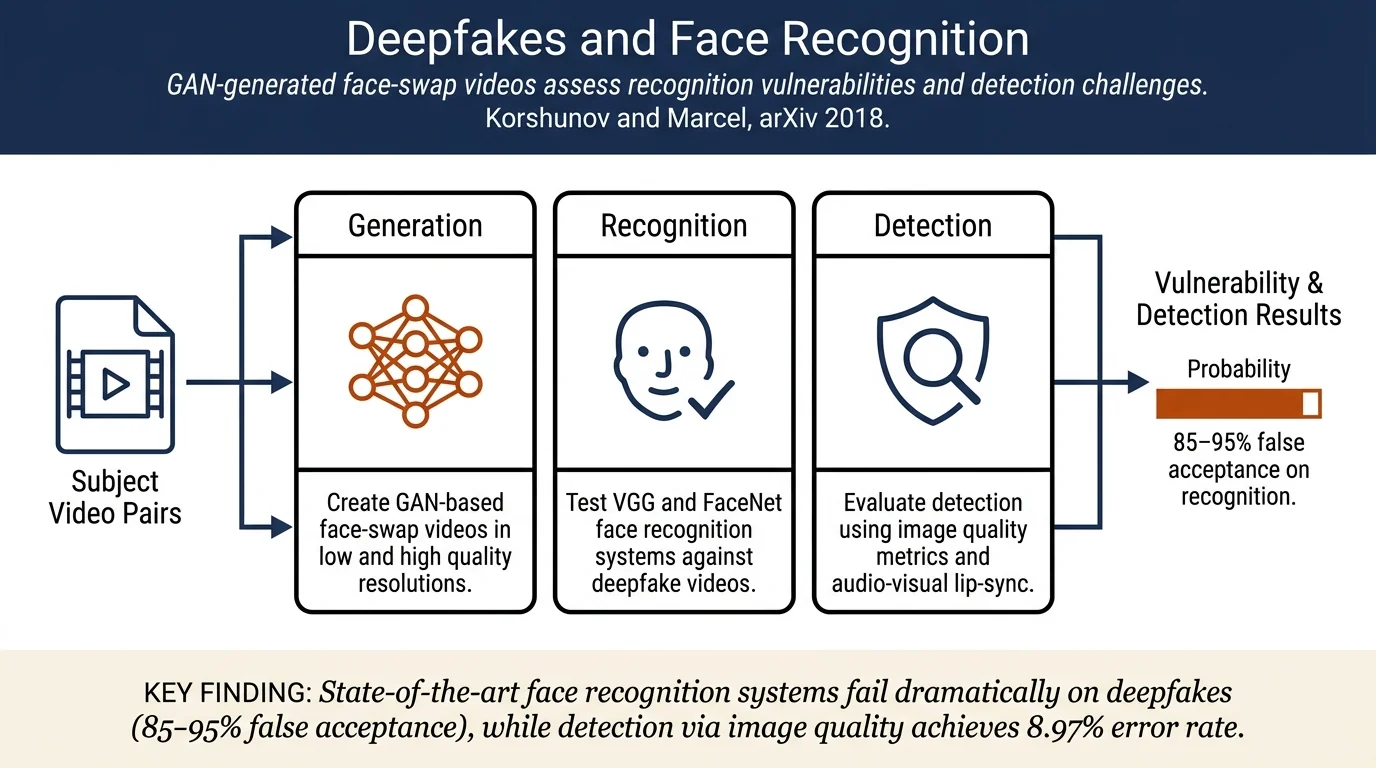
DeepFakes: a New Threat to Face Recognition? Assessment and DetectionGAN-based face-swapping (Deepfakes) pose a significant threat to face recognition systems: VGG and FaceNet achieve false acceptance rates of 85.62% and 95.00% on high-quality Deepfakes. The authors release the first public Deepfake video database (620 videos from 16 subject pairs) and show that image quality metrics with SVM achieve…
 Detection methodsFact-checking & verification
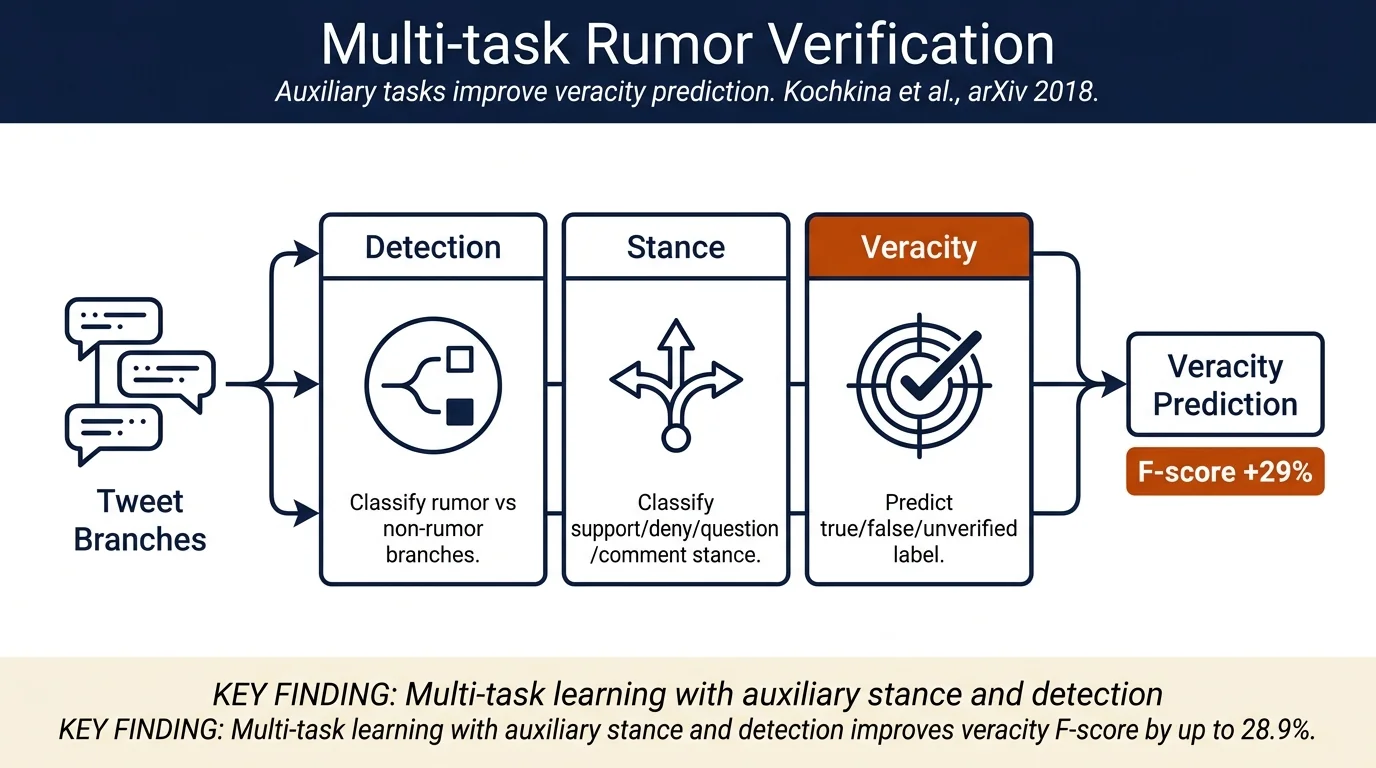
All-in-one: Multi-task Learning for Rumour VerificationThis paper proposes a multi-task learning framework for rumor verification that jointly trains veracity classification (the main task) with auxiliary tasks—rumor detection and stance classification. The approach outperforms single-task baselines on both RumourEval and PHEME datasets, demonstrating that sharing representations across…
 Datasets & evaluationSpread & networks
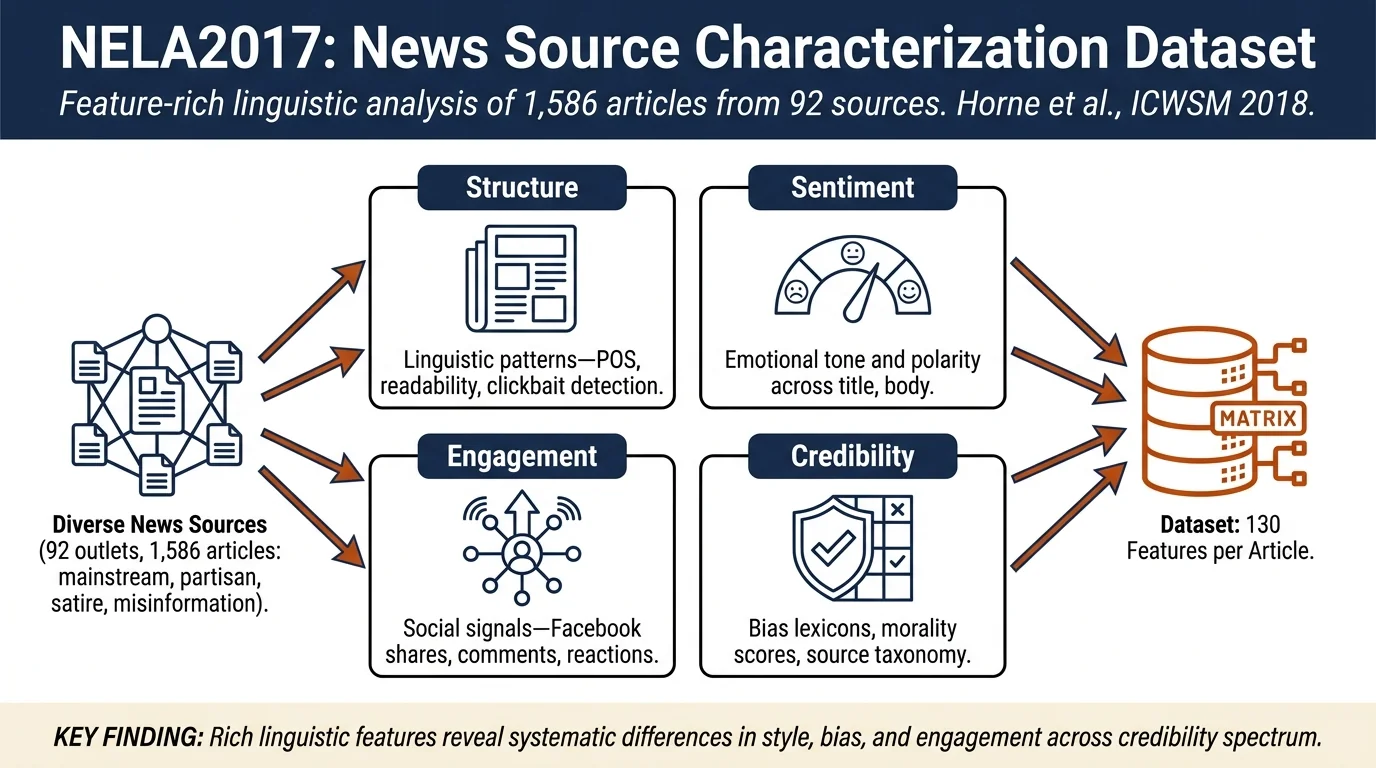
Sampling the News Producers: A Large News and Feature Data Set for the Study of the Complex Media LandscapeIntroduces NELA2017, a dataset of 1,586 news articles from 92 diverse news sources over 7 months (April–October 2017), including mainstream outlets, hyper-partisan sources, satire, and deliberately false news sites. Computes 130 content-based linguistic and engagement features on each article, enabling large-scale comparative analysis of…
 Psychology & interventionsPlatforms, policy & society
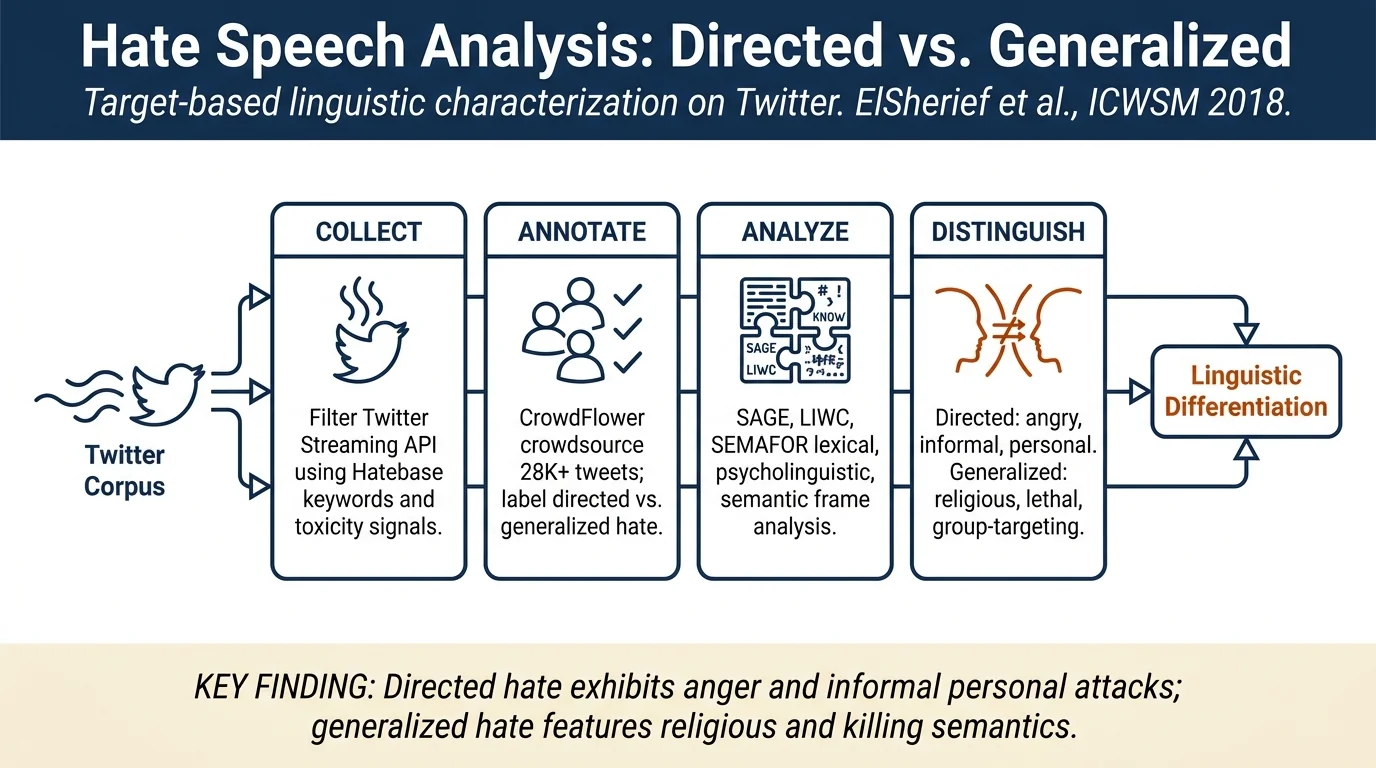
Hate Lingo: A Target-based Linguistic Analysis of Hate Speech in Social MediaThis paper presents the first large-scale linguistic and psycholinguistic analysis of hate speech categorized by its target: directed (personal attacks) versus generalized (targeting groups). The authors analyze 28,318 directed and ~2,500 generalized hate tweets, revealing that directed hate is more informal, angry, and explicitly…
 Fact-checking & verificationDatasets & evaluation
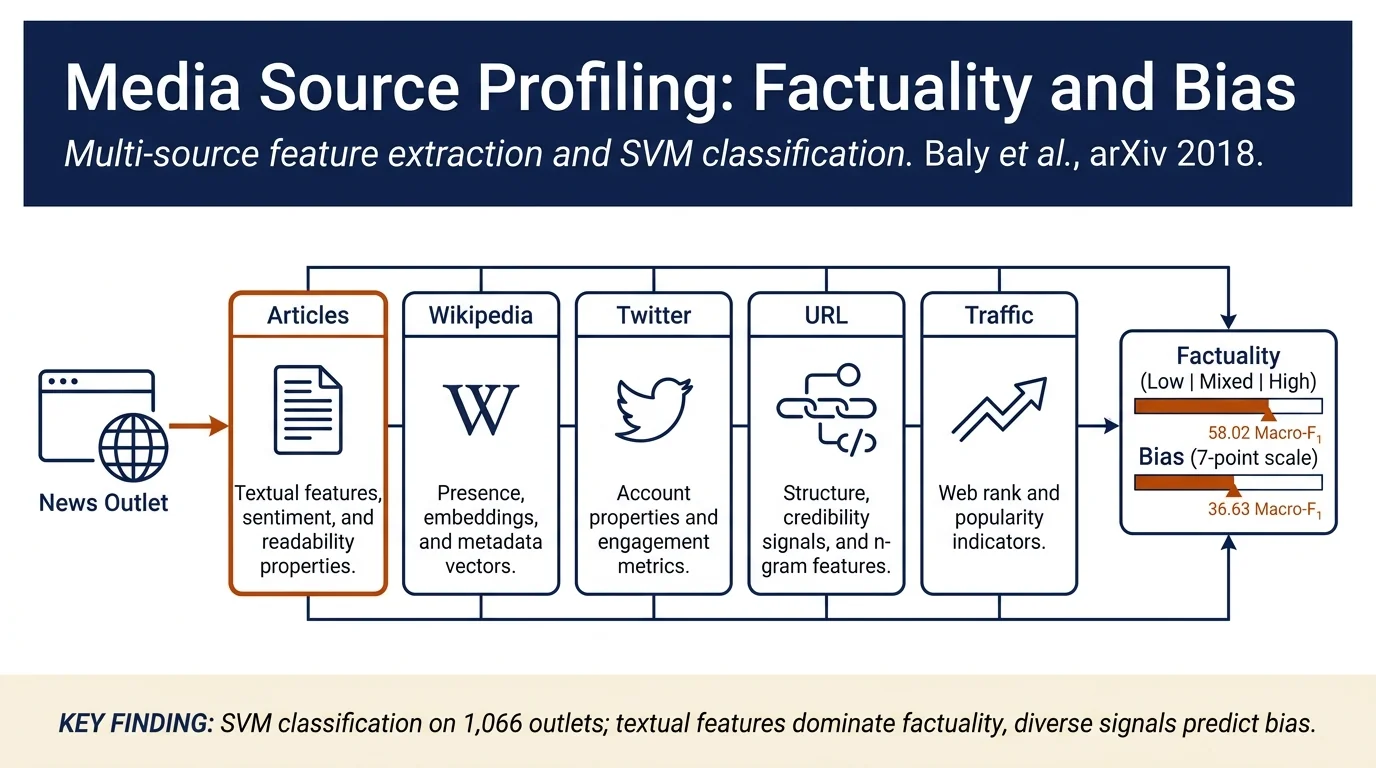
Predicting Factuality of Reporting and Bias of News Media SourcesThis paper frames predicting news media factuality and bias as classification tasks at the news outlet level rather than at the claim or article level. The authors extract 141 features from multiple sources (articles, Wikipedia, Twitter, URL structure, web traffic) and train SVM classifiers, creating a dataset of 1,066 websites manually…
 Deepfakes & multimodalDatasets & evaluation
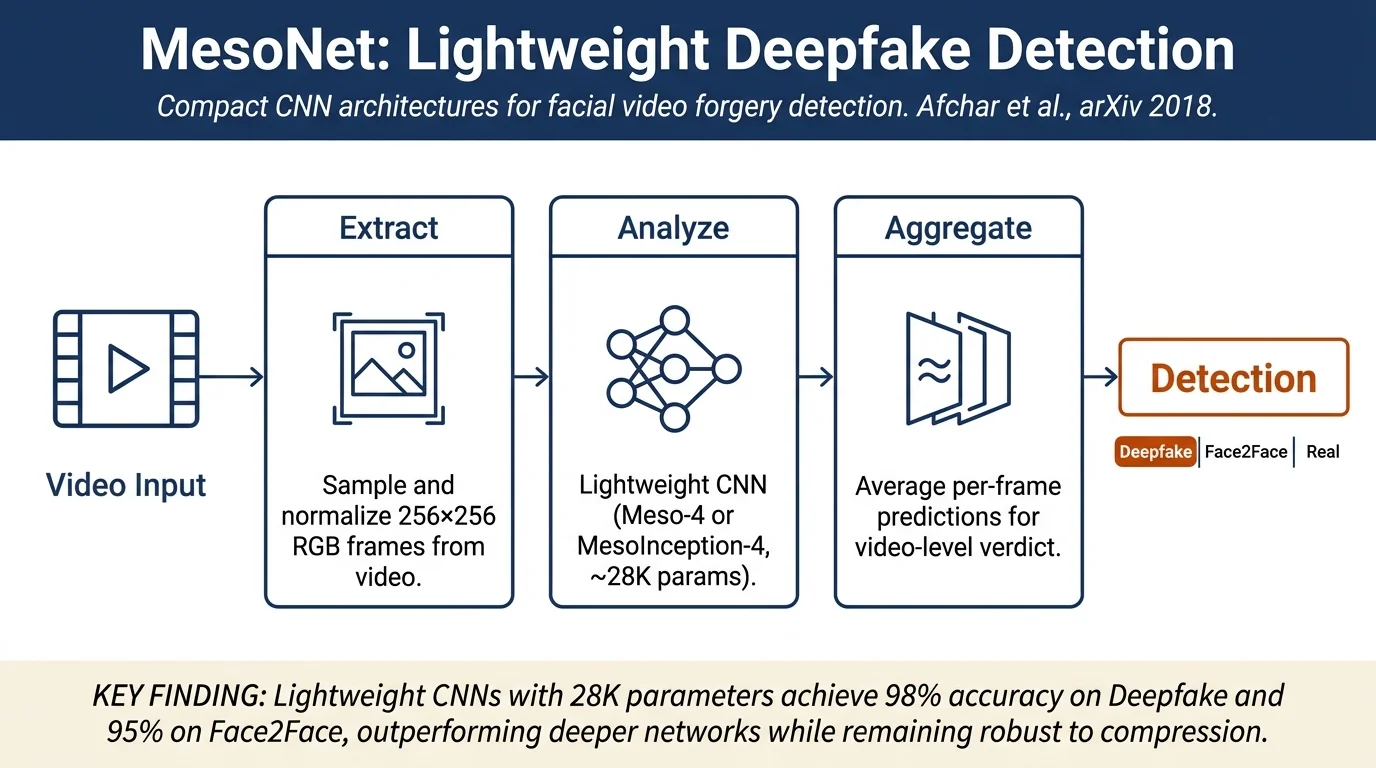
MesoNet: A Compact Facial Video Forgery Detection NetworkThis paper proposes two lightweight CNN architectures (Meso-4 and MesoInception-4) to detect facial video forgeries created by Deepfake and Face2Face techniques. Operating at the mesoscopic level of image analysis, the networks achieve 98% detection accuracy for Deepfake and 95% for Face2Face videos under realistic compression conditions.
 Datasets & evaluationSpread & networks
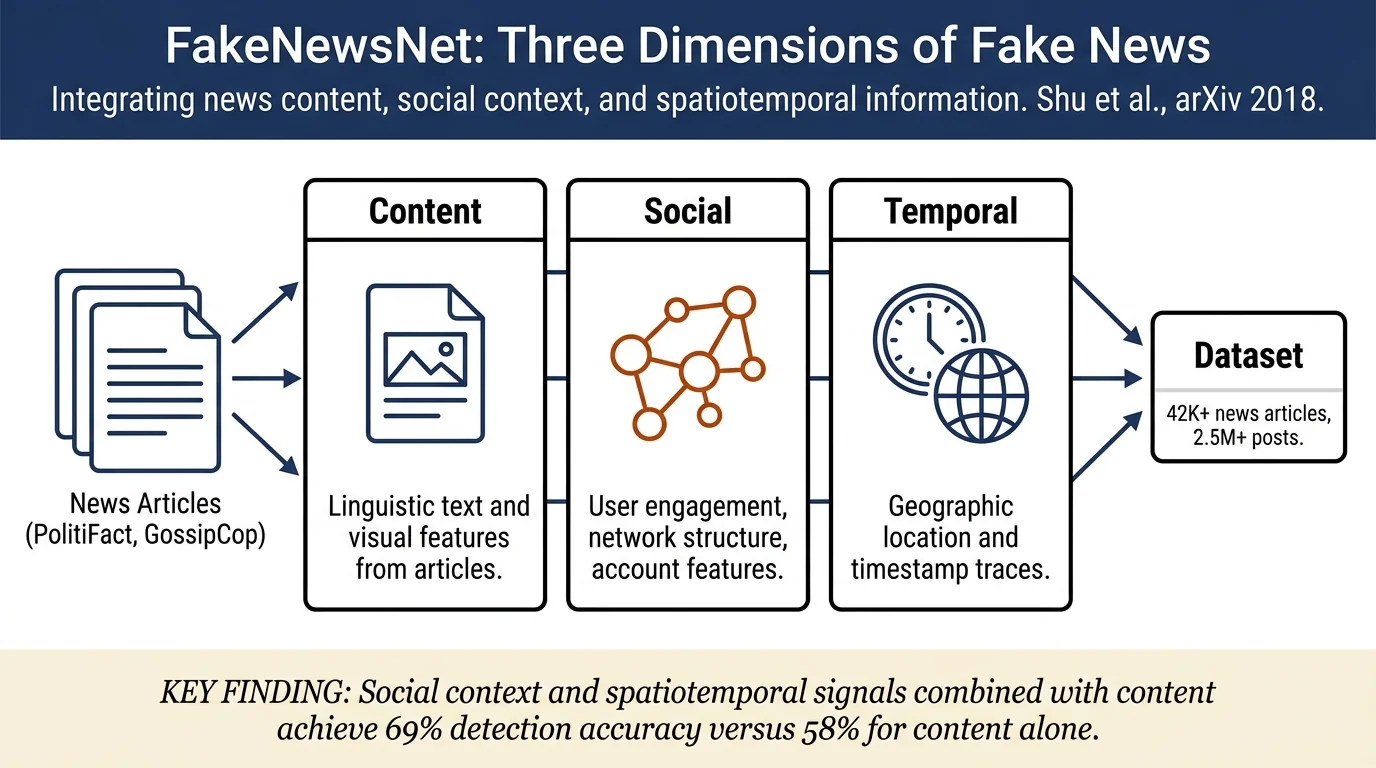
FakeNewsNet: A Data Repository with News Content, Social Context and Spatiotemporal Information for Studying Fake News on Social MediaFakeNewsNet is a multi-dimensional repository for fake news research on social media, integrating news content (linguistic and visual features), social context (user engagement, network structure, response patterns), and spatiotemporal information (location, timestamps). The dataset contains both fake and real news from PolitiFact and…
 Detection methodsDatasets & evaluation
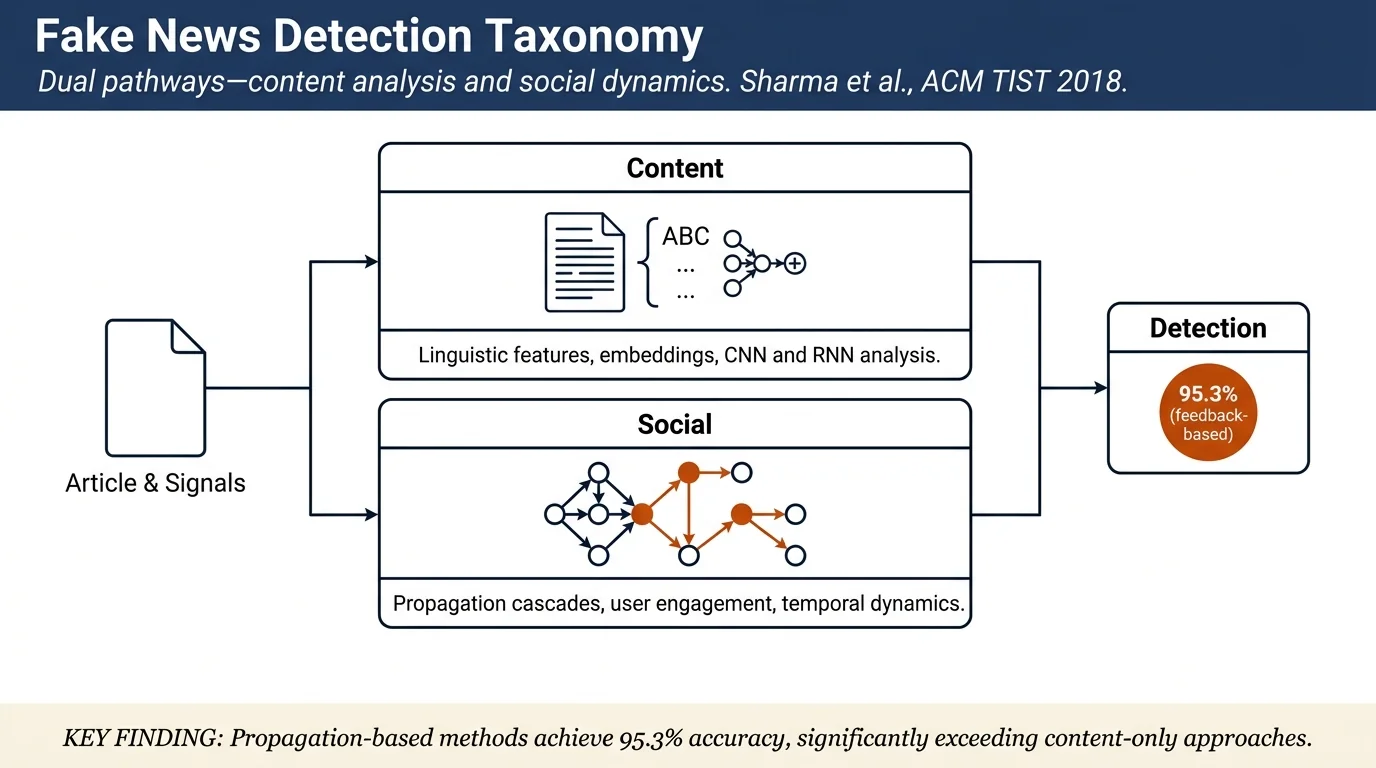
Combating Fake News: A Survey on Identification and Mitigation TechniquesThis comprehensive survey of fake news detection and mitigation organizes existing methods into two broad categories: content-based approaches (linguistic and deep learning methods) and feedback-based approaches (exploiting propagation patterns, user responses, and temporal dynamics). The authors consolidate 23+ publicly available…
 Spread & networksBots & coordinated campaigns
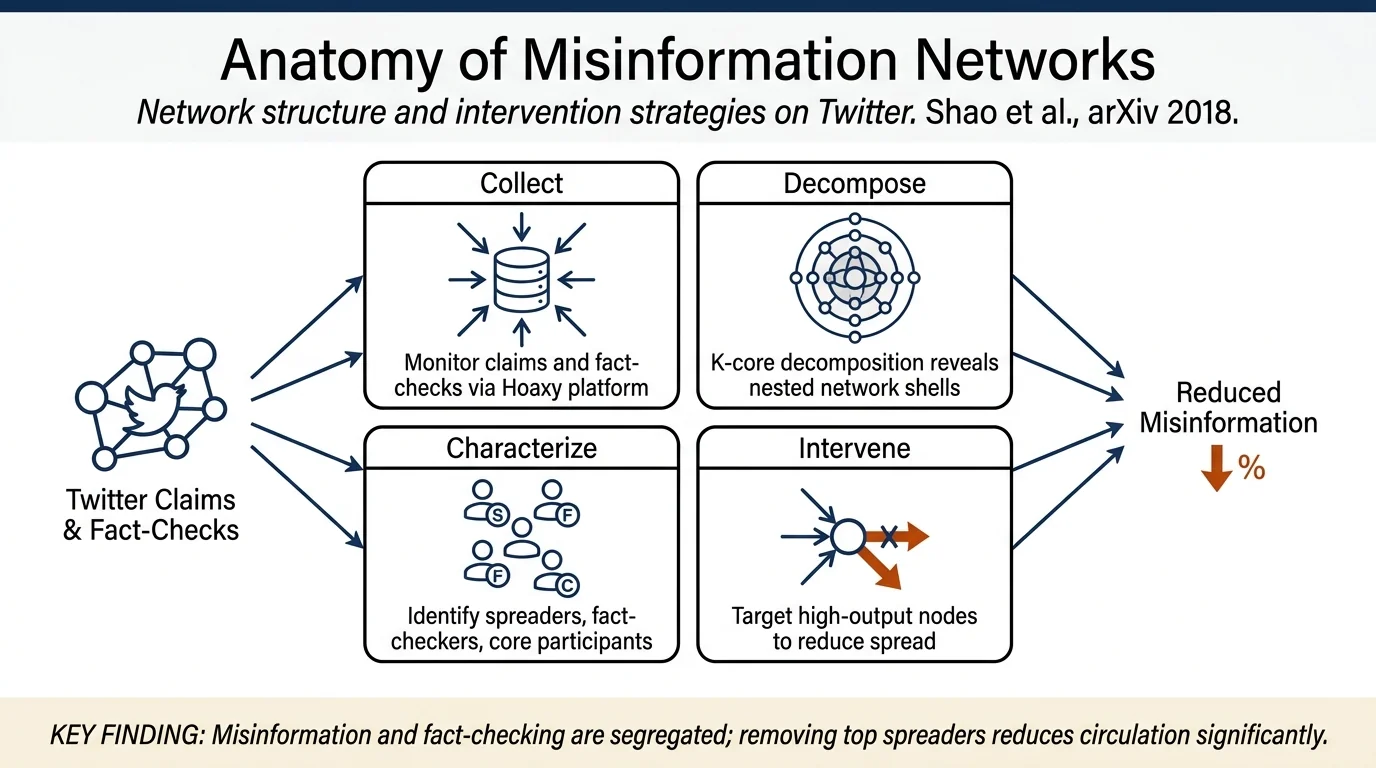
Anatomy of an online misinformation networkA network analysis of misinformation and fact-checking spread during the 2016 US Presidential Election reveals stark segregation between the two communities on Twitter. The core of the network is dominated by misinformation spreaders; fact-checking nearly disappears in the densest regions.
 Spread & networksDetection methods
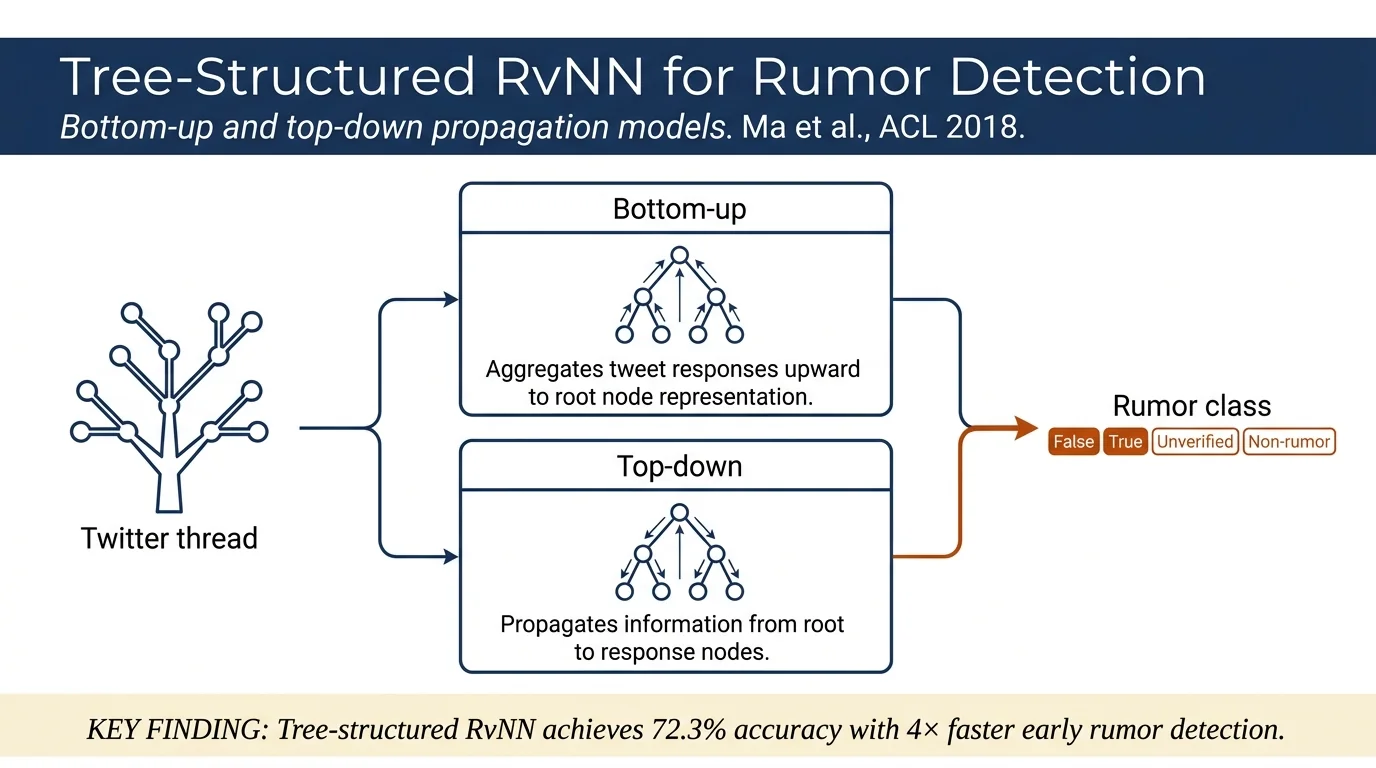
Rumor Detection on Twitter with Tree-structured Recursive Neural NetworksProposes two variants of recursive neural networks (RvNN)—bottom-up and top-down—that operate on propagation tree structures of tweets to detect rumors. Rather than treating tweets sequentially, the model learns representations that respect how tweets actually propagate in response threads.
 Platforms, policy & societyFact-checking & verification
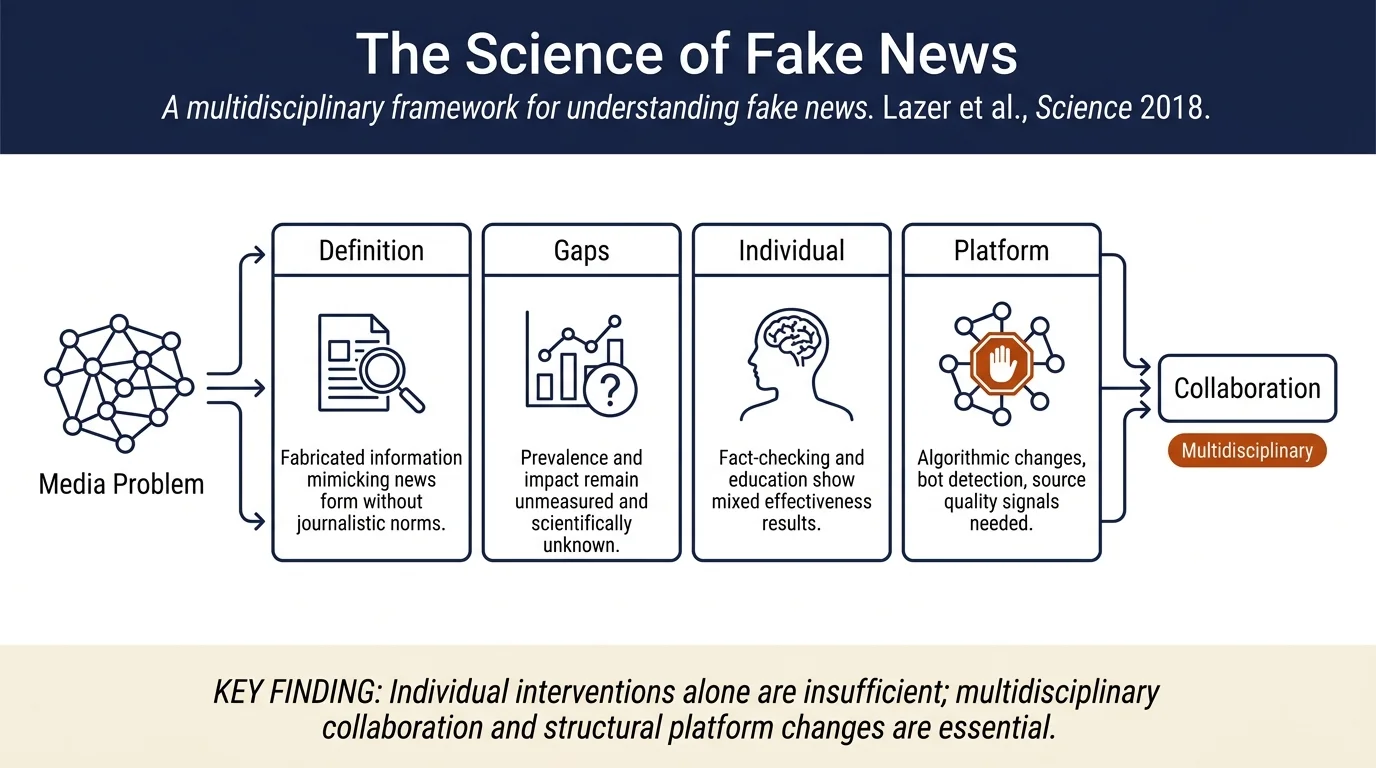
The Science of Fake NewsThis multidisciplinary review establishes a scientific framework for studying fake news, defining it as fabricated information that mimics news media form but lacks editorial norms. The paper identifies two mitigation strategies—empowering individuals through fact-checking and education, and structural platform interventions—while…
 Deepfakes & multimodalDetection methods
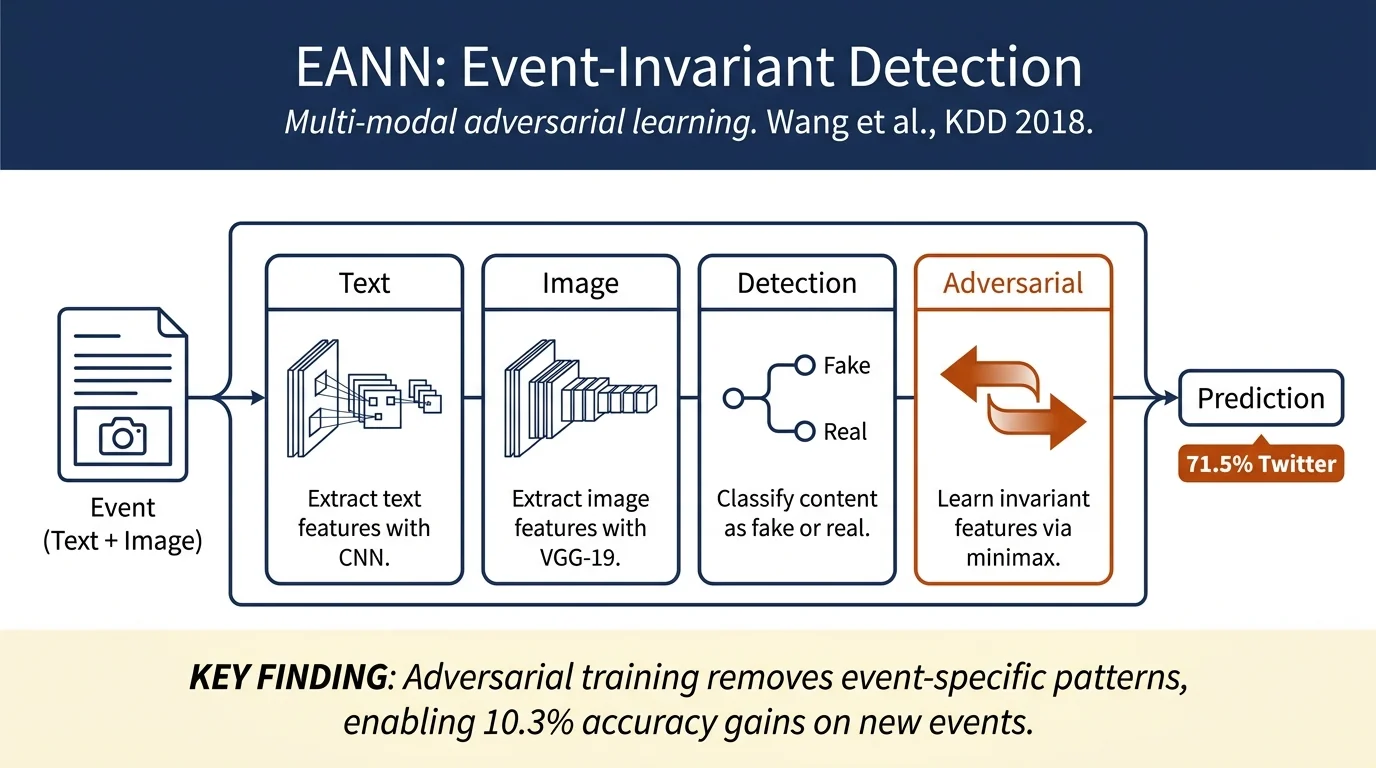
EANN: Event Adversarial Neural Networks for Multi-Modal Fake News DetectionThe paper proposes EANN, an adversarial neural network that detects fake news on newly emerged events by learning event-invariant features. An event discriminator forces the multi-modal feature extractor to remove event-specific features while preserving shared patterns across events.
 Psychology & interventionsPlatforms, policy & society
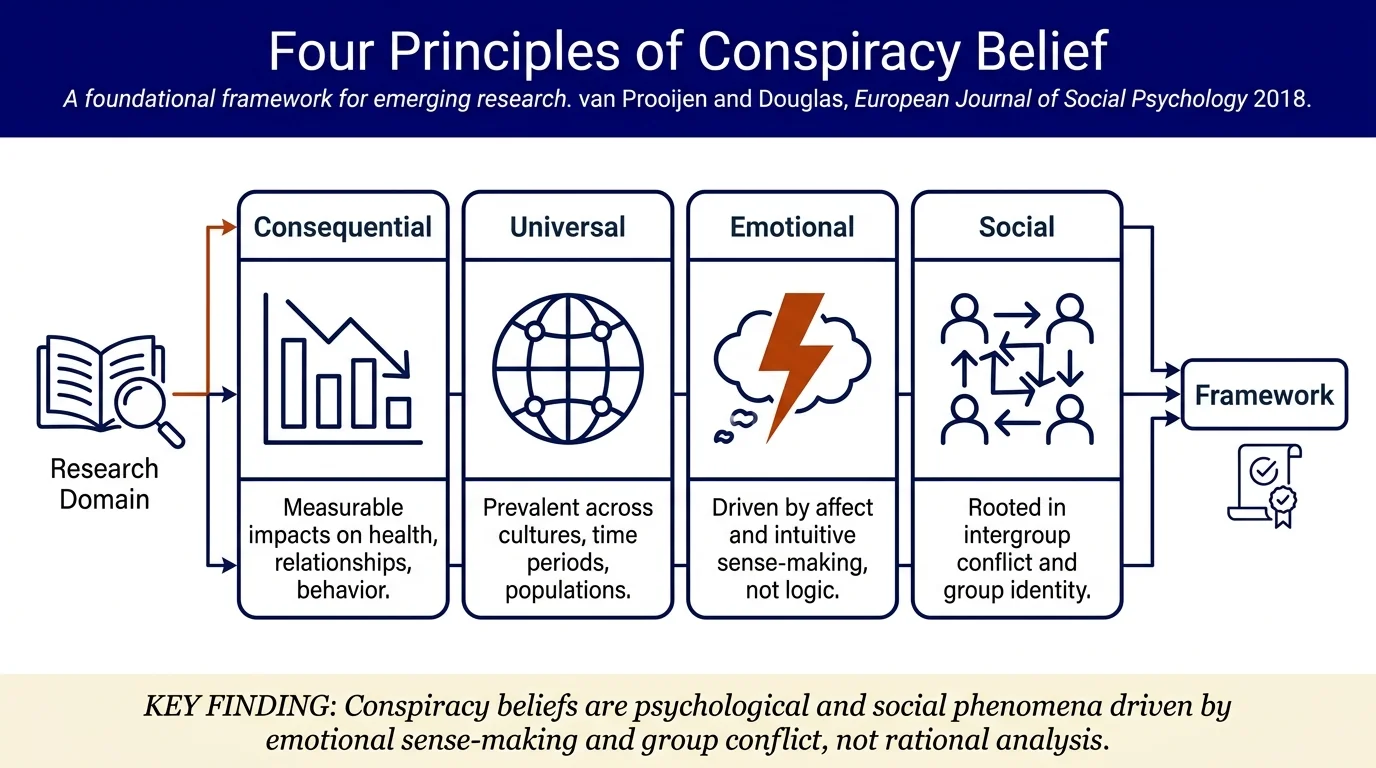
Belief in conspiracy theories: Basic principles of an emerging research domainThis special issue introduction proposes four foundational principles for the emerging scientific study of conspiracy belief: conspiracy beliefs are consequential (with real impacts on health and relationships), universal (across cultures and historical periods), emotional (driven by sense-making rather than logic), and social (rooted in…
 Bots & coordinated campaignsSpread & networks
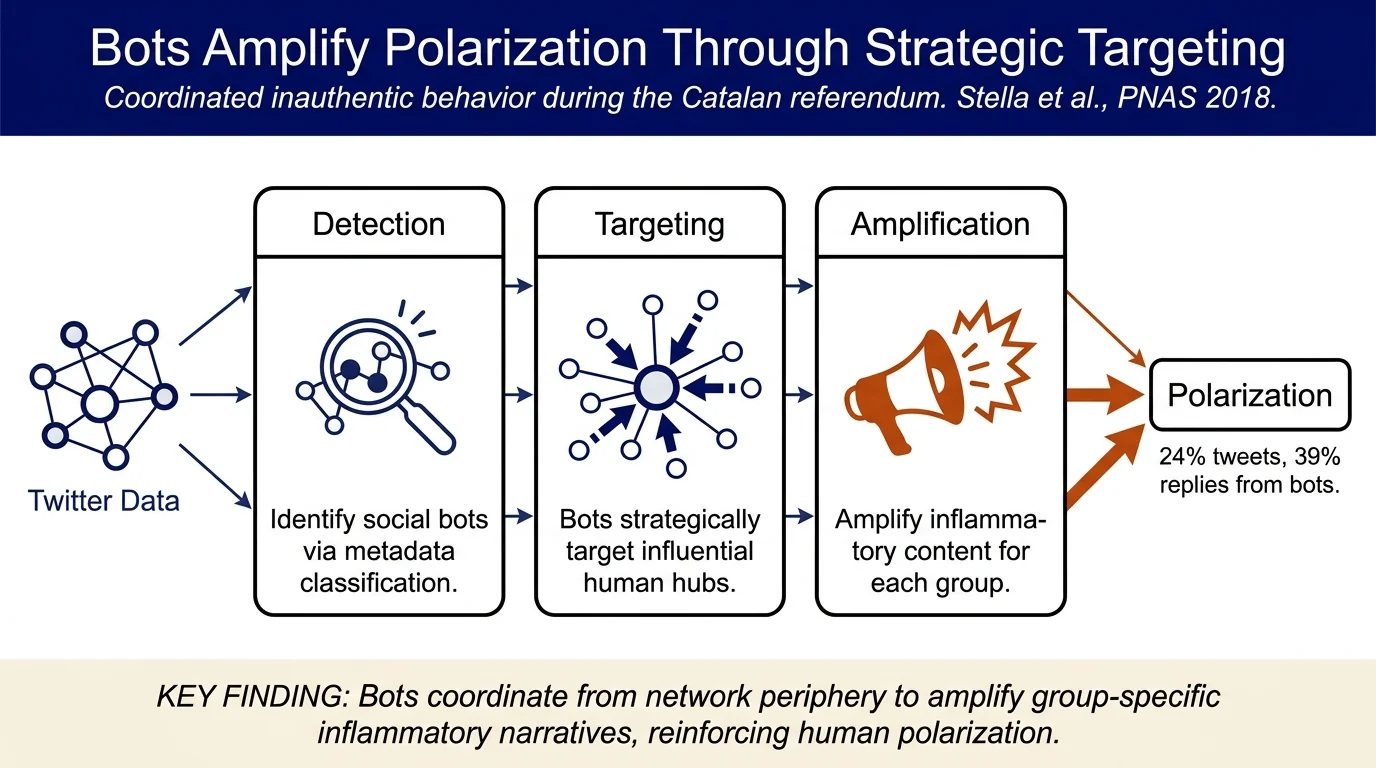
Bots increase exposure to negative and inflammatory content in online social systemsSocial bots during the 2017 Catalan independence referendum strategically targeted influential humans to amplify negative and inflammatory content. Operating from network peripheries, bots coordinated sentiment-driven amplification that exacerbated polarization, with approximately one in three referendum-related tweets generated by bots.